
Claude Sonnet 4.6 Is a Knowledge-Work Model First and a Coding Model Second
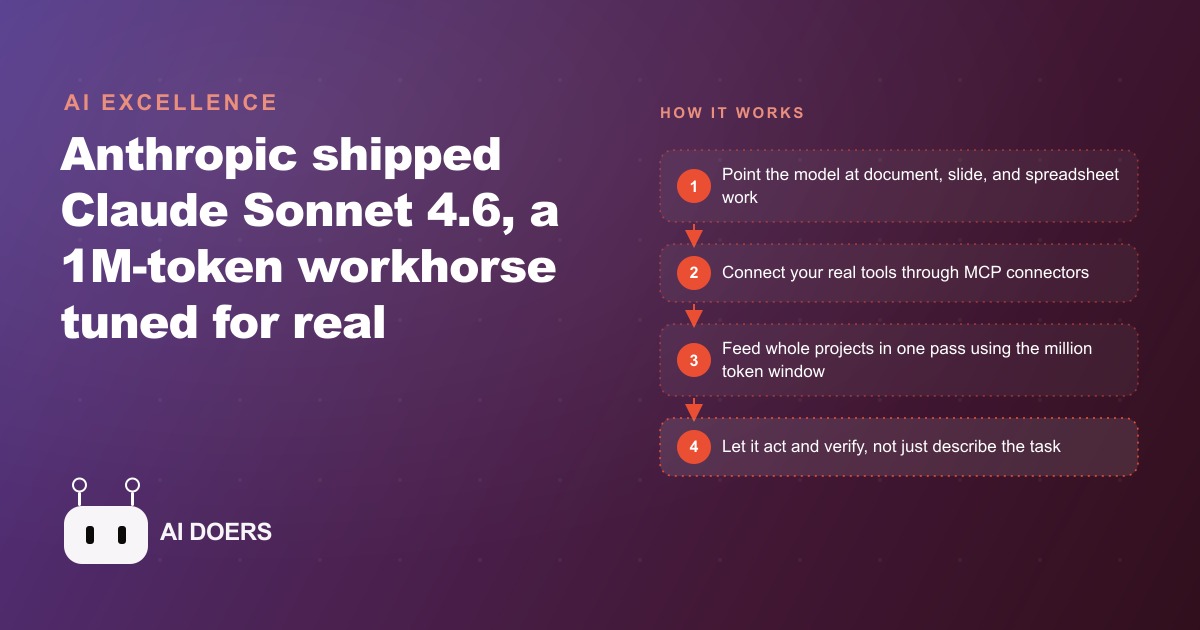
Anthropic's Sonnet 4.6 keeps the same price as 4.5 and adds a million token context window, but the real story is the jump in tool use, computer use, and agentic financial analysis. That makes it a model built for documents, slides, and spreadsheets, not just code.

The Week Sonnet 4.6 Shipped: What Changed, What We Tested, and What the Numbers Revealed
Anthropic released Claude Sonnet 4.6 with a positioning statement that is unusual in how specific it is: not just a stronger model, but specifically a stronger everyday model, with the claim that everyday-use quality has improved substantially while the price per token remains identical to the previous version. That combination, meaningfully better at the same price, is the kind of claim that deserves direct testing rather than acceptance on face value.
I am Madhuranjan Kumar, and I want to walk through what actually changed in Sonnet 4.6, what the benchmark numbers reveal when you look at them carefully rather than taking the headline figure, and what the appropriate task routing looks like for a business owner who now has Sonnet 4.6 as the default model on the free plan.
Chapter One: The Context Window and the Free Plan Upgrade
The most immediately visible change in Sonnet 4.6 is the context window. The new release ships with a one-million-token context window, a substantial increase from the previous version. For most everyday tasks, this number is larger than any practical limit you would encounter, which means the constraint that context windows imposed on tasks involving long documents, extended conversation histories, or large amounts of reference material has effectively disappeared for most users.
The free plan designation matters as much as the capability. Making Sonnet 4.6 the default model for free-tier users means that the improvement in everyday model quality applies to the largest segment of Claude's user base immediately, not just to paid users. A business owner who has been using the free plan receives a substantially more capable model without changing anything about their subscription or workflow.
For a business running regular tasks through the free tier, the practical implication of the context window increase is that tasks requiring long document context, like reviewing a long contract, synthesizing a lengthy research document, or maintaining context across an extended planning conversation, can now be run as single sessions rather than broken into chunks to stay within a smaller context window.
Chapter Two: The Agentic Tool Use Jump and What It Means Practically
The benchmark figure that matters most for business use is not the headline MMLU or coding score. It is the agentic tool use score, which jumped from 43.8 to 61.3. That is an increase of more than seventeen percentage points on a capability that determines whether the model can reliably complete tasks that require querying external data sources, calling APIs, and managing state across multiple steps.
Agentic tool use covers the class of tasks where the model needs to use tools, including search, file reading, API calls, and code execution, to complete a request that cannot be handled from the model's parametric knowledge alone. A task that asks Sonnet 4.6 to look up current data, summarize it, and then take an action based on the summary requires successful tool use at each step. If the tool use fails or produces an error the model cannot recover from, the task fails.
A score of 43.8 on this benchmark means the model completed roughly 44 percent of such tasks without error. A score of 61.3 means it completed roughly 61 percent without error. That gap, moving from less than half to more than three-fifths of agentic tasks completing successfully, changes the reliability calculation for workflows that depend on agentic behavior. Workflows that were too unreliable to put into production at 44 percent success become reasonable to consider at 61 percent. Workflows that were marginally reliable at 44 percent become dependably reliable at 61 percent.
Chapter Three: The Financial Analysis Benchmark That Reveals the Tuning Direction
The SWE-bench financial analysis benchmark is where Sonnet 4.6 separates itself most clearly from the field. On this benchmark, Sonnet 4.6 leads not just against the previous Sonnet version but against Opus 4.6, Gemini 3 Pro, and GPT-5.2. The model that is positioned as the everyday workhorse outperforms the most capable models across vendors on financial document analysis.
This result tells you something specific about how Anthropic tuned Sonnet 4.6. Financial analysis requires reading documents carefully, extracting specific numerical data accurately, applying context to interpret what the numbers mean, and producing outputs that are factually precise rather than approximately correct. These are knowledge work demands, not raw reasoning demands.
The office tasks and GDPval benchmark scores tell the same story. Sonnet 4.6 was tuned for the specific kinds of work that happen in documents, spreadsheets, and structured professional communication. The improvements are concentrated where knowledge workers spend their time rather than where AI capability demonstrations tend to be concentrated.
For a business owner, this tuning direction is directly relevant. If the primary uses of the model are reviewing contracts, analyzing financial data, summarizing research, and producing professional communications, the Sonnet 4.6 improvements are targeted at exactly those use cases. The capability improvement in the everyday category is not generic. It is concentrated in the knowledge work domain.
Chapter Four: The Computer Use Benchmark and What It Enables
On OS World, the benchmark for computer use performance, Sonnet 4.6 climbed from 61.4 percent to 72.5 percent. Computer use measures the model's ability to see a screen, identify where to click or type, and complete tasks by interacting with software interfaces the way a person would, without special APIs or integrations.
The practical implication of better computer use performance is that Sonnet 4.6 can handle a larger share of computer-based tasks without failing or requiring human intervention to correct a misidentified interface element or a missed click. At 72.5 percent on OS World, Sonnet 4.6 completes roughly three-quarters of tested computer use tasks successfully, which is a high enough rate to make the capability operationally useful rather than just technically impressive.
For workflows that involve software that does not have an API, where the only access point is the visual interface, computer use is the relevant capability. An accounting software that stores client data but does not expose an API can be accessed through computer use. A government portal that requires web browser interaction can be navigated through computer use. The improvement in Sonnet 4.6 makes these use cases more reliable.
Chapter Five: The Vending Machine Simulation and the Autonomous Judgment Test
The Vending Bench benchmark simulates running a vending machine business autonomously over a multi-period game. The model manages inventory, sets prices, makes investment decisions, and adapts its strategy based on the results of previous periods. It is a proxy for the kind of multi-step autonomous business decision-making that agentic AI is being positioned to handle.
Sonnet 4.6's jump from approximately $2,000 to $5,500 in simulated profit on this benchmark reveals something about the model's strategic judgment that the other benchmarks do not capture. The performance shows that Sonnet 4.6 made the right capital allocation decisions: investing in inventory capacity in early periods to capture demand, then shifting to a profit-maximization strategy in later periods rather than continuing to invest in capacity that would not pay off before the game ended.
That sequencing, invest early, harvest later, is a basic strategic judgment that requires understanding the time dynamics of returns on investment. The fact that Sonnet 4.6 applied this correctly across an extended simulation suggests the model's capacity for multi-period strategic reasoning improved substantially from the previous version.
Chapter Six: The ASL-3 Safety Tier and What It Signals
Anthropic shipped Sonnet 4.6 under AI Safety Level 3, the tier that applies to systems deemed to substantially raise the risk of catastrophic misuse relative to a textbook or a search engine. The ASL-3 designation means Anthropic's internal evaluation found that the model has capabilities that warrant safety measures beyond the ASL-2 standard.
ASL-3 does not mean the model crosses into the AI research acceleration or CBRN capability thresholds that would trigger ASL-4 measures. It means the model is capable enough in domains like persuasion, planning, and tool use that the deployment requires additional safeguards.
For a business owner, the ASL-3 designation is a signal about capability rather than a concern about safety for normal use cases. The same properties that make Sonnet 4.6 more capable for legitimate business tasks are the properties that triggered the more careful safety evaluation. The model is more capable, and more capability triggers more careful safety consideration. That is the intended dynamic in Anthropic's safety framework.
The Practical Routing Decision: When Sonnet 4.6, When Opus
The release of Sonnet 4.6 raises a question that is becoming increasingly common: if Sonnet is this capable, what does Opus offer that justifies its cost and its position as the "most capable" model?
Across the benchmarks where Sonnet 4.6 was specifically compared to Opus 4.6 in this release, Sonnet matched or approached Opus on most metrics while being substantially cheaper and available by default on the free tier. The benchmarks where Opus maintains a clear lead are at the frontier of scientific reasoning, multi-step complex problem-solving, and tasks where the reasoning chain itself is the primary output rather than a structured document.
For a business owner running real business tasks, the honest routing guidance is: Sonnet 4.6 for the knowledge work tasks, including analysis, writing, financial review, document summarization, and structured professional communication. Opus for the tasks where the quality of the reasoning itself determines whether the output is useful, including complex strategic questions with many interdependencies, original research synthesis where the model needs to identify non-obvious connections, and tasks where an approximate but well-reasoned answer is more valuable than a precise but shallow one.
That routing guidance applies to the current models. The gap between Sonnet and Opus is narrowing with each generation, and the speculation that Sonnet 4.6 may represent a version of a next-generation model released under the Sonnet name suggests the distinction between tiers may become less meaningful over time. For now, the routing guidance is clear enough to act on, and the improvement in Sonnet 4.6 means that for most business tasks, the everyday model is now the right choice rather than a compromise.
The Context Compaction Beta and Why It Matters for Long Sessions
The context compaction feature in beta alongside Sonnet 4.6 addresses a specific problem that becomes visible in extended working sessions. When a conversation accumulates a long history, including all the earlier context about what has been discussed, what decisions have been made, and what background information has been provided, that history consumes context window space that could otherwise be used for the current task.
Context compaction automatically summarizes the earlier portions of a long conversation while preserving the key information from that history, freeing up context window space for the current task without requiring the user to start a new session and re-establish the relevant context manually.
For a business owner running a long research or planning session, this means the session can continue productively for longer without hitting the practical limits that emerge when earlier context crowds out the space needed for the current question. The session's earlier history remains accessible as a summary rather than as a verbatim record that consumes full context window space.
The beta status means the feature's behavior may not yet be fully reliable across all session types. In testing, compaction worked well for factual and decision-based sessions where the key content of earlier turns could be accurately summarized. For creative or highly nuanced sessions where the exact wording of earlier outputs mattered, the compaction occasionally lost details that turned out to be relevant later. Testing the feature on your specific session types before relying on it for critical work is the appropriate approach.
The Search and Code Integration for Filtering Results
Sonnet 4.6 also ships with improved search and fetch tools that now write and run code to filter results before returning them to the conversation. This means that a web search for a large dataset of results can include a filtering step that selects only the results matching specific criteria, rather than returning all results and requiring the operator to identify the relevant ones manually.
For research tasks that involve a specific question with a large set of potentially relevant results, this filtering capability reduces the volume of irrelevant information that the model needs to process and that the operator needs to review. The search returns what is relevant rather than what exists, which changes how efficiently research tasks run when the target is specific.
The combined effect of the context compaction beta, the improved search filtering, and the agentic tool use score improvement means that extended research and analysis sessions in Sonnet 4.6 run more efficiently and produce more focused outputs than the same sessions in the previous version. For a business owner who uses Claude for regular research and analysis, these improvements compound across every session rather than appearing as a single step change.
That is exactly what we do at AI DOERS. Book a private 30-minute call with Madhuranjan Kumar and we will map the fastest path to it for your specific business.
Book your call →
Madhuranjan Kumar
Madhuranjan Kumar brings 20 years of performance-marketing experience and has managed over $200 million in Facebook ad spend for brands across the United States and beyond. His expertise spans the full modern marketing stack: Meta, Google Ads, TikTok, email automation, CRM, and the websites that hold it together. At AI DOERS he turns that track record into lead-generation systems for businesses across every industry.