
Claude Sonnet 4.5 and the Rise of AI That Finishes the Whole Job
The new model can work on long tasks for hours. Here is what that shift means and how an auto repair shop can hand off its paperwork.

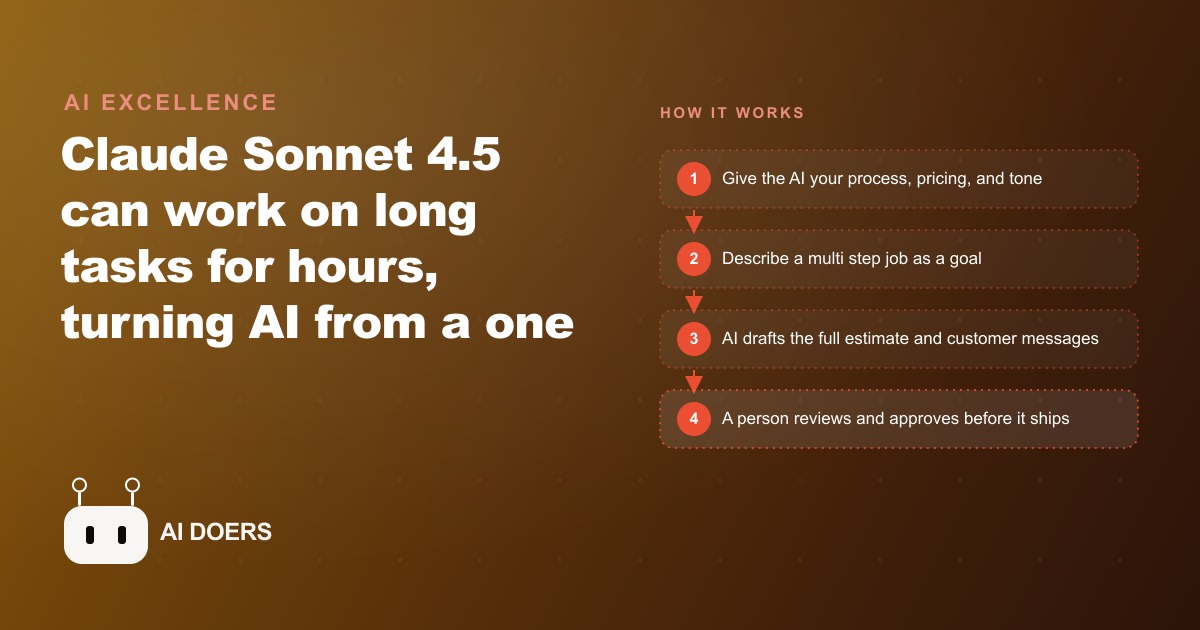
Claude Sonnet 4.5 can hold a task for 30 hours without a human in the loop, and that number resets what autonomous AI assistance actually means for a business. Not 30 minutes. Not 30 sequential tasks. Thirty hours of sustained, goal-directed work on a single complex assignment without requiring a human to re-engage the system, correct the course, or confirm each step before the next one begins. Anthropic released this alongside strong coding benchmark performance and reasoning scores that place it at the top of its class, but the benchmark numbers are secondary to the operational implication. When AI can hold a multi-step job for that long, the category of work that is worth delegating changes substantially.
I am Madhuranjan Kumar. The shift this represents is not just about duration. It is about what duration makes possible. Most AI tools today are query-response tools: you provide input, the AI provides output, you evaluate the output and decide the next input. The human is in the loop at every step. A model that can sustain 30 hours on a task is an agent: you provide the goal, the agent plans, executes, checks its own work, adjusts, and continues until the goal is met or it hits a decision point that requires human judgment. The human is in the loop at the beginning and the end, not at every step in between.
Thirty hours of sustained focus is not a benchmark, it is a business model shift
The 30-hour figure matters not because every task takes 30 hours but because it pushes the ceiling of what you can hand off in a single delegation. A task that takes a competent human 4 hours to complete has historically been difficult to delegate to AI because the models lost context, degraded in quality, or needed a human to reconnect the threads every 30 to 60 minutes. That limitation shaped which tasks were worth automating: short, discrete, well-defined, and completable in a single model context. Long, multi-step, complex tasks stayed on the human's desk.
A model that sustains 30 hours of effective work changes that calculus. The 4-hour task is now fully within the delegation window. So is the 8-hour task. The model can hold the context of the full assignment, maintain the quality standard throughout, and produce a finished result rather than a progress update that requires the human to take it the rest of the way. That is a qualitatively different kind of tool, not just a faster version of the same thing.
Research released alongside Sonnet 4.5 tracked a related trend: the length of task AI can complete has been roughly doubling every seven months. A few years ago the models were handling tasks that took a human seconds. Now they are handling tasks measured in hours. If the trend holds, the question is not whether AI agents will handle full-day work assignments but when. That timeline has shortened considerably.
The practical business implication is not hypothetical. The tasks that consume the most time in a small or mid-size business are often the long, structured ones: writing up a week's worth of estimates from rough technician notes, drafting a month of client follow-up emails from CRM records, reconciling billing across systems, or processing a backlog of incoming requests against a complex intake form. None of these require creativity or judgment at every step. They require sustained attention and structure. Those are exactly the properties the new model is built for.
The coding and test scores tell you which tasks to hand off first
The benchmark performance on coding and reasoning is not just a competition metric. It tells you something concrete about which categories of task the model handles with the highest reliability, which in turn tells you which work to hand off first when you are deciding where to start.
Sonnet 4.5 performed at the top of its class on coding benchmarks, which means it handles code generation, debugging, documentation writing, and code review at the highest current level of AI capability. For any business with code-related work, whether that is internal tooling, website maintenance, script automation, or data processing, the model is ready to take on significant portions of that work with high reliability.
The reasoning benchmark scores reflect something broader: the model reasons through novel problems rather than pattern-matching to common answers. Reasoning matters in business contexts because the right answer often depends on specific details that change from one situation to the next. An auto repair shop's estimate depends on the specific vehicle, the specific complaint, the specific parts pricing on that day, and the specific labor rate. A reasoning model that can hold all of those specifics and apply them consistently through a multi-step drafting task is more useful than a model that produces a plausible-sounding estimate based on an average.
The tasks to hand off first are the ones that combine structured process with variable inputs: the same type of output produced repeatedly from inputs that change each time. Estimates, proposals, follow-up emails, reports, status updates: all of these follow a consistent structure but incorporate specific details that vary per instance. The combination of strong reasoning and long task endurance makes Sonnet 4.5 well suited for exactly this category. Start with the structured-but-variable work before moving to the open-ended creative or judgment-heavy work.
Long-horizon tasks are different from short tasks at scale, here is the distinction
Running 100 short tasks back to back is not the same as running one task that takes 100 steps. The distinction matters practically and it explains why the 30-hour capability is significant rather than just being 30 one-minute tasks in a row.
Short tasks are discrete. Each one starts fresh, draws on the same general context, and produces an output that stands alone. Running 100 short tasks produces 100 independent outputs. If one fails, the others are unaffected. The human reviews each output independently. This is the current model for most AI deployment in business: batch processing of short, similar tasks where each one is independent of the others.
Long-horizon tasks are cumulative. The output of step 12 depends on what was discovered in step 7. The decision made in step 20 needs to be consistent with the constraint established in step 3. The entire task has an internal coherence that requires the model to maintain context across the full sequence rather than treating each step independently. A model that loses context mid-task produces outputs that contradict earlier steps, miss dependencies, or repeat work that was already completed. The result is not 80 percent of a good output. It is an incoherent output that requires a human to reconstruct what happened before deciding how to proceed.
The 30-hour endurance is specifically about holding that internal coherence across a long task. A model that can maintain context and consistency for 30 hours of work can complete the full end-of-week paperwork run for a service business, the full first draft of a complex proposal, the full processing of a large backlog of requests against a complex intake process, all as single delegations with a coherent output at the end rather than a series of partial outputs that need to be reconciled by hand.
The efficiency dimension matters as well. A capable long-horizon agent does not just hold the task for 30 hours. It completes the task in significantly fewer steps than a less capable model would require. The goal is not sustained effort for its own sake. It is purposeful, efficient progress toward the outcome that requires minimal back-and-forth to produce a finished result. Endurance without efficiency is just slow. Endurance with efficient reasoning is delegation that actually works.
The concrete handoff for a service business today
The clearest immediate application for a service business is the end-of-day paperwork and follow-up communication cycle. Every service business has a version of this: rough job notes from technicians or staff, a set of customers who need follow-up, a set of records that need to be updated, and a set of next-step communications that need to go out. Doing this well takes structured attention. Doing it every day while also running a business is one of the main reasons owner-operated service businesses stay small: the administrative overhead grows with the business faster than the revenue does.
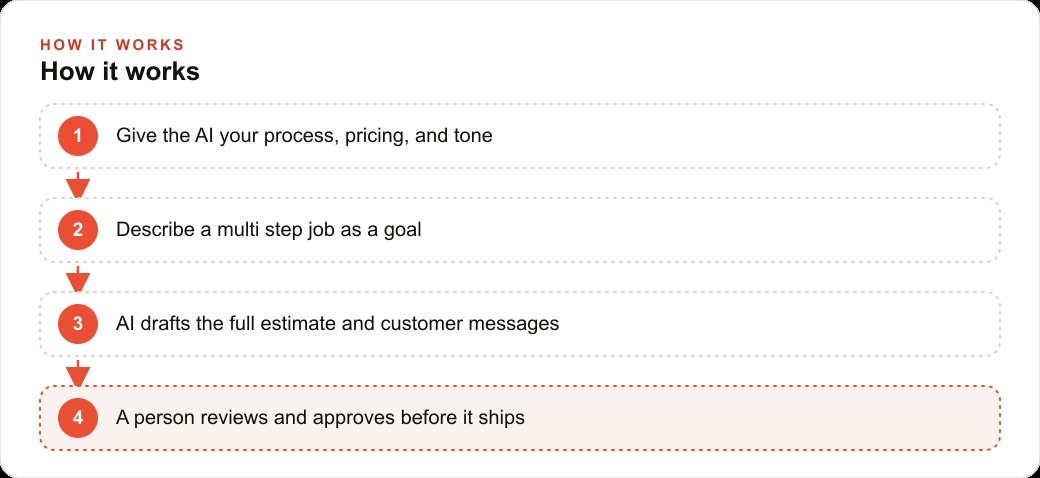
The handoff looks like this. After the last job of the day, the service manager types a brief goal into the model: here are the notes from today's jobs, here is the customer list and their histories in the CRM, here are my pricing guidelines and my communication templates, and here is what I need by morning: a clean estimate for each open job, a follow-up message for each customer whose job completed today, and a list of parts to order. The model works through the full set, applies the pricing guidelines consistently, drafts communication in the shop's established voice, and produces a review-ready output by morning.
The human reviews the output, makes any adjustments for specific situations the model could not know about, and approves the communications before they send. The review takes 20 to 30 minutes. The drafting work, which previously took 90 minutes to 2 hours of focused effort at the end of a physically demanding day, happened overnight. The next morning starts with approvals rather than drafting.
One worked example with illustrative numbers
An auto repair shop with one service writer was spending roughly 2 hours each afternoon on the end-of-day paperwork and follow-up cycle. The process was consistent in structure but variable in inputs: translate technician shorthand into customer-readable estimate language, apply current parts pricing, write a polite pickup notification for each completed job, write a brief explanation of what was found and what was done in terms the customer would understand, and draft a service reminder for each vehicle's next interval.
The service writer's time on this work was protected in theory but compressed in practice because the afternoon is also when customers call for status updates, when the parts counter is most active, and when the shop floor is closing out jobs. The actual 2-hour block was rarely uninterrupted, which made the administrative work bleed into the early evening regularly.
The shop set up a daily session for Sonnet 4.5 with the shop's pricing guidelines, the technician note conventions, and the communication templates loaded as context. The goal for each daily session: process today's job notes into estimates and completion summaries, draft follow-up messages for each completed job, and produce a parts order list. The model worked through an average day's worth of work, typically 8 to 12 jobs, in approximately 35 to 45 minutes. The service writer reviewed the output the next morning over 20 minutes before the shop opened, approved the straightforward items, and adjusted the two or three per day that required specific customer knowledge the model did not have.
The net result was roughly 80 to 90 minutes recovered from the end-of-day administrative cycle each afternoon. Customer communication went out that evening rather than the following morning, which reduced the number of customers calling for status updates the next day. The parts order list arriving with the morning review meant the parts counter could place orders at opening rather than mid-morning, which shortened the wait time on same-day parts.
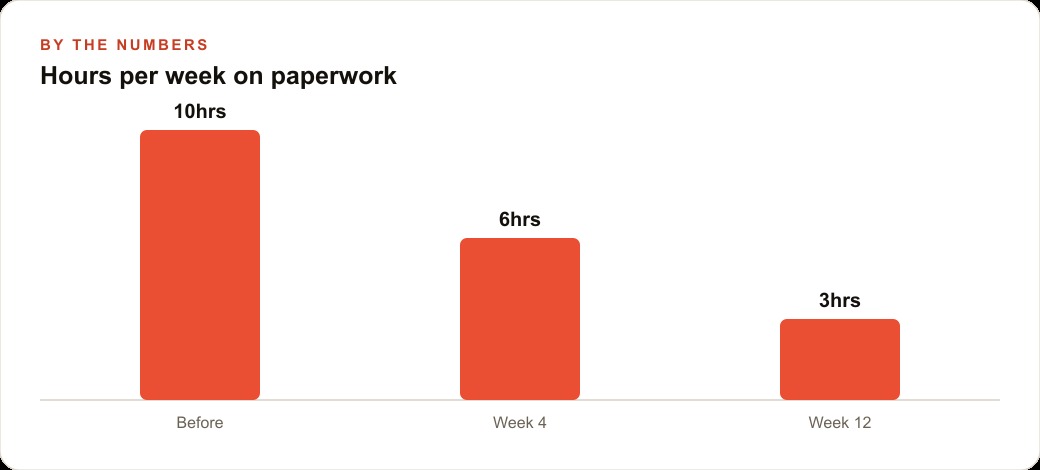
Over the first month the service writer's time on paperwork dropped from roughly 10 hours per week to under 3 hours. The difference was redirected to customer-facing time during the afternoon close rather than administrative work at a desk. These numbers are illustrative of a realistic shop workflow rather than a specific client engagement. The exact time recovery depends on job volume and how well the pricing and communication guidelines are documented for the model. The structural pattern holds across service business types: a long-horizon model working through structured paperwork overnight recovers meaningful staff time from the most cognitively expensive part of the service day.
What to do with this starting today
Start by identifying the one multi-step administrative task your business completes most consistently that follows a reliable structure but involves variable inputs each time. Estimates, follow-up emails, reports, status updates, or any recurring drafting task that currently requires sustained focus are all good candidates. Write down the exact process for that task: the inputs, the rules, the format of the output, and any specific preferences for language or tone. Load that description as context and give the model the task as a goal rather than as a step-by-step instruction.
Review the output critically on the first several runs. Note where it is reliable and where it needs adjustment. Add those adjustments to the context document rather than correcting them in every session. After five to ten sessions of refinement, the output quality on the routine portion of the task should be consistent enough to move the human review from the drafting phase to the approval phase, freeing the drafting time for other work.
The operational principle is the same as it has always been for any delegation: you are not removing your judgment. You are moving it from the beginning of the task, where it was spent on drafting, to the end, where it is spent on approval. The task still requires your sign-off. The hours between the start and the sign-off are now yours.
That is exactly what we do at AI DOERS. Book a private 30-minute call with Madhuranjan Kumar and we will map the fastest path to it for your specific business.
Book your call →
Madhuranjan Kumar
Madhuranjan Kumar brings 20 years of performance-marketing experience and has managed over $200 million in Facebook ad spend for brands across the United States and beyond. His expertise spans the full modern marketing stack: Meta, Google Ads, TikTok, email automation, CRM, and the websites that hold it together. At AI DOERS he turns that track record into lead-generation systems for businesses across every industry.