
Claude Skills and the Latest AI News: Making AI Work the Way Your Business Does
Anthropic's Skills feature lets you package your own rules and procedures so AI follows them automatically. Here is why that is the standout update, with a worked example.

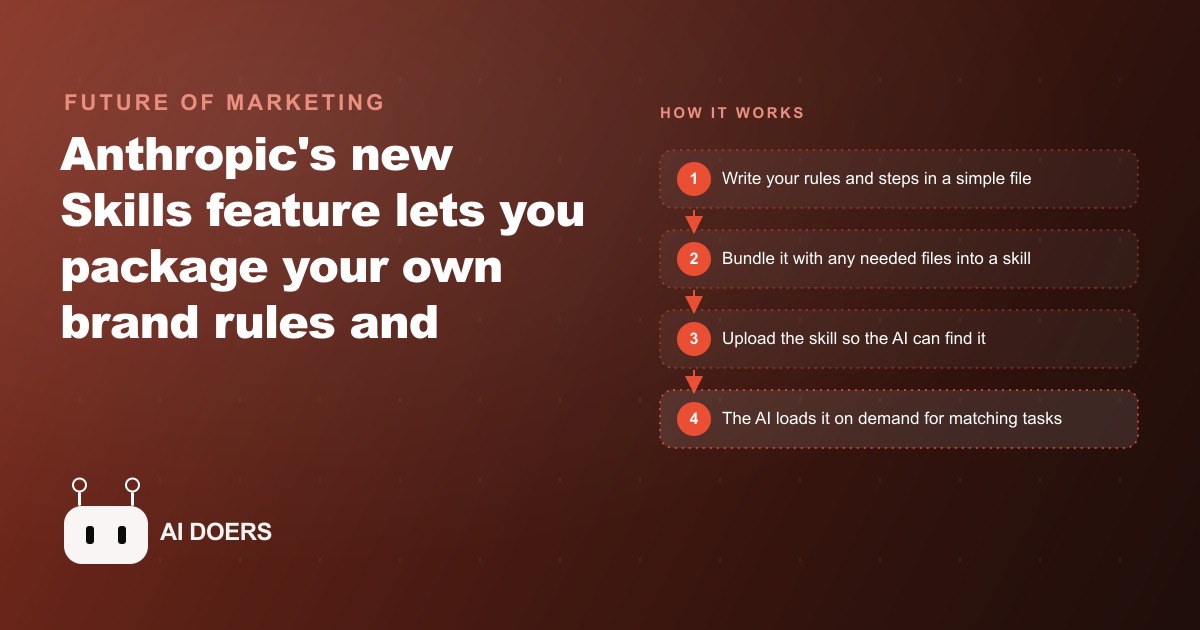
The most persistent frustration with using AI for business content is not that the output is wrong. It is that the output is inconsistent. One day the AI captures the brand voice exactly. The next day it drifts. A team member prompts it differently and gets a completely different result. The standards that took years to establish show up in the AI's output when the person remembers to include the full brief and disappear when they do not. Claude Skills is Anthropic's direct answer to that problem, and as Madhuranjan Kumar I think it is the most practical AI release of the week for a small business. The idea is to package your knowledge once into a structured skill, and have the AI load it on demand every time a matching task comes up. That change has six concrete effects on how a business can rely on AI output.
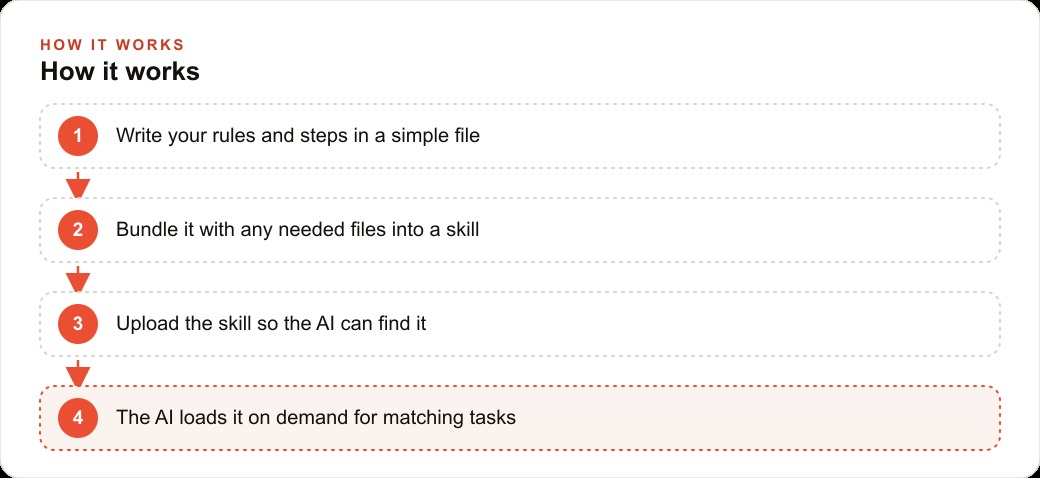
Anthropic's Skills feature addresses this with a structure simple enough that any business owner can build one: a folder containing a description file, an instruction set, and supporting examples or templates. No code required. The AI loads it on demand when a task matches the skill's description. That architecture change has six concrete effects worth understanding before you decide where to apply it first.
Your Institutional Knowledge Stops Walking Out the Door When Staff Change
Every business runs on knowledge that lives in a single person's head. The team member who has figured out exactly how the owner likes the weekly menu formatted. The front-of-house person who knows which topics need the owner's personal tone versus the team's standard tone. The person who has worked out the right way to phrase a price increase so that loyal customers feel respected rather than nickel-and-dimed. When that person leaves, the knowledge goes with them. The replacement spends months learning by trial and error what the departing person just knew intuitively.
Skills encode that knowledge into something permanent. Once the output preferences, the tone guidelines, the formatting rules, and the real-world examples are packaged into a skill, they are no longer dependent on any individual's memory or continued employment. A skill does not hand in its resignation. A skill does not get recruited by a competitor across town.
For a restaurant, this means packaging the review response style, the promotional caption format, and the weekly specials approach into three separate skills. A new social media coordinator or front desk team member does not need to be trained on brand voice from scratch. They invoke the skill and it carries the style for them. The new person focuses on learning the operations. The content standard is maintained by the tool. For any owner who has watched brand consistency erode every time a key person left, this structural protection is more useful than any amount of training documentation.
The AI Loads Only What the Current Task Actually Needs
One of the quieter problems with giving AI a long all-in-one system prompt is that the AI has to carry all of that context for every response, even responses that have nothing to do with most of it. A restaurant that has built a single long prompt covering review responses, social captions, menu descriptions, supplier emails, and customer follow-ups is feeding the AI five sets of instructions every time it writes a single caption. That extra context adds noise and increases the likelihood of the AI blending instructions from different task types in ways that produce slightly off-brand output.
Skills load on demand rather than all at once. The AI reads the description of each skill you have built and decides which one applies to the current request. A caption task loads the social skill. A review response task loads the review-handling skill. The two sets of instructions never mix in the working context unless the task genuinely involves both. The AI works with the right instructions and only the right instructions for the specific task at hand.
This modularity also makes the skill library easier to maintain over time. When the restaurant updates its promotional caption style after a seasonal rebrand, the change goes into the social captions skill and nowhere else. The other skills are unaffected. A single comprehensive system prompt requires careful editing to change one thing without accidentally altering something adjacent. A skills library is modular by design, and modular systems stay current far longer than monolithic ones.
New Team Members Produce On-Brand Output on Their First Day
Training a new hire on brand voice and content standards is one of the most time-consuming parts of onboarding in any content-dependent business. A bakery, a yoga studio, a dental practice, a family restaurant: all of them spend meaningful time in the first weeks correcting a new employee's output before it consistently matches the established standard. Some new hires pick it up quickly. Others take months. The quality of customer-facing communication varies throughout.
Skills compress that onboarding curve dramatically for content tasks. A new front desk person at a restaurant, given access to the review response skill and the promotional caption skill, produces compliant on-brand output from their first message. They do not need to have internalized the brand voice yet. The skill carries it for them while they learn the operational parts of the job. The content the customer sees is consistent regardless of whether the team member has been there one week or eighteen months.
This advantage is particularly strong for businesses with high turnover or seasonal staffing. A summer restaurant hiring four people for three months cannot run a six-week brand immersion for each of them. With skills, the output standard is enforced by the tool rather than by the training investment, and the training time can go toward operational knowledge where the direct supervision is genuinely necessary.
Corrections to the AI Stop Disappearing Between Sessions
Every business owner or content manager who uses AI regularly knows this frustration: you correct the AI on something on Tuesday, and by Thursday it is making the same mistake again because the correction only lived in that session's conversation and was not retained anywhere permanent. You make the same note again. You get a slightly better result. And two weeks later the same drift appears. The AI seems to not actually learn from corrections, no matter how clearly they are stated.
Skills fix this at the structural level. When the AI produces output that is off in a specific way, and you update the skill's instructions to prevent that issue, the correction persists permanently. It is in the skill file, which loads every time a matching task comes up. The AI does not forget a skill update the way it forgets a conversational correction. This is the difference between building a lasting capability and doing calibration work that evaporates.
For businesses that run on repeating content types, this permanence compounds fast. A property management company that gets the AI's tenant communication tone exactly right in a skill gets that precise tone on every future tenant message without re-explaining. A contractor that corrects the AI's quote formatting once in the skill gets the improved format on every future estimate. Each correction accumulates into a progressively sharper tool rather than resetting at the start of each new session.
Output Stays Consistent Across Every Platform and Every Person on the Team
Consistency problems in business content tend to fall into two categories. Inconsistency across platforms: the business sounds different on Instagram than it does on Google, which signals to customers that no one is in charge of the voice. And inconsistency across team members: the morning shift's replies sound different from the evening shift's replies, which erodes the sense of a coherent business personality.
Both problems share the same root cause. The standards live in people's heads rather than in the tools. Different people interpret unwritten standards differently, and the same person interprets them differently depending on how rushed they are or how recent their last training session was.
A restaurant that builds platform-specific skills (one for Instagram captions, one for Google review replies, one for Facebook event posts) can produce the same underlying brand voice across all three without requiring the team to remember how each platform is supposed to sound. The platform context is embedded in the skill. The team member handles the substance of the task. The output matches the platform and the brand without extra cognitive load.
Across shifts, the benefit is more direct. The morning manager and the evening manager invoke the same skill for the same task type. The customer reading a reply to their Tuesday comment and a reply to their Friday comment gets a consistent experience regardless of who was on shift. That consistency builds brand trust in a way that training alone cannot replicate, because training fades over time and skills do not.
The Gap Between Your Brand Guidelines and What the AI Actually Produces Closes to Near Zero
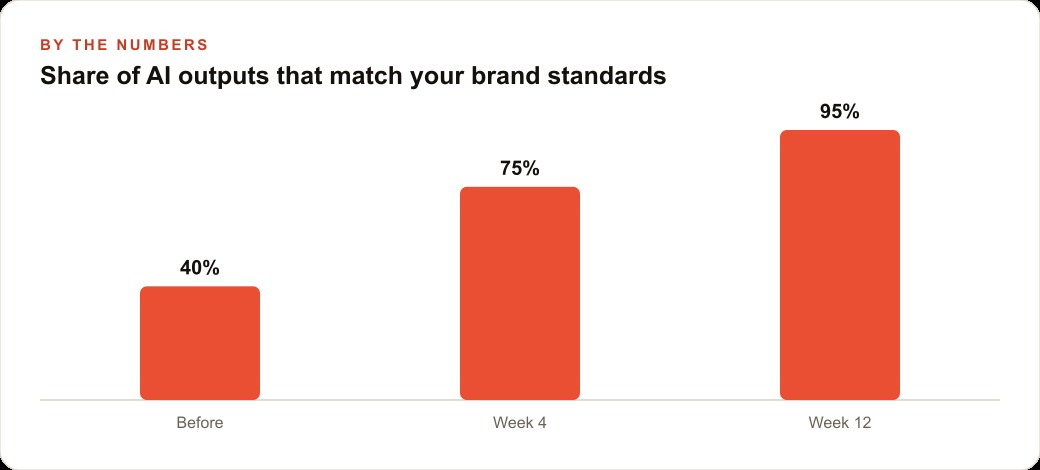
Most businesses that have tried using AI for content have guidelines that the AI roughly follows. It gets close. It sort of captures the tone. It generally avoids the words they have flagged. The remaining gap between the guidelines and the actual output is the thing that requires human editing on every piece, and that editing cost is the hidden tax on every AI-assisted content workflow. The business saves time on drafting but spends nearly as much time editing back to standard.
Skills narrow that gap by packaging not just instructions but examples. When the skill includes three or four pieces of content that represent exactly the output the business wants, the AI has something concrete to pattern-match against rather than just abstract rules to interpret. Instructions tell the AI the rules. Examples show the AI the result. Together they remove the ambiguity that produces the output gap.
For a restaurant, the practical result is that the owner stops spending 20 minutes editing every social caption down to something usable and starts spending 2 minutes approving something that already reads correctly. That 18-minute-per-post saving across a week of content production is several hours of the owner's time returned with no reduction in quality. Multiplied across a full content calendar, the compound time saving from closing the guidelines-to-output gap is one of the clearest financial returns available from the Skills feature.
What a Consistent AI Content Operation Looks Like Once Skills Are in Place
A restaurant or small business that builds its skill library carefully, with specific instructions, real examples, and precise task descriptions in each skill's header, reaches a content operation that runs without the constant supervision that AI content usually requires. The team invokes skills, reviews output quickly, makes minor adjustments where needed, and publishes. The AI's output is consistent enough across all platforms and all team members that the brand voice becomes a reliable asset rather than a variable one.
The steady state does not require advanced technical knowledge to reach. Writing a skill is mostly writing down what you already know: the rules you follow, the tone you use, the specific examples that represent your standard at its best. The technical packaging is minimal. The real investment is in the quality of the documentation, and that investment pays forward across every content task the team handles from that day on.
The broader AI news from the same period reinforces the direction. Compact AI hardware is arriving that brings capable local processing within reach of small budgets. AI systems are now contributing to scientific discovery by generating hypotheses researchers then validate. The consistent thread across these developments is the same: AI is most valuable in business when it is built on clear institutional knowledge rather than used as a general-purpose tool with no specific brief. Skills are the mechanism that makes that specificity durable and repeatable.
Skills also point toward where AI business tooling is heading more broadly. As compact AI hardware becomes cheaper and more capable AI models become available at lower price points, the businesses that have invested in packaging their knowledge into durable, reusable formats will extract disproportionately more value from each improvement. A well-written skill today becomes more valuable next year when it runs on a better underlying model. Institutional knowledge encoded in a skill compounds in a way that knowledge locked in a staff member's head does not. That compounding is the most durable argument for building a skills library now rather than waiting for the tools to mature further.
That is exactly what we do at AI DOERS. Book a private 30-minute call with Madhuranjan Kumar and we will map the fastest path to it for your specific business.
Book your call →
Madhuranjan Kumar
Madhuranjan Kumar brings 20 years of performance-marketing experience and has managed over $200 million in Facebook ad spend for brands across the United States and beyond. His expertise spans the full modern marketing stack: Meta, Google Ads, TikTok, email automation, CRM, and the websites that hold it together. At AI DOERS he turns that track record into lead-generation systems for businesses across every industry.