
Claude Routines: The New Feature That Runs Your Tasks While You Sleep
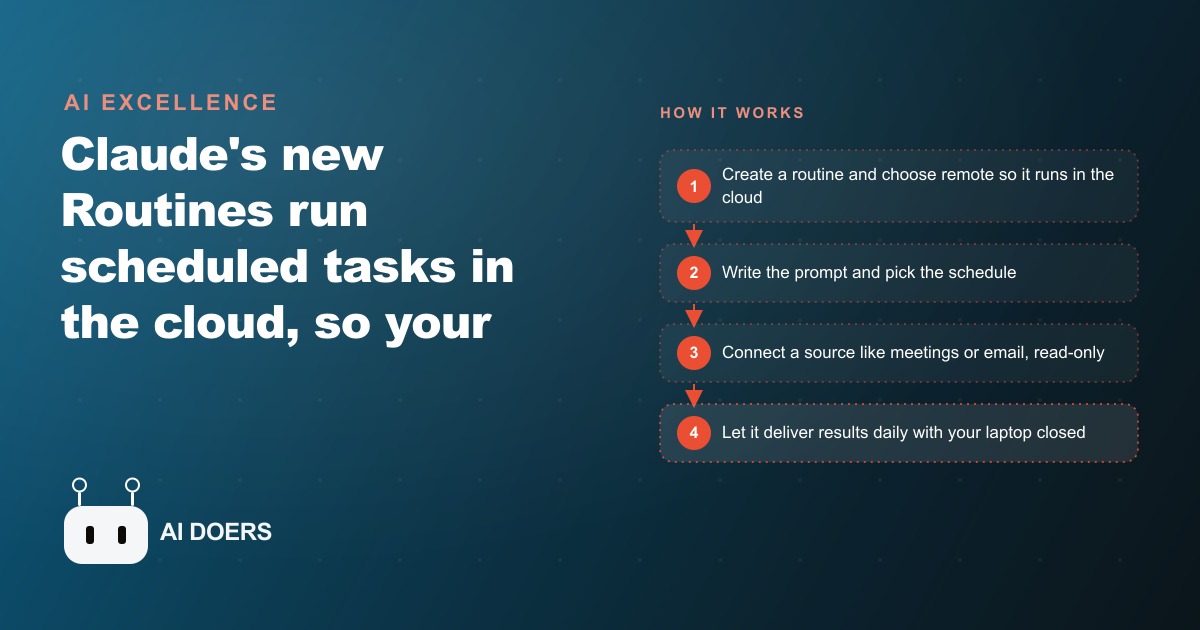
Claude Routines are scheduled tasks you can run remotely in the cloud, so your agent executes daily work even when your laptop is closed. You can build a meeting summarizer that runs every morning on a low-cost plan with no always-on machine.

The most expensive recurring cost at any professional services firm is not rent or software or even salaries in isolation. It is the fraction of every salary spent doing work that follows a predictable pattern every single week. The report that gets assembled the same way every Friday. The inbox scan that happens every Monday morning to catch anything time-sensitive. The status summary someone compiles before every team meeting to make sure no active matter gets overlooked. These tasks do not require judgment. They require attention, consistency, and time, and they consume both from people whose time is supposed to be spent on work that does require judgment.
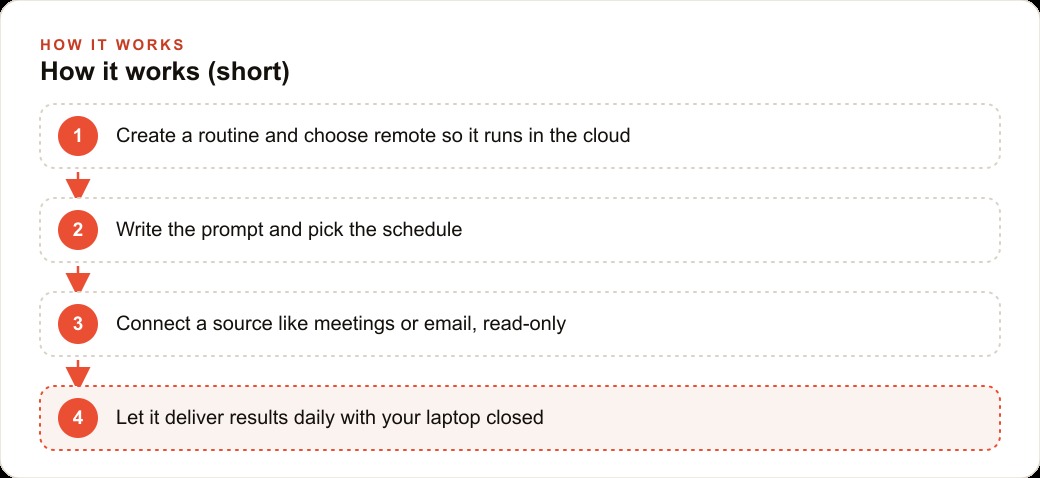
Claude Routines are scheduled tasks that run in the cloud on a timer you set, delivering their output to your account without your laptop needing to be on, without anyone needing to trigger them, and without the output depending on whether anyone remembered to do the work manually. You create a routine, choose the remote option so it runs in the cloud, write the prompt describing what you want done, connect a read-only data source if one is needed, and pick the schedule. Every morning at 8 a.m., every Monday at 7 a.m., every Friday at 3 p.m. The routine fires, does the work, and delivers the result. For a law firm, the application is direct: the recurring administrative overhead that consumes the first hour of every attorney's morning can be moved to an automated system that runs the work before anyone arrives.
Here are six specific routines a small law firm can stack, each delivering a concrete result on its own schedule.
1. A daily 8 a.m. meeting summary that organizes yesterday's client conversations before anyone sits down
Every working day at a law firm ends with meetings, calls, and conversations whose notes exist somewhere but have not been organized into a clear record of decisions, action items, and open questions. The next morning begins with each attorney reconstructing what happened the day before, reading notes if they exist, piecing together what was decided and what still needs to happen.
A daily meeting summary routine runs at 8 a.m. every morning with remote execution enabled, which means it fires in the cloud regardless of whether any machine at the firm is active. It connects to the meeting transcript source through a read-only connector, pulls the prior day's client conversations, and compiles a structured brief for each meeting: the key decisions made, the action items generated, and the open questions still pending. Each attorney arrives to find their morning brief waiting in their account rather than an unstructured pile of notes to organize. The decision and action items from each call are already surfaced. The first conversation of the day can start with what needs to happen today rather than with reconstructing what happened yesterday.
2. A Monday morning scan that surfaces any time-sensitive client message that arrived over the weekend
The gap between Friday afternoon and Monday morning is one of the most reliable sources of stress in client-facing legal work. Clients send messages over the weekend about deadlines, hearings, and filing requirements. Those messages sit in an inbox until Monday morning, when they are discovered as part of a slow manual review that eats the first hour of the week. In a law firm context, a missed message about an approaching deadline is not just an operational problem. It can have serious professional consequences.
A Monday morning scan routine runs at 7 a.m. every Monday with remote execution, pulling from the client communication source and scanning specifically for messages that reference anything with timing implications: deadlines, court dates, hearings, filing requirements, emergency language. It compiles a flagged list with the relevant excerpt, the sender, and the message date. When attorneys arrive on Monday, the list of time-sensitive items that accumulated over the weekend is already waiting in their accounts, organized by urgency rather than by chronological inbox order. The manual review that used to take an hour of unfocused reading is replaced by a structured brief that takes ten minutes to act on.
3. A Friday afternoon project status brief that replaces the weekly status meeting
The weekly status meeting exists because someone needs to know where everything stands before the week closes. In most small firms, that knowledge lives in everyone's heads simultaneously and has to be verbalized collectively to be shared, which is why the meeting takes an hour even when nothing significant has changed on most matters. The meeting is the synchronization mechanism, and it is also one of the most reliably available targets for time recovery.
A Friday afternoon status brief routine runs at 3 p.m. every Friday, pulling from whatever connected sources the firm has access to, including task lists, matter notes, and recent correspondence, and producing a one-page summary of where each active matter stands. It flags matters that have upcoming deadlines in the next two weeks, notes which matters had no activity that week, and surfaces any items that appear to be stalled. The brief lands in accounts before the end of the business day. The Monday morning meeting, if it still happens at all, starts from an already-shared status document rather than from everyone describing what they remember about each matter. Often the meeting becomes optional because the brief covers everything the meeting would have covered, and anyone with a question can raise it asynchronously without scheduling a collective hour.
4. A weekly billing digest that surfaces unbilled hours before the billing cycle closes
Billing leakage is one of the most common and least discussed problems at small professional services firms. Hours get recorded imperfectly, time entries from calls and brief reviews accumulate in notes that do not always make it into the time-tracking system, and by the time the billing cycle closes, some billable activity has been forgotten. The partner reviewing the bill often cannot reconstruct the missing time without going back through emails and calendar entries, and many hours are written off rather than billed because the evidence for them is too scattered to justify the effort of recovering them.
A weekly billing digest routine runs every Wednesday morning, reviewing the current billing period's time entries against the meeting transcripts and correspondence from the same period. It identifies gaps where client conversations occurred but no time entry appears to have been logged, and surfaces a list of potentially unbilled activities with the client name, the date, and a brief description of the interaction. The partner or billing coordinator reviews the list, confirms which items are legitimately missing from the billing record, and adds them before the cycle closes. The routine does not replace judgment about what should be billed. It prevents the judgment from being applied to information that was lost before anyone had a chance to evaluate it.
5. A competitor filing monitor that checks for new submissions in the firm's practice areas
In practices where public filings, regulatory submissions, or court records are searchable, the business and strategic intelligence available to a firm that monitors them consistently is significant. New filings in a practice area can reveal trends in how arguments are being structured, what kinds of cases are being brought or defended, and what regulatory activity is emerging that clients may need to prepare for. Most small firms do not monitor this information systematically because the manual process of checking relevant databases and organizing findings takes more time than anyone has available for it on a weekly basis.
A competitor filing monitor routine runs weekly, connecting to searchable public databases relevant to the firm's practice areas and pulling any new submissions or filings from the past seven days. It summarizes the nature of each filing, identifies the parties involved, and flags anything that appears particularly relevant to the firm's current client matters or practice focus. The output is a brief intelligence report that a partner reviews over ten minutes rather than an afternoon of database searching. Over time, this routine builds the firm's awareness of its competitive and regulatory landscape in a way that would be impossible to sustain through manual effort, and that awareness translates directly into better-informed advice for clients.
6. A quarterly client engagement check that flags relationships that have gone quiet
Client attrition at law firms often happens silently. A client that has not had an active matter in a while stops thinking of the firm as their default resource, starts taking questions to other sources, and eventually engages a different firm for the next matter without any formal notice. By the time the original firm notices the absence, the relationship has already moved on. The preventive intervention, a check-in, a note about a relevant legal development, an invitation to a relevant event, is most effective when it happens before the client has already mentally left.
A quarterly client engagement check routine runs on the first Monday of each quarter, reviewing the client list against matter activity records from the past 90 days. It identifies clients who had active matters in the prior quarter but have had no recorded activity in the current quarter, and flags clients whose last matter closed more than 90 days ago with no new inquiry since. The output is a short list of relationships that may need a proactive touch, with the last matter date, the matter type, and any relevant context about what that matter concerned. The relationship partner reviews the list, picks which clients to reach out to, and initiates contact with context already organized rather than having to reconstruct the history of the relationship before making the call.
The mindset shift that determines how much value stacked routines actually deliver
Running six routines is not the goal. The goal is identifying which recurring work can run without anyone touching it and building the system one routine at a time until the work that used to define attorneys' mornings has been transferred to something that executes reliably on a clock. That shift in orientation, from asking what this tool does to asking which of my recurring tasks can I remove from my own plate, is what separates teams that get compounding value from AI from teams that try a feature once and conclude it is not transformative.
The practical starting point is to list the five things the firm does on a predictable schedule every week that feel like they should already be automated. Most people have a list by the time they get to three. Pick the one that costs the most time and has the clearest, most structured output, and build that routine first. Run it for two weeks, refine the prompt until the output is something a partner would send without editing, then add the next one. Each routine added returns time and attention that can be redirected to the work that genuinely requires both.
The calendar view that shows all routines together is how you see the system rather than individual tasks. Check it once a month and ask whether anything done by hand last week belongs on the calendar. The value compounds as the system grows, because each routine moves recurring work off human schedules and onto an automated clock that never forgets and never calls in sick.
A four-attorney firm: what three stacked routines recover in a year
A four-attorney firm stacking the daily morning summary, the Monday scan, and the Friday status brief as their first three routines provides a concrete case for the recovery math.
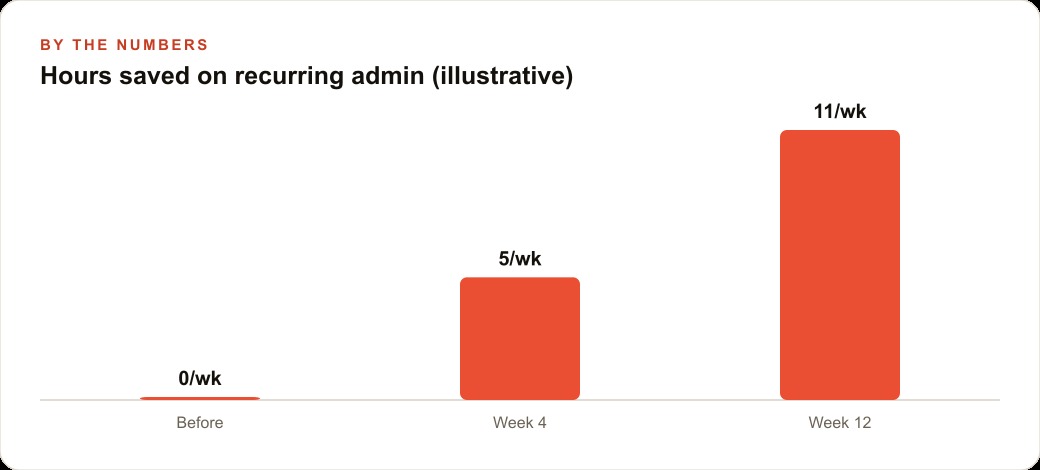
Before the routines: each attorney spends approximately 45 minutes each morning reviewing meeting notes, checking for anything time-sensitive in the inbox, and orienting for the day before any legal work begins. Four attorneys, each losing 45 minutes every morning, equals three hours of collective time lost before the team's first substantive action each day.
After the routines run: each attorney arrives to a structured morning brief that covers all three functions. Meeting decisions and action items are already organized. Time-sensitive messages from the prior day are already flagged. The week-ending status on active matters is already compiled and shared before any Monday morning discussion. Morning admin time drops from 45 minutes per attorney to approximately ten minutes: the time it takes to read the brief and decide what to act on.
Time recovered per person per day: 35 minutes. Across four attorneys, that is 140 minutes of recovered time per day, or 2.3 hours. At an average billing rate of $350 per hour for the firm, 2.3 hours per day represents $805 in recoverable billing capacity. Over 250 working days per year, the total recovered capacity exceeds $200,000.
The cost of the routines sits inside a Claude subscription that starts at low monthly tiers and scales based on usage. Even at a $100 per month tier, the ratio of cost to recovered capacity is over 160 to 1. The firm is not getting a marginal efficiency gain. It is reclaiming the entire first hour of every attorney's morning and redirecting it to the work that actually generates revenue. The routine cost is a line item that rounds to zero against that recovery.
The secondary benefit is error reduction. A manually compiled status note misses things. A routine that consistently pulls from the same sources and applies the same structure misses far less, which means fewer dropped action items, fewer missed deadlines caught only at the last moment, and fewer apologetic calls to clients. For a law firm where a missed deadline can have serious professional and reputational consequences, that consistency has value beyond the time saving. It is a quality argument built into the system architecture.
That is exactly what we do at AI DOERS. Book a private 30-minute call with Madhuranjan Kumar and we will map the fastest path to it for your specific business.
Book your call →
Madhuranjan Kumar
Madhuranjan Kumar brings 20 years of performance-marketing experience and has managed over $200 million in Facebook ad spend for brands across the United States and beyond. His expertise spans the full modern marketing stack: Meta, Google Ads, TikTok, email automation, CRM, and the websites that hold it together. At AI DOERS he turns that track record into lead-generation systems for businesses across every industry.