
Claude Opus 4.8: A Modest Upgrade Whose Real Story Is Honesty
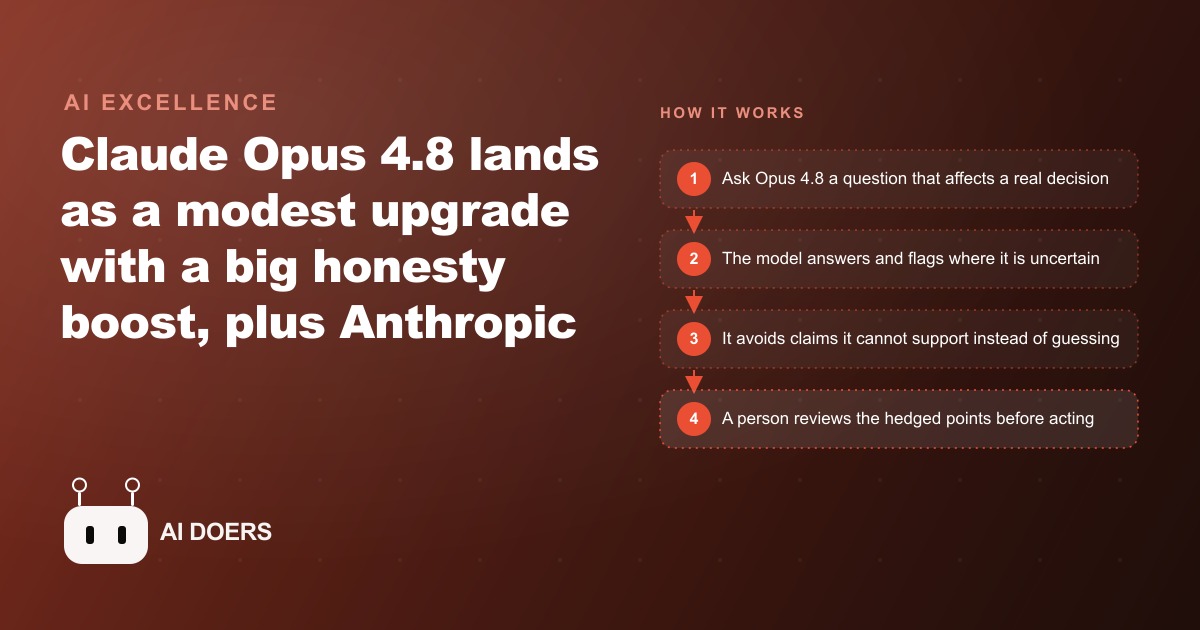
Claude Opus 4.8 is a small step up from 4.7 on coding, reasoning, and computer use at the same price, but its most meaningful change is honesty. It now flags uncertainty and avoids making claims it cannot support, which is exactly what a business wants when AI feeds a real decision.

The Monday headline that looked bigger than it was
The accounting firm's managing partner opened email on Monday morning to subject lines from three different newsletters: "Anthropic valued at nearly $1 trillion." Below the valuation story, in each newsletter, a smaller headline: "Claude Opus 4.8 released."
I am Madhuranjan Kumar, and I want to trace how this firm actually processed that week of news, because the way they moved from Monday to Friday is more instructive than any summary of the individual releases. The week contained a valuation headline, a model update, two Microsoft integrations, a memory agent, a map-to-video demo, and a dubbing tool. Not all of them mattered equally. The firm's job was to figure out which ones did.
The valuation number was what got attention in the Monday morning conversation. Nearly $1 trillion for a software company that had not yet launched a consumer product on the scale of a smartphone or a search engine. The number was real: Anthropic raised $65 billion in a Series H at a valuation of approximately $965 billion, making it the most valuable startup in history at that moment. The managing partner found the number worth noting and then set it aside, because a valuation is a financial instrument, not a product feature. No one in the firm would make a different decision about their Tuesday workday because of how much capital Anthropic had raised.
The Claude Opus 4.8 release was the one that deserved the closer look. The firm used Claude regularly for drafting client correspondence, reviewing documents, and preparing briefing summaries. A model update from a tool in daily use matters in a way that a funding round does not. The critical word in the release notes was "modest." Anthropic described Opus 4.8 as a modest but tangible improvement over Opus 4.7, slightly better at coding, slightly better at reasoning, a little better at computer use, with pricing unchanged. For a firm that does not write code and does not use computer-use automation, those improvements were background context.
The Monday story was about how to read big AI headlines without being distracted by the financial noise that surrounds them. The valuation is not the product. The model is the product, and Anthropic was honest enough to call a modest improvement exactly that.
What the honesty improvement actually changes on Tuesday's real work
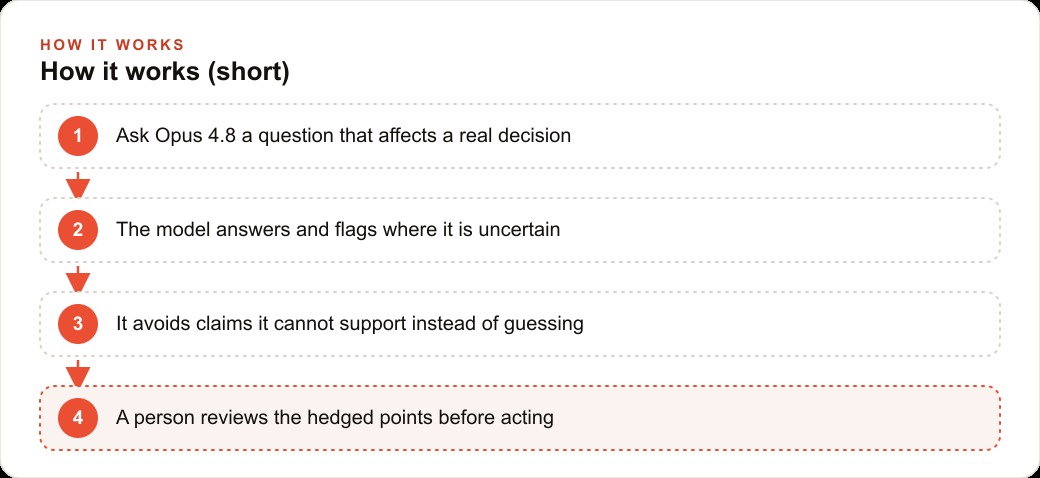
The property of Opus 4.8 that the firm's team lead noticed on Tuesday was the one that received the least attention in the press coverage: honesty. Specifically, the model's improved tendency to flag uncertainty rather than produce confident-sounding answers to questions it cannot fully support.
In an accounting context, this is not an abstract property. It is the difference between a useful research assistant and a quiet liability. The team lead used Claude to quickly review how a specific amortization method applied to an asset class the firm did not often see. With a previous model version, the output was a clean, authoritative paragraph that stated the rule and provided an example. With Opus 4.8, the output stated the general rule, noted two specific conditions under which the rule applied differently, and flagged that the answer depended on whether the client's entity type qualified under a specific regulatory carve-out that the model could not confirm without seeing the actual filing details.
That hedged answer was more useful than the clean one, because it told the team lead exactly where to look for the ambiguity before the advice went anywhere near the client. The confident paragraph from the previous version would have required a partner to re-check the entire answer. The hedged paragraph from Opus 4.8 produced a short verification list: confirm entity type, confirm qualifying conditions, check the carve-out. Three specific items, each checkable in under five minutes, rather than a full re-read of something that appeared settled.
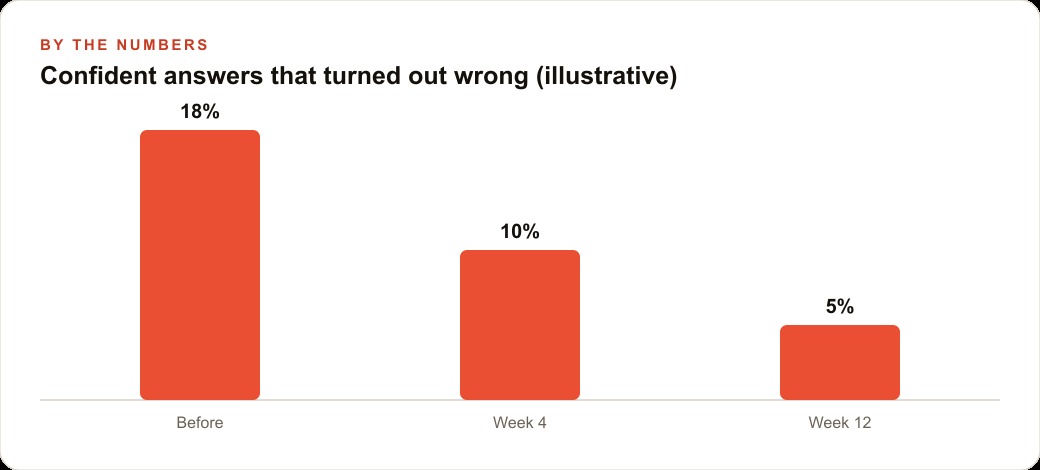
Over the course of Tuesday's work, the team lead identified five similar moments where the model's flagged uncertainty prevented a plausible error from going forward without review. Across a team doing eight to twelve substantive research tasks per day in a busy season, the math produces meaningful savings in review time. If two or three tasks per day include hedged uncertainty that targets the review rather than requiring a full re-check, the partners reviewing output spend less time and catch more. The firm's early read on this honesty property was that it would make the tool more trustworthy for client-facing work, not because it produced more correct answers necessarily, but because it clearly marked the edges of its own confidence.
Before Opus 4.8, the firm's internal rule was to treat any AI output on a technical tax or accounting question as unverified until a senior person reviewed it in full. The new rule, emerging from Tuesday's experience, was more precise: treat the body of the answer as likely correct, and treat any flagged uncertainty as a specific verification task assigned to a named person with a deadline before the output goes to the client. The honesty property only improves the work if the flags are acted on rather than smoothed over.
Wednesday: Microsoft pulling AI into the tools the firm already uses
Wednesday brought a different kind of news that the firm found more immediately relevant than the model update. Microsoft was expanding AI access inside the software the firm used every day.
Two releases pointed in the same direction. Microsoft 365 Copilot received a redesigned prompt interface that could read from emails, files, calendar events, and meeting transcripts. It built charts and tables inline within Excel and Word documents, using the firm's own files rather than generic examples. The second release: Perplexity began running inside Word, Excel, PowerPoint, and Outlook, handling complex multi-step tasks like drafting document sections with citations, researching regulatory changes across sources, and comparing clauses across multiple files.
For a firm that lived in Excel, Word, and Outlook, both announcements were more immediately actionable than a model version update. The question was not whether to try them; it was which one to trial first, given that both required a subscription decision and a team rollout before they could be used on real work.
The managing partner's instinct was to be skeptical of the newsletter version of both releases. Release announcements in the AI space consistently describe capabilities at their ceiling, not at their typical performance on ordinary workday tasks. The Perplexity announcement mentioned "multi-step jobs like drafting redlined contract edits with fallback clauses," which was a showcase example, not a description of average behavior. The real test would be whether the tool could handle the specific types of documents the firm actually used, not the press release examples.
The firm decided to treat both as two-week trials rather than immediate subscriptions. One team member would test Copilot on three real spreadsheets from current client files, noting where the tool helped and where it produced output that needed correction. A second team member would test Perplexity in Outlook on actual client correspondence. Both would report back at Friday's team meeting. That structure, a bounded trial with a specific reporting date and specific success criteria, was how the firm had learned to evaluate AI tools since the first generation of them arrived.
The pattern in the week's releases, seen from the inside
By Thursday the firm's team lead had read through the rest of the week's AI news and noticed a pattern that was not visible from inside any single announcement.
The Hermes agent release described a tool with persistent memory across sessions and a self-improving loop that built skills from past runs, connecting across Slack, Telegram, Discord, and email. The Gemini Omni release showed a multimodal model generating video from a map screenshot, producing first-person driving footage from a drawn route that looked like professional cinematography from a casual input. The Eleven Labs release described a dubbing tool that preserved voice, emotional tone, and facial expression across languages, with 30 minutes of dubbing available on the free tier.
The connecting thread across all of them was not raw capability. Every one of these tools could do something that would have seemed impossible two years earlier. The thread was context: each release pushed AI closer to the specific data and history that surrounds real work. Hermes remembered what it had done before and built on it. Copilot read the firm's own emails and files rather than generic examples. Opus 4.8 acknowledged the limits of what it knew rather than expanding its claims past the available evidence.
The team lead summarized it Thursday evening as a shift from AI that was impressive to AI that was becoming integrated. Impressive tools produce remarkable demos. Integrated tools are the ones you cannot run the day's work without. The week's releases were not all equally significant, but they were all moving in the same direction: closer to the actual data, the actual history, and the actual moment of a decision, rather than performing a task in isolation and stopping.
The Gemini Omni and Eleven Labs releases were the clearest examples of the creative layer advancing independently of the reasoning layer. Neither had direct application to accounting work. But the team lead noted them as indicators of what the creative sector would be able to do in client presentations and marketing materials within the next 12 months, worth tracking for the firm's own business development work even if they had no near-term application to the firm's core deliverables. Knowing a capability exists, even when you are not ready to use it, is useful for the moment a client asks whether you have considered it.
The two decisions the firm made by Friday: what to adopt, what to wait on
Friday morning the firm's partners sat down with two pages of notes from the week and made two specific decisions.
The first decision was to continue using Claude for substantive research and drafting work, with one change in workflow. The team would treat Opus 4.8's flagged uncertainties as a formal step in the quality process rather than as optional hedges. Any output from Claude that included a phrase indicating uncertainty would generate a verification task, assigned to a specific person with a due date before the output reached the client. This was not a complex process change. It was a one-line addition to the team's existing review checklist: "Flag any AI-marked uncertainties and assign for verification." The honesty property that Anthropic shipped in Opus 4.8 only delivered its full value inside a workflow that responded to the flags systematically.
The second decision was to proceed with the two-week trials of Copilot and Perplexity in the specific use cases assigned on Wednesday. The criterion for adoption was clear: if either tool reduced the time spent on a specific recurring task by more than 25 percent without introducing a new error rate, it would move to full subscription. If neither tool met that bar in two weeks of real use on real documents, the subscriptions would not be purchased. That criterion was specific enough to produce a clear answer at the end of the trial period rather than a fuzzy "it seems useful but I am not sure if it is worth it."
The releases the firm chose to watch but not adopt were Hermes, Gemini Omni, and Eleven Labs. All three were impressive and all three had clear long-term relevance to adjacent work, but none addressed a specific bottleneck the firm faced in the next 90 days. The criterion for waiting was simple: if a tool solves a problem the firm does not currently have, learn enough about it to recognize when the firm does have that problem, then adopt it at that moment.
The broader conclusion from the week was that the pace of AI releases had created a new professional skill worth developing explicitly: the ability to sort headlines into the categories that require immediate action, monitored trial, or simple awareness. The valuation story required no action. The honesty improvement in Opus 4.8 required a workflow change. The Copilot and Perplexity integrations required a bounded trial. The creative tools required awareness. Getting those four categories right is what kept the firm from spending the week reacting to every announcement and ending Friday having changed nothing, or alternatively, ignoring everything and missing two changes that would improve the firm's work by Monday.
A business that reads AI news this way, sorting it into those four buckets and acting only on the first two, avoids both of the failure modes that most teams fall into: chasing every release without integrating any of them, or tuning out the news entirely and falling behind. The accounting firm ended Friday with a formalized verification workflow, two time-boxed trials with explicit success criteria, and three tools on a watchlist for future evaluation. That is a week of AI news handled well.
That is exactly what we do at AI DOERS. Book a private 30-minute call with Madhuranjan Kumar and we will map the fastest path to it for your specific business.
Book your call →
Madhuranjan Kumar
Madhuranjan Kumar brings 20 years of performance-marketing experience and has managed over $200 million in Facebook ad spend for brands across the United States and beyond. His expertise spans the full modern marketing stack: Meta, Google Ads, TikTok, email automation, CRM, and the websites that hold it together. At AI DOERS he turns that track record into lead-generation systems for businesses across every industry.