
Claude Opus 4.7 Review: A Real Vision Upgrade With a Hidden 35% Cost
Claude Opus 4.7 is a genuine upgrade, most notably reading images at three times the resolution and producing better-designed output. The catch is that a changed tokenizer means you pay about 35 percent more for the same usage even though the listed per-token price is unchanged.

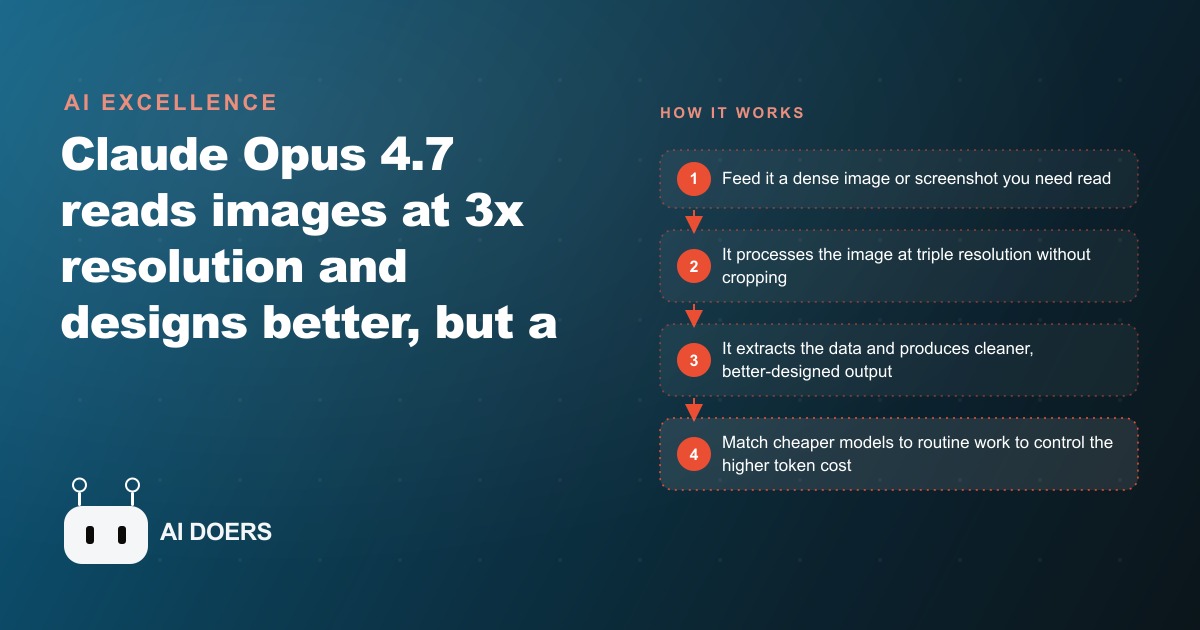
Anthropic released Claude Opus 4.7 and buried its most consequential change in the one place nobody checks: the tokenizer. I am Madhuranjan Kumar, and after running the model through real business tasks, this is a complete account of every substantive change in this release, ranked by how much it matters in practice. Eight changes. One of them quietly raises your effective bill by 35% without altering any number on the pricing page.
Triple-resolution image reading that makes dense screenshots actionable in a single pass
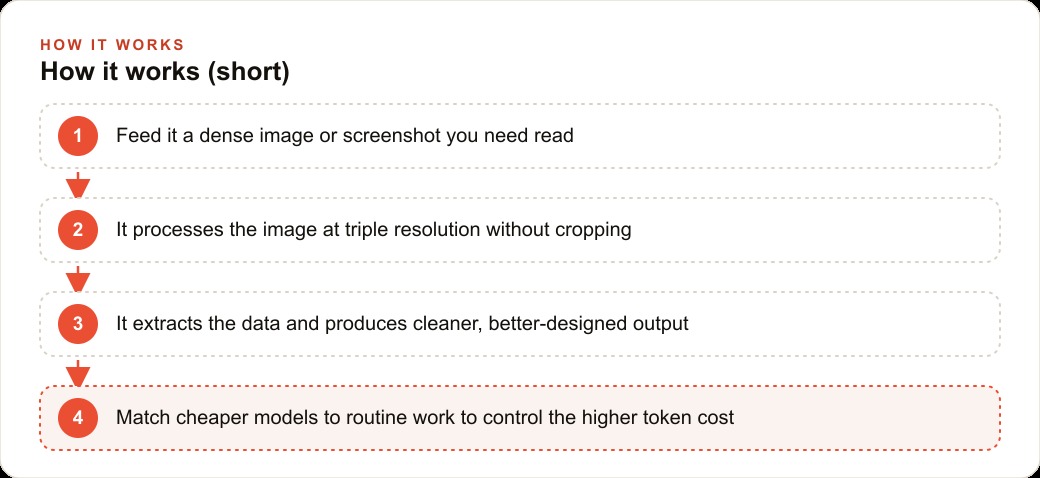
The headline improvement in Claude Opus 4.7 is vision. The model can now process images at three times the resolution of the prior generation without cropping the input, without requiring the image to be resized or reformatted, and without needing the user to direct its attention to any particular region of the image. This is not an incremental benchmark improvement. It changes what the model can do on real business assets that arrive every day as screenshots or scans.
The clearest demonstration is a fully zoomed-out analytics dashboard, the kind where 12 to 15 metrics are visible simultaneously at a size most people would find difficult to read even on a large monitor. Opus 4.7 extracts every visible number and label from that screenshot in a single response. No preprocessing. No prompting it to zoom into a specific section. No iterating across multiple calls. It reads the full image and delivers structured data.
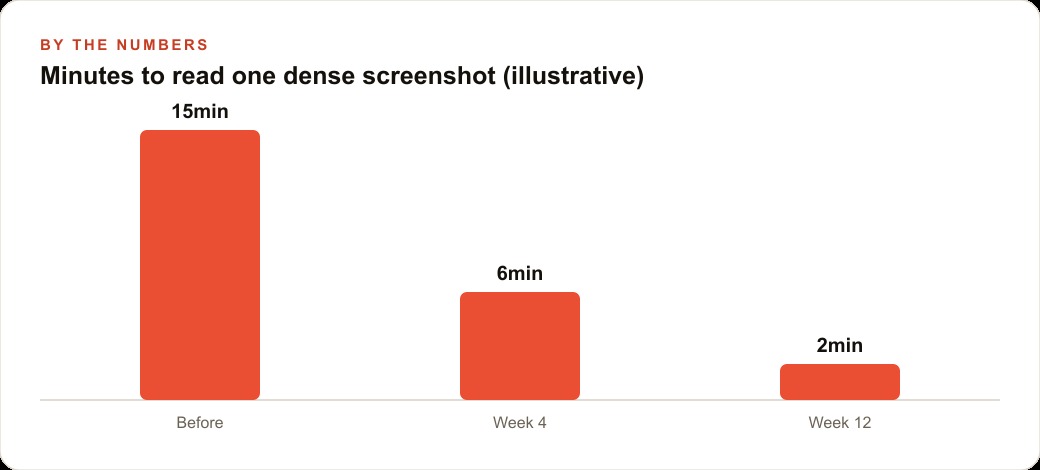
For any role where the workflow regularly involves dense screenshots, scanned financial statements, analytics reports, photographed documents, or marketing layouts that need analysis, the practical implication is significant. The work of manually reading an image and transcribing its contents, which is slow, prone to transcription error, and cognitively tedious, can now be handed to the model. The time investment drops from 10 to 20 minutes per image to under a minute, and the output is structured rather than typed field by field into a spreadsheet.
This change matters especially because the category of business data that arrives as images is large and growing. Mobile-first workflows mean more screenshots and fewer exports. Analytics platforms that do not offer the right export format mean screenshots of dashboards. Vendor documents that arrive as PDFs or photos mean scanned forms. The resolution upgrade addresses all of these cases with one capability improvement.
What Claude Opus 4.6 did on the exact same screenshot and why that comparison matters
The comparison between Opus 4.7 and Opus 4.6 on that same dense analytics screenshot is specific enough to be worth describing precisely, because it shows exactly where the prior generation's ceiling was and what crossed that line.
Claude Opus 4.6 faced with the dense image did not read it directly. It attempted to write code to extract the data programmatically, treating the screenshot as a problem to route around rather than a visual input to interpret. It ran through four consecutive tool calls attempting to make that indirect approach work. It then exhausted its tool-use allocation without completing the task and stopped with an error and no useful output.
The model was not failing arbitrarily. It was compensating for a visual limitation in the only way it could. But the compensation consumed credits, consumed time, and still did not deliver the answer. The person asking the question received nothing useful after a session that was longer and more expensive than it should have been.
Opus 4.7 reads the same image directly. One pass, one response, no tool calls, no workaround. The specific failure pattern of the prior generation is simply absent. That comparison illustrates something more general about what constitutes a meaningful model upgrade: the real improvement in value is often not measured in benchmark scores but in the elimination of specific failure patterns. When a task that previously required a failing workaround now just works, that is a genuine capability change worth understanding.
Design output quality that produces polished results without a design background
The second major upgrade is in the model's sense of visual composition. Outputs from Opus 4.7 are better spaced, better color-balanced, and more considered in their layout than Opus 4.6 outputs on equivalent prompts. This is a qualitative claim, but the evidence from multiple reviewers working across different contexts points consistently in the same direction.
The most revealing evidence is what a non-technical user can produce with a single prompt. In direct testing, someone with no coding or design background prompted the model to build a functional tool with a visual interface for converting video content into short scripts. The result shipped on the first generation. The reviewer rated the visual quality a ten without qualification.
That one-shot quality on a visual output matters specifically because it eliminates the iteration that usually consumes the most time when presentation is part of the deliverable. A business owner who needs a branded treatment menu, a professional estimate template, or a clean onboarding page describes what they want, receives a polished first version, and moves on rather than spending two hours refining something that started at too low a quality to use. The improved design judgment changes the practical utility of the model for anyone whose work involves producing something that needs to look good, not just function correctly.
The improvement is also visible on standard visual benchmarks. A complex scene that rendered in the prior model with floating elements and incorrect shading renders in Opus 4.7 with proper depth, correct shadow placement, and no artifacts. An interactive graphic with cursor-following behavior shows the level of spatial reasoning the model now handles. These are not cosmetic differences. They reflect a deeper understanding of how visual elements relate to each other and to the space they occupy.
The tokenizer change hiding a 35% effective cost increase behind an unchanged listed price
This is the change in the list that costs you money, and the reason it costs you is that it is invisible at the point where you look at the pricing page.
The listed API price per token for Opus 4.7 reads identically to Opus 4.6. Nothing on the pricing page signals any change. But Anthropic changed the tokenizer underneath that price. The same prompt and context that Opus 4.6 measured as one volume of tokens, Opus 4.7 measures as approximately 35% more. For equivalent work, the effective cost per session is 35% higher even though the rate per token is unchanged.
This is worth stating plainly: the number on the pricing page did not increase, but your bill at the same usage level did. You will not see this coming unless you are specifically monitoring cost per session or per task rather than cost per token. If you set a budget based on prior model behavior without adjusting for this change, you will exhaust that budget faster than expected and the difference will not trace back to a visible pricing update.
The adjustment is straightforward once you know about it. Route only the work that specifically benefits from Opus 4.7's image reading or design output to this model. For routine text generation, content drafting, answering questions, summarizing documents, and any task where the quality difference is not visible in the final output, the prior model or a cheaper current model produces results that are indistinguishable at a meaningfully lower effective cost. The routing decision is where most of the cost control lives.
A practical heuristic: before assigning a task to Opus 4.7, ask whether the task involves a dense image that needs reading, a design output where layout quality matters, or web research that requires synthesizing many sources. If the answer is no to all three, use a cheaper model. This one question, applied consistently, keeps your effective spend aligned with the value you are receiving from the model.
Subscription usage that burns down faster than the prior model at the same working intensity
The 35% tokenizer increase compounds with subscription usage caps in a way that creates a specific problem during high-volume work sessions. It feels like hitting a sudden wall rather than a gradual depletion because the pace of cap consumption is higher than what users experienced with the prior model.
Paid plan subscribers work within a usage cap rather than unlimited access. Because Opus 4.7 counts more tokens for the same work, the cap is reached faster at the same working pace. A tester running a sequence of benchmark prompts at typical session intensity ran out of plan allocation in under an hour. On the prior model, the same sequence at the same pace would have taken significantly longer to exhaust the same allocation.
The practical planning implication is that any work session using Opus 4.7 intensively should factor in the possibility of hitting the cap mid-task. Walking into a long build session with no contingency for this limit is how you end up blocked at a critical moment. Knowing this in advance means you can either pace your usage, route lower-value work elsewhere, or plan for the top-up option described next.
The credit top-up option that replaces the hard stop at the usage limit
Anthropic added usage-based top-up pricing to subscriptions alongside the Opus 4.7 release, directly addressing the faster cap exhaustion. When you hit the plan limit, you can now purchase additional usage and continue working rather than hitting a wall and waiting for the next billing cycle.
For business use, this changes the downside scenario in a way that matters. The prior pattern was that hitting the cap on a deadline meant stopping, switching to a different tool, losing prompt context, and resuming from a colder start. The new pattern is continuing the same session with a small incremental charge and completing the work.
The honest framing is to treat the top-up as a planned line item for intensive work periods rather than a safety net discovered mid-session. If you know a task requires sustained heavy model usage, the relevant budgeting is done before the session starts. That shift from reactive to planned is what makes the top-up option genuinely useful rather than just less bad than the prior hard stop. Build it into your estimate for any heavy session the way you would factor in any other variable cost.
Extended thinking budgets and sampling parameters removed from the API
Two developer features are absent from Opus 4.7. Extended thinking budgets, which allowed developers to specify how much reasoning time the model applied to a given task, are replaced by adaptive thinking. The model now applies reasoning depth automatically based on the complexity of the problem rather than requiring the developer to set a budget. The sampling parameters top-p and top-k are also removed from the API without a direct replacement.
For most business applications and the majority of developer workflows, these removals have no visible effect in the output. Extended thinking budgets were primarily used by developers tuning model behavior on specialized tasks that required explicit control over the depth of reasoning. Adaptive thinking handles most standard scenarios correctly without manual configuration. The sampling parameters were similarly relevant to developers running specialized fine-tuned workflows.
The removal is material specifically for any team that built a production integration relying on either of these parameters. Extended thinking budget calls in existing API code will need to be updated. Any API call setting top-p or top-k will need those parameters removed to avoid integration errors. The practical recommendation is to audit any existing API integrations before upgrading to Opus 4.7, particularly for teams that built agentic workflows on the prior model's extended thinking capability. This is a developer concern, not a business user concern, but it is worth flagging before an integration breaks unexpectedly.
A built-in thorough review command in Claude Code that replaces what used to require a manual prompt
Claude Code received a new slash command in this release that runs an extra detailed, comprehensive review pass over completed work. Before this command existed, getting this level of review required writing a manual prompt at the end of a session that described what you wanted checked and at what depth. That was a step that required remembering to do it correctly after a long working session, which meant it was easy to skip or do hastily.
The value of the command is consistency rather than raw capability. The model has always been capable of thorough review when prompted for it correctly. The question was whether the developer consistently prompted for it at the right moment and in the right way. A built-in command that runs the same review process every time removes that inconsistency and makes the behavior reliable rather than dependent on the developer's discipline at the end of a tiring session.
For anyone using Claude Code as part of a development workflow, adding this command to the end of each work session is a low-cost improvement to the reliability of what gets shipped. The command takes a minute to run and produces a consistent quality gate that applies the same standard every time, regardless of how long the session ran or how confident you felt about the output.
Worked example: recovering over 100 hours of staff time from one reporting workflow
Consider an operations manager at a mid-sized company who receives a weekly performance report from the company's primary analytics platform. The dashboard shows 14 metrics simultaneously: overall session volume, conversion rate at each of four funnel stages, revenue broken down by three channels, average order value for two product categories, ad spend against target, and return on ad spend for the current period. The platform does not export to the spreadsheet format used for weekly tracking, so the current workflow is a staff member reading the screen and manually entering each figure into the tracking sheet.
At 14 metrics per report, 52 reports per year, and roughly 12 minutes per report to read, transcribe, and double-check each entry, the process consumes approximately 130 hours of staff time annually. That estimate does not include the downstream cost when a transcription error goes undetected and a business decision is made using an incorrect number. In a reporting workflow at this frequency, errors at the human typing step are not rare events.
With Opus 4.7, the workflow changes substantially. The operations manager captures a full screenshot of the dashboard at the end of each reporting period, uploads it to the model, and asks it to extract all visible metrics into a labeled table. The model reads the dense image in a single pass and returns all 14 values in a structured table in under a minute. The operations manager reads the output against the screen to verify accuracy, which takes roughly 60 to 90 seconds, and pastes the table into the tracking spreadsheet. The total time per report is under two minutes.
At that pace, the annual time investment drops from approximately 130 hours to under 30 hours including the review step, a saving of more than 100 hours of staff time per year from a single change to one workflow. At an average hourly rate for an operations analyst role, that saving has a direct monetary value that easily justifies the model cost many times over.
The 35% tokenizer increase does mean each extraction session costs more than it would have on Opus 4.6. But the cost of one model session for this task, even at 35% higher than the prior model, is a small fraction of the hourly staff cost it replaces. The routing decision for this team is simple: Opus 4.7 handles screenshot reading, where its capability is decisive and the cost earns clear return, and a cheaper model handles routine drafting and text tasks where the quality difference is not visible.
What all eight changes add up to for anyone using the model in a business context
Claude Opus 4.7 is a genuine upgrade on the dimensions that produce real business value: reading dense images in one pass without preprocessing, producing polished design and interface output from a short prompt, and synthesizing web research more comprehensively. The costs are also real: a 35% effective increase in per-session spend from the tokenizer change, faster subscription cap exhaustion under intensive use, and the removal of extended thinking budget controls for developers who had built workflows around them.
The model earns its cost specifically for work where image reading and design output quality make a visible difference to the outcome. For routine text generation, summarization, and content drafting where the quality delta is not apparent in the final result, the prior generation or a cheaper current model delivers equivalent value at a lower spend. The discipline of deliberate model routing is where the upgrade pays off, and it requires about 30 minutes of workflow mapping to implement correctly for any given team.
That is exactly what we do at AI DOERS. Book a private 30-minute call with Madhuranjan Kumar and we will map the fastest path to it for your specific business.
Book your call →
Madhuranjan Kumar
Madhuranjan Kumar brings 20 years of performance-marketing experience and has managed over $200 million in Facebook ad spend for brands across the United States and beyond. His expertise spans the full modern marketing stack: Meta, Google Ads, TikTok, email automation, CRM, and the websites that hold it together. At AI DOERS he turns that track record into lead-generation systems for businesses across every industry.