
Claude Opus 4.6 and the Week AI Moved Toward Finishing Your Work
Claude Opus 4.6 is the most autonomous model yet, one shotting builds the last version left broken, while OpenAI Frontier makes the first real push to put agents inside enterprise systems. Here is what it means for a real business.

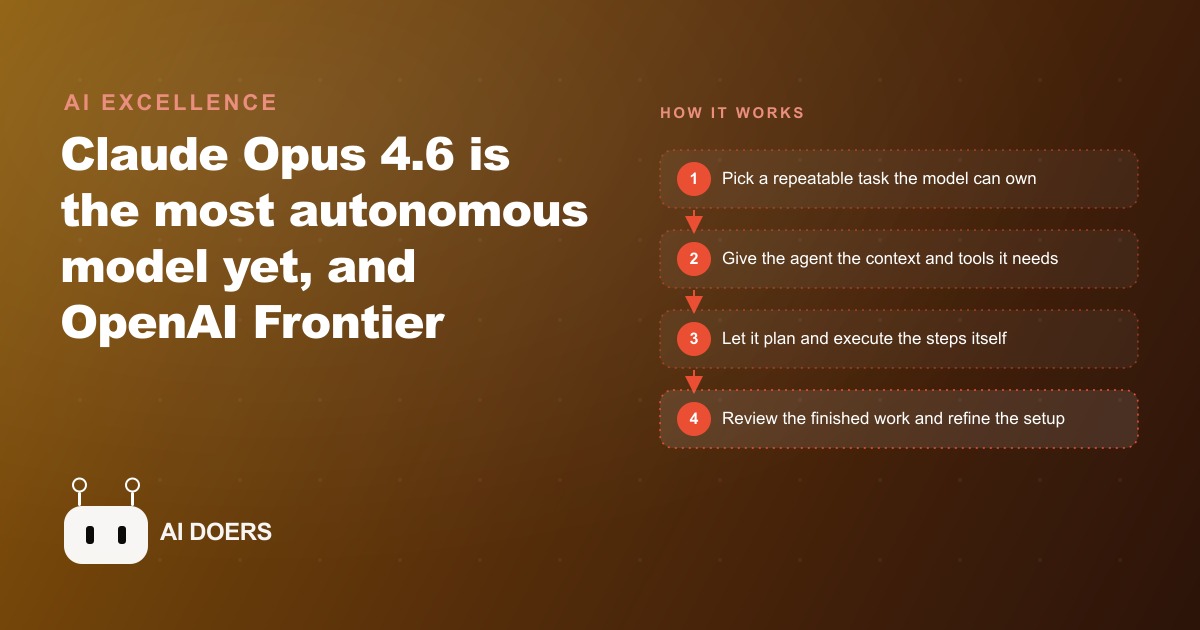
Claude Opus 4.6 landed this week and the people testing it for agentic work are not describing it as an incremental update. They are describing it as the first model that actually finishes what it starts. That distinction matters more than any benchmark number, and I want to explain why before covering the other significant release of the week: OpenAI's Frontier, which is the clearest statement yet that large AI labs believe the next product category is workers, not tools.
Opus 4.6 changed the answer to a specific question about agentic AI
The question agentic AI has been struggling to answer for the past year is not whether it can start a multi-step task. It is whether it can finish one without needing a human to intervene halfway through. Previous models would complete the obvious parts of a task, surface a problem, and wait. The human then either resolved the problem manually or spent time directing the model toward a resolution, often for several back-and-forth rounds before the task was complete.
Opus 4.6 is different on this specific behavior. A one-shot test, building a Pomodoro timer app from a single prompt with no follow-up correction, produced different results from 4.5 and 4.6. Opus 4.5 left the add-timer function broken and effectively stopped. Opus 4.6 encountered the same broken function, diagnosed the issue, applied a fix, and completed the feature without being asked. That distinction, stopping versus finishing, is the core upgrade in terms of how much supervision the model requires for extended autonomous work.
For a business, this matters because the time cost of using AI for multi-step work includes not just the time the model is working but also the time the human spends monitoring and redirecting. A model that finishes more tasks autonomously does not just reduce AI usage cost. It reduces the human time cost of running the workflow, which is typically the larger of the two numbers.
The plugin system turns Claude from a general tool into a configured business agent
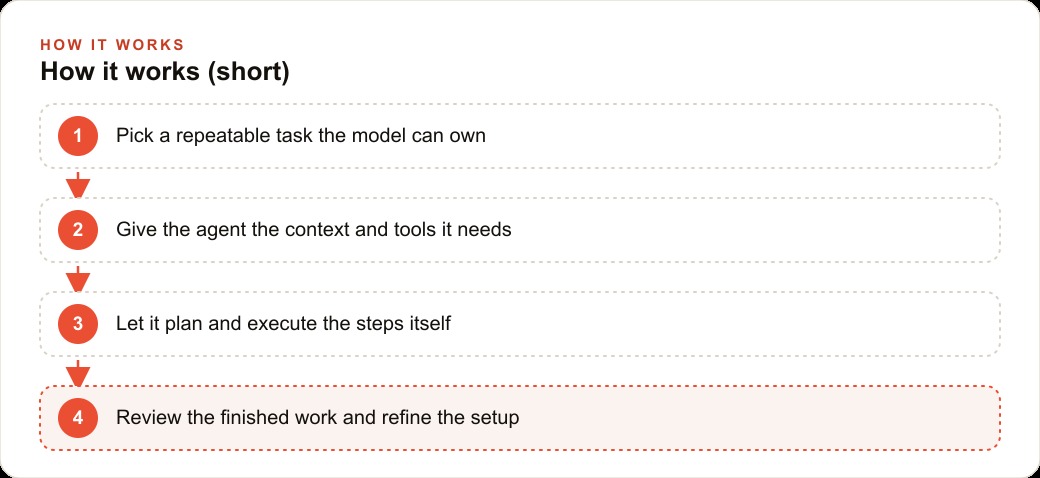
Alongside Opus 4.6, Anthropic shipped an updated plugin architecture that bundles three things into one concept: skills, which are reusable standing instructions; connectors, which are data-source integrations; and MCPs, which are tool-use extensions. The practical effect is that a business deploying Claude for a specific workflow can configure it once with the right context, the right data access, and the right tools, and the model applies all three consistently without needing to be re-briefed every session.
This is the infrastructure for a reliable AI worker rather than a capable general assistant. A general assistant is flexible but requires setup at the start of each session to know the business context. A configured business agent knows the business context from session initialization and applies it without being told. For a business with repetitive outputs, reports, proposals, service summaries, and internal briefs, the plugin system turns Claude into something closer to the second model.
The configuration investment is a one-time cost that pays back across every session that follows. A business that spends an afternoon building the right skill file, connecting the right data sources, and testing the output for their specific use case has something more valuable than access to a powerful general model: they have a Claude instance that has been taught how their business works and how their outputs should read.
OpenAI Frontier is the first serious push to replace enterprise workers
While Claude made the most notable model upgrade of the week, OpenAI's Frontier release made the most notable product category statement. Frontier is OpenAI's first offering explicitly designed to replace enterprise workers rather than assist them. It connects ChatGPT's enterprise capabilities to internal company systems and allows custom agents to be built that perform repeating functions the way an employee would, operating on a schedule, taking on multi-day tasks, and coordinating with other agents to complete complex workflows.
The framing is precise and deliberate: not "AI that helps your employees" but "AI that does the work your employees would otherwise do." That is a different product category with a different sales motion, a different implementation timeline, and a different set of objections to address. The reception was lukewarm relative to the Opus 4.6 response from Claude users, with early reviewers describing GPT 5.3 Codex, which shipped alongside Frontier, as capable but not leading the field on the tasks where Opus 4.6 has earned its reputation.
The cowork-versus-worker distinction that both companies are betting on, Claude Cowork and OpenAI Frontier both pointing in the same direction, is the most significant signal in this week's releases for a business that has not yet built AI into its operations. When the two largest AI labs both decide that the next product category is AI systems that do work rather than help people do work, the business that understands that product before it becomes standard has a head start.
What this week means for an auto repair shop
I am Madhuranjan Kumar, and here is how I would translate this week's releases into three specific changes for an auto repair shop.
The first is implementing Claude's plugin system for vehicle inspection reports. The shop's standard inspection covers a fixed set of components, each rated on a condition scale, with recommended actions and cost estimates. A skill file describing that structure, connected to the shop's parts pricing via a simple data integration, produces a structured report from a technician's voice notes or checklist input within minutes. The service advisor reviews and approves in under two minutes instead of drafting from scratch in fifteen. Consistency improves across advisors, and the shop produces a professional document every time regardless of which technician did the inspection.
The second is using Opus 4.6's improved task completion for the quote-to-estimate workflow. The inspection report line items, once structured, go into a Claude session configured with the shop's labor rates. The AI generates the formatted estimate with line items, pricing, and recommended urgency for each item. Previous model versions frequently produced estimates with inconsistently formatted line items that needed manual correction. Opus 4.6's improved finishing behavior means the estimate comes back in the correct format more consistently, which reduces the time the service advisor spends reformatting before sending to the customer.
The third is a follow-up reminder workflow for preventive service. The shop knows when each vehicle was last serviced and when the next recommended service window falls. A Claude session configured with the shop's communication voice and the service history data generates personalized reminders for every customer whose next service is approaching. The service advisor reviews a batch of these once per week and sends them in one step. The rate of preventive service appointments that come in proactively, rather than reactively after something fails, is a direct measure of the workflow's financial impact.
Together, these three workflows affect the two numbers that matter most for a service business: how many customers the shop handles per day and how often each customer returns. The service advisor who reviews and approves AI-generated estimates can handle more customers than one who drafts each estimate manually. The reminder workflow that reaches every eligible customer on schedule retains customers who would have drifted to a competitor for their next service.
The businesses that build these configurations now, with the current generation of models, and refine them over the next several months are building institutional knowledge that is very hard to replicate quickly. The prompt library, the skill files, the integration patterns, and the team habits around reviewing AI output are all durable assets that compound over time. A competitor starting from scratch six months from now starts behind, not because the tools are unavailable, but because the learning time required to tune them to a specific business's workflows cannot be compressed. Start this week, not because the tools are perfect, but because the learning time matters more than the tool version.
That is exactly what we do at AI DOERS. Book a private 30-minute call with Madhuranjan Kumar and we will map the fastest path to it for your specific business.
Book your call →
Madhuranjan Kumar
Madhuranjan Kumar brings 20 years of performance-marketing experience and has managed over $200 million in Facebook ad spend for brands across the United States and beyond. His expertise spans the full modern marketing stack: Meta, Google Ads, TikTok, email automation, CRM, and the websites that hold it together. At AI DOERS he turns that track record into lead-generation systems for businesses across every industry.