
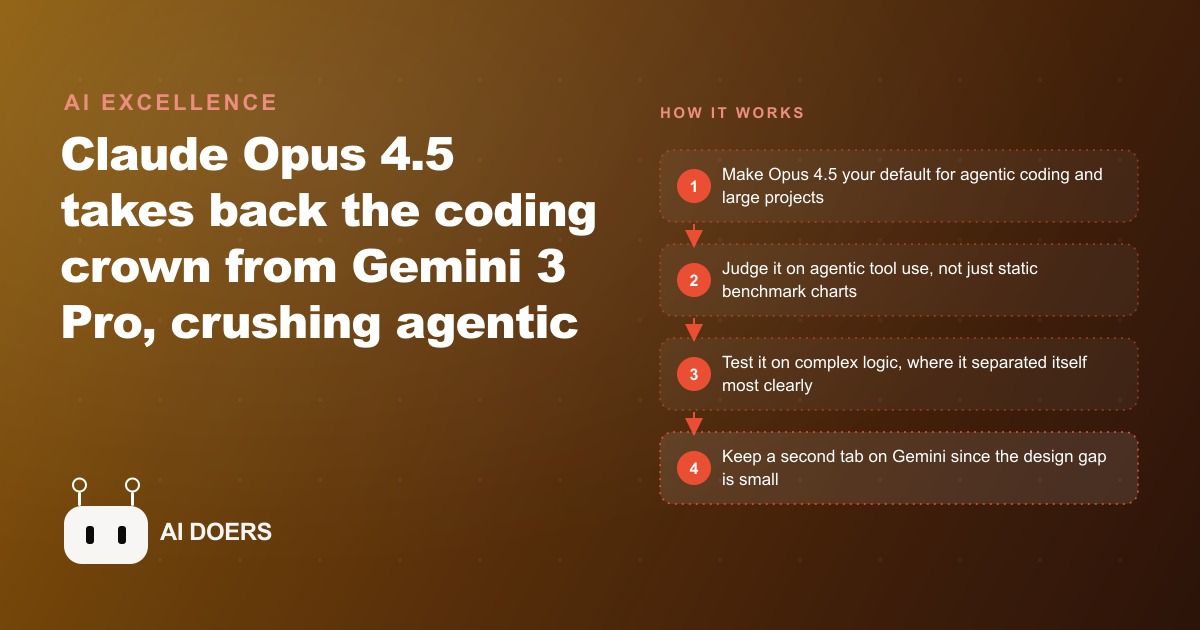
Claude Opus 4.5 Takes Back The Coding Crown From Gemini 3 Pro
Opus 4.5 reclaims the best-model-for-development title by crushing agentic coding, tool-use, and computer-use benchmarks, winning real developer sentiment, and beating Gemini 3 Pro on complex logic even though the two are close on raw design. Here is what a stronger coding model means for an everyday business.

When Lovable, Replit, and Bolt all switched to Claude Opus 4.5 within hours of its release, that was not a promotional partnership announcement. Those are platforms whose entire business model depends on the quality of the code their AI generates. Switching a core model on day one, without a visible evaluation period or a gradual rollout, is a bet made with real user relationships on the line. That bet carries more information about actual performance than any benchmark chart published alongside the release.
The vibe-coding platforms switched on day one, which is the real signal
Vibe coding platforms operate under a specific and demanding constraint. Their users do not think of themselves as developers. They describe what they want in plain language and expect a working application to come back. The user does not read the generated code, does not debug it, and has no easy fallback if it fails silently. The platform's reputation lives entirely on whether the code it generates actually runs correctly and does what the user described. When you operate under that constraint, your model choice is not a marketing decision. It is the most consequential operational decision you make.
Lovable, Replit, and Bolt are each betting their user experience on Claude Opus 4.5 performing reliably in the most demanding part of their pipeline: taking a conversational brief and producing working application code that non-technical users can immediately use without debugging. The fact that all three made that switch immediately, on release day, without a visible evaluation window, suggests they had access to early results that were decisive rather than marginal.
Madhuranjan Kumar pays close attention to adoption behavior as a signal precisely because it is harder to fake than benchmark numbers. A benchmark can be overfitted or measured on a distribution that does not reflect real use. A platform switching their core model on day one, with their revenue on the line, is making a bet with real consequences that goes well beyond a leaderboard position. When three independent platforms all make that same bet simultaneously, the probability that it reflects genuine performance rather than timing or partnership considerations becomes very high. That convergence is the strongest early signal available before wider testing has accumulated.
What Gemini 3 Pro had for exactly one week
The week before Claude Opus 4.5 was released, Gemini 3 Pro was the model most commonly described as the best overall choice for development work. Developers who tested it reported strong design output in particular: interfaces it generated had a visual polish and compositional instinct that earlier models had not matched consistently. The consensus around that assessment lasted roughly seven days before Opus 4.5 arrived.
What Gemini 3 Pro held was a one-week window at the top of a fast-moving leaderboard. That is not a criticism of the model, which is genuinely capable. It is a description of how the AI capability landscape works right now. The cycle between new capability leaders is short enough that treating any single model as a permanent answer to the question of which to use is a mistake. The right frame is that the frontier moves continuously, and each new leader brings specific improvements that deserve to be understood in terms of what actually changed, not just how the rank shifted.
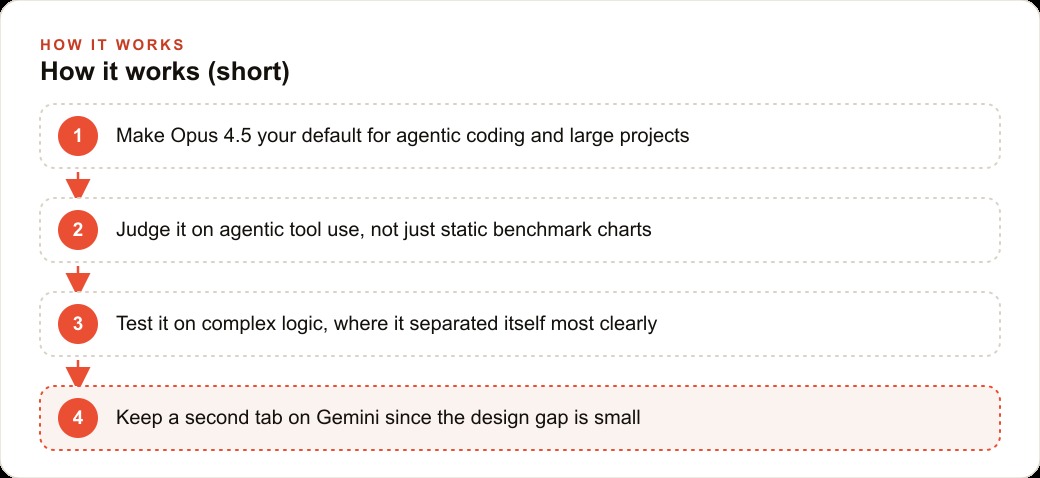
For a business building tools on these models, the one-week window story is a reminder that the most useful mental model is not which model is best in general, but which capability matters most for the specific task in front of you. Gemini 3 Pro may still be the better choice for a task where visual composition and design instinct are the primary measure of quality. Opus 4.5 is the better choice when complex logic, large codebase navigation, and agentic task execution are what determines whether the output actually works.
The practical implication is not that you should switch every workflow immediately on each release cycle. It is that you should match the model to the category of work rather than picking one for everything. The businesses that do this well end up paying less per task, producing better results on the tasks that matter most, and accumulating real familiarity with where each frontier model excels rather than treating model selection as a branding preference.
The specific capability that separates the two: complex logic at scale
The clearest signal from developer testing of Opus 4.5 against Gemini 3 Pro was what happened on complex logic tasks. On pure design output, the comparison was close enough to be a matter of individual taste: Gemini 3 Pro produced interfaces some reviewers found 5 to 10 percent more polished on strictly visual dimensions. On complex logic inside a larger application, Opus 4.5 separated itself clearly enough that developers used direct language about the gap rather than hedged comparisons.
Complex logic at scale is the capability that determines whether a coding agent is useful for real software or only for demos. A simple booking page is not a complex logic problem. A booking page that handles time zones correctly, enforces business-specific availability rules, integrates with an existing calendar, sends the right notifications based on service type, and handles edge cases like cancellations within the rescheduling window is a complex logic problem. Earlier models could produce the demo version reliably. They fell apart on the production version, and teams building web-crm integrations, lead routing tools, or booking systems with real business rules encountered that falling-apart regularly.
The Minecraft benchmark that developers use to track Opus generation improvements shows a meaningful jump from Opus 4 to 4.1 to 4.5 on the same agentic task. The benchmark is instructive: given a computer running Minecraft, build a specific scene in the game environment. That requires understanding the environment state, planning a sequence of actions, executing them, noticing when something has not worked as intended, and correcting. Showing clear improvement generation over generation on a task like that means the model is getting better at the specific capability that makes an agent useful in a real workflow, not just at passing the tests it was measured against.
For a business building a custom google-ads reporting tool that needs to apply attribution rules across campaigns, merge data from multiple sources, and calculate metrics that do not exist as standard outputs, this is exactly the capability difference that determines whether the first version works or requires weeks of debugging before it is usable. Madhuranjan Kumar has seen this pattern clearly across client builds: the tools that failed on the first version and required extensive correction were almost always the ones where the logic was complex, the edge cases were many, and the earlier model did not have the working memory to hold the whole system in mind while writing the pieces. A stronger model on complex logic is not an abstract improvement. It is the difference between a useful tool delivered in a session and a frustrating project that consumes weeks of back-and-forth before it works reliably.
What a business team actually gets when the first version starts working
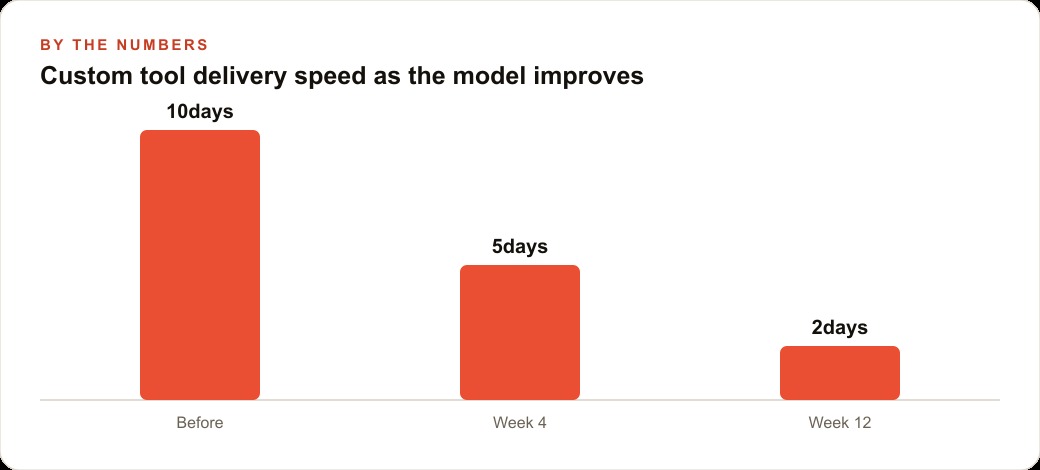
The practical value of a model that handles complex logic correctly on the first version is not primarily about the model itself. It is about the workflow change that becomes possible when the first version starts working rather than requiring extensive correction before it is usable.
When the first version of a custom tool arrives broken in complex ways, the team's attention shifts from the business problem to the debugging problem. The person who commissioned the tool must become a tester, finding the edge cases, describing the failures, waiting for corrections, and testing again. That cycle is not fundamentally different from traditional software development in terms of how it consumes time and attention. The promise of AI-assisted development was that the iteration should be fast and the first version should be close to correct.
When the first version actually works on the cases that matter, the workflow is different. The team tests with real data, finds the edge cases specific to their business context, describes the adjustments in plain language, and has a corrected version within the hour. The attention stays on the business problem rather than on software remediation. The tool earns trust quickly because it behaves correctly across the range of real scenarios from the start rather than requiring trust on faith.
For businesses running meta-ads campaigns who want a custom reporting layer that combines their ad data with their booking data in a single view, the tool that handles the data logic correctly on the first attempt earns its place in the daily workflow. The tool that requires weeks of fixing gets abandoned and the team returns to the spreadsheet. The model quality difference that separates those two outcomes is the complex logic capability that Opus 4.5 has extended relative to what was available before.
The compound benefit that practitioners emphasize most is how Opus 4.5 handles an existing codebase. Extending a tool built three months ago does not require starting over or rehiring the person who wrote it. Opus 4.5 can read the existing code, understand the conventions used, add the new feature in the same style, and fix any issues introduced without breaking the parts that already work. That maintainability is the specific thing that turns a one-time build into a long-term business asset rather than a project that is frozen in place because no one wants to touch it.
Where the design gap is small enough to be preference, not quality
The honest read of the Opus 4.5 versus Gemini 3 Pro comparison is that on visual design quality, the two models are close enough that individual preference matters more than a quality hierarchy. Some developers found Gemini's design output 5 to 10 percent more polished in specific comparisons. Others found Opus output preferable. The range of opinion across the developer community suggests the gap sits within the range of taste rather than outside it.
This has a practical implication for how a business should allocate its use of these models. If a specific project is primarily about visual design output, generating a marketing page that needs to feel premium before any backend logic is built, or exploring interface options for a client, the advice is to test both and use whichever output you prefer for that specific context. The quality gap on that dimension is not large enough to make a firm recommendation in either direction.
Where the recommendation becomes firmer is on anything involving logic, system behavior, or agentic task execution that needs to run correctly across real edge cases. The benchmark results, the developer sentiment, the platform adoption behavior, and the head-to-head testing on complex tasks all point in the same direction: Opus 4.5 is meaningfully stronger where the cost of being wrong is highest. That is the domain where it has extended its lead, and it is the domain that Madhuranjan Kumar would recommend defaulting to it without spending much time on comparison.
The 3D cityscape where cars stop at red lights, one of the demonstrations developers shared widely after the release, is the right concrete image to hold in mind. Getting the cars to stop at the red light is a logic problem, not a design problem. It requires the model to understand traffic state, model the intersection correctly, and produce code that changes the vehicle state based on the light state consistently across all the edge cases a real intersection contains. That is the kind of correctness that makes a tool trustworthy in a business context, and it is the capability Opus 4.5 has moved furthest on.
For any business that has been frustrated by AI-built tools that work on the demo but break in real use, that single benchmark image is the answer to why. The demo always uses the happy path. The real intersection has an ambulance, a pedestrian who crosses against the light, and a car that stalls. The model that handles the real intersection is the model that produces tools you can trust in production, and that is the gap Opus 4.5 has extended most clearly over the generation that preceded it.
That is exactly what we do at AI DOERS. Book a private 30-minute call with Madhuranjan Kumar and we will map the fastest path to it for your specific business.
Book your call →
Madhuranjan Kumar
Madhuranjan Kumar brings 20 years of performance-marketing experience and has managed over $200 million in Facebook ad spend for brands across the United States and beyond. His expertise spans the full modern marketing stack: Meta, Google Ads, TikTok, email automation, CRM, and the websites that hold it together. At AI DOERS he turns that track record into lead-generation systems for businesses across every industry.