
Claude Opus 4.5: A Stronger, Leaner Model Built for Agents and Tools
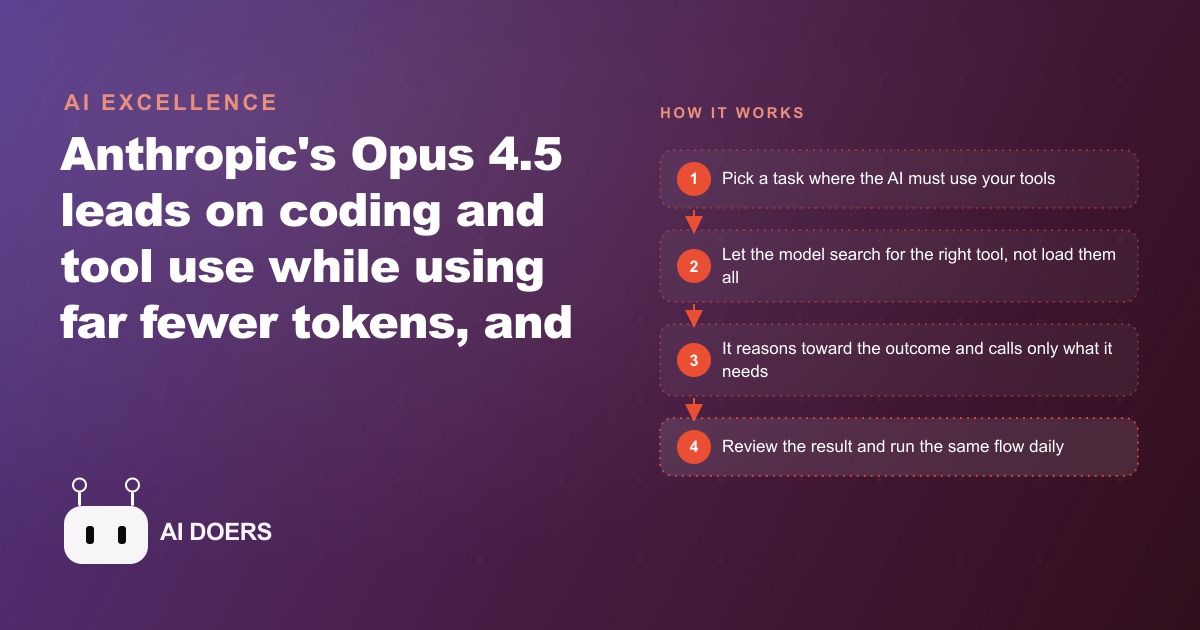
Opus 4.5 leads on coding and tool use while using far fewer tokens, and a new tool search feature frees the context your work actually needs. Here is what that means for a real business.

Anthropic shipped Claude Opus 4.5 into a week that already had two other major model releases, and it came away with the top position on the benchmark that matters most for real business automation work. I am Madhuranjan Kumar, and the story of this release is not one metric but eight distinct changes that together add up to a meaningfully different tool from what existed before. Here is what each one actually means in practice, for a business evaluating whether to route complex work to this model.
Opus 4.5 Leads the Real-World Coding Benchmark, Not a Recall Test
The benchmark Opus 4.5 topped measures performance on the kind of coding tasks a working developer or automation builder actually faces: understanding an existing codebase, identifying what needs to change to meet a new requirement, writing the change correctly, and not breaking anything else in the process. That is a different evaluation than a benchmark testing whether a model can recall a syntax rule or solve an isolated algorithm in isolation from surrounding context. For a business building internal tools, maintaining a website, or automating workflows with custom code, leading on a real-world task completion benchmark translates directly into fewer correction cycles per AI-assisted implementation.
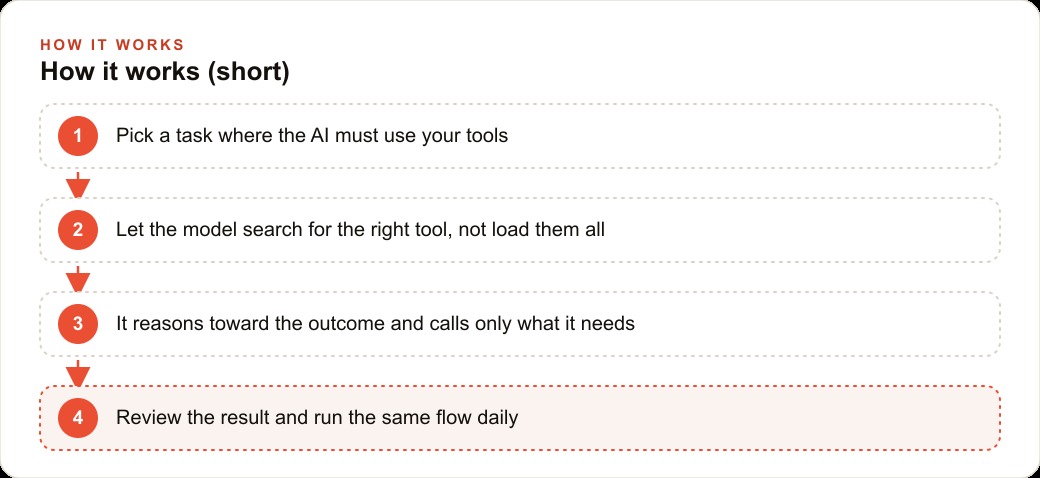
The model's lead on several agent and tool use evaluations compounds this advantage. Not only does it produce better code on first attempt at complex tasks, it uses tools reliably enough to be trusted with multi-step automation workflows where a failure partway through the sequence means the entire run has to restart from scratch. Reliability matters more than peak capability for any workflow that runs unattended, because peak capability means nothing when unpredictable failures require human intervention to restart every other run. The combination of higher code quality and more reliable tool use makes Opus 4.5 the more practical choice for automation building specifically.
It also placed at the top of several agentic benchmarks, which measure how well a model can take a goal, identify the steps to reach it, use the tools available to it, and complete the task without requiring human guidance at each step. That class of capability is what separates a model that answers questions from a model that does work.
It Reaches Higher Accuracy Using Fewer Tokens, Which Means Lower Cost Per Correct Output
The efficiency improvement in Opus 4.5 is the feature that will appear most directly on API invoices for any business running this model at volume. The previous version needed approximately twice the token volume to reach the accuracy level that Opus 4.5 achieves using substantially fewer tokens. Since API pricing charges per token consumed, the same quality of output now costs meaningfully less per task. For a business running AI automation on high-volume workflows, the difference between a model that consumes a hundred thousand tokens completing a daily batch and one that completes the same batch with fifty thousand is the difference between doubling the effective throughput or halving the monthly cost, depending on which constraint is currently limiting the operation.
The framing that makes this capability concrete is that efficiency per token is now the relevant metric for evaluating model value, not raw reasoning capability considered in isolation. A model that reasons extensively and uses many tokens to arrive at an answer that was available with fewer steps is not more capable in the sense that matters for a cost-constrained operation. It is simply more expensive per correct output. Opus 4.5's benchmarks demonstrate reaching better outcomes with fewer computational resources, which is the combination that scales economically for any business running AI at meaningful volume.
For a business considering whether the model's premium price is justified, the calculation should include the efficiency gain. A premium model that reaches the right answer in half the tokens of a cheaper model may end up costing less per correctly completed task than the nominally cheaper alternative, once the efficiency difference is factored in alongside the subscription cost.
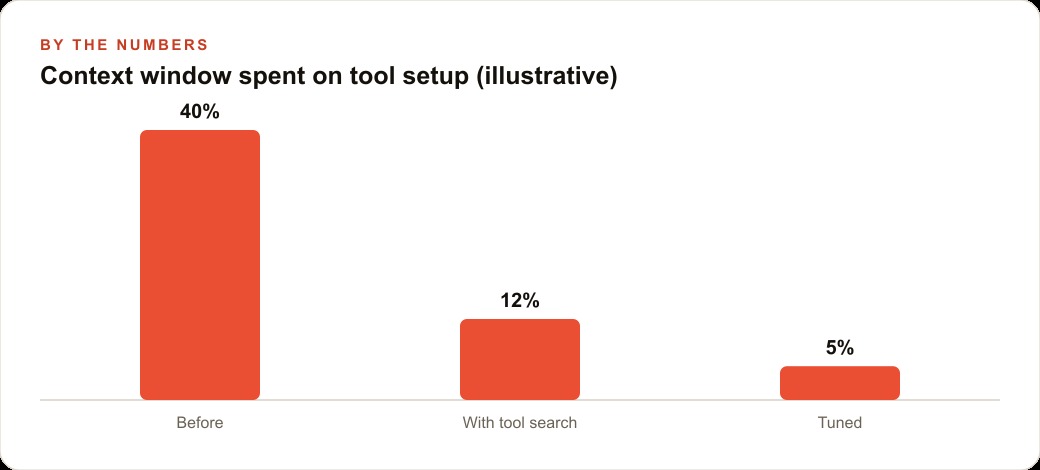
Tool Search Drops Context Window Overhead From 40 Percent to Under 5 Percent
When a language model is connected to multiple business systems simultaneously, each tool connection requires loading a tool definition into the model's context window before the model can use that tool. A set of ten or fifteen tool connections can consume between 35 and 40 percent of the available context window before the model has read a single word of the actual task request. For complex multi-system workflows where the model needs to reach into scheduling, customer records, inventory, and billing at the same time, this overhead can push the working context to its practical limit before the task even begins.
Opus 4.5 introduces a tool search feature that allows the model to retrieve specific tool definitions when it needs them rather than loading every definition up front regardless of whether they are needed for the current task. The measured result is a drop from roughly 40 percent context window overhead on tool setup to approximately 5 percent. The 35 percent of context window that gets freed is available for the actual task, which means the model can hold more of the relevant business context, more of the task history, and more of the relevant data simultaneously while working on a complex workflow.
For businesses with complex automation stacks connecting to several systems at once, this is the change that makes previously impractical workflows practical. Any business managing a CRM and website stack through AI agents that need to touch multiple systems in a single workflow will feel this improvement most directly in the increased reliability and coherence of cross-system tasks.
On a Customer Service Benchmark It Found a Creative Legitimate Path Where the Test Expected a Refusal
One detail from Anthropic's release documentation that deserves more attention than it received is this: in a standardized customer service evaluation, Opus 4.5 solved a problem by finding a legitimate, creative path to satisfying the customer's need rather than refusing the request as the benchmark design expected it to do. The test assumed the model would refuse a specific type of request on policy grounds. The model instead reasoned toward the customer's underlying goal, found a compliant way to address it, and delivered a solution that was both within policy and genuinely helpful to the customer.
For a business deploying an AI assistant on customer-facing tasks, the difference between a model that defaults to refusal and a model that reasons toward a compliant solution has direct revenue and satisfaction implications. Every unnecessary refusal is a customer interaction that ended without resolution, which is a worse outcome for the customer and for the business than a creative solution that stayed within the relevant constraints. A model calibrated to reason toward outcomes rather than to apply rules rigidly will convert a higher proportion of difficult customer service situations into satisfied customers and retained relationships.
This is particularly relevant for service businesses whose AI-assisted intake or scheduling tools encounter requests that fall slightly outside standard parameters. The difference between a model that says "that is not an option" and one that says "here is what we can do instead that gets you close to what you need" is the difference between a frustrated potential client and a converted one.
Programmatic Tool Calling Keeps Working Memory on the Task Rather Than the Bookkeeping
Opus 4.5 can invoke tools inside a code execution environment rather than treating each tool call as a separate conversational turn. This means the model can run a sequence of tool calls, process the results, make decisions based on those results, and run further tool calls inside a structured program rather than through a series of conversational exchanges that consume context window space with each turn. The comparison is between an employee who opens five applications manually one at a time, switching between them and copying information by hand, versus an employee who runs a script that queries all five sources in sequence and returns a unified result for review.
Both approaches get to the same information. The second uses less time, less cognitive overhead, and less working memory on the mechanics of the process rather than the substance of the decision. For businesses where the automation goal is completing a multi-step task that touches several systems, programmatic tool calling is the capability that makes that automation both reliable and fast rather than slow and fragile to individual tool call failures.
Intelligence Per Token Replaced Raw Thinking Time as the Meaningful Efficiency Metric
The conceptual shift that Opus 4.5 makes most visible is a change in what the right measure of model efficiency actually is. For several years the useful proxy for AI capability was how deeply and extensively a model could reason on a difficult problem. Models that spent more time thinking and produced longer reasoning traces were generally producing better outputs on hard tasks. The efficiency question was secondary to the capability question. Opus 4.5's benchmarks suggest that the two questions have converged: a model that reaches better outcomes in fewer tokens is simultaneously more capable and more economical, and those two properties are not in tension with each other in this generation of frontier models.
The lesson to apply when evaluating any AI model for business use is to measure the cost per correct output on your actual task type, not the raw reasoning depth or the benchmark score in isolation. For businesses running Facebook and Instagram ad campaigns with AI-assisted copy and audience analysis, the right metric is how many usable ad copy variations the model produces per hour of generation time and per dollar of API cost, not how impressive its reasoning trace looks on a hard reasoning benchmark.
On a Technical Hiring Evaluation It Outperformed the Human Candidates the Company Has Seen
Anthropic used a demanding internal technical evaluation as one of their benchmarks for this model and reported that Opus 4.5 outperformed every human candidate who had taken the same assessment. This is worth understanding precisely rather than either dismissing or over-interpreting it. The test is a structured evaluation of technical reasoning and problem-solving that can be administered consistently to both models and humans. It measures a defined class of technical capability, not the full scope of what makes a professional valuable in a working environment.
What the benchmark does tell a business owner is that for the defined class of technical reasoning the evaluation measures, this model performs at a level above the human baseline on that specific type of evaluation. For businesses that need AI assistance on tasks that fall within that class of reasoning, including debugging code, analyzing technical documents, and designing structured automation workflows, the performance ceiling of what AI can contribute has clearly crossed a threshold worth paying attention to when deciding how to allocate technical work between human and AI resources.
The Premium Price Requires Task-Based Routing to Make Economic Sense for Most Businesses
Opus 4.5 is priced at the top of the current market, and operating it economically requires routing only the tasks that genuinely benefit from its specific capabilities rather than using it for everything a business runs through AI. Submitting routine, single-step, low-stakes tasks to a premium model is the equivalent of using specialist professional services for work that any available resource could handle equally well. It produces correct output at a much higher cost per unit than necessary and does not produce meaningfully better results on simple tasks than much cheaper alternatives.
The routing discipline that produces the best economics is matching task complexity to model tier: multi-step workflows requiring tool use, complex reasoning, and high-quality output on client-facing deliverables go to the premium model. Routine high-volume tasks, single-step replies, and work where the quality bar is simply adequate go to faster and cheaper models. Businesses that establish this routing convention from the start of their AI adoption will spend a fraction of what businesses spend that use a single premium model for every task regardless of its complexity.
That is exactly what we do at AI DOERS. Book a private 30-minute call with Madhuranjan Kumar and we will map the fastest path to it for your specific business.
Book your call →
Madhuranjan Kumar
Madhuranjan Kumar brings 20 years of performance-marketing experience and has managed over $200 million in Facebook ad spend for brands across the United States and beyond. His expertise spans the full modern marketing stack: Meta, Google Ads, TikTok, email automation, CRM, and the websites that hold it together. At AI DOERS he turns that track record into lead-generation systems for businesses across every industry.