
Claude's New Memory Finally Makes AI Remember Your Business the Right Way
Anthropic built a memory system that keeps your core identity separate from this week's experiments and rebuilds itself nightly. Here is what that means for a real business and how I would set it up.


Every business owner who uses an AI assistant for more than a few weeks hits the same quiet frustration. You explain your business at the start of every chat, the model does good work, and then tomorrow it has forgotten who you are again. Anthropic just shipped a change to Claude's memory that fixes the root cause, and the fix is smarter than the usual sales pitch of the AI just remembers everything now. It remembers the right things and forgets the noise, on purpose. I am Madhuranjan Kumar, and this is the practical playbook for turning that new memory into an assistant that actually knows your business, without letting a single Tuesday experiment corrupt the whole thing.
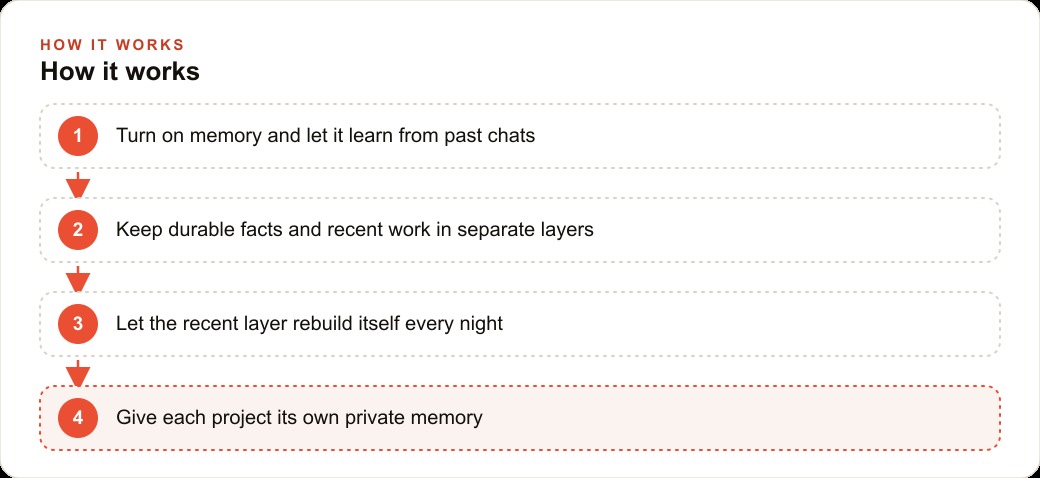
The core idea is a split. Older memory systems watched your chats, saved little facts, and stirred all of them into every future answer with equal weight. A quick test you ran once got stored with the same importance as a fact that defines your entire company. Claude now separates two layers. One holds the durable facts about you and your work, the steady stuff that rarely changes. A second, top of mind layer holds the things you have only been poking at lately, and that recent layer rebuilds itself every night. That separation sounds small. In daily use it is the difference between an assistant that feels sharp and one that slowly drifts into confusion. The rest of this article is how to set it up so it works on day one.
Step 1: Audit what the model already thinks it knows
Before you add anything, find out what is already in there. Open a normal chat and ask Claude directly what it knows about you and your work. Read the answer the way you would read a new hire's notes after their first week. You are looking for two kinds of entries. There are the true, load bearing facts, your services, your service area, the way you like things phrased. And there are the accidents, a one off question you asked, a topic you explored once for fun, a client you mentioned a single time.
This audit is the whole foundation, because you cannot tune a memory you have not looked at. Most people skip it and then wonder why the assistant occasionally says something odd. Spend ten honest minutes here. Where the model got something wrong or trivial, tell it to drop that item, because you can now edit memory in plain conversation. Where it captured something genuinely core, note that it belongs in the durable layer so you can reinforce it in the next step. By the end you should have a clear picture of the signal and the noise.
Step 2: Write your durable facts as if briefing a new manager
Now feed in the facts that should never fade. Do this deliberately, in clear language, so they land in the stable layer rather than the recent one. Think about what a competent new office manager would need to know to represent you well. For most businesses that list includes the services you offer, your pricing logic and any rules around it, your service area, the tone you want in customer messages, and any hard conventions, for example that a quote always lists the inspection first or that you never promise a specific turnaround in writing.
The reason this step matters so much is that the quality of every future answer is capped by the quality of this brief. An assistant working from a rich, accurate core will draft a customer email, a follow up, or a plan that already sounds like you, with no pasting required. An assistant working from a thin core keeps asking you to re explain yourself. Treat this like documentation you are writing once and benefiting from a thousand times. Be specific. Vague inputs produce vague memory. When you name your voice, give an example of a sentence you would send and one you never would.
Step 3: Split your work into projects so contexts stay clean
The new memory also works per project, and this is the stage most people underuse. Each project grows its own memory that updates only as you work inside it. If you keep everything in one endless chat, your marketing context and your operations context blend into a single muddy profile, and the assistant starts mixing tones and facts that should never touch.
So carve your business into its natural parts and give each one a project. A common split is one project for customer communication, one for internal planning and scheduling, and one for content or marketing. Now the chatty, persuasive voice you want for customer replies never leaks into a cold operational planning note, and vice versa. This is also the stage where the recent layer earns its keep. Because the top of mind summary rebuilds every night, a seasonal business gets a memory that follows the season on its own. During a summer rush the recent layer naturally fills with that work, so drafts lean toward the current push. When the season shifts, the nightly rebuild quietly follows, and the assistant stops over weighting last month. You get relevance without maintenance.
Step 4: Turn on team sharing and the browser workflow
Two other moves shipped in the same window, and they belong in this playbook because they multiply the value of everything above. First, projects can now be shared. One person builds the context once, gets the durable facts and the project structure right, and then the whole team inherits a well briefed assistant instantly. That is a genuine unlock for any business with more than one person, because the hardest part, the setup, gets done a single time rather than badly by everyone.
Second, Claude Code now runs in a browser tab connected to your code, with no terminal needed, and it even works on a phone. That last detail matters more than it sounds. It means the non technical people on your team can finally touch tools that used to require a command line. When you combine shared projects with a browser based interface, an assistant that knows your business stops being one power user's private setup and becomes a shared capability the whole team leans on. The broader industry is moving the same direction, with OpenAI shipping its own browser and Google rebuilding AI Studio into a single interface, so this is not a one off feature. It is the shape of where these tools are going, and setting your memory up well now means you are ready for it.
A worked example: a seasonal service business
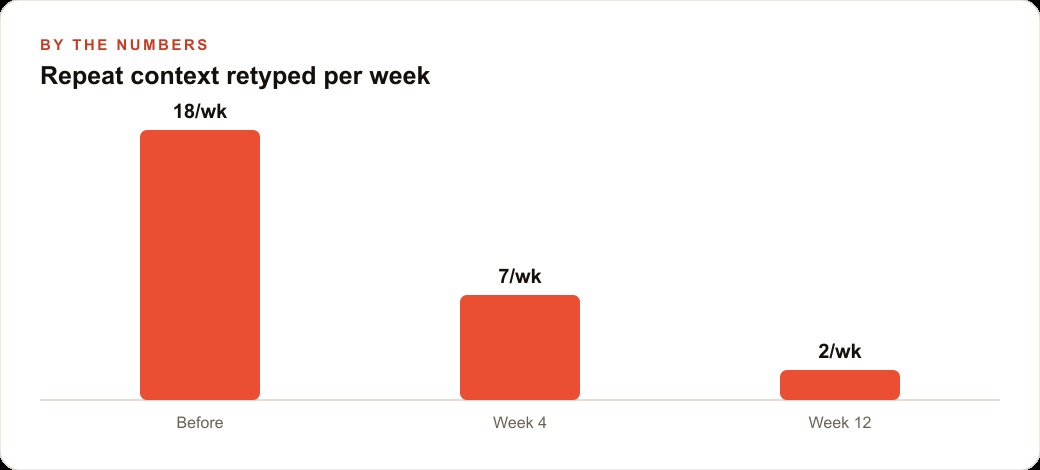
Let me make this concrete with a pest control company, using illustrative numbers to show the shape of the payoff. Before any of this, imagine the office manager retypes the same background into roughly eighteen chats a week, the services, the tone, the rule that a quote lists the inspection first. Each re explanation costs a few minutes and a little accuracy. Call it two hours a week of pure repetition, plus the drift of an assistant that never quite learns.
Following the playbook, I would put the stable facts into core memory: the services offered, the standard treatment steps, the service area, the seasonal pests the company handles, the owner's preferred tone, and that inspection first rule. Now every time a technician or the office manager asks Claude to draft a customer email, write a follow up after a treatment, or explain a recurring plan, the assistant already knows all of it. The eighteen re explanations a week fall toward two, then toward almost none, because the model stops needing to be told what it already holds.
The seasonal layer is where it gets satisfying. During an ant surge in summer, the recent memory fills with that work, so drafts and summaries lean toward the current rush without anyone configuring a thing. When the work shifts to rodents in the fall, the nightly rebuild follows, and the assistant stops leading with ant language. Meanwhile the projects keep things clean, so the persuasive customer voice never bleeds into a dry internal scheduling note. The clean, consistent customer messages this produces feed naturally into your CRM and website stack, where reliable follow up copy is half the battle, and the saved time frees the owner to focus on the work that actually grows the business, whether that is sharpening Facebook and Instagram ad campaigns or finally writing the service pages that help with SEO and organic search. The assistant starts to feel like a long time office manager who remembers the business but never gets stuck on last month.
Why the nightly rebuild is the underrated part
It is worth pausing on the mechanism that makes all of this work quietly in the background, because it is the piece that separates this from older memory systems and the piece most people will not think about until it saves them. The recent layer rebuilds itself every single night. That means yesterday's one off experiment does not calcify into a permanent part of who the assistant thinks you are. If you spent an afternoon exploring a topic that has nothing to do with your normal work, it does not get welded onto your profile. By tomorrow morning the recent layer reflects what actually matters now.
This solves a genuinely annoying failure mode of the old approach, where a single unusual session could bias weeks of answers. Imagine testing a wildly different tone once, for fun, and then watching the assistant creep toward that tone in every customer draft for the next month. That is the kind of slow corruption that made people distrust AI memory and turn it off entirely. The nightly rebuild is a self cleaning mechanism. It lets you experiment freely, knowing the experiments will not stick unless you deliberately promote them into the durable layer. That freedom to poke at things without consequences is underrated, because it means you can use the assistant boldly instead of tiptoeing around it, afraid of what it will remember. The stable layer holds your identity. The recent layer holds your current focus and resets on its own. You get both without having to manage either by hand.
Step 5: Keep the memory honest with a monthly review
The last stage is a small habit, not a big project. Once a month, open the memory and read it again. Businesses change. You add a service, drop a plan, adjust your pricing logic, shift your tone for a new audience. If you never revisit the core memory, it slowly falls out of step with reality, and an assistant working from a stale brief makes confident, wrong drafts.
This is also where you prune. Ask the assistant what it knows, tell it to drop anything that no longer applies, and reinforce anything new that should be permanent. Because you can now do this in plain conversation, the review takes minutes. Think of it as the same maintenance you would give any employee's understanding of the business, a quick catch up so they stay current. The technology does the heavy lifting of sorting stable from recent, but the judgment of what belongs in each layer stays yours, and that judgment is the whole game.
The honest bottom line
The new memory is a real step forward, but it does not remove the one thing that actually determines whether your assistant is useful. Someone still has to decide what belongs in core memory versus what is just noise. Get that right and Claude feels sharp from the first message every morning. Get it wrong and it drifts, no matter how good the underlying model is. The five steps above, audit, write your durable facts, split into projects, turn on sharing and the browser workflow, and review monthly, are the difference between an assistant that works on day one and one that needs a month of cleanup.
You can absolutely do all of this yourself in an afternoon by being deliberate about what you feed it. If you would rather have the memory, the projects, and the team sharing set up properly and tuned to how your business actually runs, that is the kind of thing I set up for clients so it works from the start instead of after weeks of frustration.
That is exactly what we do at AI DOERS. Book a private 30-minute call with Madhuranjan Kumar and we will map the fastest path to it for your specific business.
Book your call →
Madhuranjan Kumar
Madhuranjan Kumar brings 20 years of performance-marketing experience and has managed over $200 million in Facebook ad spend for brands across the United States and beyond. His expertise spans the full modern marketing stack: Meta, Google Ads, TikTok, email automation, CRM, and the websites that hold it together. At AI DOERS he turns that track record into lead-generation systems for businesses across every industry.