
Claude Fable 5 Is Here: What Anthropic's New Top Model Actually Changes
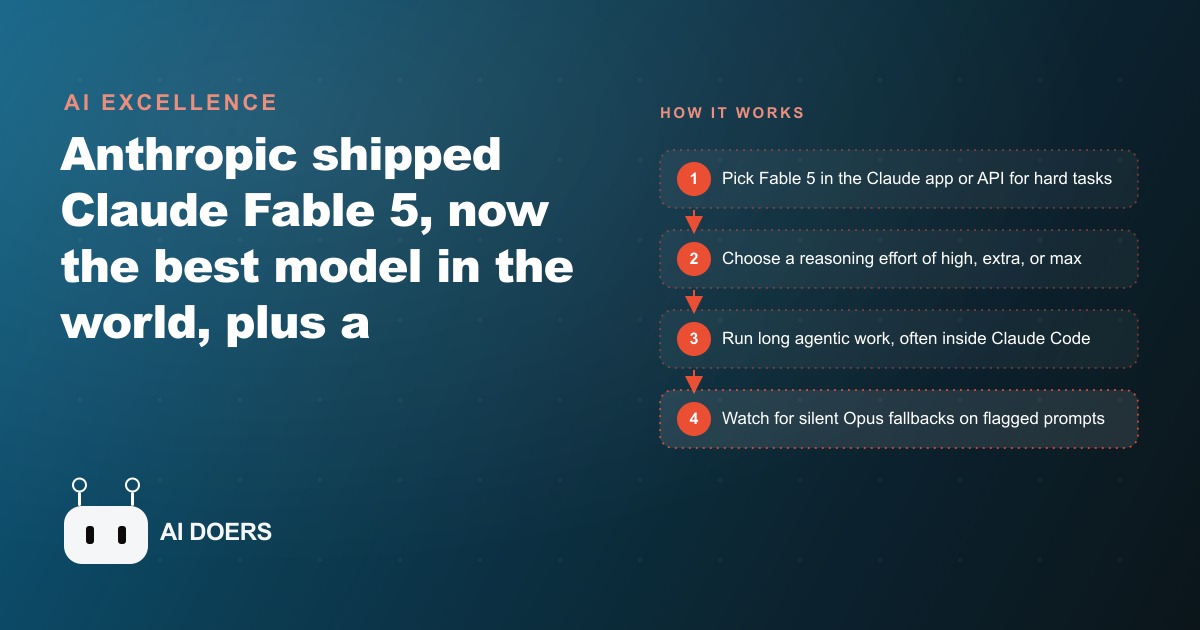
Claude Fable 5 is Anthropic's new best model, ranking ahead of Opus 4.8, Gemini, and ChatGPT on benchmarks, and it ships as a safeguarded version of the restricted Mythos 5 because the raw model is too capable to release unguarded.

The benchmark report circulated in the team channel at 7:43 in the morning, and by the standup at ten the evaluation plan was already written.
The Benchmark Result That Stopped the Standup
I am Madhuranjan Kumar, and the teams I watch most carefully are not the ones that chase every new model release. They are the ones that have a clear evaluation process and run new models against their actual work before making any routing decision. The team in this story is that kind.
They were a product engineering team of eleven people building a document intelligence platform for mid-size legal and compliance departments. Their core product extracted relevant clauses and obligations from long contracts, summarized risk factors, and flagged deviations from a client's standard agreement templates. The AI layer was not an optional feature. Every time the underlying model improved by a meaningful margin, it translated directly into the accuracy of their core product.
They had been running on Opus 4.8 as their primary model for complex extraction tasks and Sonnet for the lighter summarization and classification work. The routing was deliberate. Opus for depth, Sonnet for speed and cost. That split had been working well, and they did not change models without a structured evaluation.
When Anthropic shipped Claude Fable 5, the team's lead read the announcement and flagged two specific claims: first, that Fable 5 had placed above Opus 4.8 across reasoning and knowledge benchmarks by a meaningful margin; second, that it excelled specifically at long autonomous tasks requiring sustained coherence. Both of those claims mapped directly to the hardest problems in their product. Long contract extraction tasks could run for several minutes, required sustained coherence across hundreds of pages, and accumulated errors in a way that short tasks did not.
The lead wrote an evaluation plan in the group channel before the standup started. By ten o'clock the team had agreed on three evaluation tasks, a scoring approach, and which engineer would run the first batch.
Running Fable 5 Against Opus 4.8 on Their Actual Contracts
The evaluation took three weeks, not because it was complicated but because they wanted enough data to trust the result. They selected forty contracts from the category their customers found most difficult: long-form commercial agreements with nested obligations, many cross-references between sections, and conditions that modified other conditions. These were the contracts that generated the most client questions and the most post-review corrections in their platform.
They ran each contract through both models using their existing extraction prompts, scored the outputs against a ground truth annotation set their domain expert had built over the previous six months, and recorded the result. The scoring covered three dimensions: clause identification accuracy, obligation extraction completeness, and risk flag precision, which measured whether the flags the model raised were genuine risks rather than false positives.
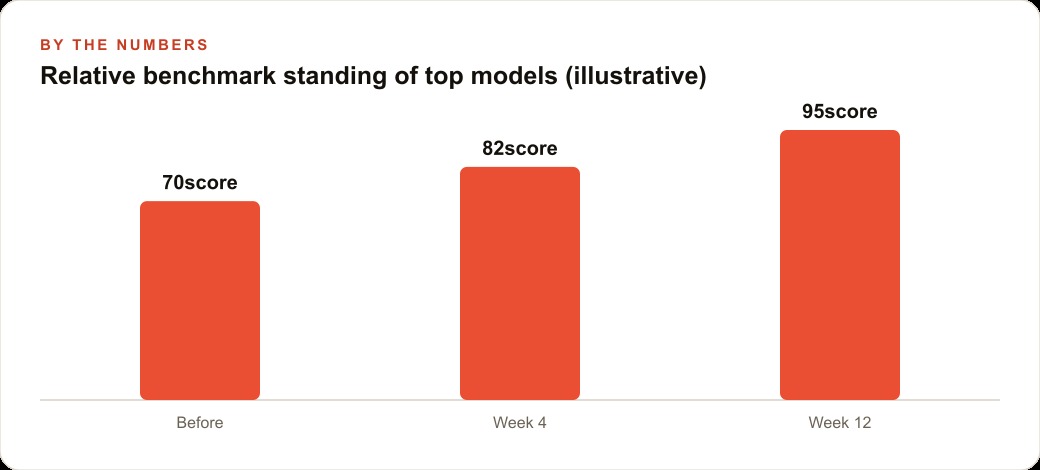
The results at the end of week two were not subtle. On clause identification accuracy, Fable 5 scored an average of ninety-three point four percent against the ground truth, compared to eighty-six point one percent for Opus 4.8. On obligation extraction completeness, Fable 5 missed fewer nested obligations on long documents. On risk flag precision, the difference was smaller but favored Fable 5 on contracts over fifty pages, where Opus 4.8 showed a measurable tendency to raise false positive flags in the later sections of very long documents, which the team attributed to context drift as the task grew longer.
The one area where Opus 4.8 held its own was on short contracts under fifteen pages, where the performance difference was minimal. That was useful information for routing. Short contracts did not need to move to Fable 5. The routing decision would be surgical, not wholesale.
What a Safeguarded Mythos 5 Meant for the Team's Trust in Deploying It
The team had read the Anthropic announcement carefully. The disclosure that Fable 5 was a safeguarded release of the Mythos 5 model, and that Mythos 5 had been restricted because the unrestricted model was strong enough at cybersecurity analysis to provide meaningful capability uplift to malicious actors, was not alarming to them. It was reassuring.
The lead made this point explicitly in the team review session. The fact that Anthropic had identified the capability level of the model clearly enough to build a restricted twin, and had shipped the public version with heavier safeguards than any previous Claude, was evidence that the model was being released responsibly. A company that does not understand what its model can do does not release a safeguarded version alongside a separately controlled restricted version. The existence of Mythos 5 as a controlled product told the team that Anthropic had mapped the capability boundaries carefully before releasing Fable 5 into general use.
For a team deploying a model on client legal documents, that kind of capability transparency mattered in a way it might not for other product types. Their clients were compliance-sensitive organizations. They could not deploy a model that had not been thoroughly evaluated for safety and for the kinds of outputs it would and would not produce. The Fable 5 disclosure, unusual in its specificity for a model release announcement, gave the team something concrete to point to in an internal risk review: here is the documented reasoning behind the safeguard design, here is what the unrestricted version was capable of, here is the evidence that the version being deployed has been deliberately constrained in the areas of highest risk.
They added the Anthropic safety documentation to their internal deployment record alongside the evaluation results.
The Integration Decision and the First Live Deployment
The team made a deliberate routing change rather than a wholesale switch. Fable 5 replaced Opus 4.8 on contracts over fifteen pages and on any contract flagged by a classifier as high complexity, which meant documents with more than twelve unique obligation types identified in the first pass. Opus 4.8 remained the default for short contracts and for the summarization tasks where the performance gap was below their threshold for a routing change.
The integration was straightforward because they were already on the Anthropic API. The change was a routing logic update, not a platform migration. They deployed the new routing to a ten-percent traffic slice first, compared the outputs from the Fable 5 path against the Opus 4.8 path in their logging system, and watched the accuracy metrics for two weeks before widening to full traffic.
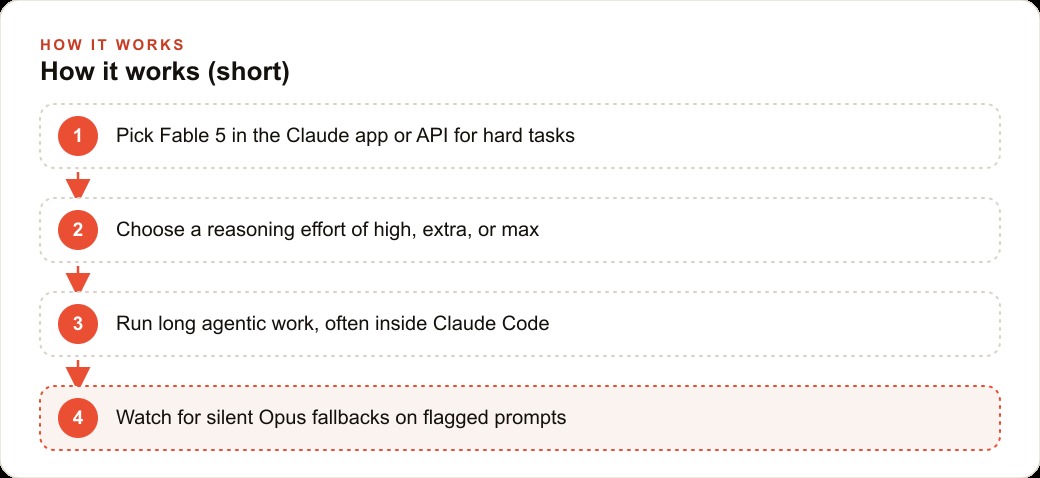
The two-week monitoring period surfaced one issue they had not anticipated. On a small number of requests involving contracts with detailed descriptions of cybersecurity obligations and data handling provisions, the model fell back silently from Fable 5 to Opus 4.8. The outputs were still usable but the accuracy was closer to Opus-level than Fable-level. The team initially attributed the performance variability to something in their prompting. It was only when they added model-identity logging to their API call wrapper that they identified the silent fallback as the source of the variability.
They added a monitoring alert that flagged any Fable 5 request that completed on Opus 4.8 instead, so the issue was visible rather than hidden. They also reviewed their contract corpus to understand which contract types were triggering the fallback and added routing notes to handle those specifically.
The silent fallback behavior was the most operationally important thing they learned during the evaluation period that had not been in the announcement. Any team routing tasks to Fable 5 specifically for its quality advantage on high-stakes work should build model-identity logging into their API calls from day one, not as an afterthought.
What Changed at Thirty Days and the Numbers Behind the Change
At thirty days, the team ran their standard monthly product review against the same ground truth evaluation set. The routing change had been running at full traffic for twelve days of those thirty.
The aggregate accuracy on the complex contract category had moved from the eighty-six point one percent baseline to ninety-one point eight percent across the month. The improvement was consistent with the evaluation results, slightly below the full-evaluation number because the Opus 4.8 fallback on a fraction of complex cybersecurity contracts was pulling the aggregate down modestly.
The practical consequence for the product showed up in the client review workflow. Legal reviewers using the platform spent an average of fourteen minutes per contract reviewing the extraction output and making corrections before the routing change. That number, measured by a sample of the platform's ten most active users, dropped to nine point three minutes per contract after thirty days. The reduction was attributed by reviewers to the higher quality of the initial extraction, which meant fewer corrections and less second-checking of sections the model had previously handled inconsistently.
Over the course of a typical month, a legal reviewer processing forty complex contracts through the platform saved approximately one hundred eighty-eight minutes compared to the prior month. That was about three hours of professional time per reviewer per month, recovered through a routing change that cost nothing beyond the incremental difference in model pricing.
The cost of running Fable 5 rather than Opus 4.8 on complex contracts was higher per request, roughly double per effective session given the model's higher token consumption. The team calculated that the additional cost per contract processed on Fable 5 was approximately forty cents, against a time savings for the reviewer of about four point seven minutes. At the billing rate of a mid-level legal professional, four point seven minutes of saved review time was worth considerably more than forty cents. The economics of the routing change were straightforward to justify.
What the Team Learned About Deploying a Fourth-Tier Model
By the end of the first month, the team had a clearer picture of the Fable 5 deployment pattern than the release announcement had given them. A few things stood out as durable lessons.
The quality improvement was real and consistent on the specific task category where the evaluation had predicted it. The model was not uniformly better at everything; it was meaningfully better at the long, complex, context-heavy tasks where context drift had been the failure mode of the prior model. Short tasks did not benefit enough to justify the cost difference, and the routing logic the team built reflected that distinction.
The reasoning effort dial mattered for the highest-stakes tasks. The team ran a subset of their most difficult contracts, those involving cross-jurisdictional obligations and multi-party agreements, at the extra reasoning effort level rather than the high level. The accuracy on that subset was higher, and the additional time the model took to process was acceptable given that these were not time-sensitive tasks. The extra cost per request was real, and the team logged it per task type so the tradeoff was visible rather than accumulated invisibly.
The silent fallback on flagged prompts remained the unresolved behavior at month one. The team had alerts on it, understood which contract types triggered it most reliably, and had built manual routing rules for the most consistent triggering categories. The fix was functional but imperfect. The lead kept it on the tracking list for month two because any behavior in a production system that occurs without signaling is worth watching until it is fully understood.
The subscription billing window that Anthropic had offered at launch had been the right time for the evaluation, and the team had made good use of it. Their actual Fable 5 usage volume during the evaluation period gave them a reliable projection of what the usage-only billing cost would look like at full production scale, which meant the first usage-based invoice was not a surprise. Teams that skip the evaluation window and discover the cost structure after the billing change have less information and less leverage when they need to justify the routing decision internally.
The broader lesson the team took from the Fable 5 adoption was about the value of having an evaluation process that runs before every significant routing decision, not just for this model but for any future release. The AI model landscape is moving fast enough that a team without a standing evaluation framework will always be reacting to marketing claims rather than making decisions based on their own workload data. The framework the team built for Fable 5 was general enough to reuse. The forty-contract ground truth set, the three-dimension scoring approach, and the model-identity logging layer were all assets that would make the next evaluation faster and more reliable than the first one had been.
That is exactly what we do at AI DOERS. Book a private 30-minute call with Madhuranjan Kumar and we will map the fastest path to it for your specific business.
Book your call →
Madhuranjan Kumar
Madhuranjan Kumar brings 20 years of performance-marketing experience and has managed over $200 million in Facebook ad spend for brands across the United States and beyond. His expertise spans the full modern marketing stack: Meta, Google Ads, TikTok, email automation, CRM, and the websites that hold it together. At AI DOERS he turns that track record into lead-generation systems for businesses across every industry.