
Claude Design Turns Talking Into On-Brand Slides, Pages, and Code
Claude Design is Anthropic's new lovable-style canvas, powered by Opus 4.7, that builds prototypes, slides, and one-pagers from your own design system and then hands the finished work to Claude Code to build and ship.

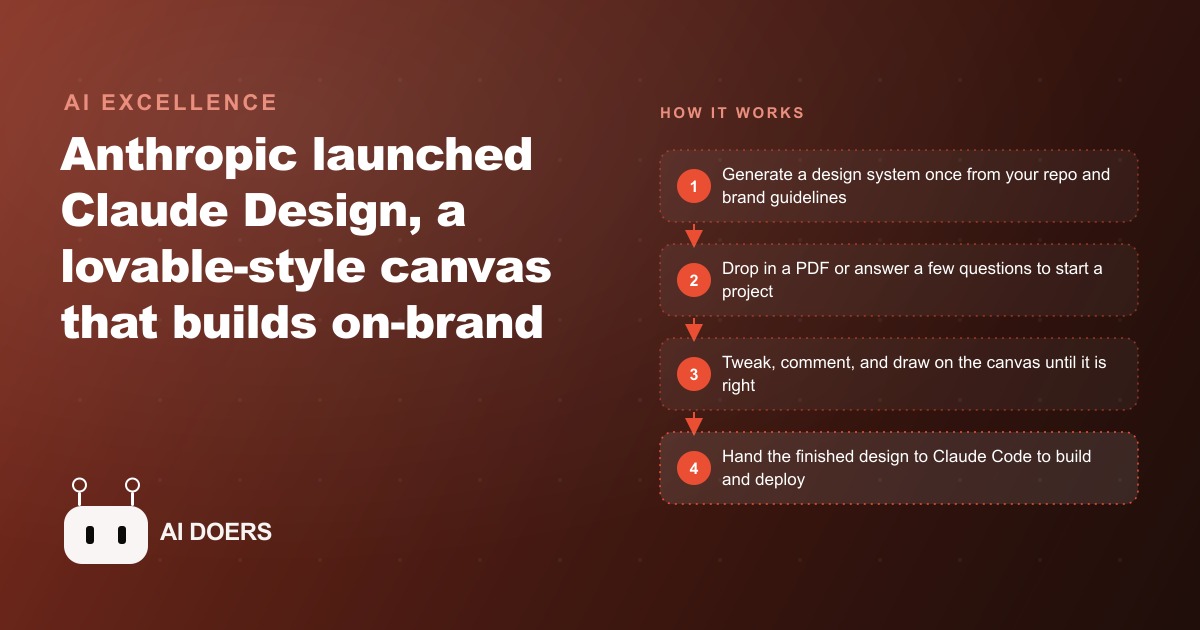
Anthropic launched Claude Design while most design tools are still asking you to drag rectangles. I am Madhuranjan Kumar, and what makes this worth paying close attention to is not that it builds slides or landing pages from a conversation. Several tools can do a version of that. What makes it different is the design system at the foundation and the direct handoff to Claude Code at the end. The whole creative cycle, from brand-grounded planning to deployed working page, now lives inside one context without switching tools or copying files. This article walks through each stage of that journey, because the sequence matters as much as any individual capability.
The fifteen-minute setup that makes every future project faster
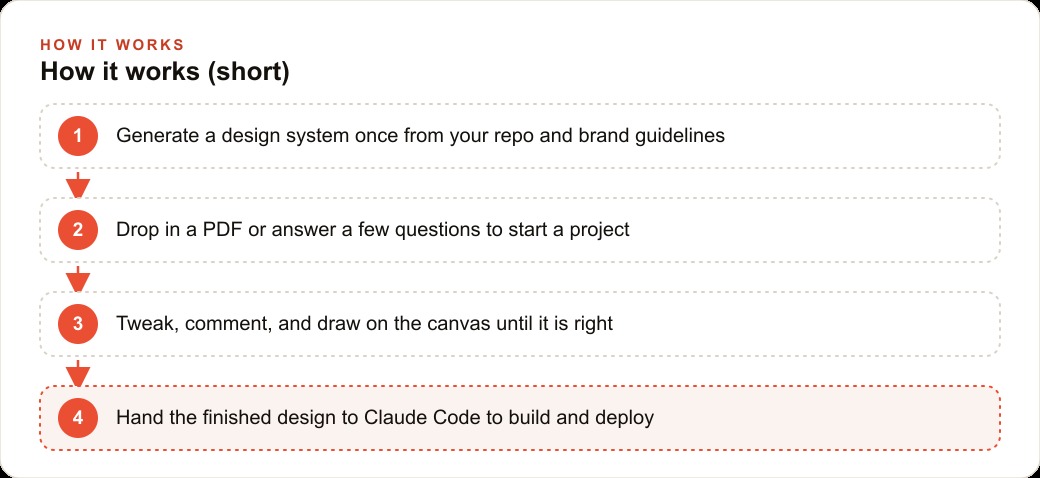
The first thing Anthropic's demo establishes is that Claude Design is not a fresh-start tool. It is anchored to a design system you build once, and that system becomes the default for everything created afterward. The setup takes roughly fifteen minutes. You give it a project name, a short description, a pointer to your GitHub repository, and your brand guidelines. The tool reads them and generates the design system: colors, neutrals, typographic choices, gradient definitions, button styles, and spacing rules.
As it generates, it surfaces each decision for your approval, one token at a time. The accent color it chose from your brand kit appears for confirmation before it is locked in. The heading typeface, the neutral palette, the button shape: each one reviewed before it becomes a rule. This approval step is the most important part of the setup, because it is what turns the system from an approximation into something your team can trust.
The compounding effect of doing this once is the part that changes the economics of all future work. Every project created after the system exists inherits the brand automatically. The fifteenth landing page looks as on-brand as the first, not because someone remembered to check the hex codes, but because the system enforces them. For a business that produces a consistent volume of client-facing material, this setup session is the highest-leverage fifteen minutes in the workflow.
For a real estate agency, I would do this once using the agency's existing site and brand standards document. From that point, every agent in the office who needs a listing one-pager or an event landing page starts from a system that already knows the agency's colors, fonts, and logo placement.
Dropping a PDF and watching the deck take shape around your brand
The slide deck path shows how the design system becomes the engine behind what looks like magic. You drop a PDF onto the canvas. Claude Design invokes a skill to read the document, checks the active design system, plans the structure of the presentation, and builds the slides. In the demonstration, this produced a nineteen-slide deck that arrived branded immediately: the correct color hierarchy, the right typefaces at the right weights, the logo in its designated position on each slide.
That last-minute-checked, barely-on-brand deck that comes back from a developer or a non-designer assistant is familiar to anyone who has managed creative production under deadline. The gap between what the brand actually specifies and what someone in a hurry approximates is where professional presentation falls apart. The design system eliminates that gap because the deck is built from the rules, not from someone's memory of what the rules probably were.
For the agency, this path handles the quarterly market report. The analyst drops the data summary PDF, the system reads it, and builds a branded deck structured around the data the PDF contains. The team reviews the output on the canvas and requests changes inline before anyone sends the report to clients or posts it to the SEO content section of the website where it serves as an authoritative reference for potential buyers doing research.
The speed matters here in a specific way. A quarterly market report is only timely for a short window. A brokerage that can produce a branded, professional report and distribute it within hours of the data being ready operates differently than one that spends a week in the production cycle before the window closes.
The interview-driven landing page and its live controls
For open-ended creative work, Claude Design takes the interview route before generating anything. When asked to build a landing page for a buyer seminar, it asks: what is the event name, what are the dates, what time, who is hosting it, what is the pricing. Each answer shapes what gets built. The resulting page arrives with live controls that let you adjust specific elements without going back to a text prompt: change the accent color with a slider, update the early-bird deadline date inline, toggle the countdown timer on or off, reposition the sticky call-to-action button.
This is genuinely different from the prior workflow where every change meant writing a new prompt, waiting for a rebuild, and checking whether the change landed correctly. The live controls on the canvas mean the refinement loop is visual and immediate. You see the accent color change as you adjust it. You see the countdown number update when you change the event date. Non-technical team members can participate in this refinement without understanding what an API call or a build step is, which changes who can meaningfully contribute to the design before it ships.
For the agency, this is the open house and buyer seminar path. A new event gets a dedicated landing page through the interview flow. The agent answers the six questions, reviews the result on the canvas, adjusts the accent color to match the listing's photography, updates the registration link, and confirms. The page is ready to hand off without a designer or a developer being in the critical path. Paired with a Meta ads campaign driving traffic to the registration page, the agency can have a complete event funnel live within a single working session.
Iterating on the canvas without waiting for a terminal to report back
Development workflows impose a rhythm on iteration: write code, run a build, wait for the terminal, check the result, write more code. That rhythm is natural for engineers and alienating for everyone else. The canvas removes it for the design phase of the work.
On the canvas, you comment on a specific element to request a change. You draw on the surface to indicate where you want something moved. You click directly on text to edit it inline. Claude responds to these inputs in place rather than rebuilding the whole output from scratch. The element you commented on changes. The slide you drew on updates. The rest of the design is untouched.
This also changes the collaboration picture. A senior agent can mark up the canvas on a listing one-pager the same way they would mark up a physical proof: circle what needs to move, note the change in a comment, and the revision happens. A marketing coordinator can refine the copy on a seminar landing page without understanding the technical structure underneath the page. Iteration is something the whole team participates in, not something that waits for a specialist.
For the agency's web CRM and client communication system, the canvas iteration model means templated emails, proposal documents, and client-facing reports can all be refined by the people who know the clients, not only by whoever happens to understand the tool well enough to drive it.
One button from finished design to deployed page via Claude Code
When the canvas is right, a single button packages the design and hands it to Claude Code. The handoff includes the visual design, the structure of the page, the content, and the instructions for building it as a working web page. Claude Code receives this package, fetches the design assets, and builds the page. In the demonstration it also identified a missing placeholder image and filled it automatically.
The result is a working deployed page built from the approved design, without anyone writing code to produce it. The context that lived in the design conversation, the brand standards, the event details, the copy decisions, transfers directly into the built page. Nothing is reinterpreted from a handoff brief. Nothing is approximated from memory. The code reflects the canvas because it was built from it.
This closes the loop that has always been open between design work and development work. The designer finishes a mockup and hands it to a developer who rebuilds it from scratch, interpreting decisions the designer made visually. Every step in that handoff introduces drift. The canvas-to-Claude-Code path eliminates the handoff because there is no separate designer and developer. The same conversation produces the design and the working page.
What consolidating the whole creative cycle into one ecosystem actually saves
I am Madhuranjan Kumar, and the value of consolidation is easy to understate because the costs of fragmentation are distributed across dozens of small frictions that each feel minor. The real estate agency example makes it concrete. Illustratively, a mid-size brokerage produces across a busy quarter: forty listing one-pagers, eight open house and seminar landing pages, two quarterly market reports for investor clients, and a set of social graphics for current listings. Each piece currently has a production cycle: someone creates it, a reviewer checks whether it is on brand, revisions go back, a designer or developer implements them, the piece ships.
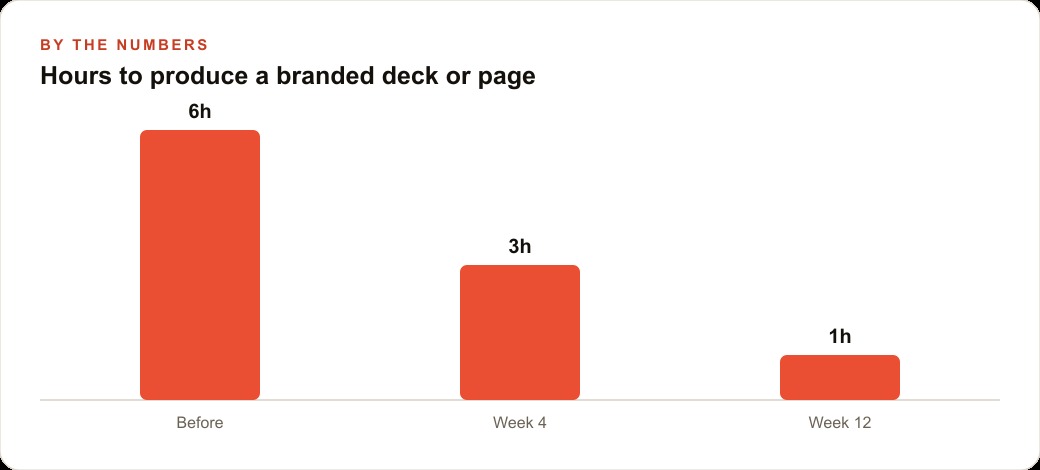
With a design system in place and Claude Design handling the production, the cycle compresses dramatically. The one-pager is generated from the listing PDF, reviewed on the canvas, adjusted inline, and handed to Claude Code to deploy in a single session. The seminar landing page comes from a five-minute interview and fifteen minutes of canvas refinement. The quarterly report comes from a PDF drop and a review pass. Illustratively, if the old cycle averaged six hours across creation, review, revision, and delivery for each piece, and Claude Design brings the average to under ninety minutes, the quarterly time recovered across that volume is over two hundred hours. That is time the team spends on client relationships, new business, and the judgment work that actually requires a person.
The other savings is brand discipline without enforcement overhead. The agency does not need someone checking whether every listing one-pager uses the right shade of the primary color. The design system enforces it. Every new agent who joins produces on-brand materials from day one without needing a brand guidelines training session. The quality floor rises automatically because the system carries the standards rather than relying on memory.
Anthropics stated collaboration with Canva rather than competition means the output can feed into existing workflows. Designs export to Canva, PDF, PowerPoint, or raw HTML. Teams that use Canva for social media posting can receive finished designs from Claude Design and distribute them through the workflow they already have. Nothing is replaced by force. The consolidation happens where it adds value and the rest of the workflow is undisturbed.
For a business that also uses AI in its client acquisition, the creative cycle consolidation connects directly to campaign throughput. A team that can produce a new landing page in a session instead of a week can run more tests, respond faster to what the data shows, and build a more adaptive approach to the markets they are in. The speed Claude Design provides is not just a production efficiency. It is a competitive advantage in how quickly the team can act on what they learn.
The design system also changes the cost structure of creative work in a way that compounds over time. Every hour a non-designer spends searching for on-brand templates, chasing a designer for a revision, or shipping a document that is close but not quite right is a recoverable cost once the system is in place. For the agency handling forty-plus branded deliverables per quarter, the investment in a fifteen-minute setup session repays itself within the first week of actual use. By the end of the first quarter, the time savings and the consistency gains are both measurable and visible to anyone who compares output from before and after. That is the kind of infrastructure investment that makes every subsequent project cheaper and faster rather than adding to the overhead. Claude Design, specifically because it anchors everything to a system rather than a session, is infrastructure rather than a one-off tool.
That is exactly what we do at AI DOERS. Book a private 30-minute call with Madhuranjan Kumar and we will map the fastest path to it for your specific business.
Book your call →
Madhuranjan Kumar
Madhuranjan Kumar brings 20 years of performance-marketing experience and has managed over $200 million in Facebook ad spend for brands across the United States and beyond. His expertise spans the full modern marketing stack: Meta, Google Ads, TikTok, email automation, CRM, and the websites that hold it together. At AI DOERS he turns that track record into lead-generation systems for businesses across every industry.