
Claude Cowork: Anthropic's First Real Agentic Assistant for Non-Developers
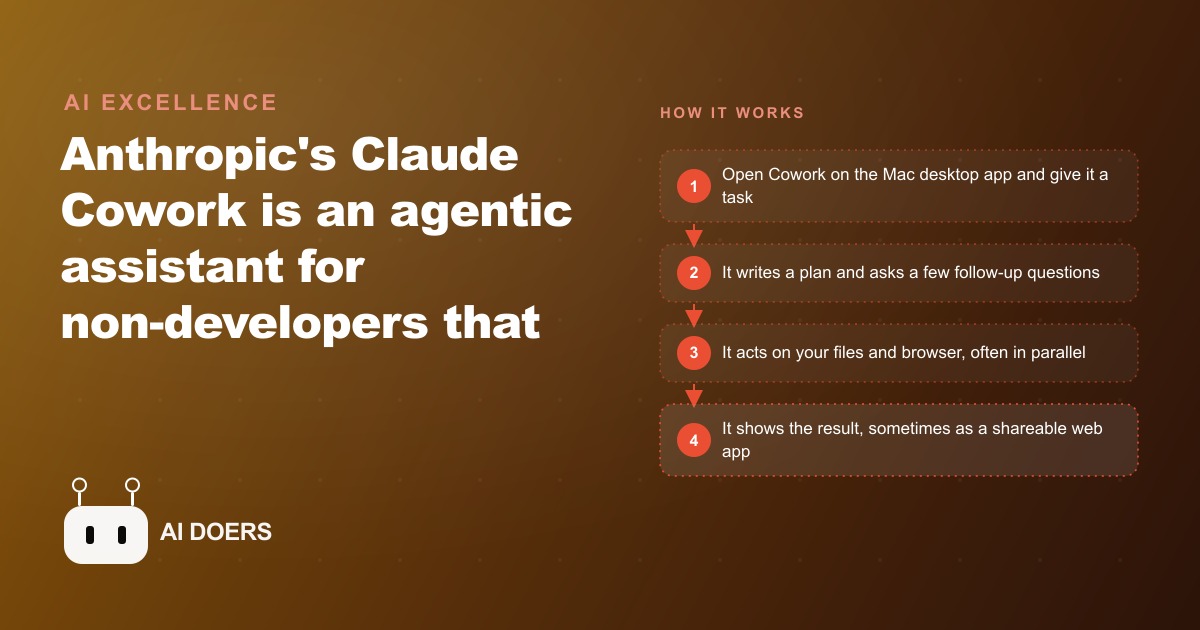
Claude Cowork is Anthropic's research-preview agent that organizes files, runs your browser through the Chrome extension, and works tasks in parallel inside one app. It is essentially Claude Code rebuilt for non-developers, with unreliable external connectors as its main current limit.

The First Week With Claude Cowork: What Actually Happened When We Tested Anthropic's New Agent Tool
Anthropic shipped Claude Cowork in a ten-day sprint and released it as a research preview available on the Max plan at a hundred dollars per month on the Mac desktop app. The framing from Anthropic was "the closest thing to a consumer AGI product." That is a strong claim. The honest question is whether the actual behavior justifies it or whether it is the kind of marketing that collapses under direct testing.
I am Madhuranjan Kumar, and I want to walk through what Claude Cowork actually did during a week of serious testing, where it performed well, where it did not, and what the experience reveals about where agentic AI is actually headed.
Chapter One: The origin story that explains what Cowork is trying to be
Claude Code was released as a developer tool. It lives in a terminal, it writes code, and it is designed for people who are comfortable reading code and running commands from a command line. That is a narrow audience.
What happened after Claude Code launched was that people with no developer background started using it anyway. Marketing professionals used it to build campaign materials. Product managers used it to prototype ideas. Writers used it to organize research. The use patterns that emerged were not the developer use cases Anthropic designed for.
Cowork is Anthropic's response to that emergence. It takes the core capability of Claude Code, the ability to plan a multi-step task, execute it autonomously, and create real files, and packages it for people who do not open a terminal and would not know what to do if they did. The interface is conversational. The output is files in folders, not code in a repository. The actions include web browsing through a Chrome extension, not just file manipulation.
The strategic bet is that the market for "an AI that actually does things" is much larger than the market for "an AI that writes code for developers." Cowork is the bet materialized.
Chapter Two: Desktop Organization and the First Real Autonomous Task
The first substantial test was asking Cowork to organize a cluttered desktop. This is a task with a defined input, an obvious desired output, and clear criteria for success. It also has real stakes: organizing files incorrectly could lose something or put it in the wrong place.
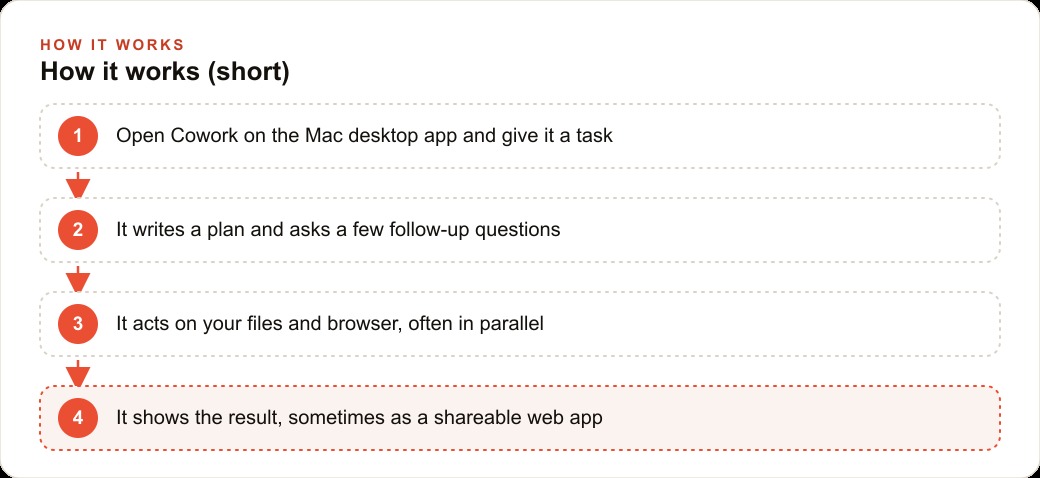
Cowork started by creating a plan. It described the grouping logic it proposed to use, asked for confirmation on a few decisions, specifically whether to group screenshots separately or integrate them by project, and asked how to handle archive folders that appeared in multiple places on the desktop. The plan stage took approximately three minutes.
After the plan was confirmed, Cowork executed without any further prompting. It built the categorization system, moved files into project-organized folders, created a screenshots folder, and merged the scattered archive folders into a single archive structure. The entire execution from plan confirmation to completion took approximately twelve minutes for a desktop with roughly 150 files.
The result was a functional organization system that matched the stated intent. Two files ended up in unexpected locations based on ambiguous naming, which is the kind of edge case that human judgment handles better than automated classification. Everything else was in the right place.
Chapter Three: Browser Control Through Chrome and What It Enables
The Chrome extension that connects Cowork to a browser adds a class of tasks that file-system access alone cannot handle. Cowork can open the browser, navigate to a specific service, interact with the interface, and return information to the main application without a separate browser window being actively managed by the user.
The demonstrated case was pulling the three most important emails from the past 24 hours out of Gmail. Cowork opened Gmail through the Chrome extension, read the inbox, assessed which emails were time-sensitive or required action, and returned a summary in the main Cowork interface. The process took approximately two minutes and did not require the user to open Gmail manually or to copy and paste anything.
For a business owner whose email management is a daily overhead, this kind of task represents the beginning of a genuinely different relationship with the inbox. Rather than opening Gmail and spending twenty minutes processing the morning's email, a prompt to Cowork surfaces the three emails that need immediate attention. The rest can wait.
The limitation that the testing revealed is that the Chrome extension approach is slower than a direct API connection would be. Cowork is essentially operating the browser the way a person would, clicking and reading, rather than querying an email API directly. This produces a more general capability, it works with any website rather than only ones that have APIs, but it also produces a slower and occasionally more fragile process than a direct API approach.
Chapter Four: Parallel Task Execution and Why It Changes the Experience
The most significant behavioral difference between Cowork and a standard AI assistant is that Cowork runs tasks in parallel rather than sequentially. While the browser task of pulling important emails was running, the desktop organization was continuing in the background. Two separate processes operating simultaneously without the user having to manage either one.
In practice, this means that a session with Cowork can accomplish multiple things in the time that sequential processing would accomplish one. A request that combines "organize my project folders, pull today's important emails, and build me a web app that shows the folder structure visually" runs all three tracks concurrently rather than finishing one before starting the next.
The web app generation, which Cowork produced as an artifact that visualized the newly organized file structure as a tree map, took approximately five minutes to build while the other tasks were running. At no point did the user need to manage the execution order. Cowork allocated the tasks across its parallel processes and produced all three outputs in the time that a sequential approach would have taken to complete one.
This parallel execution capability is what makes Cowork feel qualitatively different from the conversational AI assistant pattern where each response waits for the previous one to complete. The experience is closer to having delegated a set of tasks to a capable team member and receiving completed outputs rather than to a turn-based conversation where you wait for each response.
Chapter Five: The Connectors Problem and the Honest Assessment
The most consistent friction in the week of Cowork testing came from the external connectors. Cowork offers connections to services beyond the file system and browser, including various productivity platforms and communication tools. The connectors that were available during the testing period were unreliable in ways that were frustrating precisely because they were inconsistent.
A connector that worked in one session would fail in the next with an error that did not suggest a clear fix. A task that connected successfully and completed would not replicate on the following day. The file-system operations and the browser operations through Chrome were reliable. The third-party connectors were not.
Anthropic labeled this a research preview, and the connector reliability is the most visible evidence that the label is accurate. A research preview is a product that exists to gather feedback and demonstrate direction, not one that should be used for business-critical workflows. The file-system and browser capabilities are solid enough to build real workflows on. The connectors are not yet, and representing them as stable would be inaccurate.
The Direction This Points Toward
What Claude Cowork represents, independent of its current limitations, is a specific thesis about how AI assistance is going to evolve. The current conversational assistant model is a turn-based question-and-answer system where the AI responds to what you ask and then waits. The agentic model that Cowork represents is a delegation model where you describe a goal, the AI plans the work, executes it across multiple steps and tools, and returns the result.
The difference in what you can accomplish per unit of time is substantial. A conversational assistant amplifies what you can produce in a session where you are actively engaged. An agentic tool amplifies what gets accomplished regardless of whether you are actively engaged. Tasks run while you are in a meeting. Organization happens while you are on a call. The leverage is not limited to the hours you are spending in the tool.
For a business owner, the most practical implication of Cowork's existence and direction is that the time to develop the habit of delegation to AI systems is now rather than when the systems are more mature. The habit of describing goals clearly, of specifying what a good outcome looks like, and of reviewing autonomous output rather than micromanaging the process, is the same habit that will apply to more powerful future versions of these tools. Building it now on the current version means the habit is already established when the capability of the tools makes high-stakes delegation worth attempting.
The business owner who practices delegating small tasks to Cowork today and developing the instinct for what it can handle reliably versus what it cannot is building an organizational capability, not just using a tool. That organizational capability is what compounds as the tool improves.
What a one-week Cowork trial actually reveals about your delegation instincts
Running a structured one-week trial of Cowork, rather than a few ad hoc uses, reveals something that is worth understanding regardless of whether you continue using the tool: the quality of your task delegation.
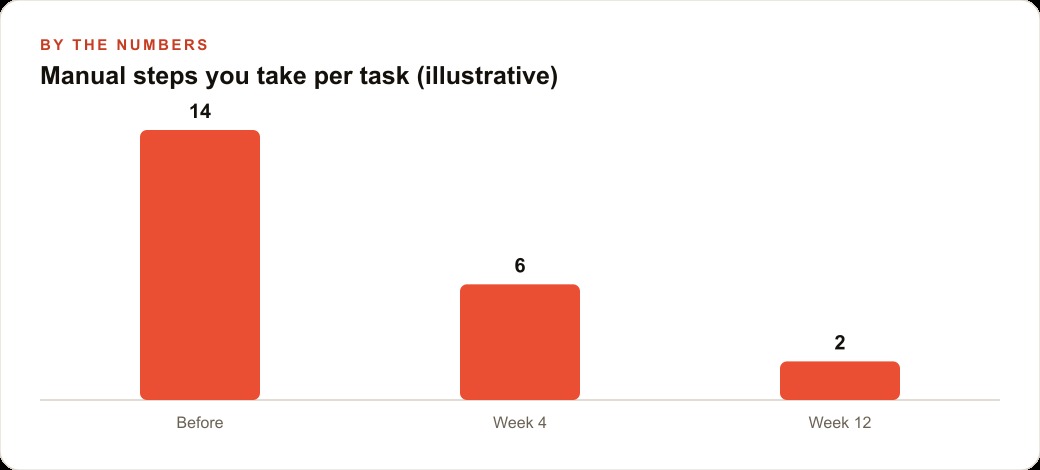
In a conversational AI session, weak delegation produces a response that you edit heavily before it is useful. The feedback is immediate and the fix is to write a better prompt in the next turn. In an agentic session with Cowork, weak delegation produces output that is off in ways that were not visible until the task was complete and the output was reviewed. The feedback cycle is longer, and the fix requires understanding what in the initial description led to the wrong interpretation.
The business owners who get the most value from their first week with Cowork are not the ones with the most complex tasks. They are the ones who describe tasks with the most clarity about what a good output looks like. "Organize my desktop" is weaker than "organize my desktop by project, keep each project's documents and images together in the same folder, put anything without a clear project affiliation into an inbox folder, and put all screenshots into a separate screenshots folder regardless of which project they relate to."
The second description produces a result that matches the intent more precisely and requires less correction. Building the habit of writing that level of specificity in task descriptions is the skill that transfers to every agentic tool, not just Cowork. It is also a skill that transfers to managing human teams: the precision of a good task brief determines the quality of the output regardless of whether the person executing it is a team member or an AI agent.
A one-week trial with Cowork, approached as a deliberate exercise in delegation quality, produces two kinds of value. The first is whatever the tasks themselves produce in terms of organized files, processed information, and completed work. The second is calibration: a clearer understanding of where your descriptions tend to be ambiguous and what specific details you habitually leave out that turn out to matter. That calibration is worth something independent of whether you conclude that Cowork itself fits into your permanent workflow.
The research preview label on Cowork is accurate and should be taken seriously. The core capabilities, autonomous file operations and browser-mediated web tasks, work reliably enough to build workflows on. The connector layer does not, and workflows that depend on connectors will need to be re-evaluated as that layer matures. The honest summary after one week of serious testing is that Cowork earns its place in the workflow for file-system tasks and email triage, not yet for workflows that require reliable third-party integrations, and clearly as a foundation for a direction in agentic AI that is going to matter significantly over the next two years.
That is exactly what we do at AI DOERS. Book a private 30-minute call with Madhuranjan Kumar and we will map the fastest path to it for your specific business.
Book your call →
Madhuranjan Kumar
Madhuranjan Kumar brings 20 years of performance-marketing experience and has managed over $200 million in Facebook ad spend for brands across the United States and beyond. His expertise spans the full modern marketing stack: Meta, Google Ads, TikTok, email automation, CRM, and the websites that hold it together. At AI DOERS he turns that track record into lead-generation systems for businesses across every industry.