
Claude Code Skills Got Easier to Build and Stronger to Use
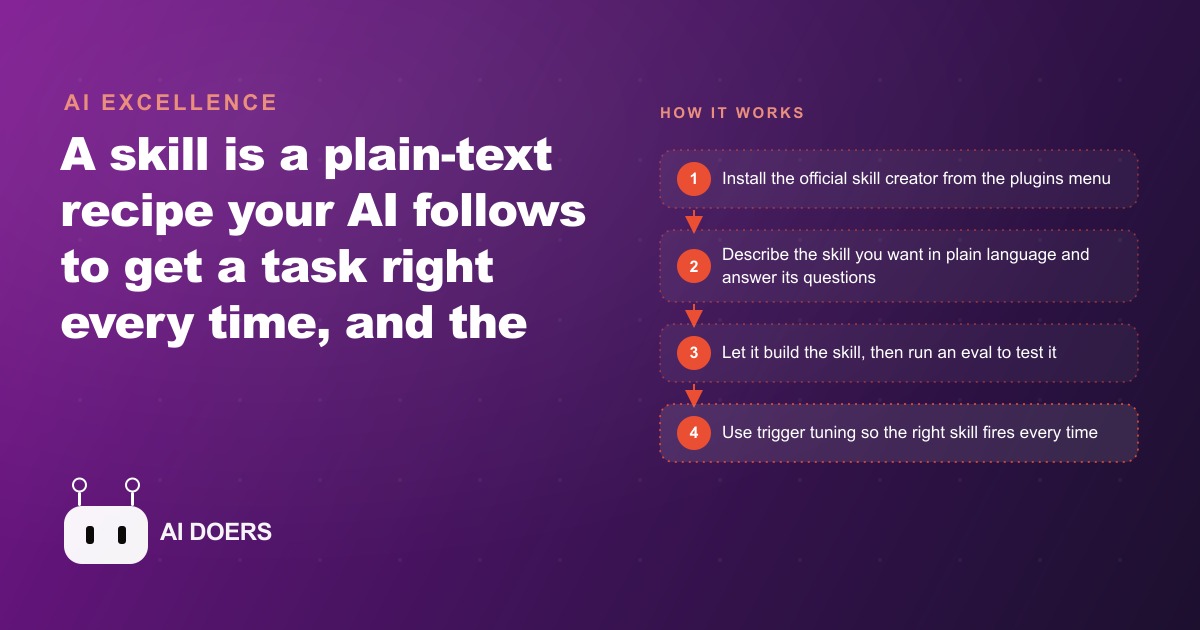
A skill is a plain-text recipe your AI follows to nail a task every time, and the new skill creator builds, tests, and tunes those recipes for you. Here is how to use it.

The most expensive AI mistake businesses make right now is not a model choice problem. It is a library problem. Every week I talk to owners and operators who have tried Claude or ChatGPT, gotten impressive results in the demo, and then found that the same prompt produces wildly different output depending on who types it or what day of the week it is. The model did not get worse. The business just never told it how they work.
I am Madhuranjan Kumar, and this is the argument I want to make in full: AI consistency inside a real business is not a question of picking the right model. It is a question of whether you have built a skill library. A skill library is a collection of plain-text recipes, each one teaching the agent exactly how your business handles one type of repeatable task. Once those recipes exist, every person on your team can trigger expert-quality output on demand, because the expertise lives in the recipe, not in the memory of whoever wrote the best prompt last month.
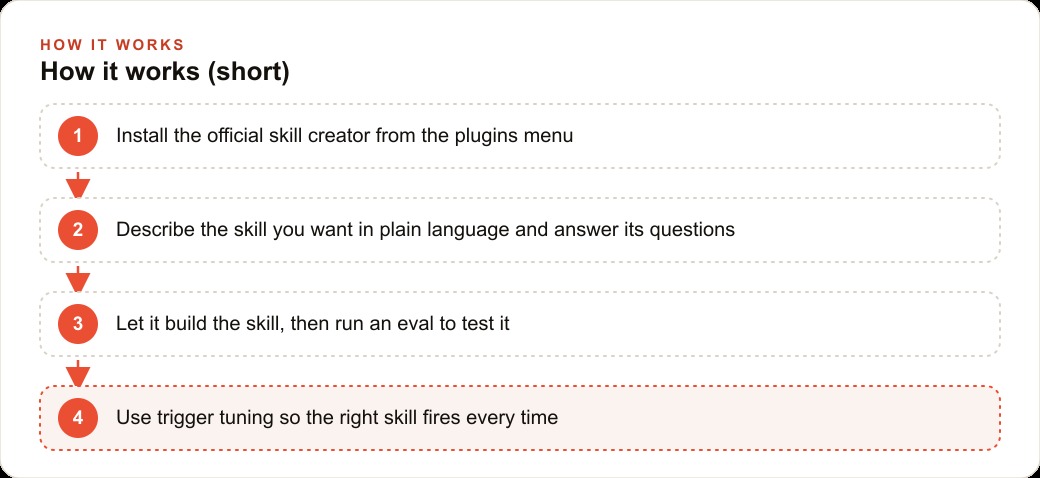
The recent update to Claude Code makes this dramatically easier to do. The skill creator, which is itself a skill built into the product, now handles the work of building, testing, measuring, and refining other skills for you. Instead of learning every best practice by hand, you describe what you want and the agent applies what it already knows about how to build a reliable skill. That compression of effort is the reason this is the right moment to take skill libraries seriously, and I want to walk through exactly what that means for a real business.
The place to start is understanding what a skill actually is, because the concept sounds more technical than it is. A skill is a markdown file. It is plain text. It describes what the agent should do when a particular task comes up, the context it should keep in mind, the steps it should follow, and the standards the output should meet. An intern could read it. A manager could write the first draft without touching a line of code. In Claude Code, you can collect dozens of these, each scoped to one type of job, and the agent reads the right one automatically when a matching request comes in.
What makes the concept worth understanding in depth is the distinction between two types of skills. Capability uplift skills teach the agent to do something better than it does by default. If the model is weak at producing a specific output format, or needs to reason through a problem type it handles poorly out of the box, a capability uplift skill closes that gap. The important thing to know about capability uplift skills is that they have an expiration date. Models improve constantly. A skill that was essential six months ago because the model struggled with a task may be obsolete today because the model got better. That is not a problem; it is expected. You benchmark the skill periodically, and when the baseline model matches the skill's output quality, you archive the skill. The skill creator now tells you when this happens, so the library stays lean rather than filling up with recipes the model no longer needs.
Encoded preference skills are different in nature and far more durable. These capture not what the model cannot do but how your business specifically likes things done. The model already understands every piece involved. It can write a proposal, a client email, or a complaint response. What it does not know is your specific sequence, your specific tone, your specific non-negotiables, and the exact standards you have developed over years of doing this work. An encoded preference skill is how you transfer that institutional knowledge into the agent permanently. No model update ever makes this skill obsolete, because no model is trained on how your business specifically operates. The compounding value here is substantial. Every encoded preference skill you build is a piece of operational IP that makes every repeatable task faster and more consistent indefinitely.
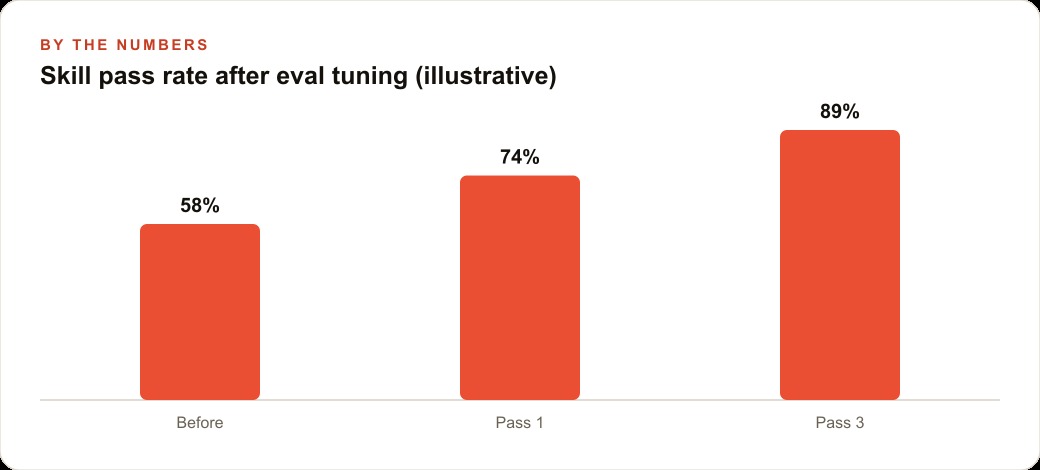
The skill creator automates three of the hardest parts of building a good skill library. Evaluations let the agent test a skill against examples you define as gold standard, then iterate on the recipe until it reliably passes. This is useful in two opposite scenarios: catching regressions, where a model update silently made a skill worse and you need early warning before that degraded output reaches a client, and catching growth, where the model has improved enough that the skill is no longer needed. Benchmarks run a task with and without the skill and display pass rate, time, and token cost side by side, so you can see the actual lift in plain numbers rather than guessing whether the recipe is earning its place. Trigger tuning addresses the practical problem that comes when a library grows past ten or fifteen skills: the agent occasionally calls the wrong one or misses the right one entirely. Trigger tuning tests the phrases a real person would use, identifies the collision points, and rewrites each skill's description until the right recipe fires reliably every time.
These three capabilities together change the nature of a skill library from a document you write once and hope for the best into a living system you actively maintain. The maintenance rhythm is simple. When you notice a repeatable task that produces variable output, build a skill. When a model update ships, run a quick eval sweep to catch regressions before they surface in client work. When a benchmark shows a skill is no longer adding lift, archive it. That cycle, done consistently, is what separates a team running efficiently on AI from a team that tried it and gave up when the output went inconsistent.
The businesses that benefit most from this are not technology companies. They are service businesses, agencies, practices, and firms where the same tasks repeat hundreds of times per year and the quality of each one matters for client relationships. The way a consulting firm writes a discovery brief. The way a law firm drafts a client update letter. The way a marketing agency formats a performance report. Each of those has a right way, a preferred structure, a house tone, and a set of things that must always be included or never appear. A skill captures all of that in one place and enforces it across every team member, including junior hires who are still learning what good looks like.
The connection to advertising and growth work is direct. If you run Meta ads and you want every ad brief, every copy review, and every post-campaign summary to follow a consistent structure, that is an encoded preference problem. A skill that captures your exact review criteria, the format your media buyer expects, and the language standards you have developed with clients will produce consistent output at scale in a way that prompting from scratch never can. The same logic applies to Google ads campaign summaries, to SEO content briefs, and to any other repeatable creative or analytical workflow that currently depends on the person at the keyboard remembering the standards.
The worked example that illustrates this most clearly comes from a service business with a large client-facing team. The business handles dozens of inbound inquiries per day, and each one requires a tailored response that follows a specific sequence: acknowledge the inquiry type, confirm what the team can and cannot do, quote a realistic timeline, and close with a clear next step. The wording, the level of formality, and the specific phrasing for delicate topics like pricing or availability drift depending on who answers. Some team members are excellent at this and have internalized the standards over years. Others are newer and produce responses that are technically correct but inconsistent in tone, which creates an uneven client experience and requires senior staff to review and correct messages before they go out.
The owner could spend more time training the newer staff. They could write a style guide that everyone is supposed to read and follow. Or they could build an encoded preference skill that captures exactly how the business communicates, feeds the agent a set of past responses rated as excellent, runs an evaluation until the skill reliably reproduces that quality, and deploys it so that any team member asking the agent for help on a response gets output that matches the senior standard. The training time drops. The review burden on senior staff drops. The junior team member in their first week produces output that is indistinguishable from what the experienced member would write, because the skill bridges the experience gap.
What this unlocks practically is the ability to delegate to AI with confidence. The reason many businesses tried AI and found it unreliable is not that the model was bad. It is that they had no recipe telling the model what reliable looked like for their specific context. Without that recipe, the model makes its best guess, and best guesses vary. With the recipe, the output is consistent because the standards are explicit and the agent is following them every time.
There is also a measurement dimension that most skill-building conversations skip. Benchmarks make the case for investment in a skill library much easier to present internally. When you can show that a task completed with a skill takes 40 percent less time, uses fewer tokens, and passes a quality check at a higher rate than the same task without the skill, the ROI argument is concrete rather than theoretical. That kind of data is especially valuable when you are managing an operation where the cost per task and the quality variance both matter for client relationships and margins.
Building this well requires thinking about the library as a system rather than a collection of individual files. Each skill should cover one distinct task, not a family of loosely related tasks bundled together. A skill that covers new client welcome messages, follow-up reminders, and complaint responses in a single recipe is hard to tune precisely because the best output for each of those tasks is different enough that one recipe cannot optimize for all three simultaneously. One skill per task, with clear and specific trigger language, keeps evaluations clean, benchmarks meaningful, and trigger tuning reliable.
The practical path forward is not to build a complete library all at once. Start with the one task that produces the most variability and costs the most time to review and correct. Build a skill for that task only, run evaluations against your best historical examples, confirm with a benchmark that it is actually lifting quality, and tune the trigger until it fires reliably. Then move to the next highest-priority task. A library of five well-built and evaluated skills will deliver more consistent value than a library of twenty skills written quickly and never tested.
The longer-term argument for this investment is compounding. Every skill you build and validate is a piece of institutional knowledge that is no longer dependent on any individual team member holding it in their head. Staff turn over. Senior people move on. The skill library does not. It accumulates the operational expertise of your best people in a form that is reusable, testable, and maintainable indefinitely. That is the actual competitive advantage of building this well, not the speed of any individual task, but the organizational resilience that comes from having your standards encoded somewhere they cannot walk out the door.
The model is ready. It has been ready. The part that takes work is the library, and the businesses that build that library carefully are the ones that will find AI actually performing to the standard they were promised in the demos.
That is exactly what we do at AI DOERS. Book a private 30-minute call with Madhuranjan Kumar and we will map the fastest path to it for your specific business.
Book your call →
Madhuranjan Kumar
Madhuranjan Kumar brings 20 years of performance-marketing experience and has managed over $200 million in Facebook ad spend for brands across the United States and beyond. His expertise spans the full modern marketing stack: Meta, Google Ads, TikTok, email automation, CRM, and the websites that hold it together. At AI DOERS he turns that track record into lead-generation systems for businesses across every industry.