
Claude Co-work: AI That Connects to Your Tools, and How a Small Business Runs on It
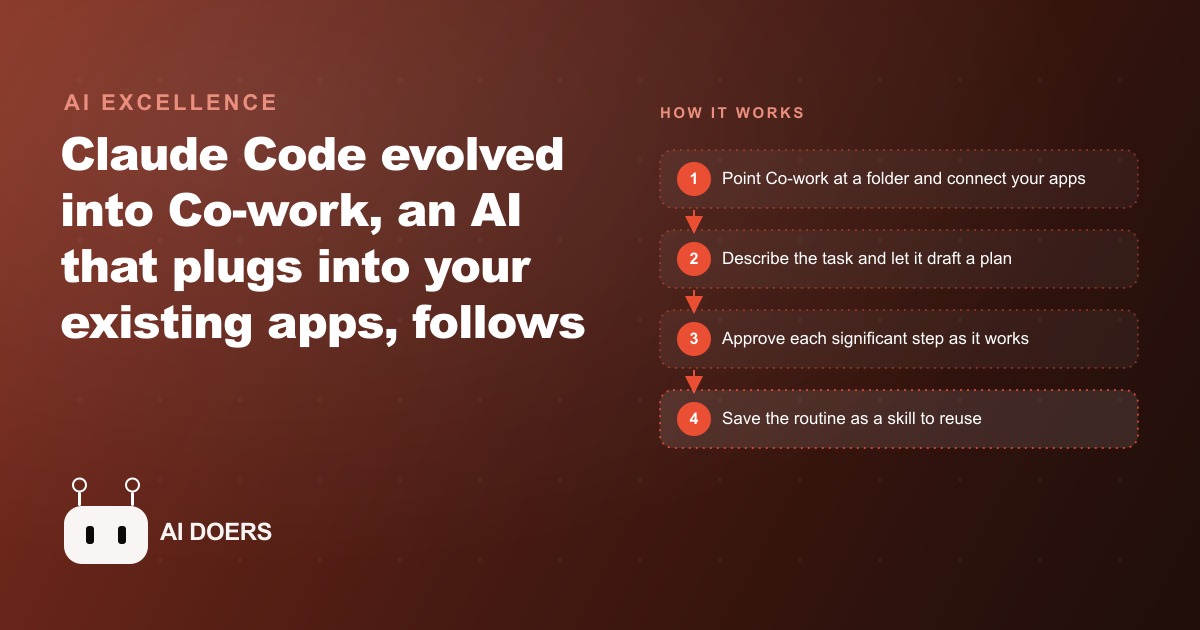
Claude Code evolved into Co-work, a version anyone can use that plugs into the apps you already run, follows a plan, and asks before it acts. Here is the grounded way a small business actually puts it to work.

The owner of a six-person bookkeeping and tax prep firm spent one afternoon in February counting the hours their team lost every week to tasks that required human hands only because the software never talked to each other. The total was eleven hours. That number is what started the Co-work experiment.
The Eleven Hours Nobody Wanted
I am Madhuranjan Kumar, and this is the kind of story I think about when a new AI tool ships. Not the benchmark score. Not the capability demo. The mundane operational moment where someone finally does the math on what the current system actually costs.
The firm handled roughly 140 small-business clients across three states. Their stack was reasonable: a cloud accounting platform, a scheduling app, a shared inbox, and a file storage system. Each tool worked reliably on its own. None of them shared data. When a new client submitted intake documents, the routine was always the same. One person opened the PDF, typed the contact data into the accounting platform, created the client folder in file storage, sent the welcome email from the shared inbox, and added the first appointment to the scheduling app. Twenty-two to twenty-eight minutes per client, every time. When a quarterly filing season closed, the same team went through every sent invoice manually to flag unpaid ones and draft follow-up messages. That took the better part of a Friday. When a client changed their business address, someone updated four different places by hand.
The owner had experimented with AI writing tools. The output was good enough. But the work still landed back on the team. The AI produced a well-drafted follow-up email, and a person still had to copy it into the inbox and press send. The gap between the suggestion and the action was filled by a human every single time.
Claude Co-work changed that premise. Anthropic described it as the grown-up version of Claude Code, rebuilt for people who never used a terminal. Instead of generating text for you to act on, it connects to your folders and your apps and acts inside your actual workflow. The owner read the description and recognized exactly what it was solving for.
The First Connector: Why Intake Documents Came First
The team chose to start with one connector and one task, not the whole stack. The reasoning was deliberate. If something went wrong on the first attempt, they wanted to contain the damage. They chose the intake document process because it was the highest-volume repetitive task, it involved no client-facing risk, and every error was catchable before anything left the building.
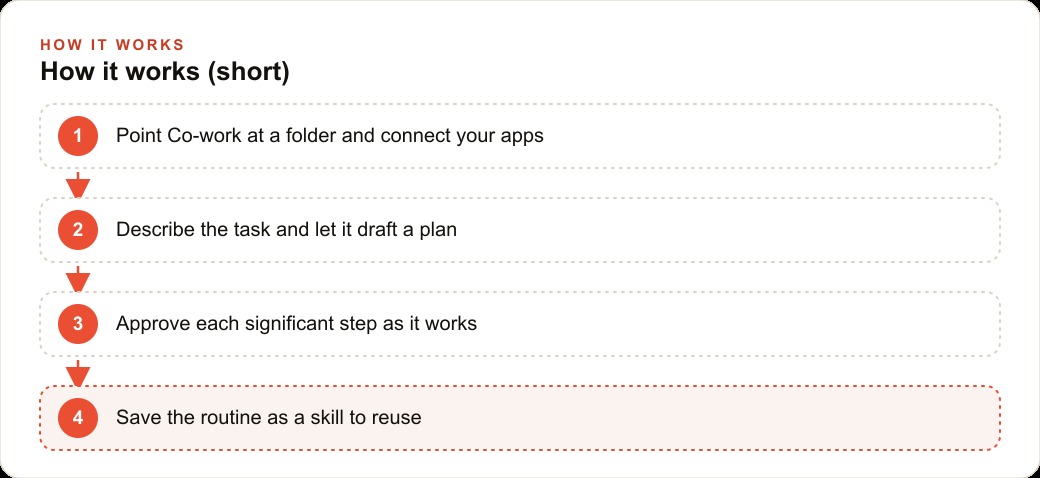
Co-work's connectors let it reach into the scheduling app and the accounting platform alongside the firm's file storage. The owner wrote a plain description of the intake task: when a new-client PDF arrives in the intake folder, read the client name, business name, contact email, and filing type; create the client record in the accounting platform; create the folder in file storage with the standard naming convention; and draft the welcome email for review. That last part, the draft-for-review rather than send, was intentional. Nothing outbound until a human signed off.
The owner pointed Co-work at the intake folder and gave it the task description. The model read it and produced a plan: steps laid out in sequence, each one labeled, the approval gate on the outbound email explicit. The owner read the plan, made one small edit to the naming convention for the folder, and approved it. Co-work ran through the sequence. It took slightly longer than a human would on the first run, the way any new team member does. The client folder appeared in the right place. The accounting record came up correctly when the owner searched for the client name. The welcome email draft landed in the shared inbox under a draft subject line the team recognized.
No one had to type anything that day for that client.
Following a Plan End-to-End for the First Time
The second week, the team handed Co-work the invoice follow-up task. At the close of each month, the accounting platform held a list of invoices that had gone thirty days past due. The usual routine was for one team member to export that list, draft a follow-up message for each client, and send them one by one, adjusting the tone slightly for clients who were usually on time versus clients who were chronically late.
Co-work's plan for this task was more detailed than the first one. It listed: pull the overdue invoice list from the accounting platform, group by client, check the client's payment history across the last twelve months, draft a message with a tone matched to that history, and queue each draft for review with the payment history summary attached so the reviewer understood why the tone was what it was. The plan had seven steps. The owner read through all seven, asked Co-work to add one step at the beginning to exclude any client who had an active dispute flag, and approved it.
The run took about twelve minutes for nineteen overdue invoices. What came back was a folder of draft messages, each one labeled with the client name, the invoice amount, the days overdue, a one-line payment history note, and the draft text. The owner went through the folder in about eight minutes, approved sixteen without changes, adjusted two tones slightly, and flagged one for a direct phone call rather than a message. Everything approved went to the inbox with one action. The whole sequence, from setup to sent, had taken twenty minutes.
The previous month that same batch of follow-ups had taken two and a half hours, spread across two people and three days.
The Moment It Stopped and Asked
The team had been told Co-work would ask for confirmation before significant actions. They believed it in theory. They understood it in practice after week three.
On the third week, the owner assigned Co-work a task to update a client's billing address across all four systems where it lived. Co-work built the plan: find the old address in the accounting platform, update it, find the corresponding folder in file storage and rename it if the naming convention included the address, update the scheduling entry, and confirm. The owner approved the plan. Co-work moved through the first three steps without interruption. Then it stopped.
The folder name in file storage used the client's old business name, not the address. But the client had also sent a message two weeks earlier mentioning they were considering a business name change. Co-work had read the note attached to the client record. It flagged the situation: the folder currently carries the old business name; a message in the client notes suggests the name may be changing; updating the folder now may require a second rename soon. It asked whether to proceed with the current name or wait for confirmation on the business name before touching the folder.
The owner had not noticed that note. If Co-work had simply proceeded, the folder would have been renamed and then renamed again two weeks later, and the second rename would have broken links that two team members used to access the folder quickly. The pause prevented that.
That moment changed how the team thought about the confirmation step. It stopped feeling like friction and started feeling like the sharpest team member in the room noticing something no one else had caught.
Thirty Days In: How the Morning Routine Changed
By day thirty, the team had built four skills: the intake process, the invoice follow-up, the address update sequence, and a new one they had not anticipated needing, a quarterly filing checklist that confirmed every required document had arrived before the team started the filing itself. The checklist ran automatically on a set schedule, flagged anything missing, and drafted a polite reminder to the relevant client asking for the specific document. The team used to do that check manually, going folder by folder, usually the week before a filing deadline when everyone was already stretched.
The owner described the change in morning routine this way: the repetitive stack at the top of the day had mostly disappeared. The inbox had the Co-work draft messages queued, already labeled and organized. The filing checklist had already run. The intake documents that arrived overnight had already been processed into the accounting platform. The team arrived and did the work that required judgment: the client calls, the unusual cases, the exceptions the system had flagged.
The volume of work handled had not dropped. What dropped was the time spent on work that followed a formula everyone already knew. That time shifted to client interaction and new-client development, which was where the real value was being generated anyway.
The skill library also changed how the team thought about new tasks. Before Co-work, when a recurring task came up, someone handled it the same way they always had. After building four skills, the team's instinct shifted. When the owner noticed that the process for onboarding a client who came in through a referral partner was slightly different from the standard intake, they built a fifth skill for that variant in an afternoon. The team was now building operational infrastructure rather than just handling tasks.
The Numbers Behind the Change
At the end of sixty days, the owner did a second accounting of the time. I am citing these as illustrative of what the firm observed rather than a guarantee of any specific outcome, because every firm's workflow and client volume is different.
The intake process that previously took an average of twenty-five minutes per new client now took about four minutes of review time, with Co-work handling the rest. The firm onboarded an average of eight new clients per month. That was a recovery of roughly one hundred sixty-eight minutes per month on intake alone.
The invoice follow-up cycle that previously took two and a half hours of combined team time per monthly close now took about twenty minutes of review. Over twelve months, that is a recovery of twenty-six hours annually from one task.
The quarterly filing checklist, which had never been systematic before Co-work, was now running reliably and flagging missing documents an average of nine days before deadline rather than the previous two or three days before deadline. The team had more lead time to chase documents, which reduced the number of filing extensions. The prior year had included four filing extensions on client matters where documents arrived late. In the sixty days of the experiment, no extension was needed on any case where the checklist had been running.
The skills library at day sixty held four skills and was expanding to a fifth. Each one represented a task that had previously required dedicated human time every time it occurred. The owner's estimate of total weekly time recovered across the team was nine hours. The initial estimate of eleven hours lost per week had nearly all come back.
The next task they handed Co-work was the address audit, a quarterly pass through all client records to identify any contact information that had gone stale. Before Co-work, no one had done that audit in two years. The owner expected it to take Co-work about thirty minutes. It took eleven.
What the Skill-Building Habit Looks Like After Two Months
The deeper shift at two months was not the time savings. It was the habit. The team had stopped accepting that a recurring task would always require the same manual effort. When a process came up more than twice in the same week, someone asked whether it was a candidate for a skill. That question had not existed in the culture before Co-work arrived.
The owner also noticed a change in how the team described problems to each other. Instead of saying that a task was time-consuming, they started describing what inputs it needed and what outputs it produced, because that framing was what a Co-work skill description required. The discipline of writing a clear task description for the AI had made the team more precise about how they described work to each other.
The security discipline stayed consistent throughout. Co-work was limited to the folders it needed for each specific skill. Approvals stayed on for anything client-facing. Browser access was off for all tasks involving client data. The owner had read about prompt-injection risks before setting anything up and had made conservative choices from the start, which meant there were no incidents to recover from during the two months.
The firm's competitive situation did not change dramatically in sixty days. But the owner had a clear view of what the next six months would look like. The time that had been consumed by formula-driven admin was now available for the work that required judgment and relationship: handling complex client situations, pursuing new partnerships, and reviewing the business's performance in a way that had previously been squeezed out by the operational load. Those were the activities that would actually grow the firm, and they now had the room to happen.
That is exactly what we do at AI DOERS. Book a private 30-minute call with Madhuranjan Kumar and we will map the fastest path to it for your specific business.
Book your call →
Madhuranjan Kumar
Madhuranjan Kumar brings 20 years of performance-marketing experience and has managed over $200 million in Facebook ad spend for brands across the United States and beyond. His expertise spans the full modern marketing stack: Meta, Google Ads, TikTok, email automation, CRM, and the websites that hold it together. At AI DOERS he turns that track record into lead-generation systems for businesses across every industry.