
Claude Co-work: Agentic AI for Non-Coders, and How a Small Business Can Use It
Anthropic shipped Claude Co-work in just 10 days so anyone, not only developers, can hand an AI a whole task and get back the finished result. Here is the practical, grounded way a small business actually uses it.

Agentic AI and chat AI are not different versions of the same thing. They are different categories of tool, and the distinction matters for understanding what Claude Co-work actually is and what it can do for a business that has never used either. I am Madhuranjan Kumar, and I want to take this distinction apart carefully, because the common shorthand, "it does the work instead of helping you do the work" - captures the surface but misses why the shift is significant.
The architectural difference between a chatbot and an agent
A chatbot operates on a single exchange. You write a message, the model processes it, and it writes back. The conversation can be long, but at each step, the model is responding to the most recent message in the context. The human stays in the driver's seat throughout. The AI responds; the human steers; the AI responds again.
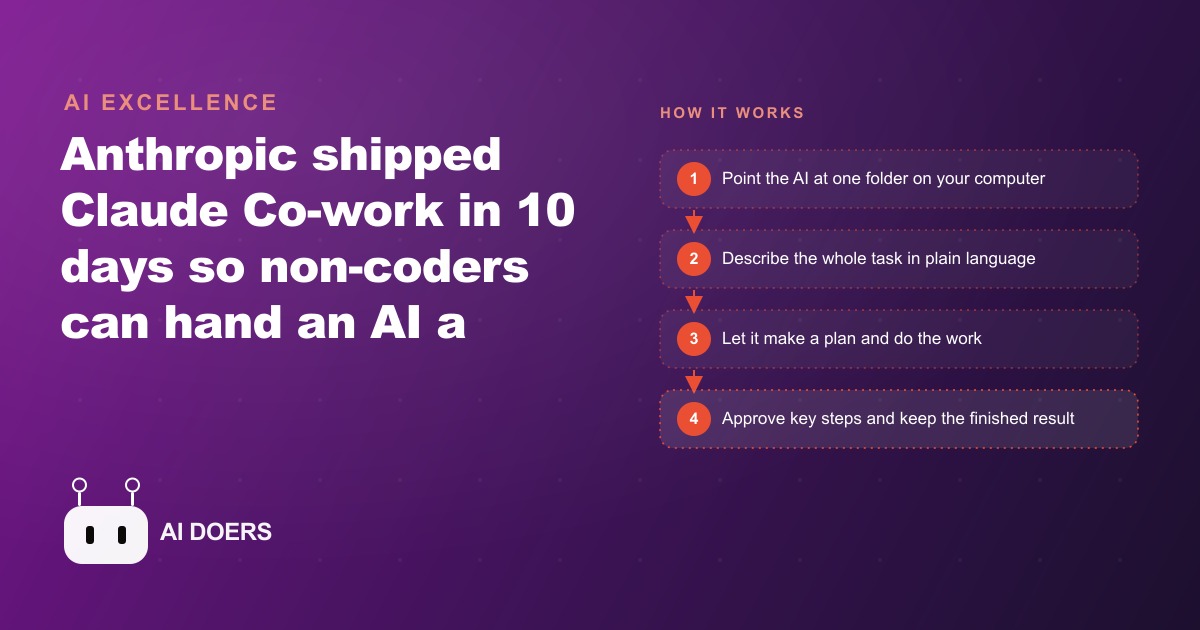
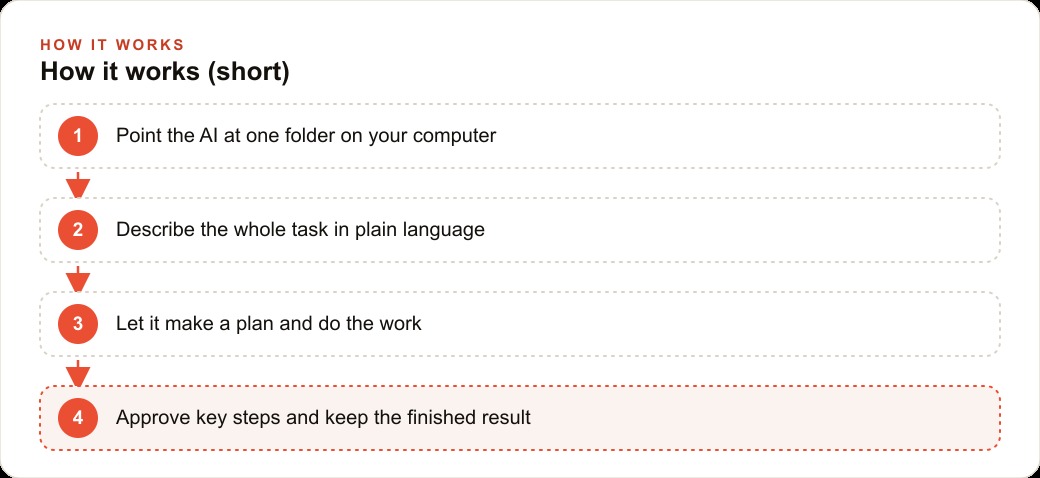
An agent operates on a task. You describe a desired outcome, and the agent builds a plan, breaks the plan into steps, executes the steps in sequence, and returns the completed result. The human approves the plan and reviews the final output. In between, the agent is directing itself rather than waiting for the human to direct each step.
The practical difference is not about intelligence. A chatbot running on a powerful model can produce excellent individual responses. An agent running on the same model can take a task from start to finish without requiring human direction between each step. The capability difference is architectural: one is designed for back-and-forth, the other is designed for end-to-end.
Claude Co-work is Anthropic's first consumer-facing agentic product, meaning it is the first version of Claude designed for non-developers to give it a whole task and get back a finished result. The original Claude Code tool, which it draws from, was designed for developers who could interpret code, run it in a terminal, and redirect the agent when it went sideways. Co-work wraps that capability in an interface that any business owner can use, with a folder-permission model that requires no command line and approval steps that require no technical knowledge to evaluate.
The cognitive offload mechanism that makes agents valuable for small businesses
There is a specific reason agents are more valuable for business owners than chatbots, even when the underlying model capability is similar, and it connects to something cognitive rather than something technical.
Focus and decision-making are finite daily resources for most people. Switching between tasks, managing interruptions, and maintaining context across multiple simultaneous projects all draw on those resources. A chatbot helps with specific messages and responses but still places the owner in the position of driving the process: writing the prompt, reading the output, deciding the next step, writing the next prompt. That back-and-forth requires active attention on the task throughout.
An agent removes the task from the owner's attention entirely for the duration of its execution. You give it the task, it executes, and you return when it is done. The mental space that would have been occupied by managing the task is available for other things during that period. For an owner who previously spent three hours per evening processing administrative work, switching to an agent that handles that work overnight and produces outputs for a morning review is not just a time saving. It is a structural change in how cognitive resources are allocated across the day.
This is what some call the automation cliff: a workflow generates minimal benefit until the last piece that requires human attention is removed, at which point the whole thing runs autonomously and the benefit becomes continuous rather than occasional. Co-work is designed to enable that cliff point for common business workflows without requiring the technical setup that agentic tools previously demanded.
The folder-permission model and why the approval steps are designed the way they are
The security model in Co-work reflects a deliberate design choice about how agentic AI should interact with a user's file system. The agent can only read and modify files within the folder you explicitly grant it access to. It cannot reach outside that folder. It cannot access other applications, other drives, or network locations beyond the scope of the specific folder permission.
The approval checkpoints that appear during task execution are also deliberate. When the agent proposes a plan, it surfaces the plan for your review before taking any action. When an action in the plan would modify or move files, it confirms before executing. When the task is complete, it produces a summary of what changed. These checkpoints are not signs that the agent lacks confidence in its decisions. They are safety mechanisms that keep the human in a position to catch errors before they compound.
The practical effect is that the agent can be given access to a folder containing hundreds of files without the risk of unintended changes cascading through the system. A business owner who grants Co-work access to their product image folder and asks it to organize by category is not exposing their entire file system. They are giving the agent a bounded domain to work within, and every change within that domain is visible and reversible.
The value of this design is most apparent on larger tasks. When the agent is processing eighty supplier documents, sorting them by supplier name and document type, the approval checkpoint at the plan stage means you have reviewed the proposed folder structure before a single file moves. If the proposed structure does not match how you want to organize the information, you redirect before any work is done. The alternative, manual organization of eighty documents, has no such checkpoint: you make decisions as you go, and if the organizational logic turns out to be wrong halfway through, you have already moved forty documents into a structure you need to undo.
The specific workflows where the agentic architecture matters most
Not every task benefits from an agentic approach. Simple one-answer questions, short text generation, and conversational back-and-forth are tasks where a chatbot interface is fully sufficient and often faster than an agent. The overhead of plan generation and approval checkpoints adds time to tasks that do not need it.
The agentic architecture produces the most value on tasks with three characteristics: the task involves multiple sequential steps, the output quality requires consistent application of rules across a large number of instances, and the cost of reviewing the final output is lower than the cost of directing each step.
For an electrician business, those three characteristics appear most clearly in: processing a month of job photos from inconsistently named camera files into a folder structure organized by job address and date; converting a week's worth of scattered job notes into a structured summary of open follow-up items; turning a stack of supplier invoices into a formatted expense report grouped by job and category. Each of these involves multiple steps, requires consistent application of a rule across many instances, and is faster to review as a finished output than to direct step by step.
The key practical skill in using an agentic tool is task description. The quality of the agent's output correlates directly with the specificity of the task description. An owner who asks the agent to "organize the job photo folder" gets a result that reflects the agent's interpretation of what organization means. An owner who asks the agent to "scan the job photo folder, identify all files with camera-generated names like IMG_ or DSC_, rename each one using the format YYYY-MM-DD-job-address-photo-number, and create subfolders by month organized by year" gets a result that matches a specific, documented standard. The second description takes five minutes more to write and saves an hour of correction after the fact.
The scope of what autonomy means for a business that has not used agents before
The transition from chatbot to agent is not primarily a technology transition. It is a workflow design transition. The businesses that get the most from agentic AI are not the ones with the most technical sophistication. They are the ones that have identified their highest-friction repetitive tasks, described what correct output looks like in enough detail that an agent can produce it, and built a review process that catches the errors that inevitably occur in a new workflow.
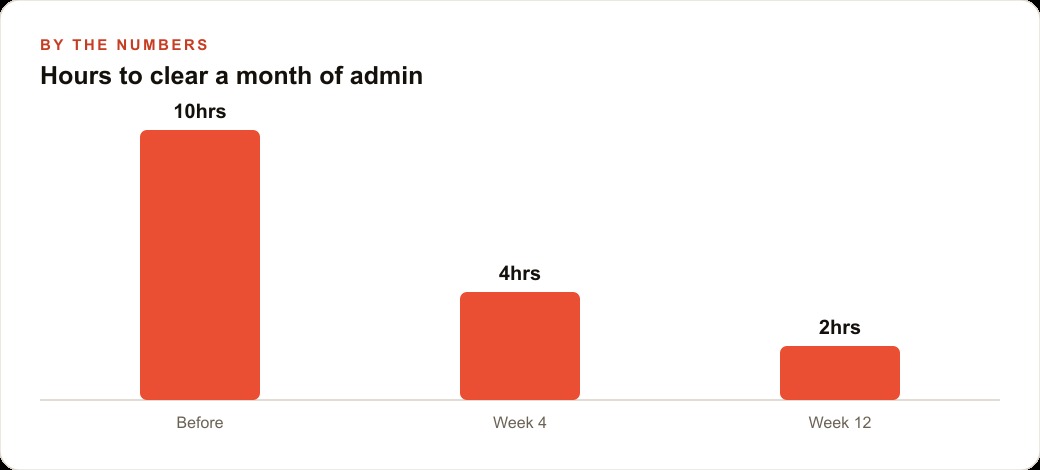
The learning curve for that workflow design is real and takes two to four weeks of active use to flatten. The first week produces outputs that require significant correction because the task descriptions are not yet specific enough. The second week produces outputs that require less correction because the task descriptions have been refined based on what the first week surfaced. By week four, the review step is genuinely light because the task descriptions reflect the actual standard the outputs need to meet.
An electrician building this kind of workflow for the first time should expect to invest three to four hours in the first week on configuration and correction, two hours in the second week, and under an hour per week from the third week onward for review of an automated workflow that runs unattended. The total setup cost is modest. The ongoing time saving is permanent for as long as the workflow runs.
For businesses considering whether to invest that setup time themselves or have someone configure it for them, the honest accounting looks like this: self-configuration takes three to four weeks to reach a reliable workflow and produces deeper understanding of how the system works, which makes future modifications easier. Expert configuration takes one to two weeks and produces a working workflow faster, at the cost of less direct familiarity with the configuration decisions. Both are valid approaches. The one that does not work is treating the agent as a chatbot by continuing to direct each step manually rather than building the task description that lets it run end to end.
The businesses building these workflows now are building the institutional knowledge, the task descriptions, the standard output formats, and the review processes, that will transfer to each successive generation of more capable agentic tools. The value compounds with each tool upgrade because the workflow knowledge transfers even when the underlying tool changes.
That is exactly what we do at AI DOERS. Book a private 30-minute call with Madhuranjan Kumar and we will map the fastest path to it for your specific business.
Book your call →
Madhuranjan Kumar
Madhuranjan Kumar brings 20 years of performance-marketing experience and has managed over $200 million in Facebook ad spend for brands across the United States and beyond. His expertise spans the full modern marketing stack: Meta, Google Ads, TikTok, email automation, CRM, and the websites that hold it together. At AI DOERS he turns that track record into lead-generation systems for businesses across every industry.