
How to Build a Custom AI Tool for Your Team Using Claude Artifacts (No Coding Required)
Claude Artifacts lets any business owner build a working, shareable AI-powered tool in a single conversation with no development cost. Here is how to use it to give your field team consistent estimating and diagnostic tools.

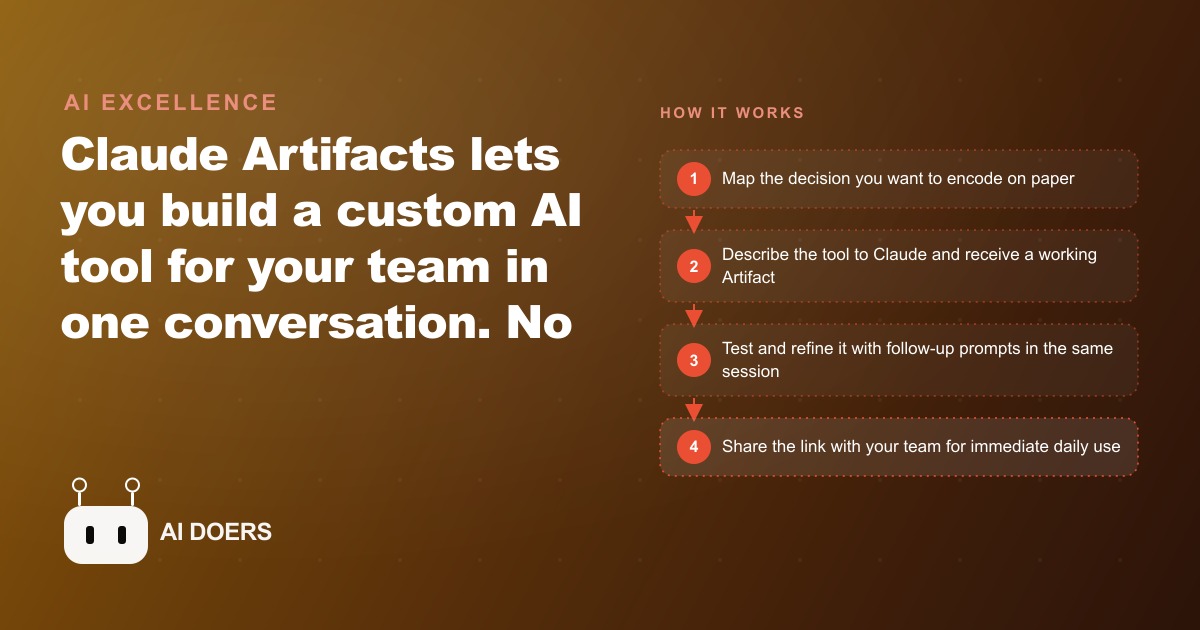
Most small businesses are paying a monthly fee for software that does not fit them, and the awkward truth is that they no longer have to. The custom tool your team actually needs, the estimator, the intake form with logic, the diagnostic wizard, can now be built in a single conversation with Claude and shared as a live link before lunch. I, Madhuranjan Kumar, want to make an argument that will annoy a few software vendors: for a large slice of the tools a small business buys, building is now faster, cheaper, and more precise than renting.
The software you rent was never built for you
Every off-the-shelf tool is a compromise. It was designed for the average customer in your category, which means it does ninety percent of what you need and forces your team to work around the other ten percent forever. You end up with fields you never use, a workflow that assumes a business slightly unlike yours, and a pricing page that charges you per seat whether or not those seats get value. That mismatch is not a bug in the vendor's product. It is the unavoidable result of one piece of software trying to serve thousands of different companies at once.
For years, the alternative was worse. Building something custom meant hiring a developer, waiting two or three days at minimum, paying for hosting, and then owning the maintenance forever. So business owners swallowed the compromise and rented. That trade made sense when building was slow and expensive. It does not make sense anymore, and pretending it still does is costing owners money every month.
One conversation replaced the developer quote
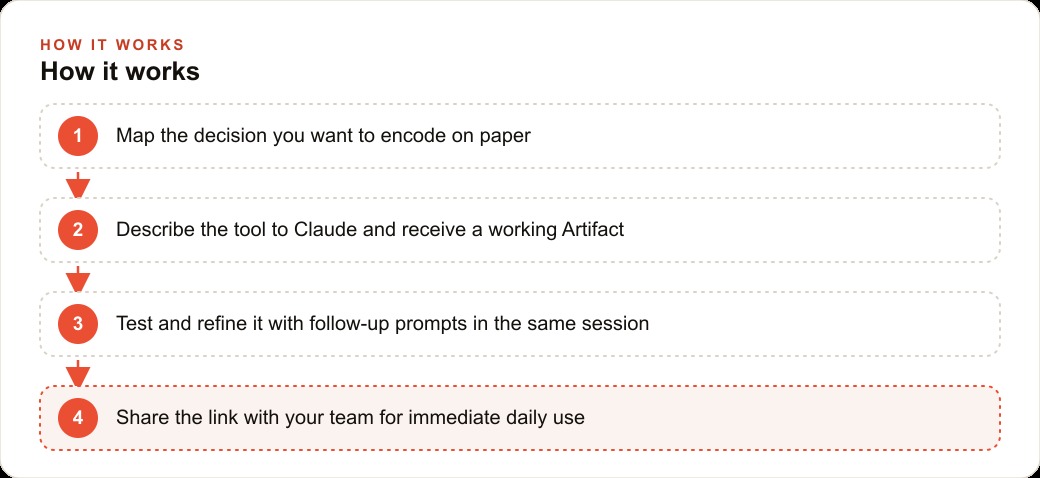
Claude Artifacts is the feature that broke the old math. You describe an interactive tool in plain language, and Claude builds a working version live in the chat, renders it as a real interface you can click, and gives you a shareable web link anyone can open in a browser. No server to configure, no deployment step, no code to babysit. When something is wrong, you say so in plain English and it updates instantly. Anthropic even ships a set of pre-built templates for common patterns, so you often start from a working structure and reshape it with a single follow-up prompt.
The part that matters for my argument is the speed and the price. A tool that used to sit behind a developer quote and a two-day wait now exists in the time it takes to describe it well. The free tier of Claude includes Artifact access, so your first tool can cost nothing, and the twenty dollar per month Pro plan covers a team that leans on it heavily. Compare that to a specialized SaaS product at forty or eighty dollars per seat per month and the case for renting starts to look thin for anything but the most complex, deeply integrated systems.
The subscription is not the real cost
People defend their software stack by pointing at the modest monthly fee, but the fee was never the expensive part. The real cost is the friction. It is the technician who guesses on a price because the price book lives on a laptop back at the office. It is the new hire who calls three times a day because the decision logic lives in a senior employee's head instead of in a tool. It is the customer who shops around because your quote came in inconsistent and slow. Those are the line items that quietly drain margin, and generic software does little to fix them because it was never shaped around how your specific team actually makes decisions.
A tool you build encodes your logic exactly. It asks your questions, in your order, with your terminology and your price ranges. That precision is where the money is, and it is the one thing a rented tool can almost never give you.
A field estimator, built and shipped before lunch
Let me make this concrete with a worked example. Take a plumbing company doing about 1.8 million dollars a year with six field technicians. Today those technicians estimate jobs by half-remembering a price book, calling the office, or quoting on gut feel. All three produce inconsistency, and inconsistency costs money on both sides: underquote and you give away margin, overquote and you lose the sale.
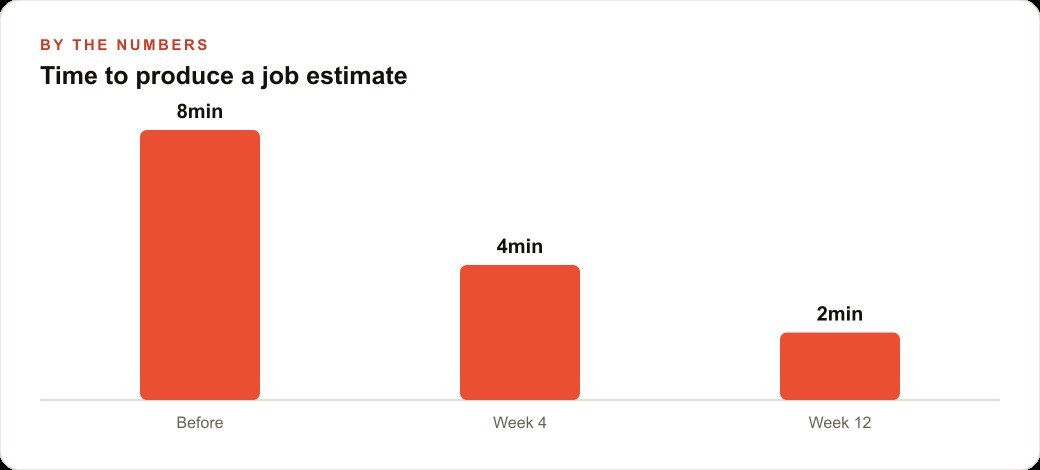
Here is what building costs in time. The owner opens Claude and describes an estimating assistant: the tech picks a job type from a dropdown (drain clearing, water heater replacement, faucet repair, pipe repair, toilet replacement), the tool asks three to five diagnostic questions specific to that job type, then outputs a low and high labor range with a note that parts are added at cost. Within two minutes there is a working tool. The owner walks through a drain-clearing scenario, sends one follow-up prompt to match the ranges to the company's real labor rates, and texts the link to the crew. Total elapsed time is under an hour, and the running cost is a twenty dollar per month plan.
Now the return. If each technician runs four to six estimates a day and each currently burns five to eight minutes of back-and-forth, cutting that to two minutes of self-service saves roughly 30 to 45 minutes per technician per day. Across six technicians five days a week, that is 15 to 22 hours of recovered capacity weekly. On pricing accuracy, if a structured estimator improves accuracy by even five percent across the job mix, on 1.8 million in revenue that is on the order of 90,000 dollars in recovered margin, an illustrative figure but a plausible one. No rented estimating product I know of would have shaped itself to this company's exact job types and rates in under an hour for twenty dollars a month.
The objection I hear most, and why it misses
The pushback is always the same: "I am not technical, I cannot build software." That objection was valid two years ago. It is not valid now, because you are not writing software. You are describing a decision you already make every week, and Claude writes the software. If you can explain to a new hire how you price a water heater job, you can build the tool. The technical skill got absorbed into the model. What remains is the thing you already have, which is knowledge of your own business.
The second objection is about trust: "What if it breaks or gives a wrong answer?" This is fair, and it is why you build small and keep a human in the loop early. But notice that rented software also breaks, also gives wrong answers, and gives you no ability to fix the logic yourself. When your Artifact underquotes a job, you send one prompt and it is corrected in seconds. When a SaaS tool does it, you file a support ticket and wait.
Build small, ship rough, refine in public
The way to win with this approach is to resist the urge to build everything at once. The most common failure I see is an owner trying to handle every job type, every exception, and every edge case in version one. The tool becomes slow, confusing, and hard to maintain. Start with your three most common jobs and the four or five questions that matter most for each. Ship it rough. Have one technician use it on a real job the same day and report what was confusing or missing. That single round of real-world feedback is worth more than an hour of solo testing.
Then keep it alive. Your prices change, your job mix changes, your process changes. Schedule a quarterly pass to update the ranges and the logic so the tool never drifts into underquoting. A tool you own can be kept current in minutes. A tool you rent updates on the vendor's schedule, not yours.
Where renting still wins, and where building compounds
I am not arguing you should build everything. Renting still wins when you need deep, live integration with payment rails, when you need compliance certifications you cannot produce yourself, or when the tool is a genuine platform that hundreds of people outside your company also touch. Accounting, payroll, and card processing are not weekend builds. Be honest about that line.
But for the long tail of internal tools, the estimators, the intake wizards, the qualification checklists, the onboarding guides, building now beats renting on cost, fit, and speed. And there is a compounding benefit that rarely gets counted: every tool you build is also a training document. A new technician who uses your estimator learns your diagnostic logic just by using it, which quietly shortens onboarding.
This same instinct, encode your own logic instead of renting a generic version, extends past internal tools. The businesses that get the most out of it also apply it to how they capture and route demand, so the leads from Facebook and Instagram ad campaigns land in a qualification flow the business actually designed, and those leads flow into the CRM and website stack where follow-up is automated instead of forgotten. The same clarity about your own process that lets you build a good estimator is what makes your Google Ads spend more efficient, because you finally know which jobs are worth bidding for.
Every tool you build quietly becomes a training asset
There is a second win here that almost nobody counts when they compare building to renting, and it is worth dwelling on because it changes the return math. When you build an internal tool that encodes a decision, you are not only shipping software. You are documenting how your best people think. A new technician who walks through your estimator is absorbing your diagnostic logic in the exact order a senior tech would apply it. A new front-desk hire who uses your intake wizard is learning your qualification questions without a single training session. The tool teaches while it works.
Rented software cannot do this, because it encodes a generic process, not yours. The vendor's onboarding wizard trains your people in the vendor's assumptions, which is precisely the ten percent that does not fit your business. So every generic tool you rent quietly trains your team in a slightly wrong process, while every custom tool you build trains them in the right one. Over a year, with normal staff turnover, that difference compounds into real money and fewer mistakes, and it never shows up on the subscription invoice you were comparing against.
Why some vendors will tell you this is reckless
Expect pushback, and expect it to sound like a safety concern. When building becomes this cheap, the people who sell rented tools have an incentive to frame do-it-yourself software as risky, unmaintainable, or unprofessional. Some of that caution is legitimate for genuinely complex systems, and I said so above. But a lot of it is the natural reflex of a business model under pressure. The honest test is not whether a vendor calls something risky. It is whether the tool touches money, compliance, or hundreds of outside users. If it does not, and most internal tools do not, then the risk of building is small and the risk of renting a bad fit forever is the larger one.
The deeper reason building wins for this category is control over the failure. When a tool you own misbehaves, you fix the logic in seconds with a plain-English prompt and re-share the same link. When a rented tool misbehaves, you file a ticket, wait, and hope the vendor considers your edge case worth their roadmap. Ownership does not just lower cost. It collapses the time between noticing a problem and fixing it, which for a busy operator is often the thing that matters most.
The compounding effect of building the habit
The first tool is the hardest, not because it is technically difficult but because it requires believing the old constraint is gone. Once an owner ships one working estimator and watches the team actually use it, the second tool takes half the time and the fear disappears entirely. Within a few months, a business that adopts this mindset accumulates a small library of tailored tools, an estimator, an intake wizard, a qualification checklist, an onboarding guide, each shaped exactly to how the business runs, each built for the cost of a conversation. That library is a genuine competitive edge, because a competitor renting generic software cannot replicate the fit.
You can absolutely build your first tool yourself, and the free tier makes it a no-risk experiment this week. If you want a more sophisticated version with multiple service categories, custom branding, or a connection into your existing quoting and CRM system, that is exactly the kind of build I do for clients, and you can bring me in to handle it. Either way, the era of paying a monthly fee for a tool that almost fits is ending, and the owners who notice first will pocket the difference.
That is exactly what we do at AI DOERS. Book a private 30-minute call with Madhuranjan Kumar and we will map the fastest path to it for your specific business.
Book your call →
Madhuranjan Kumar
Madhuranjan Kumar brings 20 years of performance-marketing experience and has managed over $200 million in Facebook ad spend for brands across the United States and beyond. His expertise spans the full modern marketing stack: Meta, Google Ads, TikTok, email automation, CRM, and the websites that hold it together. At AI DOERS he turns that track record into lead-generation systems for businesses across every industry.