
Claude 4 Opus Is a Genuine Step Change: Writing, Coding, and Agentic Tasks Tested
Claude 4 Opus landed with impressive benchmark scores, but the more interesting question is whether it actually performs better in practice. Here is what hands-on testing revealed.

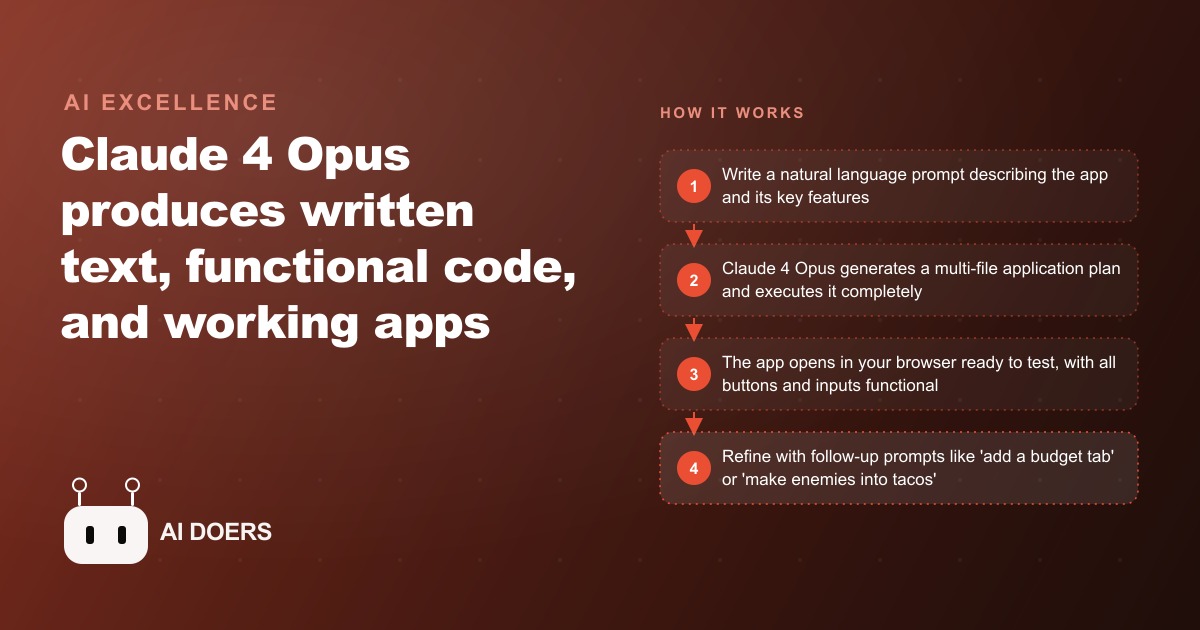
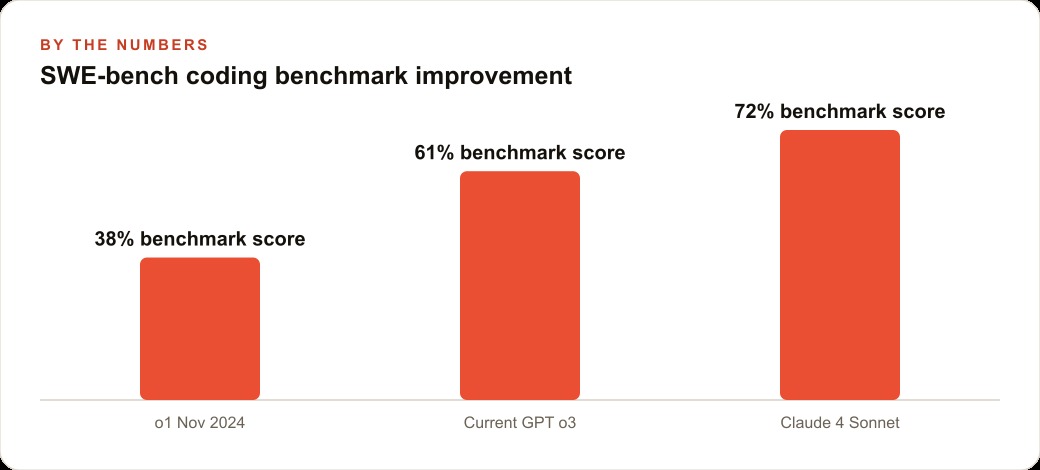
Claude 4 Opus from Anthropic scored 72 percent on the SWE-bench software engineering benchmark, nearly double what the best available model in November 2024 could manage, and the writing it produces no longer carries the hollow phrases that have made AI output recognizable for years.
Two things happened at the same time, and they matter for different people. The writing improvement matters for anyone who uses AI to produce client-facing communication and spends significant time editing before it is usable. The coding improvement matters for anyone who wants to build custom tools without hiring a developer for each one. Extended thinking that runs for up to seven hours through the API matters for any business with complex multi-step research tasks that currently take a team member a full day to complete manually.
I am Madhuranjan Kumar. The playbook below is the sequence I would use to bring Claude 4 into a business operation, starting from the part with the most immediate return and working toward the more powerful applications that take a few more sessions to set up.
Stage 1: Start by replacing your worst AI writing tasks, the ones where you edit most heavily
The place to start is not with the most ambitious application. It is with the task where you currently use an AI tool and spend the most time editing the result before it is usable. That task tells you where the tone gap is largest between what you have been getting and what the model actually needs to produce.
For most businesses, that task is some form of client-facing communication. A status update, a proposal introduction, a follow-up email after a meeting. The previous generation of AI writing tools produced text that was technically correct but tonally wrong. It opened with hollow enthusiasm, used filler phrases like it is worth noting, and ended with a restatement of the introduction. An email that a person would write in three natural sentences became a six-sentence paragraph that required cutting before it could be sent.
Claude 4 Opus does not write this way. The core improvement is that it does not produce hollow enthusiasm, does not open with the AI signature phrases, and produces text that reads like something a knowledgeable person wrote for a specific reader. The most basic test: prompt it to write a message to a manager about a broken piece of office equipment. Every earlier generation model produces a polished but robotic message. Opus 4 produces something short, direct, and natural, mentioning what was already tried and offering to help resolve it.
Run the same prompts you have been using on your current tool and compare the output directly. The editing time reduction on client-facing drafts will be visible in the first session. Start there, document how much editing time each draft now requires versus before, and use that number to decide how much of the subscription cost is already recovered.
Stage 2: Move to app building: write the specification in plain language, not the code
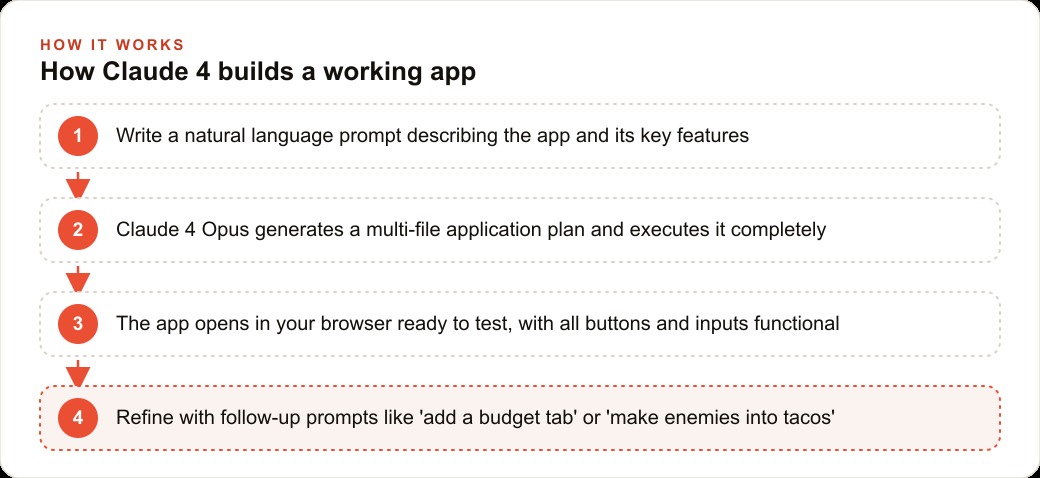
Once you have confirmed the writing quality holds for your most common tasks, move to app building. The SWE-bench score of 72 percent is meaningful context, but the practical test is this: does the first version of a simple tool you need work without significant debugging.
For Claude 4 Opus, the answer is consistently yes on tools with a clear specification. The specification is the key input. A prompt like build an interactive finance dashboard for a small business with income logging, expense categorization, and a monthly summary chart produces a working application where inputs update correctly, categories behave as expected, and the summary chart displays the right numbers. The first version works. You do not spend an afternoon debugging button states and misaligned fields before the tool is usable.
The practical method is to write the specification the way you would explain the tool to a new employee. What does it need to accept as inputs. What should it show the user. What happens when someone clicks the main button. What edge case should it handle gracefully. Write that in plain language, not pseudocode, and provide it as the prompt.
If you are running /meta-ads campaigns and you want a tool that calculates cost per lead across multiple ad sets when you paste in the data, that is a two-paragraph specification. Describe the inputs, describe the calculation, describe the output format. The first version will work. Build one small tool per week for a month and you will have four operational tools that previously sat on a backlog waiting for developer time.
Stage 3: Add a reflection loop to anything where quality matters more than speed
A reflection loop means the model generates a first draft, then evaluates it against a set of criteria you specify, then improves it based on what it finds. This is particularly useful for writing tasks where the first draft is good but not at the quality level the final output needs.
The practical setup is to add a second prompt after the initial draft. Ask the model to evaluate the draft against your specific standards: does it sound natural, does it make a single clear argument, does it avoid these specific phrases, does it stay under this word count, and what would make it stronger. Then ask it to revise based on that evaluation.
This two-pass approach produces writing that is substantially better than a single-pass generation because it applies a standard that is specific to your context rather than a generic quality check. For a business sending client reports or proposals where the quality of the writing directly affects how clients perceive the work, the reflection loop is worth the extra generation time.
Extended thinking in the API takes this further. For complex documents where the model needs to hold many constraints simultaneously, the extended thinking capability allows it to reason for much longer before producing output. Multi-constraint documents, a proposal that needs to be technically accurate, commercially persuasive, appropriately cautious about scope, and under a specific word count, hold all those constraints more reliably when extended thinking is enabled.
Stage 4: Stress-test on the edge cases before any output reaches a customer
The reliability improvement in Claude 4 Opus is real, but it is not a reason to skip review. The model produces fewer broken first drafts and fewer broken first-version apps than previous models. It does not produce zero of either.
For writing, stress-test by giving the model the unusual inputs that your actual clients produce. A client who sends a confusing briefing, a situation where the relevant information is incomplete, a context where the polite response and the honest response are in tension. These are the cases where previous models produced awkward outputs that required significant human judgment to fix. Understand where Claude 4 holds up and where it still needs a human review step, because those will differ by task.
For apps, test every input combination that a real user might try, including the ones that break things. What happens when someone leaves a required field empty. What happens when they paste data in a format the tool did not expect. What happens when the calculation produces a result that is technically correct but visually confusing. Build the edge case tests before the tool goes into production use, because finding a broken edge case during a client presentation is more disruptive than finding it in a test session.
For a business running /google-ads reporting and using an AI-generated report format, the stress test is running the report against a period of anomalous data, a month with a significant spend spike, an account with zero conversions, a period where campaigns were paused. The report template needs to handle all of those gracefully before it becomes the standard output sent to clients or stakeholders.
Stage 5: Match the model tier to the complexity and the budget
Claude 4 comes in two tiers that behave differently and cost differently. Sonnet 4 scores slightly higher than Opus 4 on the SWE-bench coding benchmark, costs significantly less per API call, and is the better choice for high-volume tasks where you need a large number of outputs quickly. Opus 4 produces better writing quality and performs better on agentic tasks where the agent needs to make judgment calls across a long multi-step process.
The practical allocation is to use Sonnet 4 for tasks where output volume matters and Opus 4 for tasks where individual output quality matters most. Writing a large number of product descriptions, generating report summaries in bulk, producing first drafts across a large content calendar: these favor Sonnet 4. Writing a proposal introduction that will go directly to a senior client decision-maker, producing a nuanced analysis document, or running a multi-hour agent session that needs to make good decisions at each step: these favor Opus 4.
For the Claude.ai subscription tiers, the Pro plan at twenty dollars per month gives access to Sonnet 4 with sufficient limits for moderate use. The Max plans provide Opus 4 access and higher usage limits. For API access, the per-token cost difference between Sonnet 4 and Opus 4 is significant enough that running high-volume tasks through Opus 4 by default becomes expensive quickly. Build the tier decision into the workflow from the start rather than discovering the cost difference after a month of high-volume Opus 4 use.
For a business managing a /web-crm and sending AI-drafted follow-up sequences at volume, Sonnet 4 handles the drafting at a cost that scales without friction. Reserve Opus 4 for the edge cases: the high-stakes proposal, the client situation that requires particularly careful handling, the analysis document that goes to a board.
Stage 6: Run multi-hour agentic sessions through the API for research and analysis work
The extended thinking capability that allows Claude 4 Opus to run for up to seven hours through the API changes the economics of complex research tasks. A task that currently takes a team member a full workday to complete manually, gathering information from multiple sources, synthesizing it into a structured document, and producing a clear recommendation, can be delegated to an agent that runs and returns a first draft for review.
The setup requires API access and either Claude Code or a script that sends the task to the API with the extended thinking capability engaged. The practical workflow is to design the task carefully: what information should the agent gather, in what order, using what sources, with what structure for the output. The quality of the output correlates directly with the quality of the task design.
To illustrate the scale of the time saving with a concrete illustrative example: consider a small accounting firm serving fifteen business clients. Each month the team produces a financial health summary for each client, which requires pulling the previous month's numbers, identifying notable changes from the prior period, checking for any regulatory deadlines relevant to the client's industry, and writing a clear narrative that a non-accountant business owner can read and act on. That process takes roughly ninety minutes per client. For fifteen clients, that is over twenty hours of professional time per month.
An agent configured with the client's data format, the industry context, and the output template produces the first draft of each report in a single run. The team member reviews each draft, verifies the key numbers, and makes any adjustments that require human judgment. The review takes twenty minutes per client instead of ninety. The saving across fifteen clients is over ten hours of professional time per month, every month. At a professional billing rate of one hundred and fifty dollars per hour, that is over fifteen hundred dollars of time recovered monthly on a single workflow, from a tool with a subscription cost measured in tens of dollars. These numbers are illustrative, but the ratio holds across similar operations.
This is where the compounding begins. Each workflow rebuilt around agentic sessions frees time for the work that requires human judgment. The accounting firm uses the recovered time to serve more clients, to deepen relationships with existing ones, or to invest in higher-value advisory work that commands a better rate than compliance reporting. The return on the initial setup compounds across every month the workflow runs.
That is exactly what we do at AI DOERS. Book a private 30-minute call with Madhuranjan Kumar and we will map the fastest path to it for your specific business.
Book your call →
Madhuranjan Kumar
Madhuranjan Kumar brings 20 years of performance-marketing experience and has managed over $200 million in Facebook ad spend for brands across the United States and beyond. His expertise spans the full modern marketing stack: Meta, Google Ads, TikTok, email automation, CRM, and the websites that hold it together. At AI DOERS he turns that track record into lead-generation systems for businesses across every industry.