
I Tested ChatGPT 5, Gemini, Claude, and Grok Across 10 Tasks. Here Is What I Found and What It Means for Your Business
Comparing four leading AI models across categories like web building, reasoning, coding, and hallucination resistance reveals differences that are small in some areas and significant in others. The right model for your business depends on what you actually use it for.

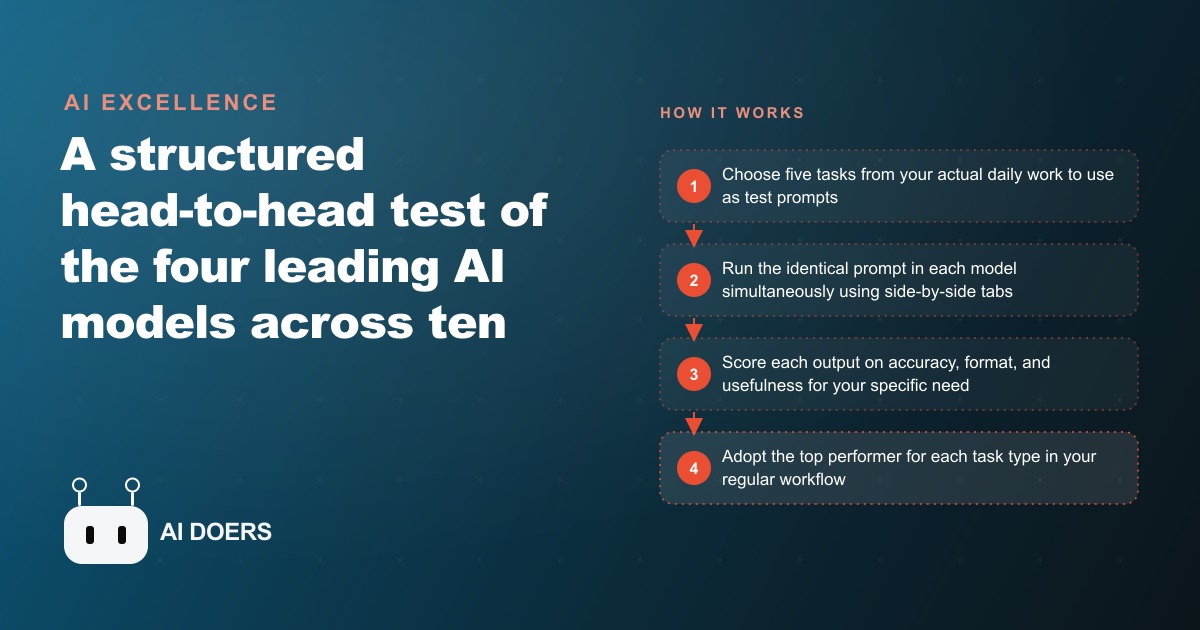
Seven things surprised me when I ran the same prompt through GPT-5, Gemini Pro, Grok, and Claude Opus across ten structured task categories. I am Madhuranjan Kumar, and I run these comparisons several times a year because the gap between what AI marketing materials claim and what a model actually does keeps shifting with every release cycle. The tests this time covered web app generation, multi-step reasoning, coding from requirements, hallucination resistance on facts and external links, business analysis, writing quality, document analysis, image understanding, creative tasks, and instruction-following accuracy. Each model received an identical prompt, submitted simultaneously in separate tabs, and scored on a one-to-ten scale based on how useful the output was for real business work. Here is what the numbers actually settled and, more importantly, what they did not settle.
GPT-5 Built the Most Functional Web App but the Margin Keeps Narrowing
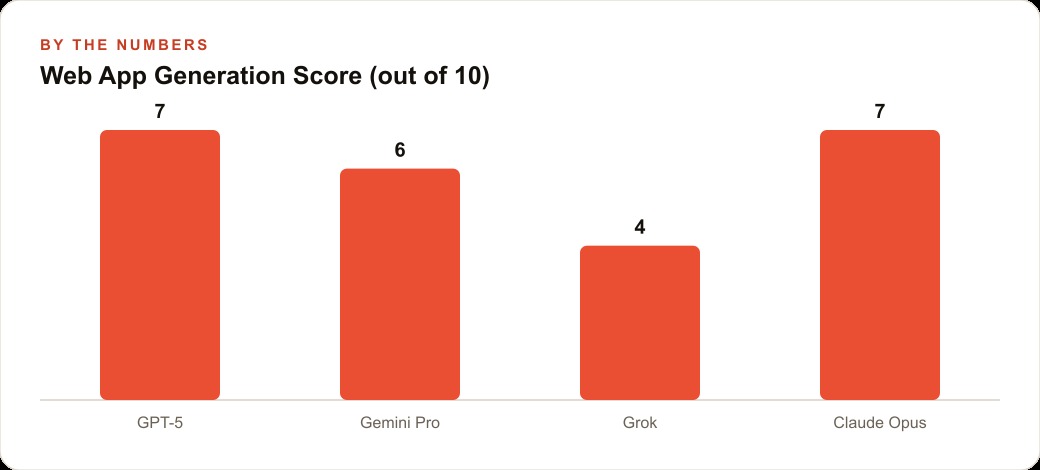
When each model was asked to build an interactive website comparing leading AI tools in a visually organized format, GPT-5 returned the most polished and immediately usable result. The layout was coherent without being explicitly instructed on layout decisions. The interactive elements worked on the first render. The code ran in a browser without additional debugging. The information hierarchy made decisions about what to emphasize that were editorially sound, even though the prompt did not specify how to structure the information. That last point is the specific capability advantage: GPT-5 applied judgment to the design of the page, not just the content of it.
The margin over the second-place model, however, was visible but not dramatic, and it did not hold across all ten task categories. A score of seven versus a score of six on a ten-point scale is meaningful in aggregate but does not justify treating the gap as a fundamental capability difference for every kind of work. For a business whose primary AI use case is generating front-end code or building interactive tools, the current GPT-5 lead is real and worth acting on. For a business whose primary use is writing, analysis, or document work, this result is essentially irrelevant to the tool selection decision.
The practical question is whether GPT-5 produces sufficiently better web outputs to justify its premium pricing compared to alternatives, specifically on the web generation tasks that appear in your actual workflow. Running a direct comparison on three to five of your own prompts will produce a more honest answer than any structured benchmark, because the structured benchmark reflects the benchmark author's task selection, not yours.
Gemini's UI Output Had Cropping Problems That Undermined Otherwise Competent Code
Gemini Pro's web generation code was structurally sound in places where GPT-5 was structurally sound. The logical structure of the response was coherent, and the implementation approach was reasonable. The failure that dropped its score was a visual one: elements were repeatedly cropped at the edges of the rendered interface in ways that made the output look broken even where the underlying code was not obviously wrong. Content that should have fit within the viewport was getting cut off in ways that a basic quality check would catch but that look correct when reading raw code.
This kind of failure is more practically damaging than a reasoning error in many business contexts. A reasoning error produces a wrong answer that a reviewer can catch and correct before publication. A layout error produces an output that looks finished, passes a quick read-through, and reaches someone external before anyone notices the content is cut off. For a business using AI-assisted code generation for customer-facing interfaces, visual presentation errors are a category that requires a browser rendering check as part of the review workflow, not just a code review. The raw code passing a read-through is not sufficient verification that the rendered output is correct.
Gemini Pro is a strong model on the task categories where this cropping problem did not appear, including document analysis, reasoning, and scientific knowledge. The weakness is specific to UI output under certain rendering conditions, not a general capability failure. Understanding where each model's specific weaknesses live is more useful than an aggregate score, because an aggregate score averages away the exact information you need to make a good routing decision.
No Model in the Test Produced a Working External Link, and That Remains the Biggest Practical Problem
This result applies equally to all four models and is the single most practically important finding in the entire test. When each model was asked to include links to real external websites within generated content, every model produced URLs that looked plausible, followed expected domain structures, and were formatted correctly as hyperlinks, but none of them pointed to real pages. Every link was fabricated. This is a documented limitation of the current generation of large language models and one that many business users still encounter unexpectedly because the fabricated links look entirely convincing until they are actually clicked.
The business implication is immediate and specific. Any AI-generated content that includes external references, citations, source links, or recommendations of specific websites must have those links verified against a real browser before the content is published or sent to a client. This is not a minor editorial step. It is a mandatory workflow requirement for any AI-assisted content that claims to reference real sources. A client who clicks a fabricated link to what was supposed to be a government statistics page, a research study, or a software tool recommendation has just experienced a credibility failure on behalf of the business that sent the content. The fix is simple: check every link. But knowing the failure exists is the prerequisite to building the check into the workflow.
The same failure pattern appears across different request types, not just citation tasks. When asked to recommend specific tools, the models sometimes recommend tools that exist and sometimes recommend tools with plausible names that do not. When asked to reference statistics, the statistics sometimes come from real studies and sometimes do not. The verification requirement applies to any factual claim in AI-generated content that would be embarrassing or damaging if it turned out to be fabricated.
The Thinking Modes Are Paywalled and the Output Quality Difference Is Significant Enough to Matter
All four models tested here require paid subscriptions to access the reasoning or thinking modes used in this evaluation. GPT-5's thinking mode, which increases the depth of reasoning the model applies before producing an answer, requires a Plus or Pro subscription. Gemini Pro, Grok's expert mode, and Claude Opus each have their own subscription requirements at various price points. The free tiers of each model exist, are genuinely useful for many tasks, and represent a meaningful capability baseline. But for complex multi-step reasoning, coding that requires tracking state across multiple functions, and document analysis where the model must hold multiple competing facts in tension, the gap between the free tier and the paid thinking mode is visible in output quality.
A business evaluating whether to pay for AI subscriptions is not choosing between free and paid on a single model. It is choosing between a meaningful quality ceiling across multiple tools and a higher quality level at a cost that needs to be justified by time savings and output improvement. For most service businesses using AI for customer communication drafts, report writing, and workflow automation, the Plus tier on one or two models is the right starting point. Very few businesses need Pro tier capabilities, which are designed for power users running the model as daily production infrastructure at high volume. Starting at the top tier before you understand your actual usage pattern wastes budget and skips the learning that comes from working within constraints and developing an informed sense of what the additional cost actually delivers.
Live Code Preview Changed How Fast You Can Evaluate Output More Than the Models Themselves
All four platforms now include a mode that shows a live preview of generated code inside the chat interface, variously called canvas, artifacts, or a similar product name. This feature changes the evaluation workflow significantly. Without it, evaluating AI-generated code requires copying the code into a separate development environment, running it, and then returning to the chat to provide feedback. With it, the rendered output appears immediately alongside the code, cutting the time between generation and useful evaluation roughly in half in most workflows.
The specific implication for business users is that the quality of the tooling wrapper around the AI model affects practical productivity as much as the model's raw capability in a controlled benchmark. A slightly weaker model with fast live preview and a clean iteration workflow can produce more usable output per hour than a stronger model embedded in a slower, more cumbersome interface. Before choosing a subscription tier purely on model capability grounds, evaluate the full workflow experience including how quickly you can see results, how easy it is to provide targeted feedback, and whether the output format integrates cleanly with your existing tools and file formats.
Benchmark Scores Do Not Transfer Directly to Your Actual Workflow and Never Did
The strongest pattern across the entire ten-category test was that model rankings shifted significantly by task type. The model that led on web generation underperformed on writing quality. A model that scored lower on coding tasks scored higher on document analysis and business reasoning. No model led across all ten categories, and the aggregate composite score conceals meaningful variation in where each model actually excels and where it underperforms. For a business choosing an AI subscription based on a composite benchmark ranking, the selection is optimized for average performance across many task types, which may not correspond to performance on the specific task types that matter for your work.
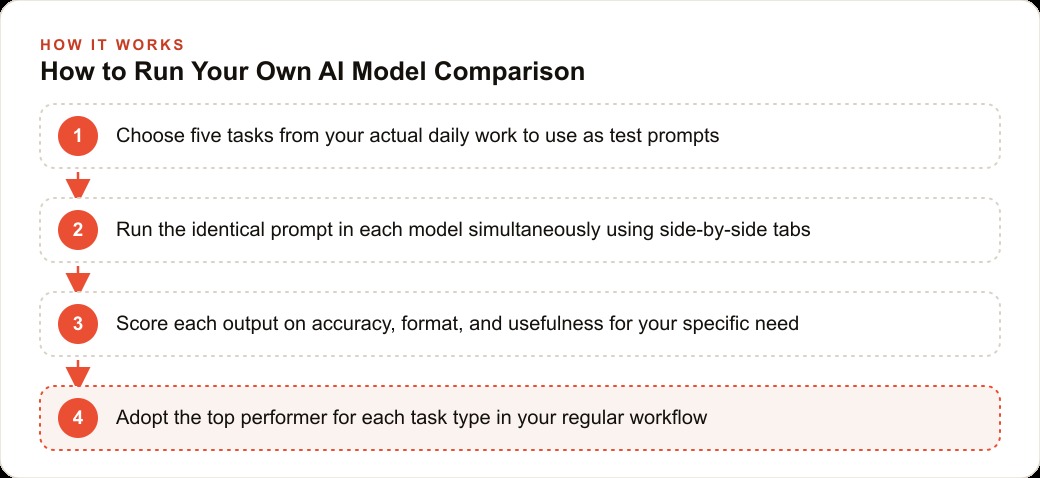
The correct evaluation process is to identify the five task types your business performs most frequently with AI assistance, write one representative prompt for each, submit those prompts to the two or three models you are considering, and score the outputs on usefulness for your actual work. That process takes less than a single afternoon and produces a ranking that is specific to your task mix rather than to someone else's benchmark design. Any business producing SEO and organic search content regularly should test specifically on their content format, target reading level, and tone requirements. Any business running Facebook and Instagram ad campaigns with AI-assisted copy should test specifically on their ad type, product category, and audience voice. The benchmark that matters is the one built on your own prompts, not on someone else's evaluation criteria applied to someone else's representative tasks.
The practical conclusion is to stop deferring the test. Run your own comparison now, using the prompts from your actual work. The comparison takes an afternoon, produces a result you can trust, and eliminates the guesswork that comes from applying someone else's benchmark to your business decisions.
Grok and Claude Had Specific Strengths That an Aggregate Ranking Makes Invisible
Both Grok and Claude scored meaningfully on specific task categories in ways that a single composite ranking flattens into apparent mediocrity. Claude's writing quality on tasks requiring sustained tone management, nuanced communication, and careful attention to implication consistently matched or exceeded the other models tested. Claude also produced the better memory architecture and handled long-document analysis tasks with more coherence across the full document rather than focusing on the most recent section, which is a common failure mode when a model is given a long document and asked to draw conclusions across the full text.
Grok performed well on creative tasks that required interpretive latitude, producing outputs that reflected genuine creative judgment rather than conservative interpolation between common patterns. Neither model dominated the composite ranking, but both would lead on a ranking built specifically around their strongest task types. For businesses with a specific daily AI use case, whether that is ad copy, technical writing, customer communication, or data analysis, testing each model on that specific use case reveals a different picture than any composite ranking provides.
The practical conclusion from a structured comparison like this is not a single winner. It is a routing table: a set of conventions about which model gets which type of task based on where each one actually leads on the work that matters for your specific business. For a business managing a CRM and website stack with AI assistance, the routing table might place document analysis and client communication drafting with one model, code generation and tool automation with another, and creative campaign ideation with a third. That routing table takes an afternoon to build with your own prompts and is more valuable than any benchmark ranking because it reflects your work rather than someone else's evaluation design, and it is updated as models improve rather than locked to a point-in-time snapshot.
The Instruction-Following Gap Is the Least Glamorous and Most Practically Important Difference
The final category in the evaluation was instruction-following accuracy: given a prompt with specific structural requirements, formatting rules, and constraint lists, which model follows all of them consistently across multiple outputs. The results separated cleanly. Models that passed instruction-following produced outputs that met every stated constraint on the first attempt. Models that failed either ignored one or two constraints entirely or followed them for the first paragraph and then drifted back to their default style by the second or third section.
For a business using AI to produce content that goes through a review and approval workflow before reaching clients or the public, instruction-following accuracy determines how much of the review step is catching and correcting AI errors versus catching actual content quality issues. A model that reliably follows formatting rules, length constraints, and tone requirements reduces the review workload to genuine quality judgment rather than mechanical correction. A model that regularly drifts from stated constraints doubles the review step. When testing models for your own business use, include an explicit instruction-following test in your evaluation: write a prompt with five or six specific constraints and see how many of them the model honors across three separate outputs. The results will tell you more than a benchmark score about which model fits your actual workflow requirements.
That is exactly what we do at AI DOERS. Book a private 30-minute call with Madhuranjan Kumar and we will map the fastest path to it for your specific business.
Book your call →
Madhuranjan Kumar
Madhuranjan Kumar brings 20 years of performance-marketing experience and has managed over $200 million in Facebook ad spend for brands across the United States and beyond. His expertise spans the full modern marketing stack: Meta, Google Ads, TikTok, email automation, CRM, and the websites that hold it together. At AI DOERS he turns that track record into lead-generation systems for businesses across every industry.