
ChatGPT vs Claude: Who Wins 10 Real-World Tasks?
Across 10 real-world tasks scored 1 to 10 by Google Gemini as a neutral judge, Claude beat ChatGPT on the combined score for writing, design, and teaching, while ChatGPT took strategy, debugging, and features.

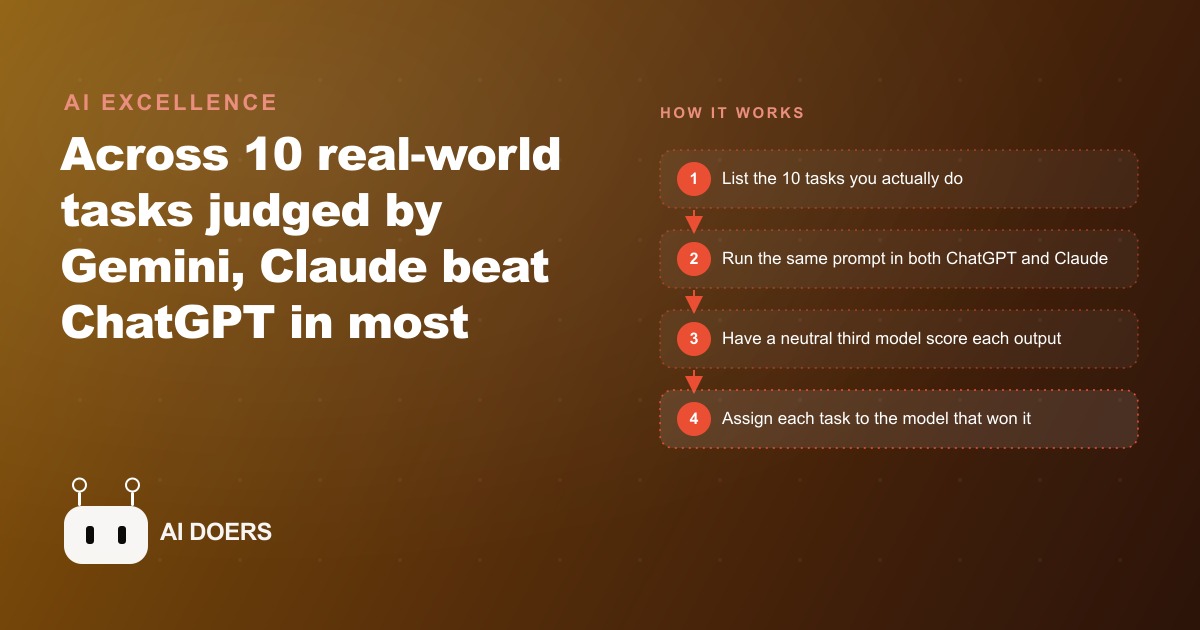
The smartest part of a recent ten-task head-to-head between ChatGPT and Claude was not the tasks. It was the judging. Instead of letting one person decide the winner based on personal preference, every output was scored from 1 to 10 by a third model: Google Gemini, neutral and consistent. That structural decision turned a subjective tool debate into something defensible, and it is the part every business owner should borrow before committing to any AI subscription.
GPT-5.5 with extended thinking ran against Claude Opus with adaptive thinking across ten real-world tasks. Here is what the scores actually tell you, task by task.
The Mini-App Build: Claude Wins on Completeness, Not Just Looks
Both models built a habit tracker inside the chat interface from the same prompt. Claude scored 9.4 against ChatGPT's 7.2. The gap Gemini cited was not just visual quality. It was feature completeness: Claude delivered a more fully realized app from the first output without needing follow-up instructions to fill in missing pieces. ChatGPT produced a working result but required additional prompting to reach a comparable state.
The practical signal for a business: if your team builds lightweight internal tools, dashboards, or utilities inside a chat interface, the model that delivers more of the spec on the first attempt saves meaningful iteration time. Those follow-up rounds add up across a week.
The YouTube Script: Claude Wins on Voice, Not Just Word Count
Both models wrote a sixty-second casual YouTube script. Claude scored 9.4 and ChatGPT scored 7.6. Gemini noted that Claude's output matched the conversational, low-hype tone of the brief more precisely, while ChatGPT's script read as slightly more formal and structured than the task called for.
For a business producing social content, short-form educational video, or any copy where the voice needs to feel natural rather than corporate, the model that can calibrate tone accurately saves an editing pass. Getting voice right on the first draft, rather than on the second or third, is where real time savings live in content workflows.
The Landing Page: Claude Wins by Actually Building the Page
This was the most instructive result in the entire test. Both models received an identical prompt asking for landing page copy. ChatGPT returned the copy as text. Claude returned a built landing page. Claude scored 9.8. ChatGPT scored 7.0, and the copy itself was rated lower separately.
That gap represents a fundamentally different interpretation of the same prompt. One model produced the narrowest possible output that fits the words. The other model inferred what the task actually required and delivered it. For any business where output completeness matters, the instruction to write landing page copy has an implicit expectation: that the output is usable as a page, not as a document. Claude met that expectation without being told to explicitly. ChatGPT did not.
The takeaway is not just the score. It is that the two models read the same instruction differently, and for landing pages, the difference between receiving text and receiving a built page is the difference between having the work done and having to do more work.
The Data Dashboard: Claude Wins on Accuracy and Summary Quality
Both models took messy input data and produced a visual dashboard with insights and recommendations. Claude scored 9.8. Gemini highlighted two specific advantages: corrected numbers, where Claude caught and fixed errors in the source data rather than passing them through to the output, and a cleaner executive summary that included specific, actionable recommendations rather than descriptions of the charts.
For a business turning raw data into weekly reports or management summaries, a model that catches numeric errors before they reach the output and structures its summary around decisions rather than observations is doing different and more valuable work. The score gap here reflects a qualitative difference in what the model understands its job to be.
The Video Storyboard: Claude Wins Board-Ready
Both models produced a commercial storyboard from the same brief. Claude scored 9.8 and ChatGPT scored 7.6. Gemini's specific note was that Claude's output was board-ready without hiring a designer, which is a precise and useful evaluation. It did not need structural revision or visual reframing before someone could hand it to a production team.
For a business producing video content, a storyboard that can go directly from the AI to the briefing room without an intermediate design pass saves a round of work that often runs several hours. The score difference here reflects production-readiness, not just creative quality.
The Business Strategy: ChatGPT Wins on Brief Adherence
This is where ChatGPT's strength appears most clearly. Both models received a prompt asking them to improve a subscription business model with a structured 90-day plan. ChatGPT scored 9.5 and Claude scored 8.0. Gemini's note was that ChatGPT followed the prompt more strictly, delivering numbered milestones against a timeline while Claude tended toward principles and frameworks.
For structured planning tasks where the output needs to match a defined format precisely: milestone lists, quarterly roadmaps, numbered action plans, tasks where deviation from the requested structure makes the output less useful regardless of its quality, ChatGPT's discipline around brief adherence is the relevant advantage. This is a task-type distinction, not a capability deficit on Claude's part. Claude produces excellent strategic thinking. It produces it in a slightly different form, and that form does not always fit structured planning deliverables as cleanly.
The AI Explanation for Non-Technical Audiences: Claude Wins on Accuracy
Both models explained how AI agents work to a non-technical business audience. Claude scored 9.5 and ChatGPT scored 8.5. Gemini's distinction was mechanically significant: Claude used a plan-act-observe framework that accurately describes how agents operate, while ChatGPT used a linear description that simplified the process in a way that introduced small inaccuracies.
For any business using AI-generated educational content for clients, prospects, or team members, the model that explains technical concepts accurately without oversimplifying is producing content you can stand behind. Content that introduces inaccuracies in service of simplicity is a liability rather than an asset, especially in contexts where the audience may act on the explanation.
The Debugging Task: ChatGPT Edges on Best Practices
ChatGPT won the light code-debugging task by producing an output that Gemini rated higher on best practices and code hygiene. Claude produced a working fix. ChatGPT produced a working fix that also addressed adjacent quality issues in the code without being asked to.
For a team that uses AI for code review, refactoring, or debugging, a model that extends its fix to include adjacent improvements by default may or may not be what the task requires. In contexts where you want a focused, contained fix, that behavior can introduce unwanted scope. In contexts where you want a model to flag and address quality issues it encounters, it is an advantage. Know which context applies to your team before treating this as a permanent signal.
The Mini-App Design Variation: Claude Needs One Extra Instruction
Without explicit style guidance, Claude produces the same visual aesthetic across multiple design tasks. ChatGPT varies its visual output by default. This surfaced clearly during the test and is worth knowing before you assume it is a fundamental limitation.
The fix is a single sentence in the prompt: vary the visual style significantly from any previous output, or specify the style direction directly. With that instruction, Claude produces visually distinct results. Without it, there is a tendency toward a consistent aesthetic that will look repetitive across a library of designs. This is not a reason to switch tools for design tasks. It is a prompt-writing habit worth building from the first design request.
The Features Comparison: ChatGPT Wins by Scope
ChatGPT won the features comparison category, partly because it offers native image generation that Claude does not currently provide. For any business whose AI workflow includes generating marketing images, product mockups, social visuals, or any other image-based output directly within the chat interface, this is a genuine capability gap rather than a style difference. No prompt adjustment closes it.
For these workflows, either routing image generation tasks through ChatGPT while using Claude for writing and analysis, or using a separate image generation tool alongside Claude, is the practical approach. Treating image generation as a separate layer in the workflow rather than a reason to use one model exclusively is the most efficient framing.
How to Run This Test for Your Own Business in One Afternoon
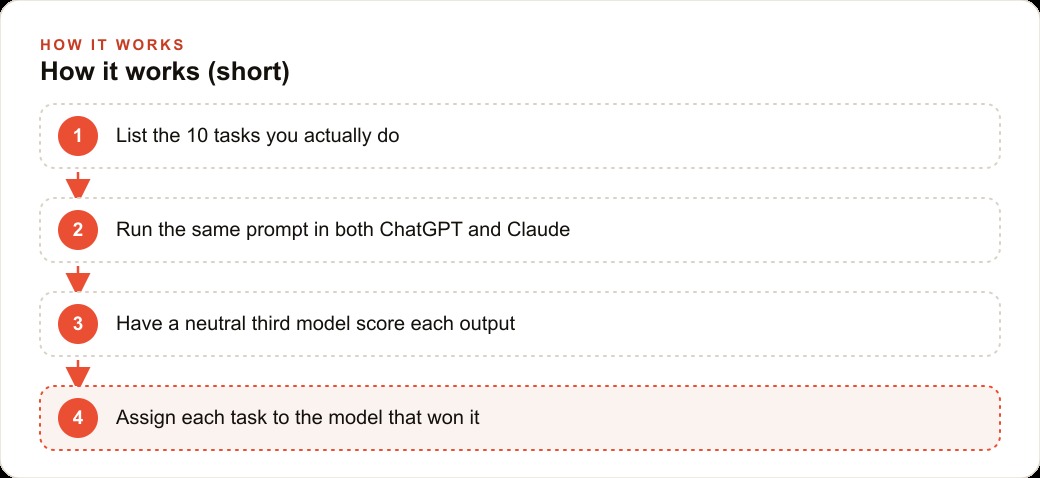
The structure is straightforward. List the ten tasks your team actually does most often in a typical week. The list should come from a real audit of how the team spends its time, not from what sounds strategic in a planning meeting. Write a prompt for each task that represents how you would actually describe it to a colleague: specific about the format, tone, length, and intended audience where those details matter.
Run each prompt in both tools with extended thinking enabled. Keep the prompt byte-for-byte identical between the two. Then take each pair of outputs and run a scoring prompt in a neutral third model, ask it to rate each output on a scale of 1 to 10 for quality, completeness, and fitness for the specific task. Save the scores and the outputs.
Based on the scores across all ten tasks, assign each task type to the model that won it. This becomes the default routing for your team: task type A goes to model A, task type B goes to model B. For a team doing this across their actual workload, the exercise typically takes three to four hours from start to a documented routing guide. That document becomes the standing answer to the which AI should we use question until the next major model release, at which point you run the test again.
For a practice with a three-person front office team and a practice manager who produces structured reports, the task list often splits roughly as follows. Writing tasks, patient communication drafts, FAQ content, and educational copy go to Claude. Structured planning documents, numbered action plans, and milestone-based timelines go to ChatGPT. Image generation requests go to ChatGPT or a dedicated image tool. The routing is documented, the decision is evidence-based, and new staff can trust the guide rather than relitigating the same debate from scratch every few months.
The specific scores from any external test are useful as a starting point. They are not a substitute for running the test on your own tasks, because the winning model changes depending on what the task actually is, and your tasks are not the same as someone else's. Build the habit of deciding by data rather than by the most recent benchmark headline, and the decision becomes cheaper to make every time you make it.
What the Scores Actually Tell You About Subscription Strategy
The ten-task format produces more than a ranked list of model preferences. It reveals a decision framework that changes how the subscription question should be framed. Most businesses ask which AI tool should we use, treating the answer as a binary. The test replaces that question with a more useful one: which AI tool should we use for this specific type of task?
When the answer to that question is documented across ten real tasks, a natural routing emerges. Some task types go decisively to one model. Others land close enough that either tool is acceptable and the decision can be made on availability or convenience. A few tasks reveal a meaningful gap that justifies routing them exclusively to the winning model even if it requires opening a second tab or maintaining a second subscription.
The routing document that comes out of the test is the practical deliverable. It replaces the ongoing team debate about which tool to use on any given day. Instead, the answer to every task type is already decided, documented, and available to anyone who joins the team. That institutional clarity compounds over time: a new hire who follows the routing guide starts producing better output immediately rather than spending weeks developing personal tool preferences through trial and error.
How Often to Re-Run the Test
The output from a ten-task comparison has a shelf life. AI models release significant updates on roughly six-month intervals at the current pace of development, and a major update can shift the score on any given task type substantially. A model that was clearly weaker on writing tasks in one version may narrow the gap or reverse it in the next. The routing document that was accurate in January may be partially inaccurate by July.
The practical cadence is a retest whenever either company ships a major model update, or at least twice a year as a maintenance habit. The retest does not need to be as extensive as the initial ten-task comparison. If the initial test revealed five task types where one model clearly dominated and five where results were close, the maintenance retest can focus specifically on the categories where the gap was meaningful, since those are the decisions most likely to change if model quality shifts.
Running the test on the same ten tasks each time also produces a longitudinal record. Over two or three retests, patterns emerge: certain task types are consistently won by the same model across versions, while others swing based on the specific release. That pattern is informative for long-term subscription decisions. If writing tasks consistently go to Claude across every retest regardless of model version, that stability makes the routing decision for writing tasks a durable one rather than something requiring frequent review.
The test itself takes less time with each iteration because the prompts already exist from the prior run. The main work is running each prompt again in both tools, noting the new scores, and updating the routing guide where the winner changed. For most businesses, a maintenance retest runs in about two hours. The cost of that two-hour investment is a routing guide that remains accurate rather than drifting into obsolescence as the tools evolve around it.
That is exactly what we do at AI DOERS. Book a private 30-minute call with Madhuranjan Kumar and we will map the fastest path to it for your specific business.
Book your call →
Madhuranjan Kumar
Madhuranjan Kumar brings 20 years of performance-marketing experience and has managed over $200 million in Facebook ad spend for brands across the United States and beyond. His expertise spans the full modern marketing stack: Meta, Google Ads, TikTok, email automation, CRM, and the websites that hold it together. At AI DOERS he turns that track record into lead-generation systems for businesses across every industry.