
ChatGPT Image Generation Hits One Million Users Per Hour and What Dental Offices Need to Take From a Week of Unprecedented AI Scale
When one million people per hour discover that AI can generate professional-quality images for free, the creative content landscape shifts overnight. For a dental practice trying to produce consistent, professional visual content on a constrained budget, this is the week that changed the cost equation.

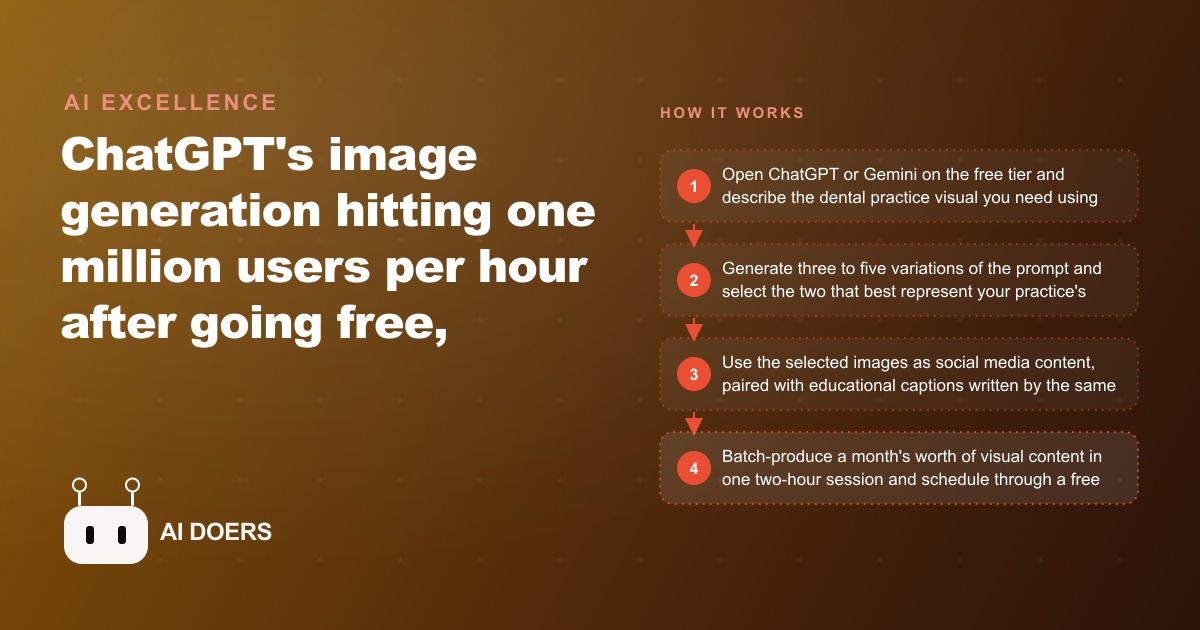
When OpenAI dropped the subscription requirement for image generation inside ChatGPT, the platform hit one million users per hour at peak. Many popular consumer apps never reach a million users in a whole month, so a million an hour, sustained for hours, is not a vanity number. It is a signal about where visual content is heading, and for a small business like a dental practice, reading that signal correctly matters more than the headline itself. The same week brought a record funding round, expanded free access to a frontier model, a browser-automation agent, and a major jump in AI video. Underneath all of it sits one idea worth taking apart carefully: the cost of professional-quality content just collapsed, and that changes the standard your customers hold you to.
One million users an hour is a signal, not a stat
The number matters because of what the adoption velocity implies. A million people an hour trying AI image generation for the first time is a million people who, over the next month, will post that content, use it in their own communications, and quietly recalibrate what they expect professional visual content to look like. The count itself is not the point for a dental practice. The point is that a very large population just gained the ability to produce clean, polished images for free, and that ability spreads a new baseline through every feed those people scroll.
This is the part most businesses miss when they see an AI headline. They ask whether they personally need the tool, when the more important question is what the tool does to everyone else's output, because that is what resets the standard they are measured against. Adoption at this speed is not a trend to monitor. It is a change in the environment your content already lives in.
The real shift is a rising visual baseline your patients bring
Here is the facet that actually affects a practice. A patient who follows ten businesses on Instagram, yours among them, is increasingly seeing AI-enhanced or AI-generated visuals from businesses in every other category. The visual standard they carry into evaluating any business's social presence is rising, whether or not anyone announced it. A practice still posting dim, poorly lit smartphone photos in this environment is not holding steady. It is falling behind a bakery down the street that moved this week, because the comparison a patient makes is not against last year's dental offices, it is against the best-looking content in their feed regardless of industry.
That reframes the opportunity. The value of free image generation to a practice is not that it saves a little money on a marketing assistant. It is that it lets a small business meet a visual standard that used to require a budget it never had. When professional-looking content becomes free to produce, the businesses that adopt it early get to look far more established than their size would suggest, and the ones that wait look dated by comparison. This is exactly the kind of foundation that makes both SEO and organic search and paid promotion work harder, because polished visuals earn the click that thin ones do not.
Why the free tier is not a temporary promotion
A reasonable worry is that the free tier is a bait-and-switch that vanishes once habits form. The record funding round is the reason to doubt that. Raising a very large round at a historic valuation signals that the company's investors expect it to stay at the frontier for a sustained period and that the commercial opportunity from that position justifies the price. For a practice building workflows on the free tools, the relevant implication is specific: the free tier is a customer-acquisition mechanism for a business that needs an enormous user base to justify its valuation, so the incentive is to keep the free tier accessible and to keep improving it. Building on free ChatGPT capability is not building on sand. It is building on one of the best-capitalized platforms in technology, with a strong commercial reason to maintain what it just gave away.
Frontier writing quality is now a free input too
The image story has a twin. Google expanded free access to Gemini 2.5 Pro and Flash, which means a model that ranks at or near the top of most independent benchmarks is now usable without a paid subscription, within usage limits. For a dental practice, the highest-quality AI writing, research, and analysis is available at no cost for typical daily volumes. The capabilities that matter most at that level are concrete: long-document analysis for reviewing insurance policy terms, treatment-plan language, and consent-form wording; multi-step reasoning for finding the clearest way to explain a complicated treatment recommendation; and research synthesis for staying current on the patient-facing health topics that keep coming up in consultations. With both the leading image tool and a leading writing model free for most task volumes, the tool cost of AI for a practice is effectively zero. What remains to invest is time, specifically the time to build good prompt habits and fold them into the workflow.
Browser agents take aim at the front-desk grind
Amazon Nova Act points at a different facet of the same week: agents that navigate web browsers autonomously to complete multi-step tasks. Instruct one to check a patient's deductible and remaining benefits on an insurance portal, or to compare a specific material's price across three dental-supply vendors and return a table, and it works through the sites the way a staff member would. For a practice, the immediate relevance is insurance verification and supply procurement, two chores that eat front-office hours navigating payer and vendor sites. An agent that can check multiple payer portals in sequence, pull the coverage data, and drop it into a standard template could recover several hours a week of staff time.
Nova Act is not yet a broadly available product, but the underlying capability already exists through browser-automation tools including Anthropic's computer-use offering and similar tools from other vendors, and the announcement signals that this capability is heading toward a price point that makes it widely accessible. The correct first step is a supervised trial on one specific task, insurance verification for a single payer's portal, with a human checking every output during testing, because browser agents make errors and incorrect verification data carries real consequences. Once verification is reliable, the recovered hours are the kind that show up in the CRM and website stack as faster follow-up and fewer dropped inquiries.
Video crosses the line from novelty to usable
The last facet is Runway Gen-4, a video model that produces cinematic-quality output at a meaningfully higher standard than previous versions, with better lighting realism, more natural motion, and rendering that is harder to spot as AI on a casual look. For a practice producing educational or marketing video, this enables quality that used to require professional production. Common formats include patient education about specific procedures, practice-tour clips for new-patient welcome sequences, and social content showing the environment. With a stronger model, a practice can generate photorealistic clips of dental scenarios, professional environments, and patient-interaction moments without scheduling camera time around actual appointments. An educational clip about cavity prevention can come from a text description with enough realism to serve as genuine patient education.
The limit here is not technical, it is ethical and legal, and it defines the whole approach. Any AI-generated video used in patient education or marketing must accurately represent the procedures and outcomes it depicts. A clip that makes a procedure look more comfortable, faster, or more effective than it usually is creates an expectation mismatch that hurts satisfaction and can raise concerns under patient-communication guidelines. Accuracy is not a nice-to-have on clinical content. It is the boundary that keeps the whole strategy safe to run.
Before the example, it is worth naming why these facets reinforce each other rather than standing alone. Free image generation, free frontier writing, cheap browser automation, and usable AI video arriving in the same week is not a coincidence, it is the shape of a market where the inputs to professional content are all trending toward zero at once. A practice that adopts one of them gets a modest lift. A practice that stitches several together, images for the feed, writing for the captions, automation for the back office, video for education, gets a compounding advantage, because each free input makes the others cheaper to act on. That is the real story of the week, and it is why the sensible response is a system rather than a single experiment.
A worked example: a dental practice's visual content system
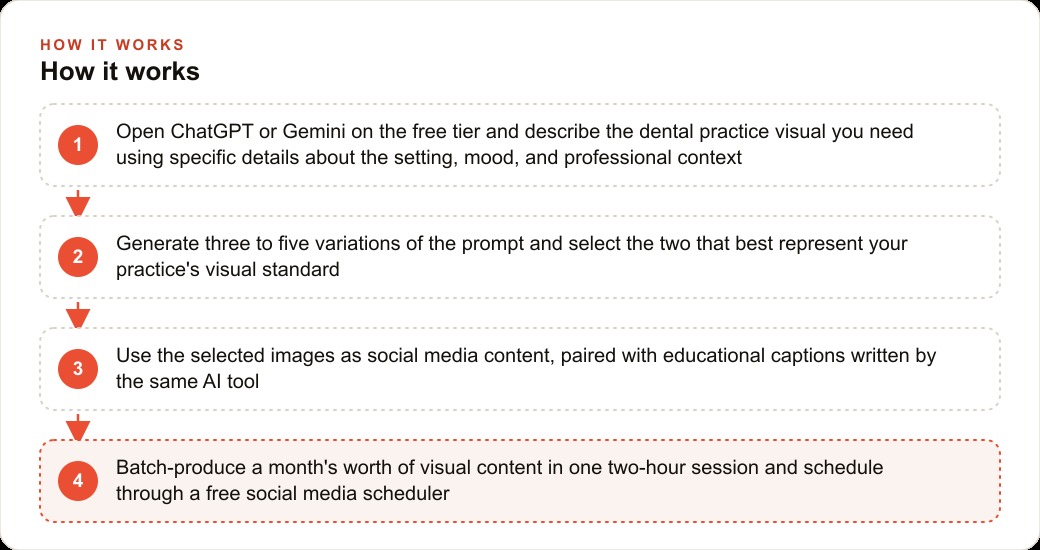
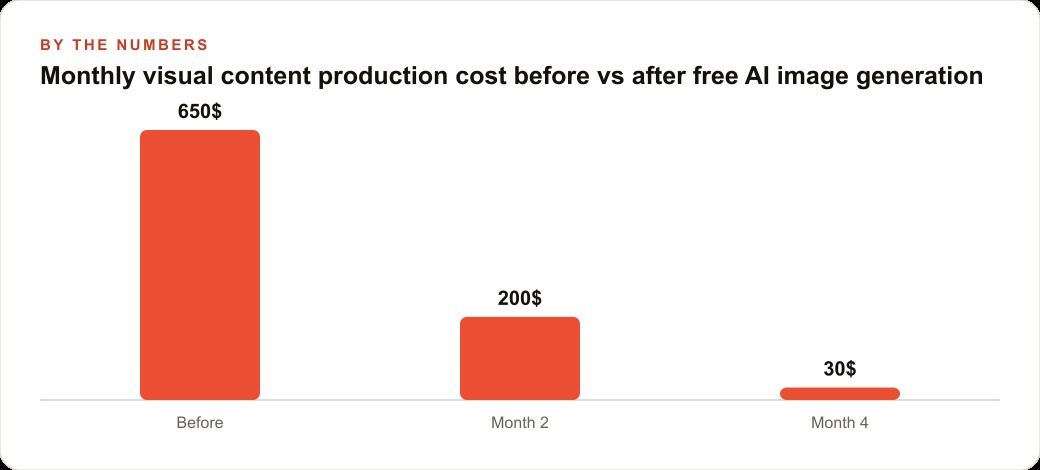
Put the week's tools together for a two-dentist practice with five staff and a small marketing budget, with illustrative numbers. The practice currently posts two or three times a week and pays roughly six hundred fifty dollars a month for a part-time marketing assistant. In month one, the practice manager spends two hours generating a library of thirty professional images with ChatGPT's free image generation: a dental team in a consultation setting, a clean modern operatory, a warm patient conversation, dental-education concepts, and the exterior in attractive light. None depict real patients, staff, or the actual space, so consent and staff approval are not needed. Each image is paired with a caption written on the free Gemini tier using a simple template that asks for a warm, genuinely helpful hundred-twenty-word caption ending in one low-pressure call to action.
In month two, the manager generates five two-minute educational videos with a Gen-4-class model, covering the five questions the dentists field most: the difference between a cleaning and a deep cleaning, when a cavity needs a crown versus a filling, what to expect during an implant, how long whitening lasts, and how to tell if gum disease is present. These are edited with a free editing tool using transcript-based trimming to tighten pacing. By month three the practice has thirty static images and five educational videos covering the most common patient decision points, and the total tool cost is about thirty dollars for this breakdown credits, with everything else on free tiers, down from the six-hundred-fifty-dollar monthly line and dropping toward a token amount as the library gets reused. The content runs on Instagram, Facebook, and the website's FAQ section, where educational clips on specific topics draw organic search traffic and the practice starts appearing for queries like when do I need a crown with credible visual content at the top of the page. The best-performing pieces are the ones worth putting a small budget behind on Facebook and Instagram ad campaigns, because you are amplifying content you already know resonates.
The line you cannot cross with clinical content
The deepest lesson of this week is that near-zero production cost raises the stakes on accuracy, not lowers them. The most serious mistake is using AI-generated images that depict clinical results, such as before-and-after whitening or orthodontic outcomes, without clearly disclosing they are AI-generated rather than real patient results, because dental and medical advertising faces specific accuracy requirements in most jurisdictions and this is a false-advertising risk more serious than in general marketing. Use AI images for atmosphere, education, and team culture, and use real patient photos with consent for outcome illustration. The second mistake is educational video that makes clinical claims the practice cannot substantiate, so a dentist should review any AI-generated script for accuracy before it publishes. The third is letting the visual style drift between batches, which makes the brand look inconsistent, so document a short visual brief and hold every batch to it.
This week the cost equation for professional content changed, and a practice can build a starting library in about two hours at effectively no tool cost. The discipline that makes it work is not technical skill, it is judgment about where AI content is appropriate and where accuracy and consent draw a hard line. You can stand up the first batch yourself following the steps above, or bring in someone to design the full patient-communication and content strategy, covering social, patient education, appointment follow-up, and review generation, so it holds together and stays on the right side of every clinical line.
That is exactly what we do at AI DOERS. Book a private 30-minute call with Madhuranjan Kumar and we will map the fastest path to it for your specific business.
Book your call →
Madhuranjan Kumar
Madhuranjan Kumar brings 20 years of performance-marketing experience and has managed over $200 million in Facebook ad spend for brands across the United States and beyond. His expertise spans the full modern marketing stack: Meta, Google Ads, TikTok, email automation, CRM, and the websites that hold it together. At AI DOERS he turns that track record into lead-generation systems for businesses across every industry.