
ChatGPT Image 2 Is a Step Change Because It Thinks While It Draws
OpenAI's new image model jumped more than 250 Elo over the prior best and now reasons while it generates, which means dense text, consistent characters, and one-shot drastic edits finally work. Here is what that unlocks for a real business.


Ten reasons ChatGPT Image 2 is a step change, not an update
I am Madhuranjan Kumar, and the simplest way to understand OpenAI's new image model is the scoreboard. On the main text-to-image leaderboard it did not just take the top spot, it took it by a margin that does not happen in normal updates, moving from 1270 to 1512, a jump of more than 250 Elo points over the previous best, Gemini's Nano Banana 2. Most model releases fight over a handful of points. A lead this size is not an iteration, it is a category shift. Here are the ten reasons that matter to a business that actually publishes images, each one concrete, with a worked example at the end.
1. It reasons before it renders
The headline capability is that Image 2 carries thinking-level intelligence and real world knowledge, essentially frontier reasoning applied to pixels. It fills in gaps using what it knows about the world, so you get smarter images with far less prompting. In practice this means you stop fighting the tool with ever-longer instructions and start directing it. The reason everything else on this list works is this one thing: the model understands what it is drawing instead of just matching patterns.
2. Dense text finally renders correctly
For years the tell of an AI image was garbled text, letters that dissolved into nonsense the moment you asked for words. Image 2 renders full infographics, handwriting, and chalkboard equations cleanly and accurately. This is not a cosmetic upgrade for a business. It is the difference between an image you can put a price, a label, or a tagline inside and one you cannot. The moment text is reliable, a huge category of marketing graphics moves from impossible to routine.
3. Characters and scenes stay consistent across images
Consistency used to break the instant you asked for a second image of the same subject. In one demonstration a chameleon dressed as a sailor stayed coherent across seven stitched frames, all the way down to fine detail. For anyone building a series, a brand character, a set of matching product shots, a multi-panel story, this is the feature that turns a single lucky image into a usable body of work. Your product or your mascot can now appear the same across an entire campaign instead of subtly mutating from frame to frame.
4. Drastic edits work in a single instruction
Older models resisted big changes after the first render. You could nudge, but ask for a real transformation and they fought you. Image 2 turned a flat, simple board into a hyperreal classroom scene in one edit. This matters because real creative work is iterative. You rarely nail the concept on the first try, and a model that lets you make sweeping changes in one step, rather than starting over, collapses the time between an idea and the finished version.
5. Photoreal detail down to individual grains
Asked to zoom in on rice at high resolution, every single grain came out distinct and real, to the point where you likely could not tell the result was generated. For product and lifestyle imagery this is the bar that matters. Detail that survives a close crop is what separates a hero shot you can put on a homepage from a blurry approximation you have to hide at small size. When the detail holds up under scrutiny, the image can carry real commercial weight.
6. Turn thinking on when accuracy is on the line
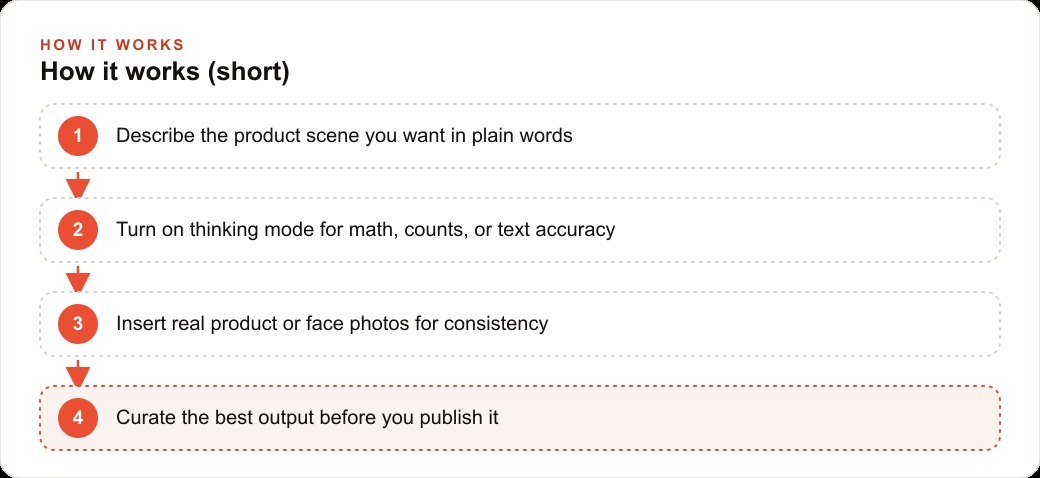
Here is a specific, practical rule that comes straight from the model's design. Asked to solve a board equation, it first returned the wrong answer with thinking off, then the correct one with thinking on. The lesson is direct: when you need exact counts, math, or precise text, turn thinking on. It is the difference between a confident wrong result and a correct one. For pure mood shots where speed matters more than precision, leave it off. Knowing which mode to use is a small skill that saves you from publishing a subtly wrong graphic.
7. Full game sprite sheets from a single prompt
In one shot it built a complete character sprite sheet with hit reactions, dashes, shields, and death animations. Even if you never build a game, this tells you something about the model's range and coherence, that it can produce a large, internally consistent set of related images from one instruction. For a business the same underlying ability shows up as consistent icon sets, matching illustration libraries, and unified visual systems produced in a fraction of the usual time.
8. Clean face and product insertion
It copy-pasted a real face into a polished thumbnail cleanly, even pulling in the correct associated branding. Insertion of a real face or a real product into an existing scene is excellent, which is exactly the capability an e-commerce or personal brand needs. You are not generating a fake approximation of your product, you are placing your actual product into any scene you can describe while keeping it accurate.
9. Flexible aspect ratios cover real publishing formats
You can generate across wide and tall layouts, from 3:1 banners down to 1:3 verticals. That single detail matters more than it sounds, because it means one tool covers the formats you actually publish in: wide website heroes, square social posts, and tall stories and reels, all from the same workflow. You are not cropping one shape to fit everywhere and losing the composition, you are generating the right shape for each placement.
10. Taste is still the human's job, and that is the whole point
The honest caveat is the most important item on the list. Better output is still slop without a human curating it, because the curation is done for other humans, and taste is what decides what actually wins. The tool floods you with options. The edge belongs to whoever knows which one looks good to a real audience. This is not a limitation to work around, it is where your value moves. The model handles production, you handle judgment, and judgment is the part that cannot be automated.
What a 250 point jump actually signals
Before the worked example, it is worth pausing on why the size of that leaderboard jump matters beyond bragging rights, because it changes how you should plan. When a model improves by a few points, the practical advice is to keep your existing workflow and enjoy slightly better output. When it jumps by more than 250 points, that advice is wrong. A leap that large means capabilities that were unreliable yesterday, dense text, character consistency, drastic edits, crossed the line from occasionally-works to dependably-works. And a capability that is merely possible is a curiosity, while a capability that is dependable is something you can build a business process around.
That is the real signal. Reliable text inside images means you can design a repeatable template for price graphics instead of generating and discarding dozens of garbled attempts. Reliable consistency means you can commit to a brand character across a whole campaign without gambling that frame four will look like frame one. Reliable drastic edits mean you can promise a client fast revisions without dreading the request. The jump is not just a better model. It is the moment a set of shaky tricks became a foundation you can actually stand on, and foundations are what you plan a workflow around. Treating this like a minor update means you leave most of the value on the table.
The workflow shift underneath the features
There is a deeper change hiding under the ten features, and it is the thing I would want a business to internalize. For years, working with AI images meant fighting the tool: writing longer and longer prompts, generating huge batches to fish for one usable result, and accepting that text and detail would probably fail. Because Image 2 reasons before it renders, the whole relationship inverts. You describe intent in plain language and direct rather than fight, and the model fills in the world knowledge you used to have to spell out.
That inversion is what makes a real creative engine possible instead of a slot machine. A slot machine gives you random results and hopes one is good. An engine takes a clear input and produces a dependable output you can refine. Once you feel that shift, you stop treating each image as a gamble and start treating the tool as a junior designer who reliably executes and hands back options for you to judge. The scarce skill stops being prompt-wrestling and becomes exactly what item ten described: taste, the judgment to pick the winner and kill the rest. Every business that publishes images should reorganize its creative process around that shift, because the old batch-and-pray habits waste most of what the new model offers.
A worked example: the e-commerce store
Let me run these capabilities through one concrete business, because a feature list only matters when it touches revenue. Most online stores live or die on product imagery, and shooting every variant in a studio is slow and expensive. With Image 2 I would start from one clean product photo and use insertion to keep the product perfectly consistent while changing the scene around it. The same coffee maker can sit on a marble kitchen counter, a rustic wood table, and a bright minimalist shelf, all on brand, all in minutes.
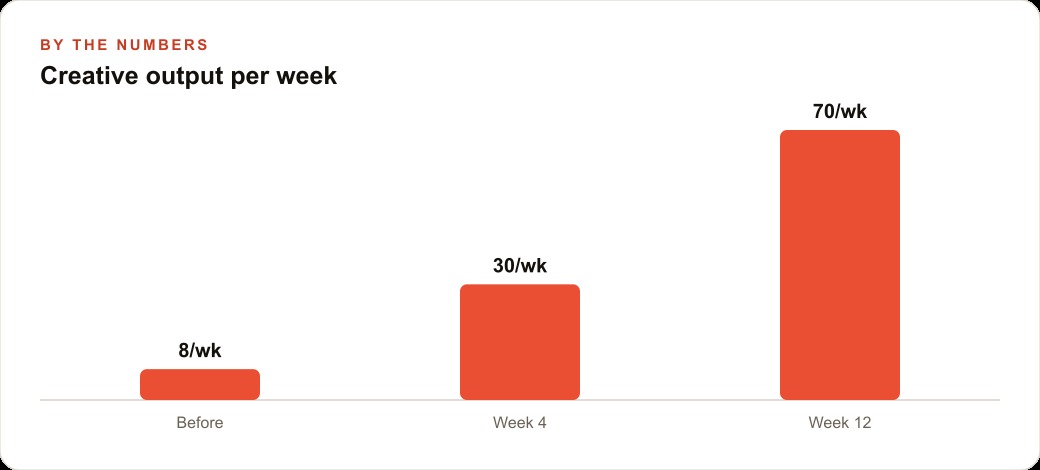
For seasonal campaigns I would generate the hero scene and drop the real product in, so a holiday banner, a summer sale graphic, and a tall vertical for stories all share the same look. Because dense text renders correctly now, I can put the actual price or the discount line inside the image and trust that it reads cleanly. When I need a comparison graphic or a spec card with exact numbers, I turn thinking mode on so the counts and figures are right. Put illustrative numbers on it: a small store that used to ship eight creatives a week could realistically push thirty or more within a month and keep climbing past seventy as the workflow settles. That volume feeds directly into Facebook and Instagram ad campaigns, where more fresh creative to test is one of the most reliable ways to keep cost per result from drifting up. The same images populate product pages that support SEO and organic search, and the whole library flows through the CRM and website stack that ties the store together. The owner stops being the bottleneck and starts being the curator.
How to build the habit
Start small and let the workflow teach you. Pick one product and one campaign. Write a plain description of the scene, then insert your real product photo so the item stays accurate. Turn thinking mode on whenever the image needs correct text, math, or object counts, and leave it off for pure mood shots. Generate a batch, then do the one step the tool cannot do for you, which is choose. Pick the two or three frames that genuinely look good to a human and discard the rest without guilt. Then build a simple library: save the prompts and reference images that worked, so your next campaign starts from a proven base instead of a blank box. Over a few weeks this becomes a repeatable creative engine rather than a series of one-off experiments.
The power is real, and so is the catch. The model gives you more and better output than ever, but taste, brand judgment, and knowing what your customers respond to are still human work. You can absolutely run this yourself, and many store owners should. If you would rather hand the setup, the prompt library, and the curation discipline to someone who does this every day, that is exactly the kind of thing I build for businesses, and a short call is the fastest way to see whether it fits yours.
That is exactly what we do at AI DOERS. Book a private 30-minute call with Madhuranjan Kumar and we will map the fastest path to it for your specific business.
Book your call →
Madhuranjan Kumar
Madhuranjan Kumar brings 20 years of performance-marketing experience and has managed over $200 million in Facebook ad spend for brands across the United States and beyond. His expertise spans the full modern marketing stack: Meta, Google Ads, TikTok, email automation, CRM, and the websites that hold it together. At AI DOERS he turns that track record into lead-generation systems for businesses across every industry.