
ChatGPT Apps Finally Work, Plus a Qwen Model That Splits Any Image Into Layers
ChatGPT apps now pull real tools like Spotify and Photoshop directly into the conversation instead of linking out, and a new Qwen image model can automatically separate any image into editable layers, making it useful for reverse-engineering existing graphic design.

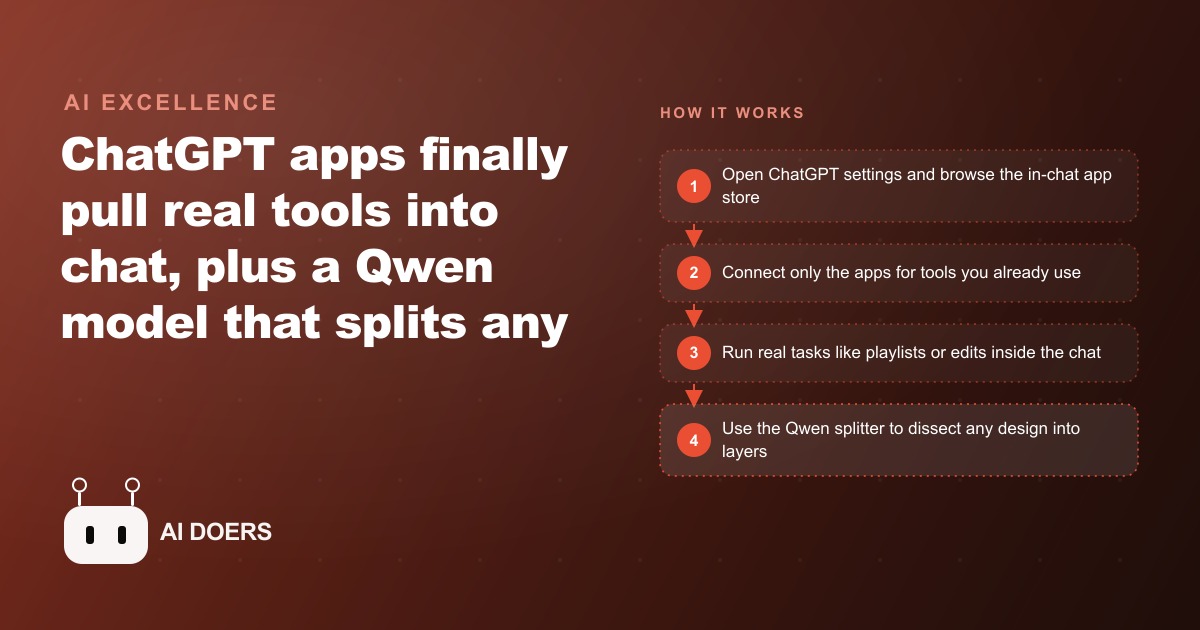
What ChatGPT apps changed about the nature of the tool itself and what the Qwen layer splitter reveals about the architecture underneath
I am Madhuranjan Kumar, and I want to explain two things that are connected in a way that is not immediately obvious: what the ChatGPT apps feature changed about how people relate to language models, and what the Qwen layer splitter analysis reveals about what is actually happening inside these models when they do the things we ask of them.
The connection is this: the apps feature makes language models feel more like products and less like interfaces. The layer splitter makes visible why that product feeling is coherent, because the underlying model has organized itself into functional regions that correspond to recognizable cognitive tasks. These two facts together explain something important about where the technology is going and what it means for the way you should think about building on top of it.
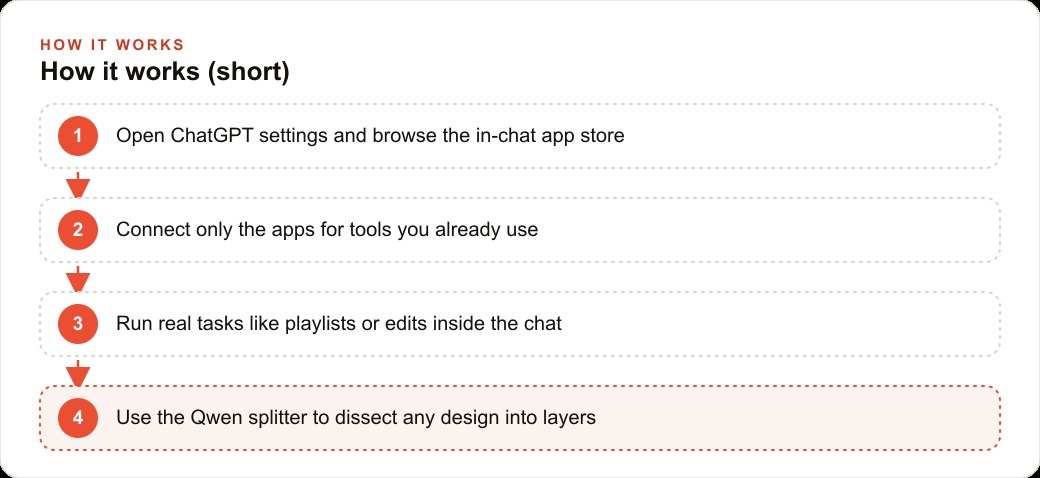
How the apps feature changed the user relationship with the model
Before the apps feature existed, using ChatGPT required the user to carry the full context of what they wanted the model to do. Every conversation started from scratch. If you had a specific workflow, a particular tone you needed, a set of constraints that shaped every output, you either wrote them out at the start of every session or you kept them in a document and pasted them in. The model was capable, but the capability was always accessed through a prompt-writing interface that required the user to maintain the configuration.
The apps feature inverted this. Instead of the user configuring the model at the start of each conversation, the model comes pre-configured for a specific purpose. An app that is set up to review legal contracts starts every conversation already knowing that it is reviewing legal contracts, what standard it should apply, what format the output should take, and what it should decline to address. The user does not write any of this. They just upload the contract.
This changes the user relationship from tool-use to product-use. A person using a word processor thinks of themselves as using a tool that requires skill and judgment to operate. A person using a configured ChatGPT app for contract review thinks of themselves as using a product that does a specific thing. The underlying capability is the same language model in both cases. The configured wrapper makes the interaction feel fundamentally different.
For a business building on top of language models, this distinction matters because the product experience is more durable than the tool experience. A user who has integrated a configured app into their workflow does not switch away when a better underlying model becomes available. They switch when a better configured product becomes available. The configuration layer is where the user relationship is built.
What the Qwen layer splitter analysis revealed about internal model organization
The Qwen layer splitter is a research approach that analyzes where specific types of processing happen inside a large language model by examining the activation patterns at different layers of the model's architecture. The finding that emerged from this analysis is that the model is not homogeneous across its layers. Different layers are doing demonstrably different things.
The early layers process the basic properties of the input: what language is it in, what kind of text is it, what are the tokens and their relationships. The middle layers handle the semantic and reasoning operations: what does the text mean, what is being asked, how do the pieces of the input relate to each other. The later layers generate the output: what words to produce, in what order, at what level of specificity.
This organization is not something that was designed into the model by its creators specifying which layers should handle which functions. It emerged from training on large quantities of text. The model organized itself this way because this layered organization produces better predictions. The functional specialization is a consequence of the training objective, not a deliberate architectural decision.
Why spontaneous specialization matters for practical model use
The fact that model specialization emerged rather than was designed has a specific practical implication: the model's capabilities are not uniformly distributed across tasks in the way a general-purpose tool would be. The model is specifically strong at the types of tasks that its training produced functional specialization for, and specifically weak at tasks that require capability the training did not organize.
The categories where language models show strong specialized capability based on layer analysis include: pattern completion in the early layers, semantic reasoning in the middle layers, and fluent output generation in the late layers. The categories where they show weak capability include tasks that require genuine memory of facts learned in training rather than reasoning from provided context, and tasks that require multi-step physical-world reasoning where each step changes the state of something outside the model.
For practical applications, this means that the tasks where AI models are most reliable and most valuable are the tasks that match their emergent specialization: reading and analyzing a provided document, generating structured output from a clear specification, identifying patterns in text, and synthesizing information from multiple provided sources. The tasks where they are least reliable are the ones that require them to apply world knowledge they learned in training to novel situations, especially situations involving specific numbers, dates, or chains of causation.
How the apps feature and the layer splitter connect to a broader architectural trend
The apps feature and the layer splitter analysis are both pointing at the same underlying architectural shift: language models are developing persistent, organized, internal structure that makes them behave more like specialized systems than like general-purpose statistical generators.
The apps feature makes this specialization externally visible through the configuration layer: a model configured for a specific task produces more reliable output for that task because the configuration aligns the model's general capability with a specific use case. The layer splitter makes the internal structure of the specialization visible: the model has organized itself in ways that map onto cognitive functions.
The direction this points toward is models that are increasingly designed to be configured rather than used raw, and increasingly understood in terms of their internal functional organization rather than just their external behavior. A model that has demonstrably organized middle layers for semantic reasoning can be evaluated for reasoning task performance in a more principled way than a black-box model whose internal organization is unknown.
What this means for building durable AI-powered products
For a business building products on top of language models, these two developments suggest a specific architectural approach. Build the configuration layer as the primary product surface, not the raw model interface. The configuration layer is what captures the user relationship, what persists across model upgrades, and what differentiates your product from a direct competitor using the same underlying model.
The configuration layer includes: the system prompt that defines the model's role and constraints, the knowledge base that provides the specific information relevant to your domain, the output templates that structure the model's responses in the format your users need, and the integration points that connect the model's output to the systems your users actually work in.
When OpenAI releases a new model that is better at reasoning, your configured product benefits automatically because the new model runs your existing configuration and produces better results. Your users do not experience a model upgrade. They experience their product getting better. This is what makes the configuration layer the durable component of an AI-powered product: it captures the value specific to your use case while remaining compatible with improvements in the underlying capability.
The layer splitter insight reinforces this approach from a different direction. If the model has organized itself into functional regions corresponding to specific cognitive tasks, then configurations that align with those functional regions will be more reliable than configurations that work against them. A system prompt that asks the model to do things that align with its demonstrated areas of emergent specialization will produce more consistent output than one that asks it to do things the specialization does not support.
These are not abstract architectural considerations. They produce measurable differences in output quality and user reliability for anyone building products on top of these models, and understanding them is the difference between a product that gets better as the underlying technology improves and one that requires constant revision as model behavior changes in unpredictable ways.
The organizational capability that emerges from the configuration layer investment
Organizations that invest in building well-configured AI applications for their internal processes are not just reducing labor costs on specific tasks. They are building a configuration library that represents the organization's operational knowledge in a form that can be tested, improved, and reused. This is a different type of organizational asset than a documented process.
A documented process requires a human to read and interpret it, apply judgment about how it applies to the current situation, and execute it with the variability that human interpretation introduces. A well-configured AI application embodies the same process in a form that executes consistently every time, produces auditable output, and can be evaluated quantitatively over a large number of runs to identify where it fails.
The Qwen layer analysis suggests that this consistency is not accidental. The model's emergent functional specialization means that a configuration aligned with the model's demonstrated areas of competence produces a consistent output distribution across a wide range of inputs. This consistency is what makes the configuration layer an organizational asset: it is not just a tool that works, it is a defined specification of how a specific task should be executed that can be maintained, versioned, and improved over time.
The organizations building these configuration libraries now are accumulating a form of operational knowledge capital that will be difficult for competitors to replicate later. The competitor who starts building the library in 12 months will find that the early organization has not just the working configurations but the failure case documentation, the prompt tuning history, and the integration architecture that produces the consistency the competitor is only beginning to develop.
Why the conversation about which model is best is less useful than the conversation about which configuration is best
The practitioner or organization that is optimizing their AI-powered workflow against the question of which model is currently the best is optimizing against the wrong variable. The model rankings change on a 45-minute timescale. The configuration quality, the system prompt precision, the knowledge base coverage, and the output format design change only as fast as the practitioners responsible for maintaining them invest in improving them.
A well-configured application running on a second-tier model will produce more reliable, more useful output than a poorly-configured application running on the current market leader. The model is the engine. The configuration is the vehicle. Investing in a better engine while neglecting the vehicle design produces less improvement than investing in a better vehicle design while keeping the engine constant.
This is the specific counterintuitive lesson that the ChatGPT apps feature and the Qwen layer splitter analysis together provide. The apps feature shows that configuration is the user-facing product, not the underlying model. The layer splitter shows that the model has organized itself in ways that make good configurations reliably effective. Together they point at the same conclusion: the practice of configuration design is the high-leverage investment, and it is an investment that compounds over time as the configurations are tested and refined.
The practitioner who builds the configuration layer as their primary professional asset is also building something with a different relationship to model improvements than a practitioner who builds raw-model expertise. Raw-model expertise depreciates with each release cycle. Configuration expertise appreciates because the quality of your configurations compounds with each iteration of testing and refinement, regardless of which model runs them.
The model is the raw material. The configuration is the craftsmanship. Invest in the craft.
That is exactly what we do at AI DOERS. Book a private 30-minute call with Madhuranjan Kumar and we will map the fastest path to it for your specific business.
Book your call →
Madhuranjan Kumar
Madhuranjan Kumar brings 20 years of performance-marketing experience and has managed over $200 million in Facebook ad spend for brands across the United States and beyond. His expertise spans the full modern marketing stack: Meta, Google Ads, TikTok, email automation, CRM, and the websites that hold it together. At AI DOERS he turns that track record into lead-generation systems for businesses across every industry.