
GPT-5 Is Here: What It Actually Does and What It Means for Your Business
OpenAI released GPT-5 on August 7, 2025, and the jump in reasoning depth, accuracy, and practical capability is real. Here is what changed and how to put it to work immediately.


The Admin Hours That Never Made It Into the Business Plan
When the owner of a plumbing service company plans out a week, the plan looks like service calls. Dispatch a technician, diagnose a problem, complete the repair, move to the next address. Four technicians, thirty to eighty calls per month depending on the season, and a revenue model built entirely around time and materials.
The plan does not include the hours that happen around those service calls. Twelve to fifteen hours per week, every week, consumed by email replies, estimate drafts, response to online reviews, follow-up messages to customers who had asked for a quote and then gone quiet, and the coordination overhead of scheduling and rescheduling in a business where emergency calls disrupt the calendar without warning.
Those hours are not exceptional to this company. They are the standard administrative burden for any service business at this scale. They are also hours that, in most companies like this one, belong to whoever is least occupied at any given moment, which is usually the owner. The owner drafts the estimates because the owner knows the rates. The owner writes the review responses because the owner knows the context of each job. The owner handles the follow-up because the owner does not fully trust anyone else to communicate in the voice the business has developed over years.
The problem with this arrangement is not that the owner is doing the work. The problem is that at a billing rate equivalent of one hundred and fifty dollars per hour for the time the owner could otherwise spend on sales calls, site assessments, and technician training, twelve to fifteen hours of administrative work represents eighteen hundred to twenty-two hundred dollars per week in opportunity cost. That number is invisible in the business plan because it appears as "overhead" rather than "lost revenue."
GPT-5 changed the arithmetic.
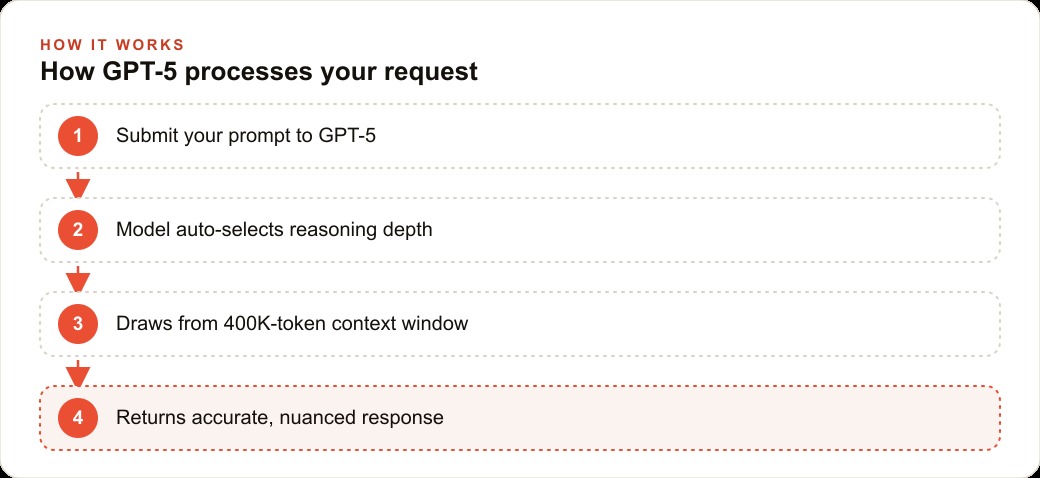
Week One: Testing the Inbox With Four Hundred Thousand Tokens of Context
The owner did not begin with a full workflow redesign. The first test was simple: take three emails that had been sitting in the inbox for more than a day and see what happened when they were pasted into GPT-5 alongside the rate card.
The three emails were not complex: a service request for a water heater inspection from a homeowner who mentioned they had two children and were worried about safety, a complaint from a customer who felt the bill for a drain cleaning had been higher than quoted, and a request from a property management company for the company's standard pricing on common apartment repairs.
The rate card, with materials pricing, labor rates by service type, and the standard language for warranty terms, went into the same context. Then the prompt: draft a response to each of these three emails, matching the tone the company uses with residential customers, using the rate card for any pricing references, and noting where a follow-up call would be more appropriate than a written reply.
The output for all three took under ninety seconds. The water heater reply was warm, specific about what the inspection would cover, and included the standard rate without being transactional in tone. The complaint response acknowledged the customer's concern, offered a clear explanation of how the quote had been structured, and suggested a conversation to review the invoice together rather than escalating in writing. The property management response matched the company's standard format almost exactly.
The owner made minor adjustments to two of the three and sent them. The entire process took eleven minutes for three emails that, written from scratch, would have taken forty-five minutes.
The context window is what made this work. GPT-5's four-hundred-thousand-token window means the rate card, the service history notes, and the specific details of each job can all be present simultaneously when the reply is being drafted. The model is not guessing at the rate for a water heater inspection. It is reading the rate card. The output is accurate because the source material is present, not because the model has memorized pricing that might have changed.
Month Two: The Estimate Turnaround That Changed Client Expectations
By the second month, the workflow had expanded beyond email replies to the task that had previously been the most time-intensive: generating written estimates for jobs that required a scope of work description along with pricing.
Before GPT-5, producing a formal written estimate for a larger job, a bathroom remodel rough-in, a full water heater replacement with permit coordination, a commercial building drain snake with a follow-up camera inspection recommendation, required the owner to sit down with the job notes, the rate card, and a template document, and spend twenty to twenty-five minutes producing something professional enough to send. That was not an unreasonable amount of time for a single estimate. It became a significant burden when four or five estimates were requested in the same week.
With GPT-5, the process changed. The owner took notes on a service call or a phone consultation the same way as before. Those notes went into GPT-5 alongside the rate card and a brief instruction: produce a formal written estimate in the company's standard format, itemizing materials and labor separately, including the standard warranty language for each service category, and noting any permit requirements based on the scope described.
The output time was under two minutes. The owner reviewed the estimate, which was accurate to the rate card and correctly flagged the permit requirement for the water heater replacement, made one edit to specify the brand of unit being proposed, and sent it.
Estimate turnaround dropped from an average of twenty-two hours to under ten minutes. Not because the owner was spending more time on estimates, but because the drafting step, which had been the bottleneck, was handled by a model that had the rate card and the job notes present simultaneously.
The effect on the business was visible within weeks. Two customers who had been comparing quotes from multiple companies mentioned that the speed of the estimate was a factor in choosing this company. One of them said directly that the other company had quoted a similar price but had taken three days to produce the written estimate, which made her wonder how responsive they would be during the actual job.
Ninety Days, One Clear Number
At the ninety-day point, the owner did a simple accounting of where the time had gone.
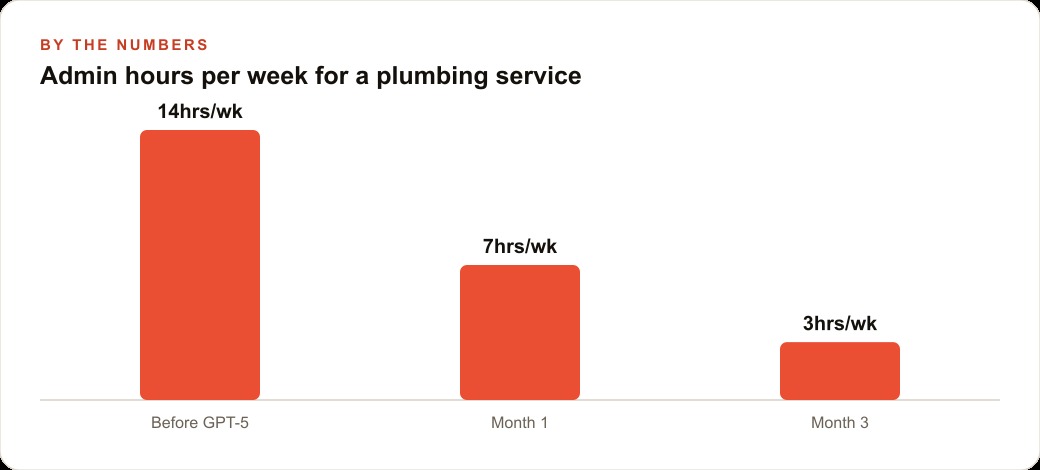
Before GPT-5: twelve to fifteen hours per week on email replies, estimate drafts, review responses, and follow-up messages. Average across the period: thirteen hours per week.
After GPT-5 at the ninety-day mark: approximately three hours per week on the same categories of work. The three hours were review time, not drafting time. The owner was reading outputs, making adjustments, and sending. The drafting was done.
Ten hours per week recovered. At the owner's equivalent billing rate of one hundred and fifty dollars per hour for productive work, that represented fifteen hundred dollars per week in recovered capacity.
The cost of the GPT-5 Pro subscription: two hundred dollars per month.
Net recovery at the ninety-day point: approximately sixteen thousand dollars in recovered time against six hundred dollars in subscription cost. That is not a precise figure because the recovered time was not all converted into direct billing. Some of it went to a long-deferred conversation with a commercial property management company that resulted in a maintenance contract. Some of it went to a Saturday that the owner had not worked in four months.
The subscription paid for itself in the first two weeks of the first month and continued to pay for itself every week after that. The question after ninety days was not whether the tool was worth the cost. The question was where else in the business the same leverage existed.
What the Pro Tier Gives You That the Free Version Cannot
GPT-5 is available on a free tier, and the free tier is genuinely capable for basic tasks. For a service business running the kind of workflow described here, the Pro subscription at two hundred dollars per month adds two things that matter specifically to how the tool is being used.
The first is extended reasoning mode. When the reasoning effort parameter is set to high, GPT-5 takes additional steps before producing the output. For a simple email reply, this is unnecessary. For a complex multi-item estimate where the scope of work spans three different service categories with different labor rates, different permit requirements, and different warranty terms, the extended reasoning mode produces estimates with fewer errors and better internal consistency. The owner noticed this specifically on a commercial job estimate that involved five separate line items across two service categories. The first pass on medium reasoning required two corrections. The equivalent estimate on high reasoning required none.
The second is the context discipline that the Pro tier enables through the verbosity parameter. In practice, this means the owner can specify at the prompt level whether the output should be short and direct, appropriate for a text message to a customer confirming a service window, or fully detailed, appropriate for a formal estimate with complete scope of work. Without this parameter, outputs tend to default to a middle length that is sometimes too long for brief communications and sometimes too compressed for formal documents. With it, the calibration is handled in the prompt rather than by manual editing of the output.
The free tier is a reasonable starting point for a business owner who wants to test whether GPT-5 fits their workflow. The Pro tier is the version worth committing to if the primary use case involves estimates, formal correspondence, and the kind of context-heavy writing that requires the full rate card, the job notes, and the company's standard language to all be present at once.
The model does not replace the judgment that makes a plumbing company trustworthy. The owner still knows whether a job was done well. The owner still knows when a customer's complaint is legitimate versus unreasonable. The owner still knows when an estimate needs an on-site visit before any number can go in writing.
What the model replaced was the blank-page friction that had been attaching itself to every piece of writing the business needed to do, and turning thirty minutes of administrative work into two minutes of review. Over ninety days, that difference accumulated into a number that is hard to argue with. ## The Ninety-Day Number and What It Said About the Pro Tier
After ninety days, the owner ran the calculation that the decision about subscription tier deserved. The ten recovered hours per week at a value of one hundred and fifty dollars per hour, reflecting the billing rate of the owner's time on the highest-value service activities, produced a weekly return of fifteen hundred dollars. The monthly return was approximately six thousand dollars. The Pro subscription cost two hundred dollars per month.
The ratio was thirty to one. That ratio was not primarily a function of GPT-5's raw capability. Any recent large language model, configured appropriately, would have produced a similar time recovery on the specific tasks the owner was using it for. The ratio reflected the fact that the owner had been spending twelve to fifteen hours per week on activities, drafting quotes, writing review responses, composing follow-up emails, that a well-configured language model can execute in minutes with appropriate context.
What the Pro tier added over the free tier, in practice, came down to two differences that were invisible in the first week and apparent by month two. The extended context window allowed the full rate card, the job notes, and the company's standard estimate language to be present simultaneously in a single prompt, which eliminated the need to split complex estimates into separate prompts and then reconcile the outputs. Without the extended context, estimates for larger jobs required a back-and-forth session that took longer and produced inconsistent results. With it, the prompt was longer and the output was complete on the first generation.
The second difference was the reasoning depth on edge-case scenarios. When the owner described a job with unusual access constraints, a non-standard scope combination, or a customer situation that fell outside the patterns the model had seen in the provided context, the extended reasoning mode produced an estimate rationale that addressed the specific complicating factor. The free tier produced a generic answer that required manual override. For a business where most jobs are routine, this distinction is minor. For a business that sees a non-standard scenario every third or fourth job, the difference is compounding across the full week.
That is exactly what we do at AI DOERS. Book a private 30-minute call with Madhuranjan Kumar and we will map the fastest path to it for your specific business.
Book your call →
Madhuranjan Kumar
Madhuranjan Kumar brings 20 years of performance-marketing experience and has managed over $200 million in Facebook ad spend for brands across the United States and beyond. His expertise spans the full modern marketing stack: Meta, Google Ads, TikTok, email automation, CRM, and the websites that hold it together. At AI DOERS he turns that track record into lead-generation systems for businesses across every industry.