
ChatGPT 4o Images and Gemini 2.5 Pro: What Changed and How to Use Both for Your Business
One week produced two genuinely significant AI releases: ChatGPT 4o image editing and Gemini 2.5 Pro with a one-million-token context window. Here is what each tool can actually do and how a service business can put them to work right now.

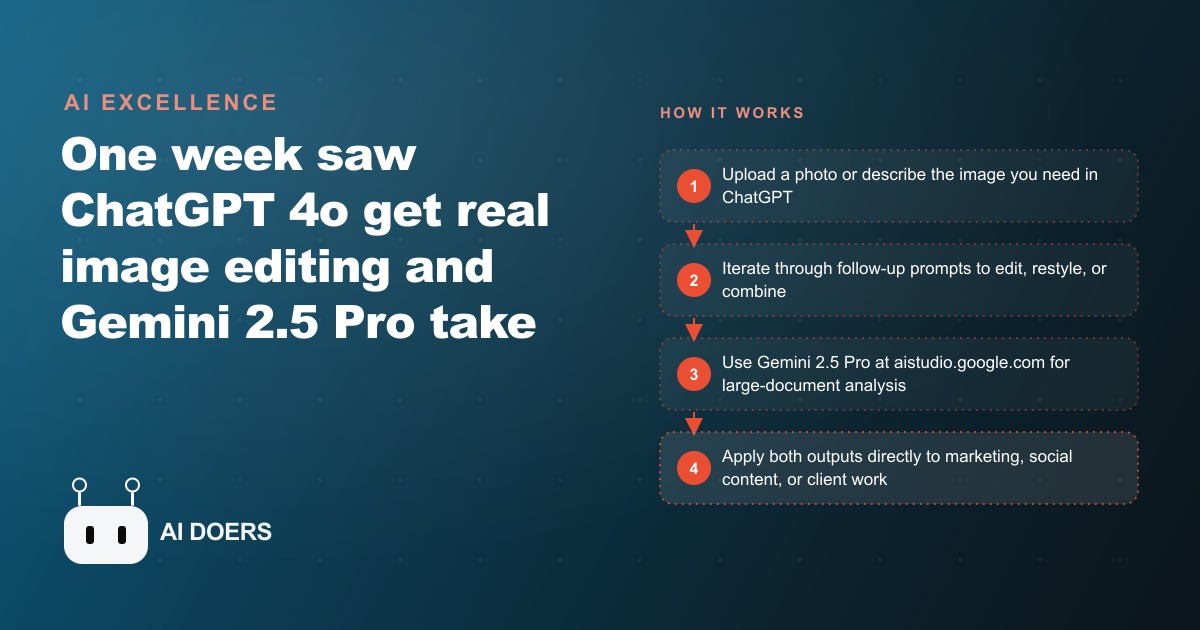
One week in late March 2025 produced more practical change for small business content production than the previous six months combined. Two releases defined it: ChatGPT 4o image generation and Gemini 2.5 Pro. I am Madhuranjan Kumar, and instead of running through each tool's spec sheet, I want to name the eight specific things that actually changed for a business trying to produce content, run ads, or do serious research. Not what the tools can theoretically do. What changed for real work.
ChatGPT 4o now edits images through follow-up conversation
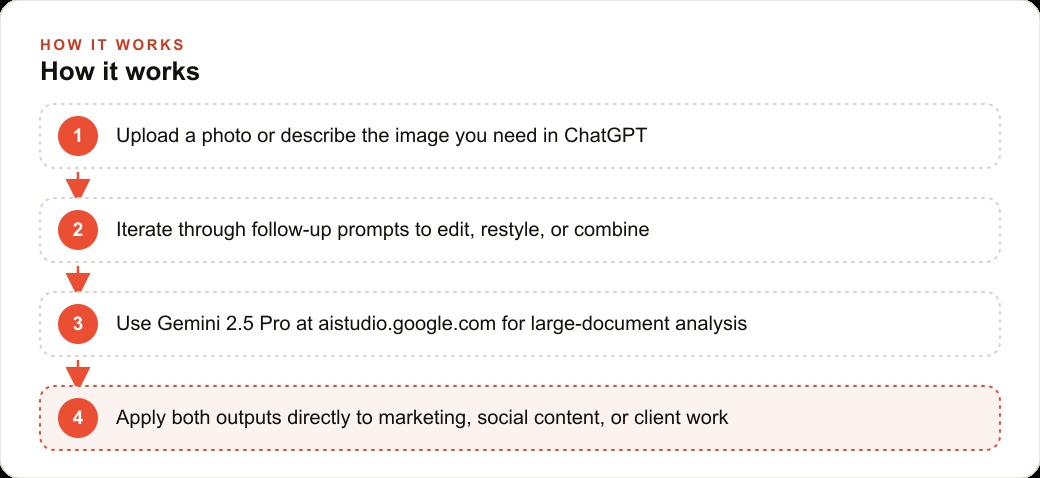
The defining shift in the 4o image release is not generation quality. It is the edit loop. Before this, generating an AI image meant starting fresh each time. You could not say "change the background to white" or "make the text bolder" and have the model apply that change to the existing output. Now you can. A follow-up message is a direct edit instruction on the previous result. This changes AI image generation from a slot machine you keep pulling until something decent comes out into an actual iterative design process. You generate a first version, see what is off, describe the fix, and get the corrected version. That loop is faster than any traditional design iteration cycle because there is no file to export, import, and re-upload between rounds.
For businesses running Facebook and Instagram ad campaigns, this means a creative that almost works is now one follow-up sentence away from working. The old answer to a near-miss creative was to start over or accept what you had. The new answer is a single edit instruction.
Readable text inside AI-generated graphics is finally reliable
Every AI image tool before this had the same Achilles heel: text inside images came out garbled, misspelled, or visually wrong in ways that made it unusable for professional purposes. Infographics, product labels, thumbnail headlines, promotional banners with call-to-action copy: all of them required a separate design step to add the text correctly after generation. The 4o model handles text inside images at a level of reliability that makes that workaround unnecessary for most commercial purposes. An infographic with a headline, three labeled steps, and a footer citation can be generated in one prompt and published without correction. That is not a small improvement. It eliminates an entire step in the content production workflow.
Gemini 2.5 Pro ranked first on the blind human taste test
LM Arena is the benchmark worth paying attention to because humans evaluate responses without knowing which model generated them. There is no benchmark gaming possible on a blind taste test run by real people. Gemini 2.5 Pro moved to the top position on LM Arena at the time of release, ahead of every other available model. The practical meaning of that result is not that Gemini is definitively "the best" for every task. It is that the output quality is high enough that real people, reading without any preconceptions about which model wrote the response, preferred it. For businesses generating customer-facing copy, research summaries, or content for SEO and organic channels, that preference signal matters more than most technical benchmark numbers.
A one-million-token context window became free on the same day
Gemini 2.5 Pro launched with a one-million-token context window available at no cost through Google AI Studio. One million tokens is approximately 750,000 words. That is enough to feed an entire year of email correspondence, every customer support ticket from the past quarter, a competitor's full published content library, or a 43,000-token four-hour video transcript, all in a single model call. The significance is not just the size. It is the combination of size and price. Large context windows existed before this release, but at costs that made them impractical for routine business use. Free makes this a tool any business can reach for on any research task regardless of document volume.
Complex interactive apps now build from a single prompt
Users demonstrated in the same week that Gemini 2.5 Pro could generate working Rubik's Cube simulators, flight simulators, zombie games, and particle physics simulations from single prompts. The mechanism is the same one that makes the large context window valuable: a model that can hold enormous amounts of structured information in working memory without losing coherence can also hold the full logical structure of a complex interactive application while writing it. The business implication is the same as it is for Claude's one-shot game demo: bounded, describable tools for your own business are now within reach of a clear brief and a single generation session.
A hand-drawn thumbnail sketch translates directly into a finished graphic
One of the most practically useful demonstrations from the 4o launch week was the thumbnail workflow. Someone sketched a rough layout on paper, annotated it with handwritten notes indicating where each element should appear, photographed it with a phone, and uploaded the photo to ChatGPT with the instruction: generate a hyperrealistic YouTube thumbnail based on this sketch. The model read the sketch, interpreted the layout, and produced a finished graphic. Not a clean version of the sketch. A produced image that matched the compositional intent of the sketch while replacing the rough drawing with a polished visual. The follow-up prompt refined specific elements. This workflow compresses what used to be a multi-hour process involving Photoshop, a stock photo subscription, and manual text placement into a conversation that takes twenty minutes.
The old multi-tool workflow for consistent AI image editing is now obsolete
Before this release, producing AI images with specific requirements, such as a real person's face held across multiple images, a consistent brand aesthetic, or accurate text inside the image, required a technical stack. ComfyUI, ControlNet models, LoRA weights, and IP Adapters were the tools that serious users assembled to achieve controlled, consistent AI image output. Each of those requires installation, configuration, understanding of how they interact, and ongoing maintenance as models update. The 4o model handles the most common versions of those requirements through plain conversation. The technical stack is still more capable at the far end, but the practical use cases that most businesses needed it for no longer require it. The barrier that kept consistent AI image editing inside a developer skill set dropped to a browser conversation.
A full week of competing free tools also launched in the same seven days
The same week saw Ideogram 3.0 release with strong text-in-image handling, Luma AI add magic doodle-to-video generation and a second-generation video model, and Pika Labs ship face insertion into animated video clips. Each of these releases would have been notable in isolation. Together they represent a competitive response to the ChatGPT image release that produced multiple strong free tools in parallel. For a business building its content workflow in this environment, the practical outcome is that the free tier of capable AI image and video tools is richer than it has ever been. The ceiling on what zero-budget content production looks like moved up substantially in one week, and the businesses that updated their workflow to reflect that move are producing better content at lower cost than the ones still using the tools they had in January. The compounding advantage of being early in adopting each wave of tooling is not dramatic in any single week. Across a year, it accumulates into a meaningful gap in content quality and production cost between the teams that kept current and the ones that fell a tool cycle behind.
That is exactly what we do at AI DOERS. Book a private 30-minute call with Madhuranjan Kumar and we will map the fastest path to it for your specific business.
Book your call →
Madhuranjan Kumar
Madhuranjan Kumar brings 20 years of performance-marketing experience and has managed over $200 million in Facebook ad spend for brands across the United States and beyond. His expertise spans the full modern marketing stack: Meta, Google Ads, TikTok, email automation, CRM, and the websites that hold it together. At AI DOERS he turns that track record into lead-generation systems for businesses across every industry.