
How the New Wave of Hardware From CES 2026 Is Changing HVAC Field Operations
Autonomous drones, AR glasses, and intelligent sensor networks debuted at CES 2026 at price points that make them relevant for HVAC service businesses this year, not in ten years.
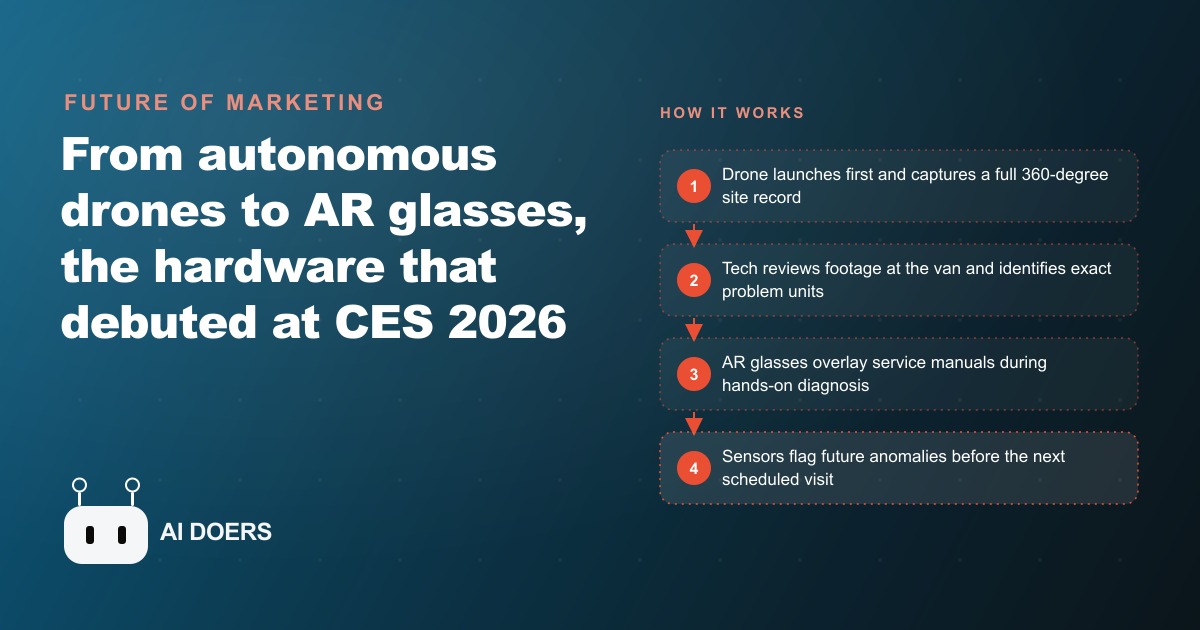
At CES 2026, a category of field hardware crossed the line from consumer novelty into genuine operational tool, and the price tags are what made it real. Autonomous drones, augmented reality glasses, and sensor-rich systems debuted at numbers a small or mid-size service business can put in a single equipment line this year, not in ten years. For HVAC companies squeezed on labor, fuel, and customer expectations, that timing matters more than the spec sheets.
The clearest example is the Anti-Gravity A1 drone, which won a Best of Innovation award at the show. It captures 8K video in a full 360-degree sphere at 249 grams, deliberately just under the 250-gram FAA registration threshold. The pilot only has to fly. The camera records everything in every direction at once, and the final frame is chosen later, in post, from the complete recording. Written by Madhuranjan Kumar, this piece looks at what actually shipped, why it lands now rather than someday, and the concrete first move for an HVAC operator who wants the margin gain without buying hype.
What actually crossed the threshold this year
Three products tell the story. The A1 drone turns a rooftop inspection into a review-later exercise: fly first, capture the whole site, then decide exactly where to climb. The XREAL 1S AR glasses connect to almost any screen-output device and project what feels like a 500-inch floating display, with a real-time 3D conversion chip built in, at around 450 dollars, cheaper than the previous generation. The Strut EV1 autonomous wheelchair mapped its environment, navigated obstacles, and took early pre-orders around 5,300 dollars, far below what anyone expected from hardware that capable.
The pattern across all three is identical. Capability that used to demand expensive specialized equipment now arrives at prices a service business can absorb in a single fiscal year. That is the actual news. Not that drones or AR exist, but that the price-to-capability ratio finally makes sense for a company with a fleet of vans rather than a research budget.
Why the timing lands now, not someday
HVAC companies are under cost pressure from several directions at once. Technician labor has gotten more expensive. Fuel and vehicle costs have climbed. Customer expectations for same-day and next-day service have tightened. In that environment, any tool that shaves time off a job site, or cuts the number of return visits needed to diagnose and fix a problem, flows straight to margin. When the tool also costs less than a mid-range set of gauges, the decision stops being speculative.
The counterexample at the same show was robotics. Over 40 companies brought humanoid robots to the floor this year, and the gap between the hardware and the software was visible in person. One unit collapsed face-forward onto a journalist during a live demo. Another folded a single shirt slowly enough to make the point that robotic dexterity is nowhere near replacing a human in a mechanical environment. The lesson for operators is to separate what is ready from what is merely impressive. Invest in drones, AR glasses, and sensor networks now, and keep the robots on a watch list, not a budget line.
Where the hardware slots into an existing workflow
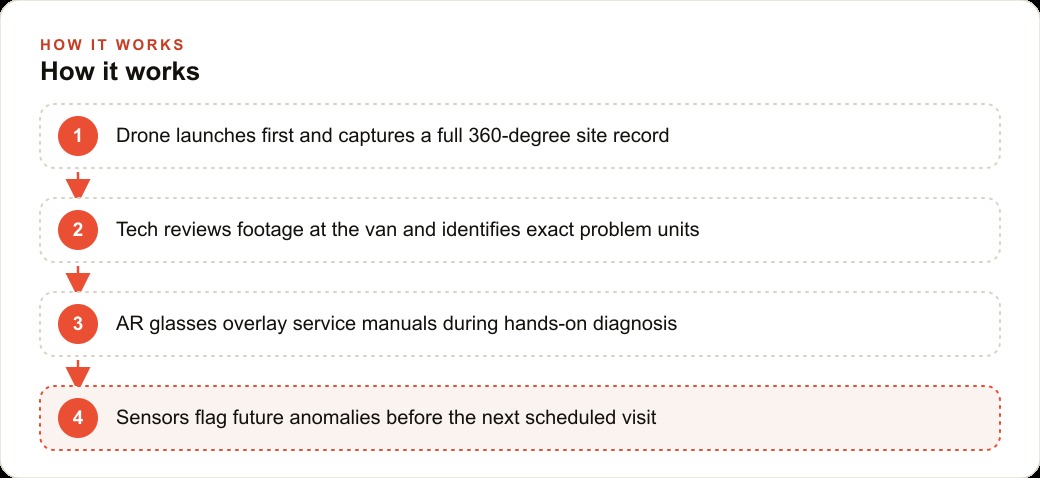
The value shows up at specific chokepoints where time or safety is the limiting factor. Drones replace the first phase of a rooftop inspection. A technician can fly the A1 over a commercial building's rooftop units in under eight minutes and capture a complete 360-degree record of every condenser, duct penetration, and unit housing. Back at the van they review the footage, identify the units that need attention, and go straight to them. No ladder setup for a preliminary scan. No time spent walking the whole roof before knowing where the problem is.
AR glasses slot into the diagnostic phase. The XREAL 1S connects to a phone or tablet, and the service manual, wiring diagram, or error-code lookup appears as an overlay in the technician's field of view, hands-free, while both hands stay on the equipment. Diagnostic time drops sharply when the tech does not have to stop, set down tools, find a page, and return to the unit.
Sensors are the third layer. The same redundancy philosophy that makes the Strut safe, with lidar, cameras, ultrasonic, and time-of-flight sensors working together, maps directly onto HVAC predictive maintenance. A sensor network on commercial rooftop units can catch refrigerant pressure anomalies, motor vibration changes, and airflow irregularities weeks before they become failures. That shifts the company from a reactive break-fix model to a subscription maintenance model, with steadier revenue and stronger retention. Monthly monitoring revenue per commercial account commonly runs 150 to 400 dollars, and the alert data gives the company a documented reason to stay in front of the customer between visits, which quietly protects renewal-cycle accounts from competitors.
Who benefits first
The businesses that gain most immediately are HVAC companies with commercial accounts, where inspection and maintenance cycles are regular, the job sites are consistent, and the return on cutting technician time compounds across many contracts. Residential operators with high call volume can use drones on large properties and homes with awkward roof access. Commercial mechanical contractors handling many equipment types benefit most from the AR overlay, because their documentation load across brands and models is the heaviest. New-construction subcontractors benefit from drones during rough-in and final inspection, where a complete site record heads off disputes over what was installed and where.
The pattern extends beyond HVAC to plumbing inspection, commercial electrical maintenance, roofing assessment, and facilities management for any organization running a large physical plant. The common thread is a business that sends skilled technicians to job sites repeatedly and bleeds margin on inspection time, documentation, and return visits caused by incomplete first diagnostics.
A worked example: a 90-day pilot at a commercial HVAC company
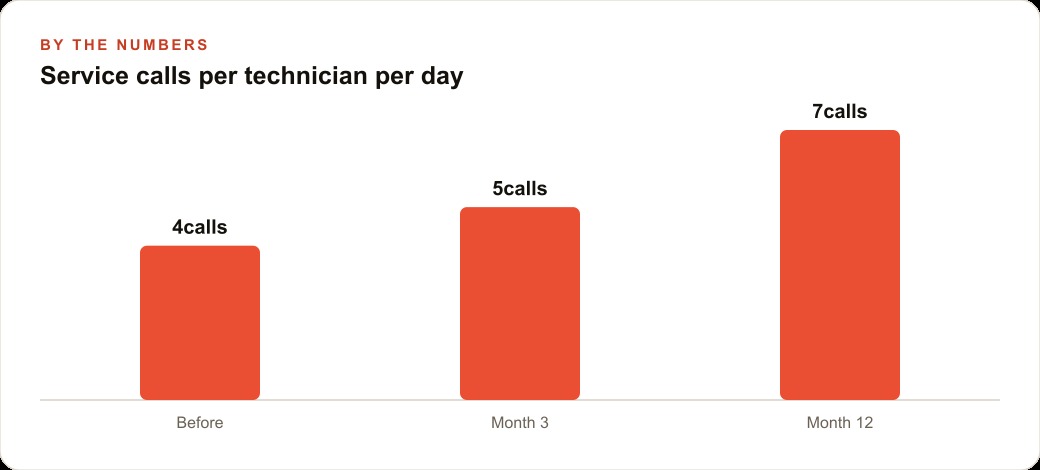
Consider a mid-size commercial HVAC company running 230 active maintenance contracts across a metro area. Before the pilot it averaged 4.1 service calls completed per technician per day, with about 95 minutes of site time per job and 28 percent of calls requiring a return visit for parts or additional diagnosis. Those are illustrative figures, but they are the kind of numbers this hardware moves.
The company piloted two tools over 90 days. First, it added a drone to the lead technician's kit for commercial rooftop accounts. Each rooftop visit began with a five-minute flight that captured a full record and identified visible problem areas before the tech climbed. Site time per commercial visit fell by an average of 22 minutes. Second, it configured AR glasses for the two most experienced technicians on complex multi-unit accounts, loading wiring diagrams and manufacturer manuals for the 14 brands they serviced most as overlays. Diagnostic time on unfamiliar equipment dropped by about 35 percent.
After 90 days, average calls per technician per day moved from 4.1 to 5.6, and the return-visit rate fell from 28 percent to 17 percent. The combined effect of more calls and fewer returns added the equivalent of roughly 1.4 technicians of productive capacity without a single hire. At an average loaded technician cost near 85,000 dollars a year, that is on the order of 119,000 dollars in effective productivity, against a hardware investment for both pilots of under 8,000 dollars. The freed capacity also gives the sales side something to sell, and the documented sensor catches become proof points that strengthen both SEO and organic search content and the company's local Google Ads, because every prevented breakdown is a real story a prospect can trust.
Adoption is a process change, not a purchase
The hardware only pays off if the workflow changes around it, and that is worth stating plainly because it is where most rollouts quietly fail. A drone that lives in a van but never changes how a technician approaches a roof delivers nothing. The change that unlocks the value is a rule the whole team follows: on a commercial rooftop account, the drone launches first, the tech reviews the footage at the van, and only then does anyone set up a ladder. That sequence, fly first and climb second, is the actual product. The device is just what makes it possible.
The same is true of the glasses. AR only saves time if the manuals and diagrams the technicians need are loaded and organized before the job, so the overlay appears the instant they look at it rather than after five minutes of searching. Spend an afternoon building that document library once, keyed to the brands you service most, and every diagnostic after that is faster. Skip it, and the glasses become an expensive novelty. The lesson across all of this hardware is the same: the equipment is cheap and the process change is where the return lives.
The documentation you capture becomes an asset
There is a second-order benefit that is easy to miss on the first pass. Every drone flight produces a complete visual record of a site, and every sensor network produces a stream of data about equipment health. Over time that becomes a genuine asset. When a customer disputes what was installed or when a unit failed, you have footage and readings, not memory. When you bid on a renewal, you can show the customer exactly what your sensors caught before it became a breakdown, which is a far stronger pitch than a generic promise of good service.
That documentation also feeds the parts of the business that grow revenue rather than just protect margin. A library of real before-and-after inspections and prevented failures is exactly the kind of proof that makes marketing believable. It gives substance to the company's SEO and organic search content and credibility to its local Google Ads, because the claims rest on documented work rather than adjectives. None of this requires a data team. The footage lives in a folder, the sensor alerts arrive as simple notifications, and the value comes from actually using them in customer conversations and renewals. The companies that treat the record as clutter to delete miss the point. The ones that treat it as evidence, of work done and disasters averted, turn a cost-saving tool into a selling tool without spending another dollar.
The concrete move, and the mistakes to sidestep
Start with one drone and one commercial account, your densest rooftop contract, the building where you spend the most time in preliminary inspection. Fly the first three visits under the old workflow and time yourself, then introduce the drone protocol and measure the time saved. That single data point, replicated three times, tells you exactly what the device is worth to your operation. Next, identify the equipment categories that eat the most diagnostic time, load those manuals into a document app on the AR glasses, and run a 30-day pilot with your lead tech measuring first-visit completion. For sensors, begin with your highest-value accounts and propose monitoring as a premium maintenance tier, using the caught anomalies as a trust-building sales tool that renews contracts without competitive bidding.
Three mistakes waste the investment. The first is buying hardware without changing the workflow around it, so a drone sits unused in a van; the fix is a short training protocol and a clear rule that the drone launches first. The second is confusing demo quality with deployment readiness, which is exactly what the falling robots at CES illustrated; do not budget for robotic labor before you see it running at scale. The third is ignoring the FAA weight threshold and choosing a heavier drone for slightly better specs, which adds registration burden that erases the efficiency gain. Deploy what is ready today and improve iteratively. The flying cars and eVTOL aircraft on the same show floor are interesting, but the drone and glasses in your budget this quarter are what actually change your numbers.
If you want help modeling the return for your specific commercial operation or setting up the drone and AR protocols, that is the kind of operational planning I work through with service businesses, and you can bring me in to handle it.
That is exactly what we do at AI DOERS. Book a private 30-minute call with Madhuranjan Kumar and we will map the fastest path to it for your specific business.
Book your call →
Madhuranjan Kumar
Madhuranjan Kumar brings 20 years of performance-marketing experience and has managed over $200 million in Facebook ad spend for brands across the United States and beyond. His expertise spans the full modern marketing stack: Meta, Google Ads, TikTok, email automation, CRM, and the websites that hold it together. At AI DOERS he turns that track record into lead-generation systems for businesses across every industry.