
Can AI Employees Really Outperform Human Ones? Inside a Live Sales Agent
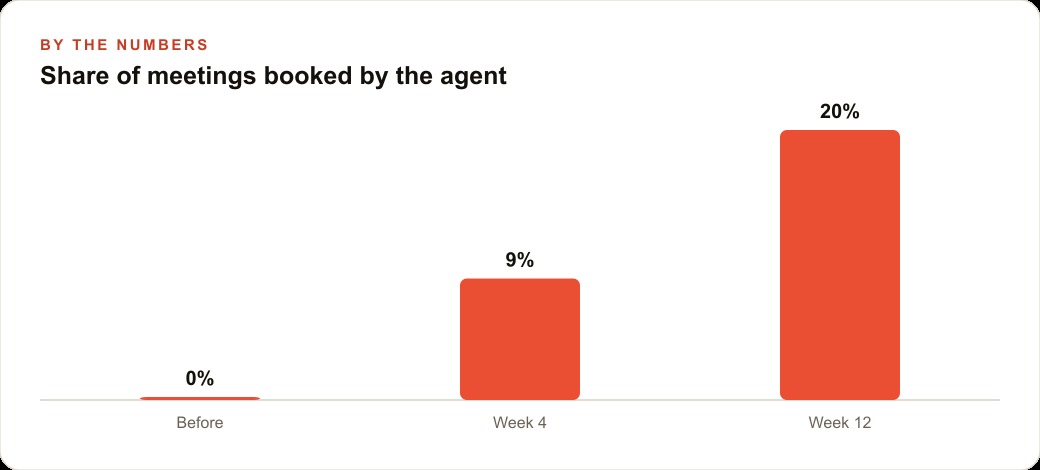
A deployed AI sales BDR agent already books roughly 20 percent of a team's meetings, and it does it by splitting one job across specialized agents that share memory and can be corrected with a prompt.

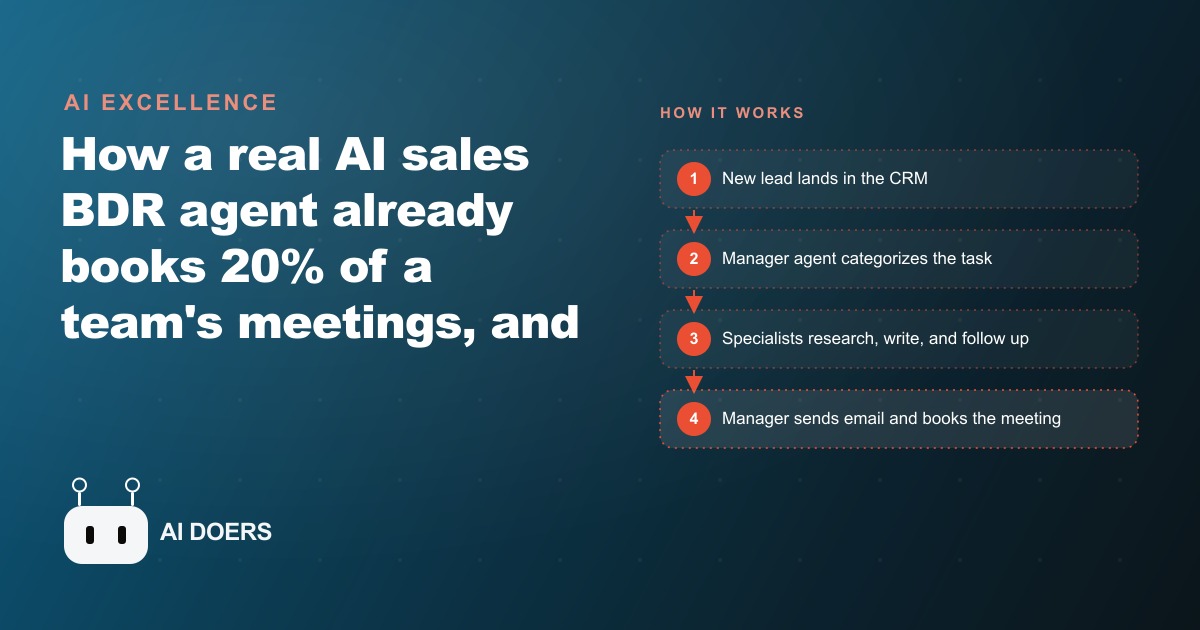
I'm Madhuranjan Kumar, and I want to walk through something that sounds like hype but is, in practice, a straightforward engineering and economics story: a multi-agent sales system that handles the full outbound business development job and books roughly 20 percent of a team's meetings without a human BDR in the loop.
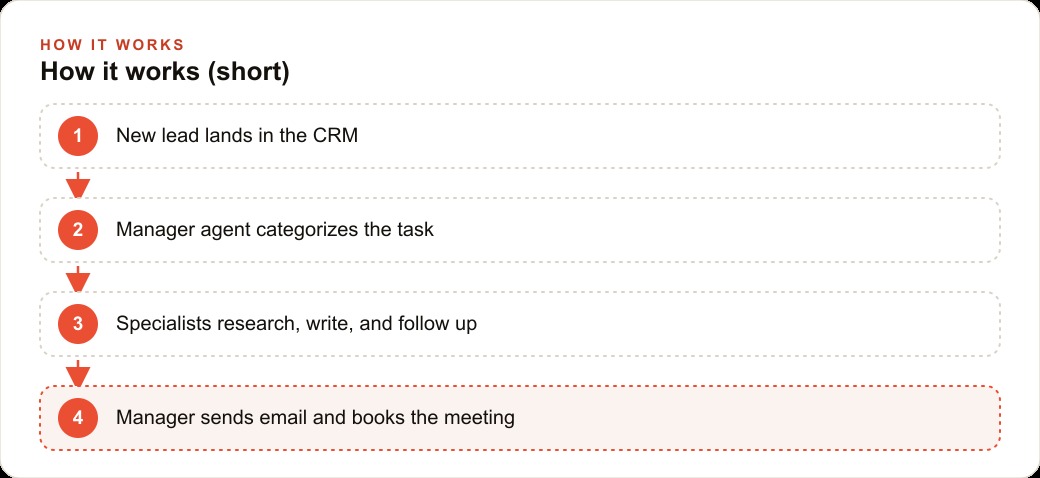
The deployment I am describing is not a demo. It is a production system. It researches leads, writes personalized outreach, sends follow-ups, answers replies, logs every interaction to the CRM, and books meetings into the calendar when a prospect agrees to connect. It has been running long enough that the team has data on its performance, and the data is clear enough to draw structural conclusions about where multi-agent systems outperform human employees and where the limits are.
The answer is nuanced, but the structural advantages are real, specific, and worth understanding. Here are seven of them.
1. Every Decision in the Pipeline Is Rewindable
A human BDR makes dozens of micro-decisions every day: which version of the subject line to use, how long to wait before following up, whether to send a break-up email or a softer check-in, how to respond to a reply that is ambiguous between mild interest and polite dismissal. These decisions happen in real time, are rarely documented, and are essentially invisible to the manager reviewing outcomes.
The multi-agent system logs every decision with its inputs. When the prospect researcher agent chose this description of the prospect's recent initiative over three other formulations it generated, that choice is recorded alongside the inputs that produced it. When the follow-up specialist agent chose a 72-hour follow-up interval rather than a 48-hour one, based on signals in the prior message's engagement, that is recorded. When the inbox manager agent classified an ambiguous reply as "mild interest, continue nurturing" rather than "not interested, remove from sequence," the classification rationale is available.
This rewindability has compounding value that is not obvious until you have operated one of these systems for a few months. When a particular sequence of decisions leads to an unusually high conversion rate in a segment, you can examine the exact decisions that produced it and deliberately replicate them. When a sequence leads to a high spam-complaint rate, you can trace back to the decision that triggered the pattern. Human BDR performance is opaque by comparison. You can see the outcomes, but the decision chain that produced them is largely inaccessible.
2. No Memory Resets Between Messages in a Sequence
Human BDRs carry the context of a prospect relationship in their working memory, supported by whatever they can find in the CRM. When a BDR goes on leave and hands a prospect to a colleague, or when the BDR simply forgets a detail from a conversation three weeks ago, the prospect notices. The second message in a sequence that ignores something mentioned in the first message is a small trust failure. It signals that the sender is not paying real attention.
The multi-agent system does not experience memory resets between messages in a sequence. The full context of every prior interaction with a prospect, every message sent and received, every piece of information the prospect researcher agent collected about the company, every signal extracted from prior replies, is available to every agent that touches that prospect's sequence. The fourth follow-up references the prospect's role change mentioned in the second reply without being explicitly programmed to do so, because the inbox manager agent recorded that information and the follow-up specialist agent has access to it.
This structural continuity means the system gets better at personalizing as the sequence progresses, not worse. Human BDRs often get worse at personalization over a long sequence because the early-stage research gets stale and the urgency to keep the sequence moving overrides the discipline of updating the context.
3. Parallel Research at Scale Without Quality Degradation
The prospect researcher agent in a multi-agent sales system can research 200 leads in a week at a quality level that would be impossible for a single human BDR to sustain across that volume.
Here is what "research" means in the production system I am describing: pulling recent news and announcements from the prospect's company, identifying the prospect's specific role and tenure, noting any recent public statements from the prospect or their leadership that are relevant to the outreach topic, identifying mutual connections or shared context, and constructing a one-paragraph synthesis that gives the outreach agent specific, accurate material to reference.
A human BDR researching 200 leads per week, at 5 to 10 minutes of research per lead, is spending 17 to 33 hours on research alone. That is before writing a single message. The result is almost always that research quality degrades as volume increases. BDRs doing high-volume prospecting develop shortcuts that produce generic research because the alternative is not finishing the list.
The agent does not get tired. It does not develop shortcuts under time pressure. The 200th research brief is the same quality as the first. This structural advantage compounds when the business needs to surge volume temporarily, as during a product launch or a new market entry. The human team has a ceiling at the quality level they can sustain under pressure. The agent system does not.
4. The Manager Agent Learns From Aggregate Patterns a Human Manager Cannot See
The multi-agent architecture includes a manager agent that delegates work to specialist agents, receives their outputs, and coordinates the sequence. This manager agent can also be given access to aggregate performance data across all sequences running in parallel, and it can update its delegation parameters based on that data.
In practical terms: if the manager agent observes that sequences using a particular opening frame are generating 3x the reply rate of sequences using another frame, it can shift the distribution of new sequences toward the higher-performing frame without waiting for a human manager to notice the pattern, run an analysis, write new playbook guidance, and distribute it to the team.
Human sales managers generally operate on a weekly or monthly reporting cycle for pattern detection. The aggregate data exists in the CRM, but extracting actionable patterns from it requires analysis time that competes with every other management priority. The patterns that are most actionable, the micro-variations in framing, timing, and sequencing that produce material differences in conversion, are often too granular to surface in standard reporting.
The manager agent is continuously exposed to the full data set and can update its delegation behavior without a reporting cycle. This means the system improves between each send cycle in a way that a human-managed team typically does not.
5. The Cost Structure Inverts the Economics of Scale
Let me give you the economics of the deployment I am describing, because the numbers make the structural advantage concrete.
The system handles 200 leads per week. Across a 52-week year, that is approximately 10,400 leads researched, sequenced, and followed up. The 20 percent meeting booking rate produces roughly 40 meetings booked per week, or around 2,080 meetings per year.
The total cost of running this system, primarily API inference costs for the large language model calls that power each agent, runs to approximately $180 per month, or about $2,160 per year.
A junior BDR hired to handle equivalent outbound volume, assuming a fully-loaded cost including salary, benefits, tools, management overhead, and training, costs approximately $58,000 to $65,000 per year in most major markets. That BDR, working a full 40-hour week and meeting a reasonable performance benchmark for someone in their first year, might book 20 to 25 meetings per week, below the system's 40.
The multi-agent system produces more meetings at roughly 3.7 percent of the cost of a junior BDR. That is not a marginal improvement in unit economics. It is a structural change in what outbound sales can cost.
The comparison is not entirely clean: the BDR handles relationship nuance and judgment calls that the current system still escalates to a human. But for the volume and complexity of outreach that constitutes most BDR work at the junior level, the cost structure comparison is accurate.
6. No Communication Barrier Between Agents in the Pipeline
In a human sales team, information transfer between roles is a persistent source of friction and error. The BDR who researches and sequences a prospect passes their notes to the account executive who handles the meeting. The meeting notes go back to the BDR for follow-up sequencing. At each handoff, information gets summarized, abbreviated, or lost. The account executive goes into the meeting with a partial picture. The BDR follows up without knowing what was discussed.
In the multi-agent architecture, there is no communication barrier between agents. The prospect researcher agent's output is directly available to the outreach agent when it writes the first message. The inbox manager agent's classification of a reply is directly available to the follow-up specialist when it constructs the next message. The entire interaction history is available to any agent that touches the prospect at any point in the sequence.
This structural transparency between components is why the system can do things that would require careful human coordination to achieve: reference a specific detail from a prospect's third reply in the fifth follow-up message without anyone having explicitly programmed that connection.
The agents share a structured memory of every prospect interaction, and every agent draws on that memory when making decisions. That shared memory eliminates the coordination overhead that consumes significant management energy in human sales teams.
7. Radical Transparency Makes the System Improvable in Ways Human Teams Resist
Every step of the system is rewindable, as I described earlier. But there is an additional dimension to this transparency that deserves its own item: the system does not resist feedback the way human employees sometimes do.
When you identify that the follow-up specialist agent is waiting too long between touches in the middle of a sequence, you update the parameter and the behavior changes immediately across all active sequences. There is no conversation about why the current approach is better, no need to build consensus, no lag between the identified problem and the corrected behavior.
When the inbox manager agent's classification of "mild interest" is producing too many sequences that drag on too long without converting, you can examine the classification criteria, identify where the judgment is off, and update the criteria. The corrected behavior deploys instantly.
Human sales teams resist changes to their outreach approach because changing approach requires changing habits, and changing habits is effortful. Playbook updates get partial adoption. New messaging frameworks take weeks to become natural. Feedback about specific message choices often creates defensiveness rather than improvement.
The multi-agent system has none of these organizational friction costs. Every identified improvement translates directly into corrected behavior without negotiation, without training time, and without the inconsistent adoption that characterizes most sales playbook rollouts.
What This System Does Not Replace
I want to be direct about the limits of this kind of deployment, because understanding the limits is part of understanding the structural advantages correctly.
The multi-agent system handles outbound prospecting: research, first contact, follow-up sequences, reply handling, and meeting booking. It does not handle the meeting itself. The judgment required in a real sales conversation, reading the room, handling objections that were not anticipated, building rapport across a complex political dynamic, making credible commitments on behalf of the organization, all of that remains human work.
The system also handles relatively structured replies with high accuracy but degrades on highly unusual responses. If a prospect's reply is ambiguous in a way the inbox manager agent's classification has not encountered, it escalates to a human rather than guessing. That escalation rate is a metric worth tracking: too many escalations suggests the classification criteria need refinement; too few suggests the criteria may be too coarse.
What the system genuinely replaces is the rote, repetitive, high-volume work that constitutes the majority of a junior BDR's day. That work has a ceiling in human execution, both in terms of the volume achievable and the consistency achievable. The multi-agent architecture does not have that ceiling.
The result is a team that does more meetings with less outbound labor cost, and whose human sales capacity is concentrated on the work that actually requires human judgment: the conversations that convert those meetings into clients. I'm Madhuranjan Kumar, and the math on this is not close.
That is exactly what we do at AI DOERS. Book a private 30-minute call with Madhuranjan Kumar and we will map the fastest path to it for your specific business.
Book your call →
Madhuranjan Kumar
Madhuranjan Kumar brings 20 years of performance-marketing experience and has managed over $200 million in Facebook ad spend for brands across the United States and beyond. His expertise spans the full modern marketing stack: Meta, Google Ads, TikTok, email automation, CRM, and the websites that hold it together. At AI DOERS he turns that track record into lead-generation systems for businesses across every industry.