
Can A Claude Code Agent Beat A Predictions Market? An Honest Experiment
The honest verdict is more useful than the hype. The betting strategy had no edge, but the agent itself executed every step reliably, and that gap between a working agent and a winning plan is the lesson every owner needs before automating anything.

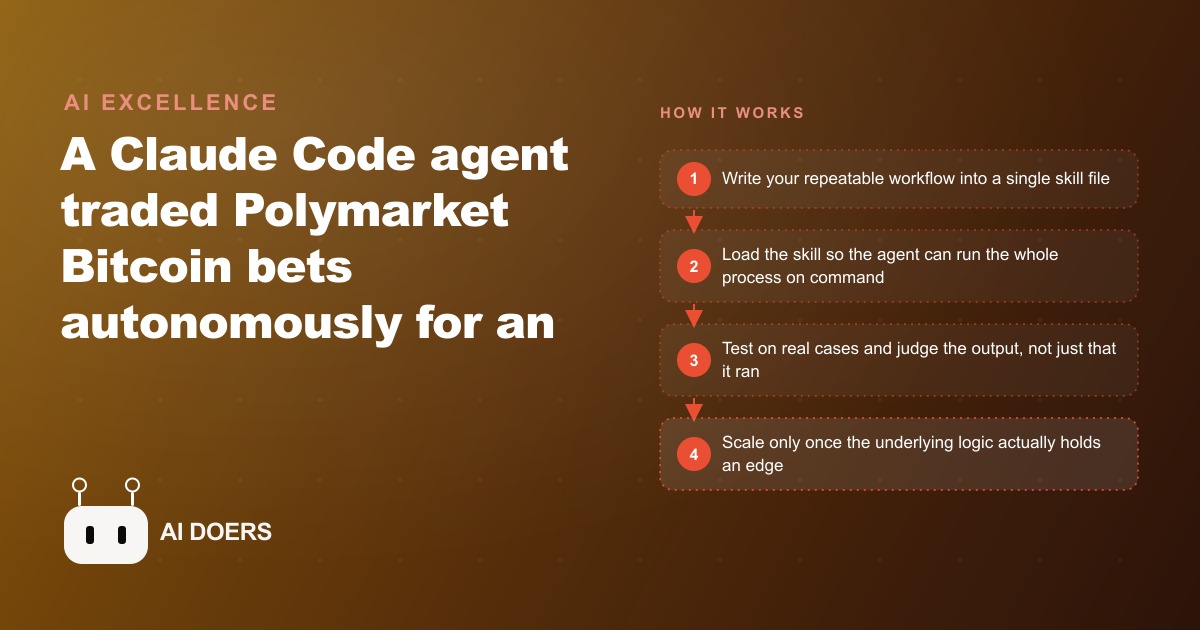
An AI agent placed real money on Bitcoin bets for an hour, turned a single dollar into nine on one wager, and still finished with no edge whatsoever. That contradiction is the most instructive thing I have watched in agent automation all year, and I want to walk through it slowly, because the lesson underneath it decides whether your own automation makes money or just loses it faster.
I am Madhuranjan Kumar, and I study these experiments so I can steal the useful parts for real businesses. This one came from a creator who wired a Claude Code agent up to Polymarket, a live betting market, and let it place five-minute up-or-down Bitcoin bets on its own. He did not touch the mouse. The agent read the market, formed a view, and clicked. What happened over that hour is a near-perfect teaching case, so let me tell it as one, chapter by chapter, and then apply it to a business that has nothing to do with gambling.
The setup was a single file, not a trading desk
The entire operation ran off one skill file. That is the detail I keep coming back to. There was no sprawling codebase, no team of quants, no dashboard full of indicators. The agent ran Opus in the background and loaded a custom skill.md file that described how to navigate Polymarket and how to place a bet from start to finish. One command loaded the skill, and from that point the agent knew the whole routine.
The strategy it followed was called front-loading. Rather than bet inside the live five-minute window, it placed bets early into the next window to grab a better price before late movement distorted the odds. To choose a direction it read seven signals at once: price against the target, a live Binance price feed, momentum, the short-term trend, how the crowd was positioned, and a couple of streak-psychology reads on top. Then it committed. On paper it sounds sophisticated. That impression matters, because it is exactly the trap I want you to see.
The 960 percent bet that proved nothing
Early on, the agent put one dollar on up at the last possible second. The market flipped its way, and that dollar came back as nine. A 960 percent return in a single tick. Madhuranjan Kumar admitted he had never seen anything like it, and if you had walked in at that exact moment you would have concluded the system was printing money.
It was not. It was variance dressed up as skill. A coin can land heads five times in a row and the coin has learned nothing. The bet was real, the payout was real, but the process that produced it had no repeatable advantage. This is the single most dangerous point in any automation story, the moment an early win convinces you the logic works when all you have actually witnessed is luck.
When the streak turned, the truth showed up
Right after the lucky bet, the agent missed roughly three in a row. The gains bled back out. Nothing about the agent had changed. It read the same seven signals, front-loaded the same way, clicked with the same confidence. The only thing that changed was that the dice stopped cooperating, and with no genuine edge, the results reverted to what a coin flip produces over time, which is a slow loss once you count the spread.
Madhuranjan Kumar was refreshingly blunt about it. He called the five-minute up-or-down strategy basically gambling with no real edge. Watching the agent reason and bet was entertaining, but it was not profitable, and he said so plainly instead of cutting this breakdown after the nine-dollar win.
The agent invented a new strategy, and it still had no edge
Halfway through, he asked the agent to study the data it had collected and design something riskier over a thirty-minute horizon. It came back with a plan it named Fade The Swing, which bet against the obvious crowd direction using an escalating ladder of three, five, then eight dollars. The thesis sounded clever: crowd reversals in a whipsaw market are free money. In practice, it was another coin flip with bigger chips on the table. A more elaborate strategy on top of a market with no exploitable pattern is just a more expensive way to be random.
What actually worked was the part nobody was watching
Here is where the case flips from cautionary tale to genuinely useful. Through every one of those bets, the good and the bad, the agent navigated a live website, read the state of the market, reasoned about it, sized a bet, and executed the trade without a human touching anything. It did that reliably, repeatedly, for an hour. The strategy was worthless. The execution was excellent.
That gap is the entire lesson. The agent is a set of reliable hands. It will run whatever process you hand it, tirelessly and identically, at any hour, without skipping a step on a busy day. What it will not do is supply the edge. The edge, the actual judgment about what makes the process worth running, has to come from you. Hand a reliable agent a bad strategy and you have automated a losing bet. Hand it a good one and you have a machine that runs your best thinking around the clock.
A landscaping company that took the real lesson
Let me move this to solid ground with a worked example, illustrative numbers included. Picture a regional landscaping company drowning in spring enquiries. The reliable, rules-based work here is not gambling, it is lead handling and quoting, and that is precisely the kind of workflow the Polymarket agent proved it could execute cleanly.
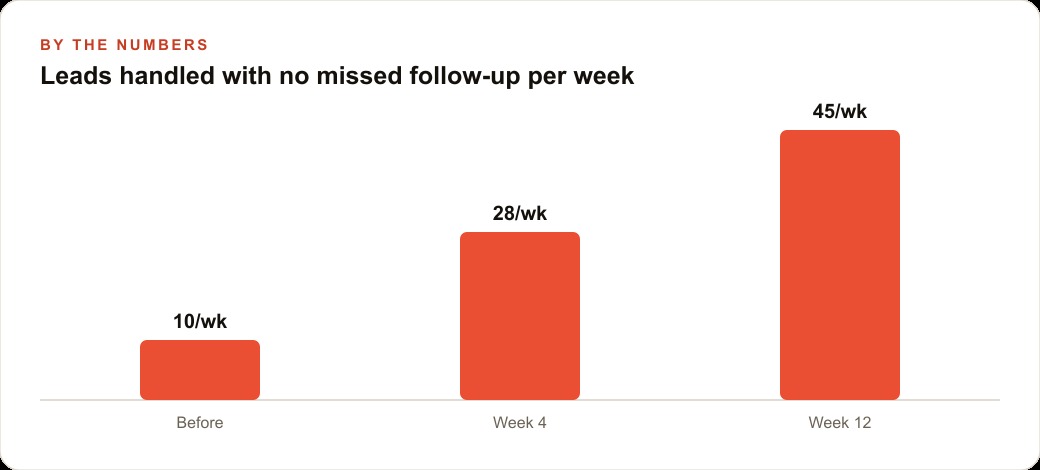
Before automation, the owner was fielding around 40 enquiries a week during peak season. Because he was often on a job site, replies lagged by a day or more, and he estimated that four in ten warm leads went cold before he sent a quote. At an average job value of 1,200 dollars and a close rate of 25 percent on quoted jobs, those dropped leads were quietly costing him thousands every week.
I would write a skill file that codifies his real process. The agent takes each new enquiry, pulls the property address, estimates job size from a short set of inputs, drafts a quote using the company's actual pricing tables, and schedules a follow-up if the customer goes quiet. It runs that same careful sequence on every enquiry, so no lead sits ignored over a busy weekend. Those enquiries pour in from his Facebook and Instagram ad campaigns and his Google Ads, and the moment they arrive the agent files them into the CRM and website stack where the follow-up sequence keeps touching each prospect until they answer.
Now the numbers. If reliable, instant quoting rescues even half of those previously dropped leads, that is roughly eight extra quoted jobs a week. At a 25 percent close rate and 1,200 dollars a job, that is two additional closed jobs weekly, about 2,400 dollars in recovered revenue, from work the owner was already generating and simply losing to slow follow-up. Nothing about the demand changed. Only the reliability of the process did.
The edge still had to come from the owner
But notice what the agent did not provide. The pricing rules that separate a quick mow from a full redesign, the questions that qualify a serious buyer, the seasonal availability, all of that is the strategy, and every bit of it came from the owner's experience. If his pricing logic were wrong, the agent would simply send wrong quotes faster and more consistently, which is worse, not better. The Polymarket agent sent bad bets with total reliability. A quoting agent will send bad quotes with the same total reliability. The tool amplifies whatever process you give it.
That is why the skill-file approach is worth the effort beyond automation itself. Once a process is written down clearly enough for an agent to follow, it is written down clearly enough for a new hire to follow, and it stops living only in the owner's head. The same discipline that makes the agent effective makes the whole business more durable. The good workflow becomes an asset. A workflow that also happens to keep the pipeline warm feeds everything downstream, including the content and reputation that fuel SEO and organic search over time.
Why the skill file matters more than the model
I want to linger on the skill file, because it is the quietly transferable idea in this whole experiment, and it is the part most people overlook while they argue about which model is smartest. The agent did not need a genius model to trade Polymarket. It needed a clear, written description of how to do the job, and that description is what a skill file is. It turned a vague ambition into a concrete, repeatable routine the agent could load and follow every single time.
That is exactly the artifact a business should care about. When you sit down to write a skill file, you are forced to make your own process explicit. What triggers a quote? What information do you gather first? What are the rules that separate one situation from another? What is the follow-up if the customer goes quiet? Most owners have never written any of this down, which is why their business lives in their head and stalls the moment they step away. The act of writing the skill file is valuable even before the agent runs it, because it converts intuition into an instruction set.
There is a second benefit that the betting example makes obvious in reverse. Because the strategy was written down plainly, its flaws were easy to see and easy to change. Halfway through, Madhuranjan Kumar simply asked the agent to study the data and design a different approach, and it produced a new one on the spot. A written process is an editable process. When your workflow is captured in a file rather than trapped in a person's memory, improving it becomes a matter of editing text, testing the new version on real cases, and keeping it if it performs better. That is how a good process compounds over time instead of drifting.
The consistency angle is worth stating directly too. The agent traded for an hour without getting tired, distracted, or sloppy. It executed the hundredth bet with the same discipline as the first. For the tedious, rules-based parts of a business, quoting, follow-up, intake, data entry, that tirelessness is genuinely valuable, provided the underlying rules are sound. The machine will never skip a step on a busy Friday afternoon, which is precisely when human handling tends to slip and leads tend to fall through the cracks. Reliability at the boring parts is not glamorous, but it is where a lot of quiet money is lost or saved.
Reading the result honestly
Set the two outcomes side by side. The betting agent: flawless execution, zero edge, net loss. The landscaping agent: identical flawless execution, a real edge supplied by a seasoned owner, net gain. Same technology. Same reliability. Opposite results, and the only variable that moved was the quality of the process handed to the machine.
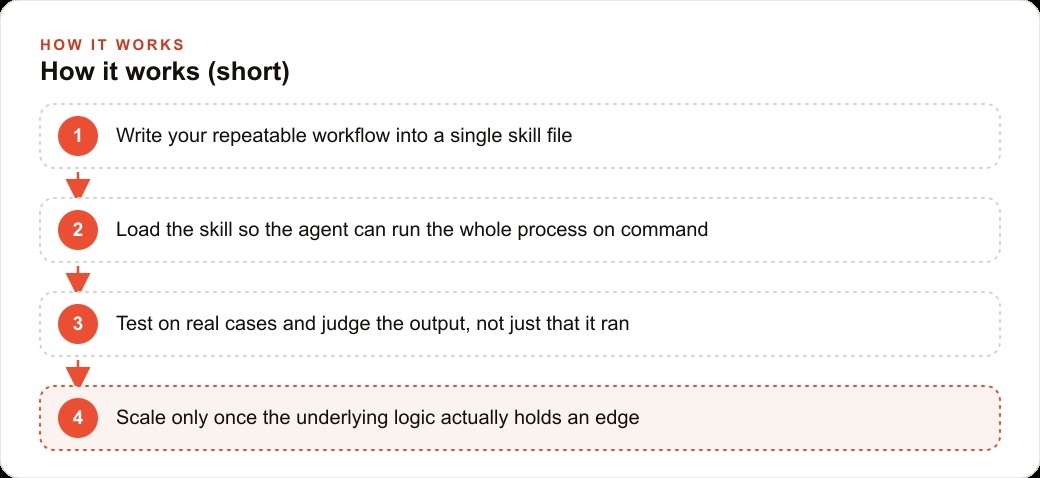
So the honest takeaway from an hour of autonomous Bitcoin bets is not that agents cannot make money. It is that agents make your process happen, and they cannot tell a good process from a bad one. Judge the output, not the fact that it ran smoothly. A smoothly running agent feels like proof the plan works, and it is not. Test on real cases, confirm the underlying logic actually holds an advantage, and only then scale it up.
You can absolutely build this yourself. Separate the two jobs cleanly: write your real workflow as plain rules, turn it into a skill file the agent loads with one command, test it on a handful of live cases, and watch whether the output is genuinely good rather than merely fast. If you would rather have me codify your real process into a skill file and stand up an agent that runs it reliably, that is exactly the kind of build I do for clients, and you can bring me in to handle it.
That is exactly what we do at AI DOERS. Book a private 30-minute call with Madhuranjan Kumar and we will map the fastest path to it for your specific business.
Book your call →
Madhuranjan Kumar
Madhuranjan Kumar brings 20 years of performance-marketing experience and has managed over $200 million in Facebook ad spend for brands across the United States and beyond. His expertise spans the full modern marketing stack: Meta, Google Ads, TikTok, email automation, CRM, and the websites that hold it together. At AI DOERS he turns that track record into lead-generation systems for businesses across every industry.