
Build the System First, Then Automate It With AI
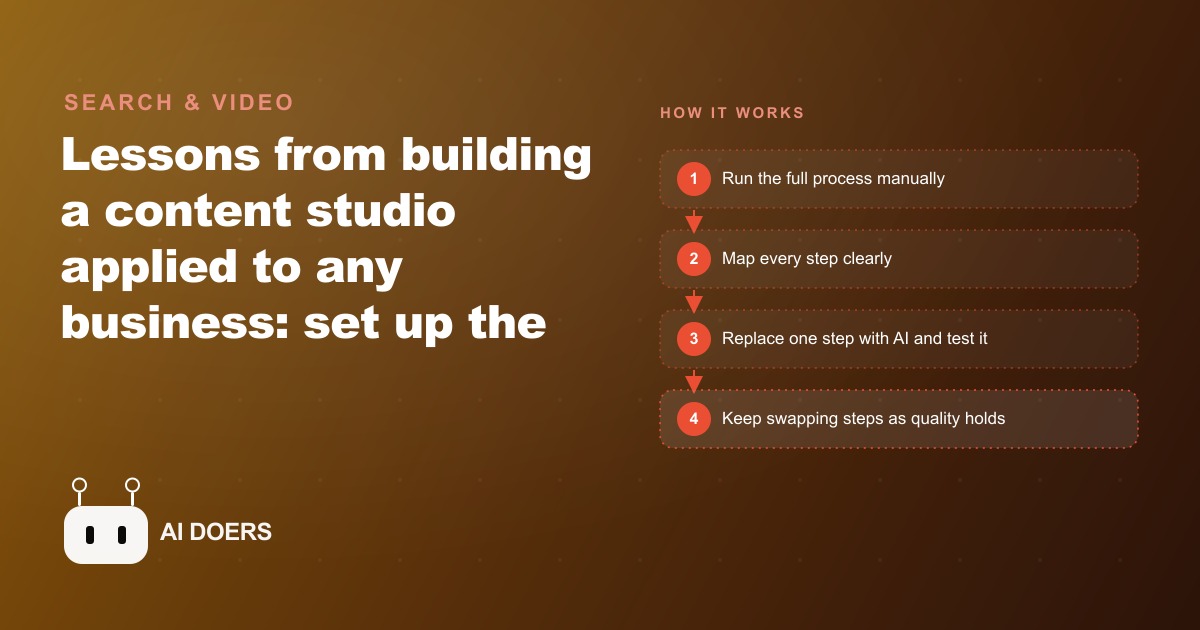
The smartest way to bring AI into a business is to run the process by hand first, then replace each step one at a time as quality allows.

There is a failure mode I see repeatedly in businesses that try to automate with AI, and it almost always looks the same. The business hears that AI can handle customer follow-up, or scheduling, or content creation, or research. They pick a tool. They set up some prompts or configure some nodes. They run it. The output is technically a product of the process they asked it to automate, but it is bad. The emails sound robotic. The summaries miss what matters. The generated content is generic in a way that is hard to articulate but immediately obvious to anyone who reads it. The team calls it "AI slop" and goes back to doing the work manually, concluding that AI is not ready for their use case.
The diagnosis I give every time I see this is the same: they automated a process they did not understand yet.
This is the central mistake. AI is capable of executing a process that is clearly defined. It is not capable of compensating for a process that was never clearly defined in the first place. When you automate a process you do not fully understand, what you get is speed and scale applied to confusion. You produce more outputs faster, and none of them are quite right, and because they are coming out of an automated system you feel some obligation to use them anyway, and the result is what engineers call garbage in, garbage out, except at volume.
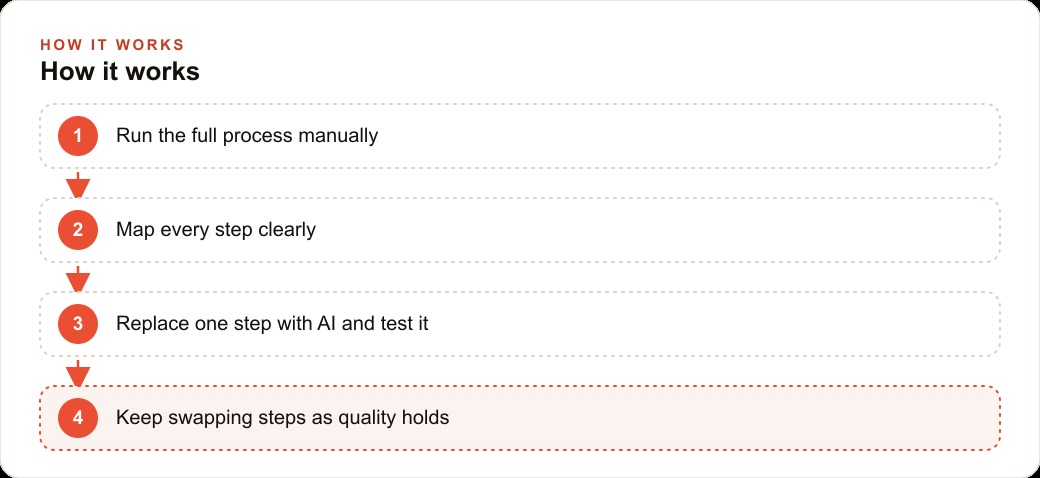
The alternative approach sounds slower at first. Run the full process manually. Every step. Every judgment call. Understand not just what the steps are but why they work, what failure looks like, what a good output feels like compared to a mediocre one. Then, and only then, start handing steps to AI, one at a time, starting with the steps where the quality threshold is lowest and the volume is highest. Protect the steps that require real judgment and keep them human. Approve and reject AI outputs rather than reviewing them from scratch.
I want to walk through this with a concrete example that illustrates every part of the method.
A pet grooming business was spending about eight hours per week on client communication. Appointment reminders the day before. Follow-up messages the day after to check how the pet was doing and whether the client was happy with the result. Review requests about a week later. All of it was happening manually, which meant it happened inconsistently. Reminders went out when the owner had time to send them, not always the day before. Follow-ups got forgotten during busy weeks. Review requests happened sporadically, whenever the owner thought to send them, which was not often enough. The business had high customer satisfaction, but its Google and Yelp review counts were low because most happy customers never thought to leave a review unless they were specifically asked at the right moment.
Before doing anything with AI, the owner spent four weeks documenting the process manually. Not digitizing it, just writing down what actually happened and what worked. When did reminders perform best? The owner had discovered over years of running the business that a reminder message which mentioned the pet's breed alongside its name got significantly better appointment-keeping rates than one that used only the name. "Your golden retriever Biscuit's appointment is tomorrow at 2pm" performed better than "Your appointment for Biscuit is tomorrow at 2pm." This was a hard-won piece of knowledge that lived entirely in the owner's head. No one else on the team knew it. It had never been written down.
When did the day-after follow-up feel welcome versus intrusive? The owner tested a few variations and found that same-day felt too soon. Two days later felt late enough that the connection to the visit had faded. The day after the appointment, when the pet was presumably at home and the client was still in the warmth of having had a nice interaction, was the window that generated the most replies and the most positive sentiment. This was a judgment about human psychology, not about grooming, and it took four weeks of paying attention to confirm.
What did the review request need to include to actually convert into a posted review? A direct link to the review platform was necessary. Without it, the conversion rate on review requests was near zero. People intended to write a review, closed the message, got distracted, and never came back to it. With a direct link that took them to the review form with one tap, the conversion rate was meaningful. This was also something the owner had learned the hard way before the documentation exercise: a warm, earnest message asking for a review produced almost nothing, while a slightly shorter message with a direct link produced actual reviews.
After four weeks, the process was explicit. It was not just "send a reminder, send a follow-up, ask for a review." It was: send a breed-name reminder 24 hours before the appointment with a prep note about what to bring. Send a personal follow-up the day after that asks a specific question about the result. Send a review request eight days post-appointment with a direct link to the Google review page with the business pre-selected.
Now the automation was possible, because what needed to be automated was fully understood. Not "set up AI to do follow-ups," but "send this specific message at this specific time with these specific fields populated from the booking data."
The owner started with the appointment reminder. It was the simplest step: fixed timing, a template with variable fields for breed, name, and appointment time, and low downside if something was slightly off. An AI agent with access to the booking calendar and a defined template sent the reminders automatically. After two weeks, the owner reviewed a sample of thirty reminders. Every one was correct. The breed and name fields populated accurately from the booking records. The timing was consistent in a way the manual process had never been. This was the first step handed off to the machine.
The day-after follow-up was harder. The specific question needed to match the service the pet received. A dog that had only a nail trim needed a different follow-up than a dog that had a full bath and cut. The owner documented three follow-up variants: one for nail and basic services, one for full grooming, one for specialty work like dematting or deshedding that required more time and sometimes left the pet a little tired. The AI agent was given the service type from the booking record and matched to the correct template variant. Over the first three months, the owner approved and rejected a batch of follow-ups each week manually before deciding the matching was reliable enough to run unsupervised. The rejection rate dropped from about 20 percent in the first week to under 5 percent by week six. At that point, the owner handed off the follow-up entirely.
The review request was the last step handed off, six weeks into the project. The direct link had to be accurate and formatted correctly. If the link was malformed or led to the wrong destination, the conversion rate collapsed. The owner verified the link format once, stored it in the workflow configuration, and the review request went out automatically at the eight-day mark for every closed booking. Review counts started rising in the second month.
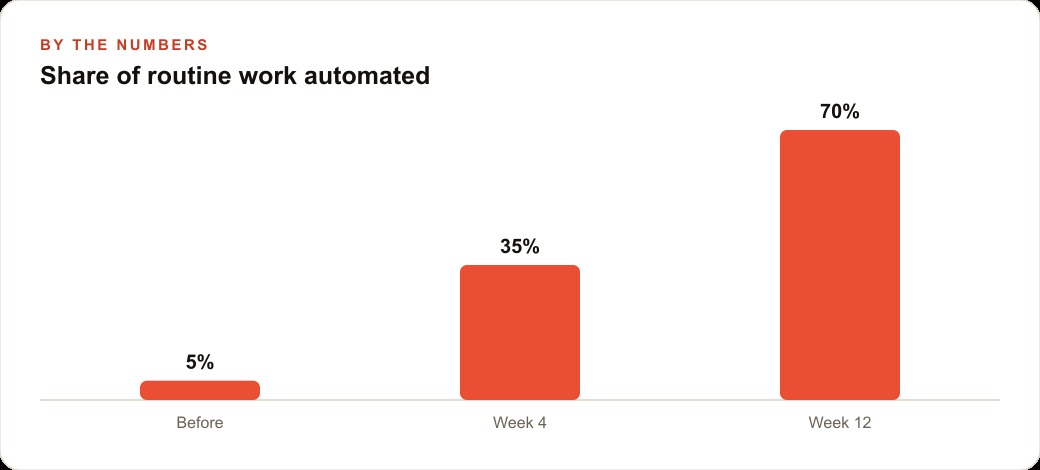
At the end of three months, the business had recovered six hours per week of the owner's time. The two hours that remained were the genuine judgment work: responding to clients who wrote back to the follow-up with a concern about their pet's reaction to the grooming, handling requests to change appointments, reading the review page periodically to spot any pattern that needed addressing. The automation handled volume. The owner handled nuance.
Repeat bookings increased by fourteen percent over those three months compared to the same period the prior year. The owner is cautious about attributing all of that to the follow-up sequence, because other variables changed too. But the follow-up cadence had been inconsistent the prior year and was consistent in this one, and the timing aligns. Review count grew from eleven reviews accumulated over three years of sporadic manual asking to thirty-one reviews over the nine months of consistent automated requesting.
The reason this worked is not that the AI was particularly sophisticated. The templates are simple. The timing logic is simple. What made it work was that the process was understood before the automation was written. The breed-name insight was not something an AI discovered. The owner discovered it over years and documented it explicitly. The AI then applied it consistently, at scale, every time, in a way the owner simply could not do manually while also running the shop.
The content-studio version of this argument is worth stating because the failure mode there is more damaging and harder to diagnose. A studio that automates its content production without understanding its own content process gets something I would describe as technically correct but emotionally absent. The content covers the right topics. The structure is sound. The keywords are present. But the voice is not there. The specific perspective that makes the studio's work distinctive is absent. And the audience, who was reading because of that perspective, notices immediately even if they cannot articulate why they have started to drift away.
The studio that gets this right runs its best content production process manually for long enough to understand exactly what makes a piece of content good versus mediocre. What questions does it ask that competitors do not ask? What does it assume the reader already knows versus what does it explain? What is the specific thing it says that makes a reader feel like the content came from someone who actually does this work, not from someone who read about it? Once those things are documented clearly enough that another person could follow them, the AI can apply them. Before they are documented, the AI will produce technically adequate content that misses the point entirely.
The hardware-software-system framing is the most useful way I know to describe why sequence matters. Hardware is the tools: the AI model, the automation platform, the publishing stack. Software is the configuration that makes the tools work together. The system is the sequence of steps and judgments that produces a good output, and the knowledge of why each step exists and what failure looks like at each one. Hardware and software can be set up in an afternoon. The system takes weeks or months to understand. Most failed automation attempts spend an afternoon on hardware and software and then skip the system entirely, running the automation before the system is known. The successful ones spend weeks on the system and find the hardware and software almost configure themselves once the process is clear.
Protecting the team's best hours is the practical application of this principle. The best hours should go to work that requires the most judgment, not to work that takes the most time. In many businesses, the most time-consuming work is also the most mechanical: scheduling, reminders, status updates, data entry, recurring reports. These are the first things to automate because the judgment content is low and the volume is high. The work that requires the most judgment, reading the customer relationship for when someone is at risk of leaving, deciding which inquiry deserves a personal response from the owner rather than the assistant, adjusting the offer based on what the market is doing, should stay human for as long as possible. That is where AI output will most consistently underperform a thoughtful human until the standard for that work is documented with enough specificity that the AI can meet it.
Approve and reject. Do not redo from scratch. This is the last piece of the method and the one most often ignored. When an AI output is in front of you, the decision should be binary: good enough to use, or flag it with specific feedback and send it back. The failure mode is taking a mediocre AI output and editing it into something good. This costs nearly as much time as writing it from scratch and creates a false impression that the automation is working when it is consistently producing below-standard work. If you are editing every output, the automation has not succeeded. It has just changed the form of the manual work from writing to editing.
Daily research on customers and competitors is one of the few tasks that can run automatically from day one, even before the process is understood in depth, because the output is purely informational and the judgment step stays human. AI reads competitor websites and notes pricing changes, new service offerings, and review patterns. The owner reads a morning summary and applies their own judgment about whether anything warrants a response. The AI provides the information. The owner does the thinking. This division is natural and it works early in the process, before the deeper judgment steps are ready to hand off.
The businesses that extract real value from AI automation are the ones that do this work in the right order. Run the process manually. Document what matters and why. Hand off the mechanical steps after you know them well enough to describe them to a stranger. Keep the judgment steps. And when something goes wrong with the automation, the documentation tells you exactly where the gap is and what to fix. Without the documentation, you are guessing, and guessing is slow.
The process first. The automation second. In that order. Always.
That is exactly what we do at AI DOERS. Book a private 30-minute call with Madhuranjan Kumar and we will map the fastest path to it for your specific business.
Book your call →
Madhuranjan Kumar
Madhuranjan Kumar brings 20 years of performance-marketing experience and has managed over $200 million in Facebook ad spend for brands across the United States and beyond. His expertise spans the full modern marketing stack: Meta, Google Ads, TikTok, email automation, CRM, and the websites that hold it together. At AI DOERS he turns that track record into lead-generation systems for businesses across every industry.