
Build the Software You Used to Pay For: The Bespoke-Tool Shift Hitting Small Business
A wave of software value is being erased as AI lets people build the exact tools they need by describing them. Instead of renting apps and services, owners are getting custom software made on demand. Here is what that shift means and how I would use it.

For three decades, the price of custom software was a project estimate that small businesses opened, read to the bottom, and declined to pursue. A developer at a significant day rate, several weeks of specification and back-and-forth, and ongoing maintenance costs that never ended put bespoke tools out of reach for any operation below a certain scale. The result was a consistent compromise: businesses bent their own processes to fit whatever commercial software was available, accepting the misalignment as the cost of being too small to commission something built specifically for them. That economic reality changed materially in the last 18 months, and most small business owners have not yet processed what the collapse of that threshold means for them.
I am Madhuranjan Kumar, and the angle I want to take on this shift is not about what AI can do in a demo. It is about economics. The genuinely interesting thing is not that AI agents can write code, which they have been doing at some level for several years. The interesting thing is that the cost and time to build a working, custom business tool crossed a threshold that makes it practical for a five-person operation for the first time in history. When a threshold falls that far, the businesses that notice first have a head start that compounds, and the ones that notice last spend years catching up.
The Old Cost Structure That Kept Custom Software Out of Reach
Custom software had a specific cost structure that made it inaccessible to most businesses below a significant scale. A developer working to a client specification charged by the day at rates that put even a simple internal tool at several thousand dollars before any working functionality existed. The specification process itself took weeks of back-and-forth and almost always produced a document the developer interpreted differently from what the client intended. The first version of the tool was rarely right. Revisions added cost. Maintaining the tool after delivery required either keeping the developer on retainer or accepting that changes would be slow and expensive each time the business needed to adjust its logic.
That structure produced a consistent economic verdict: buy the commercial product, pay the monthly subscription, and adapt your workflows to fit the product's design assumptions. The assumptions embedded in commercial software are often wrong for your specific operation, but they are cheaper to work around than to replace. An insurance brokerage runs its client tracking through a generic CRM built for sales teams in general, not for the specific pipeline logic that brokers use to track policy renewals, coverage reviews, and claims support alongside new business. The workarounds accumulate: the broker flags certain accounts manually, keeps a separate spreadsheet for renewal dates, and calls the real pipeline status something different inside the tool than what the tool labels it. The workarounds function, mostly. But they create friction every day, they fall apart when a new team member joins, and they leave when an experienced person does.
The commercial software vendor cannot fix this without building something custom for the brokerage at a price point that makes sense for both sides. The brokerage cannot afford to commission a developer for a project of that scope. So the workaround persists, invisible in the operation, costing small amounts of accuracy and time every day, compounding into a real inefficiency over years.
What the Threshold Shift Actually Means in Practice Hours
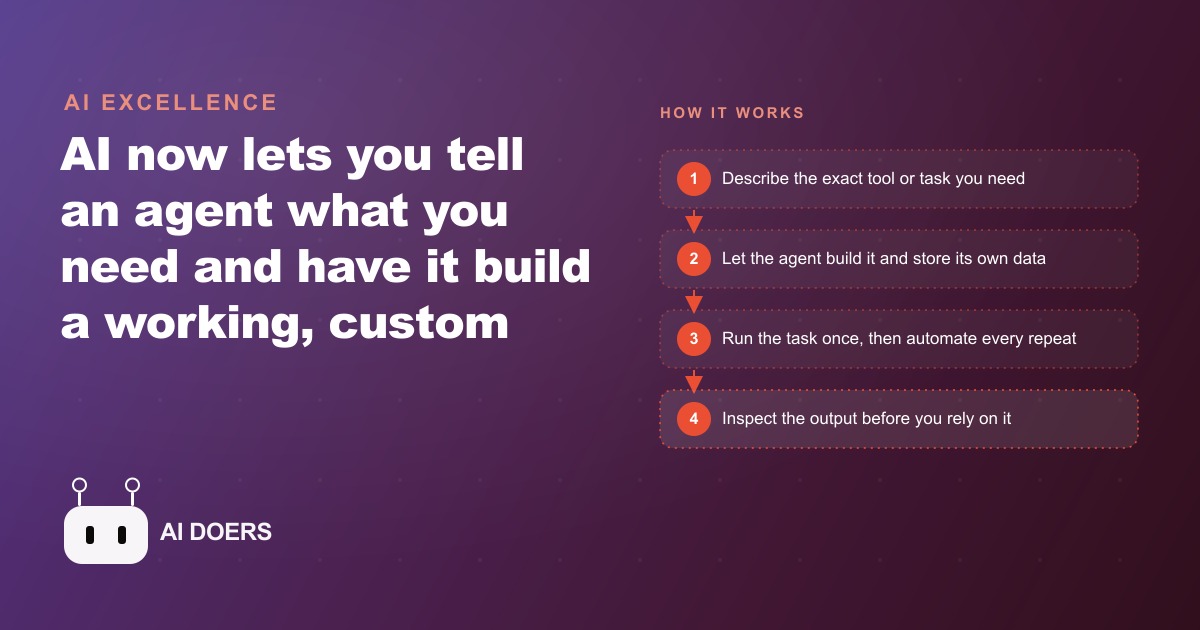
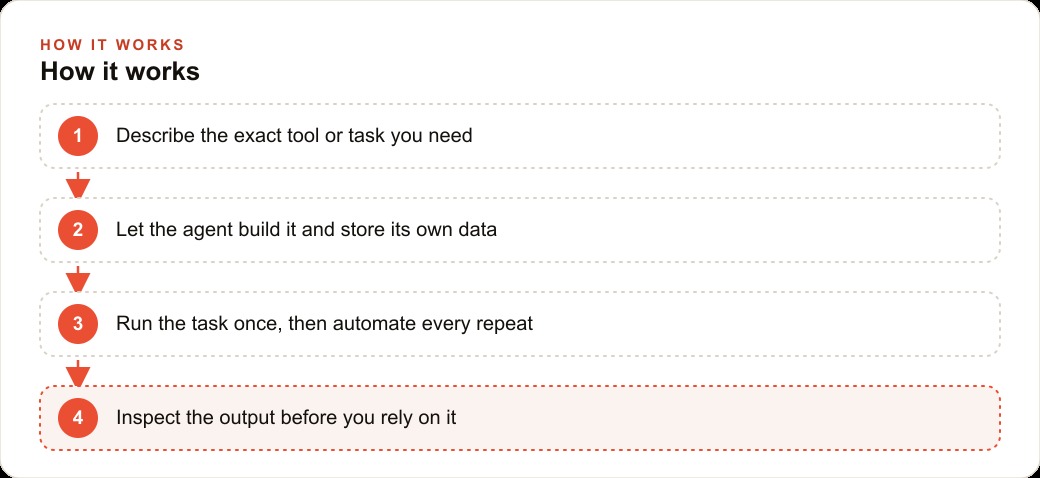
The shift is concrete to describe. Building a working custom tool with an AI agent now takes hours where it used to take weeks. The cost per generation step has dropped to near zero. What previously required a developer briefing, a specification document, several rounds of revision, and a testing phase now requires a clear description of what you need, a few real examples from your actual business, and the willingness to review what the agent produces and correct it before relying on it.
A large fund reported roughly a 20 percent productivity gain from these tools across their operations, which they estimated as equivalent to more than a hundred additional full-time employees worth of output, added without adding headcount. That figure comes from a real organization tracking across actual business operations, not from a hypothetical scenario. If a 20 percent productivity gain is achievable at that scale, with the operational complexity that large organizations carry, a focused small business applying the same approach to its most repetitive tasks can see proportional or greater benefit in relative terms.
For a small business, the proportional impact can be larger because the workarounds are more visible and the friction from fixing even one major bottleneck is immediately apparent. An insurance brokerage that builds a renewal-tracking tool around exactly how its pipeline actually works saves time every single day, not just in the first month. The tool does not leave when a broker does. The logic is captured and consistent. A new team member can run the process from the first week without learning an undocumented set of manual workarounds that nobody wrote down because nobody thought to.
The broader story behind this shift is that a significant amount of software value is being erased. When businesses can build the exact tool they need in an afternoon rather than commissioning it for tens of thousands of dollars, the monthly subscription fee for a generic commercial tool becomes harder to justify. This is why whole categories of SaaS products are under pressure from businesses that have discovered they can describe what they need and have it built around their actual process.
The Workflow-First Principle: Why Automation Cannot Fix a Broken Process
The most important caution in this shift is also the most commonly ignored one. An AI agent builds what you describe to it. If you describe a clunky, inconsistent process with undocumented exceptions and workarounds that only long-tenured staff understand, you get a clunky, inconsistent tool that executes the broken process at machine speed. The productivity gain from automating a well-designed process is real and compounds over time. The outcome from automating a broken process is a faster way to generate the same errors at higher volume.
This matters most in small businesses because the processes are often tribal knowledge that has never been articulated in writing. The logic that an experienced team member applies when making an exception to a standard renewal process is real and coherent in their mind. It has never been mapped, because the exception has always been handled by one person who simply knows. Before that logic can be handed to an agent, it must be made explicit enough that someone could read it, verify it, and hand it to a new person without losing anything in the transfer.
The mapping exercise is often the most valuable part of the whole project, independent of what gets automated afterward. It surfaces the inconsistencies in the current process, the unnecessary steps that accumulated over years without review, and the moments where the documented procedure and the actual practice quietly diverged. Businesses that do this mapping carefully often discover that the process needs redesign before it is automated, which saves the cost of discovering that problem after a tool has been built around the wrong logic.
The right sequence is to map the real process first, including every exception and every case where judgment is required rather than rule-following. Then review the map with the people who execute the process and confirm that it reflects what actually happens. Then describe the clean, confirmed process to the agent and let it build around that version. The discipline of mapping before building is what separates teams that build tools they rely on from teams that build tools they end up working around.
The Everything-Becomes-an-API Architecture and What It Changes
The setups that work best with AI agents are the ones where every piece of data the agent needs is accessible directly, without requiring it to navigate a graphical interface built for human eyes. When a system exposes its data through a direct connection, the agent can reach in, pull what it needs, and work with it without friction. When the data is locked behind a dashboard that requires logging in, navigating menus, and manually exporting files, the agent is being asked to operate through an interface designed for humans, which is slower and less reliable.
This principle has a concrete implication for how you evaluate the systems your business uses as AI agents become more central to how work gets done. A scheduling system that can send its data to an agent directly is more valuable than one that requires a manual export each time. A payment system that lets an agent pull transaction records through a clean connection is more automatable than one that requires someone to log in and download a report.
For the web and CRM tools that most service businesses use to manage client relationships, this architecture question is becoming increasingly important. A CRM that makes its contact records, deal status, and pipeline data available to an agent directly, without requiring a custom integration project or a manual export, is worth more in an AI-augmented operation than one that locks data inside a visually impressive dashboard that must be opened and clicked through by a person. The dashboard is not the valuable part. The data underneath it is, and the value of that data scales when an agent can use it without friction.
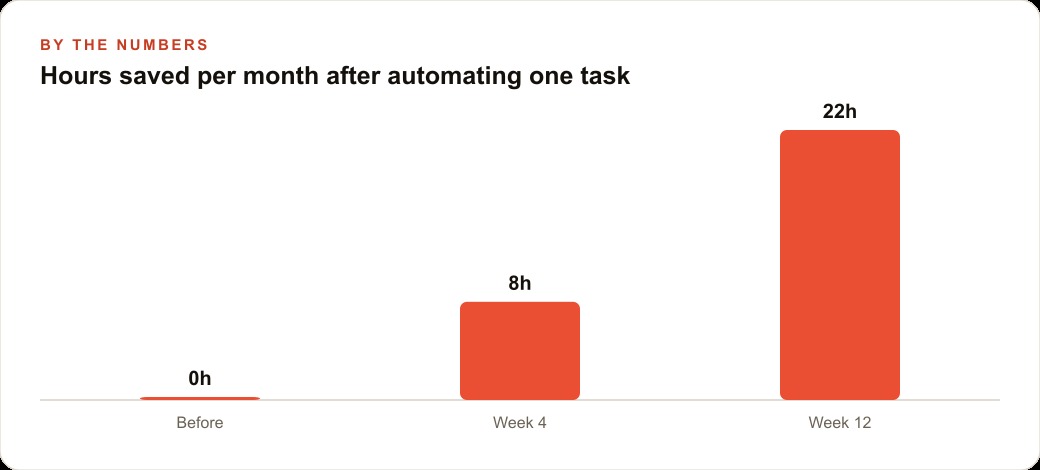
Automated reporting is a specific example where this matters immediately. A business that can ask an agent to pull this week's numbers and compare them to last week's, without anyone logging into a platform and manually navigating to the right view, saves time and removes the friction that makes reporting feel like a burden. For operations managing Google Ads campaigns, automating the data pull and comparison step alone can save several hours a month of manual export and formatting work, and the agent can build the analysis in seconds rather than the time the manual process takes.
The Inspection Discipline: Speed Without Review Is How Errors Scale
The agent's greatest asset is also its most significant risk when unmanaged. It moves fast. Fast execution of a correct process is exactly the outcome you want. Fast execution of an error is how a small problem turns into a significant one before anyone notices.
The discipline that separates businesses getting reliable value from AI agents from those having costly experiences is straightforward: inspect every output before you rely on it, especially during the first several weeks of a new automated task, and maintain a calibrated spot-check habit after the initial validation period. Not paranoid review of every line forever, but a disciplined check appropriate to the stakes of what the agent is handling.
For a scheduling tool, that means reviewing the draft output for a sample of jobs at the start of each day against what you know the real schedule requires. For a client summary, it means checking the agent's categorization against a few source records to confirm the matching logic held. For any communication the agent drafts, a person reads it before it leaves the business. These are small time investments against real risks, and they shrink over time as you develop a clear picture of where errors tend to cluster and what kinds of tasks the agent handles well.
The inspection discipline also builds something valuable beyond error prevention. The person reviewing the agent's output develops a precise mental model of where errors occur and what kinds of exceptions the agent handles poorly. That model improves with time and leads to better descriptions when the task is updated or when a new tool is built. Businesses that learn to inspect agent output well become progressively faster at building reliable automation, because the descriptions they write get more precise and their testing instincts sharpen across each project.
A Commercial Landscaping Company Puts This to Work
As an illustrative example, consider a commercial landscaping company with 90 accounts across three crews and two equipment trailers. The scheduling is done manually each week by the operations manager, who matches account size, location, service requirements, and crew capacity from experience and memory. When a crew member is unavailable or equipment needs service, the manager rearranges by phone and instinct. Client notes about preferences, access codes, and recurring exceptions live in a combination of a shared spreadsheet and the manager's head, and they transfer incompletely to new crew members.
This business is a strong candidate for two bespoke tools built around how it actually operates. The first is a scheduling assistant that knows the account list, crew assignments, equipment availability, standard service times per account type, and the recurring exceptions each account has documented. The operations manager describes the week's constraints in plain language and the agent produces a draft schedule in minutes. The manager reviews it, adjusts for anything the agent could not know from the documented data, and the schedule is done. When something changes mid-week, the manager asks the agent to rebuild around the new constraint and reviews the result.
The second tool captures and retrieves client notes systematically. After each site visit, the crew logs brief notes using a simple form. The agent organizes and retrieves those notes automatically whenever the account appears in a scheduling request or a client contact. The institutional knowledge that currently lives in the operations manager's memory, the access codes, the slope near the retention pond that adds time to one property, the client who requires advance notice before any team arrives, becomes searchable and persistent rather than dependent on one person staying with the business indefinitely.
Total setup time, including the workflow mapping that should happen before any building starts, is a few focused workdays. The return is a scheduling operation that runs consistently regardless of who handles it, a crew that arrives at each account with the right context, and an operations manager who spends less time on reconstruction each week and more time on the quality checks and client relationships that the business actually bills for.
The discipline is to start with one tool, prove it on real jobs before relying on it fully, inspect its output carefully for the first two weeks, and move to the second tool only after the first is demonstrably stable. That sequence turns the threshold shift in bespoke software economics into a compounding advantage for a small operation that starts it now.
The First Task to Automate and How to Know It Worked
The question of where to start is almost always answered by the friction you feel most often. The task you work around most frequently, delegate imprecisely, or explain differently to each person who handles it is the right first target. Map it honestly, including every exception. Describe the clean version to an agent. Review the first output against real data before trusting it with anything consequential. Prove it on a small set of real tasks before applying it at full volume.
You know it worked when the output is consistent, when a new team member can run the process without calling the person who previously owned it, and when the quality is at least as good as what the manual process produced on a good day, not just on average. That combination, consistency, transferability, and quality held under real conditions, is the sign that the threshold shift is actually benefiting your operation rather than being an impressive exercise you ran once and moved on from.
The window to get ahead of this is still open. Only a small fraction of small businesses are using AI agents reliably on real operational tasks today. Getting fluent on even a single real task now puts a business meaningfully ahead of most of its competitors, and every subsequent task is faster to build because the practice of describing processes precisely and validating outputs carefully compounds into an operational capability that is hard to replicate quickly from a standing start.
That is exactly what we do at AI DOERS. Book a private 30-minute call with Madhuranjan Kumar and we will map the fastest path to it for your specific business.
Book your call →
Madhuranjan Kumar
Madhuranjan Kumar brings 20 years of performance-marketing experience and has managed over $200 million in Facebook ad spend for brands across the United States and beyond. His expertise spans the full modern marketing stack: Meta, Google Ads, TikTok, email automation, CRM, and the websites that hold it together. At AI DOERS he turns that track record into lead-generation systems for businesses across every industry.