
Build Anything With Grok 4: A Powerful Reasoning Model and a Team of Agents
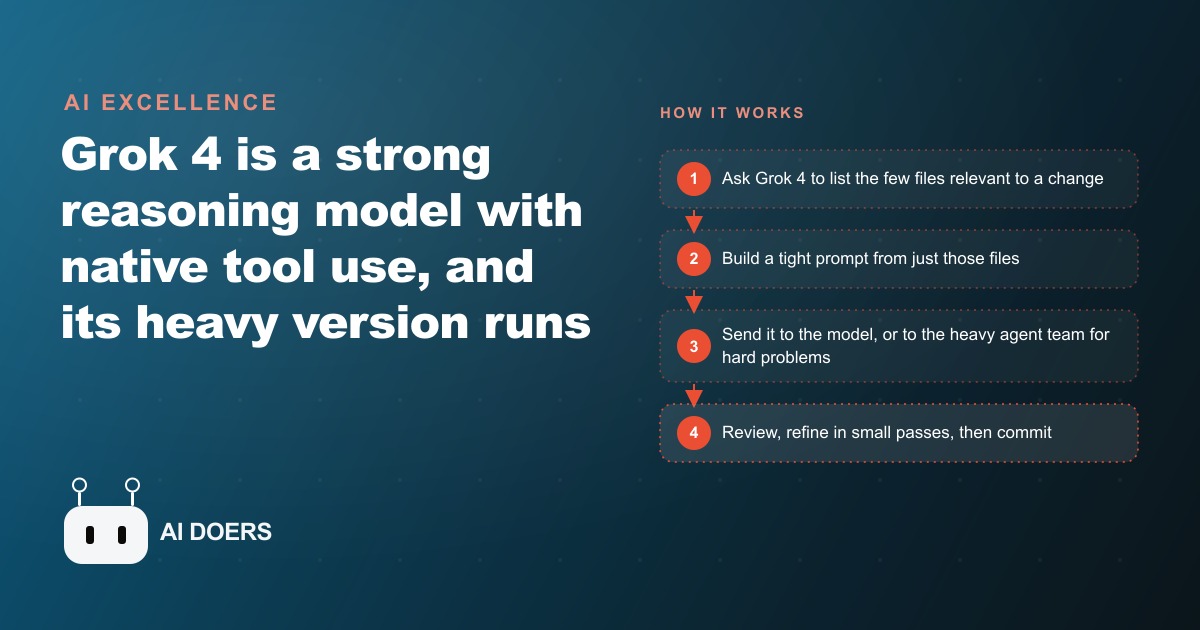
Grok 4 is a strong reasoning model with native tool use, and its heavy version runs several agents in parallel that converge on the best answer. Here is how it works and how I would put it to work for a real business.

The benchmark headline for Grok 4 is that it scores near or at the top of most available reasoning evaluations at the time of release. That is the least interesting fact about it for someone trying to build something with it. What matters in practice is a set of design decisions that change how you interact with it and what you can reasonably ask it to do. Madhuranjan Kumar has been testing Grok 4 since shortly after release. The differences from previous reasoning models are real, and several require a change in how you structure prompts and projects. Here are eight things that actually matter.
Tool Use Is Part of the Reasoning, Not a Separate Step
In most AI systems, tool use is added on top of the core model: the model finishes a reasoning step, decides whether to call a tool, waits for the response, and then resumes reasoning. The tool call happens at the boundary of a thought, not inside one. In Grok 4, the model was trained to call tools mid-thought. It can retrieve data, check a result, or verify a claim while it is still working through the logic of a problem, before committing to a direction.
This changes the reliability of outputs in a way that is not obvious from reading about it. When a model reasons to a conclusion and then checks whether that conclusion is factually correct, there is already a commitment bias in the system. The model produced an answer; it is now evaluating that answer while already invested in it. When the model can interrupt its own reasoning to verify a claim before continuing, the verification happens before commitment. The resulting output has been checked at the moment when checking is most useful.
For a restaurant updating its online ordering page, this matters in a specific way. If the task involves referencing supplier descriptions, verifying that an allergen claim is accurate, or checking that a regulatory requirement applies to the service model, the model can check those things during reasoning rather than producing a confident draft and appending caveats afterward. The first draft is more accurate. The revision loop is shorter. For a task like updating an ordering page, where allergen information and pricing are published directly to customers, accuracy during drafting is not a convenience. It is the point.
The Heavy Version Runs Parallel Agents That Converge on a Shared Answer
Grok 4 has a standard version and a heavy version. The heavy version is not a larger model in the conventional sense. It runs multiple independent agents that each approach the problem from a different angle, then converge on an answer through a synthesis process.
The practical effect is that the heavy version finds errors and edge cases that a single agent working linearly would miss. Each parallel agent may take a different path through the problem space and arrive at a different preliminary answer. When those preliminary answers disagree, the synthesis process must resolve the disagreement explicitly. Disagreements that surface during synthesis get caught. Disagreements that would only have emerged if a single sequential model had run a second pass over the problem may never surface at all.
This makes the heavy version genuinely more reliable for categories of task where a confident wrong answer is costly: architecture decisions, legal and compliance reviews, financial projections, complex scheduling problems, and risky refactors of working systems. The parallel convergence catches the kind of error that feels obvious in retrospect but is easy to miss when you are reasoning forward through a problem rather than backward from a possible failure point. The heavy version is slower and more expensive than the standard version. That trade-off is meaningful and worth making consciously for the right set of tasks.
Context Engineering Comes Before Writing the Actual Prompt
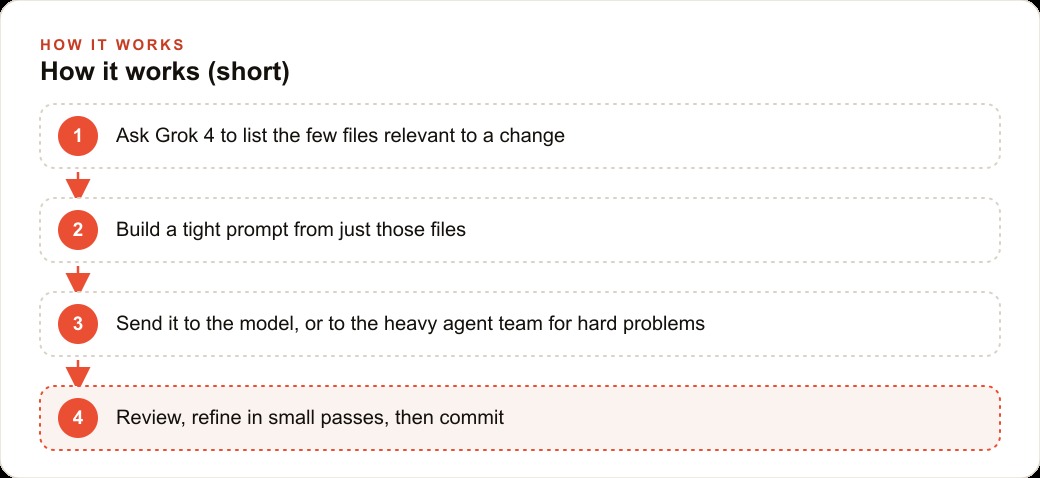
Grok 4 responds well to structured context supplied before the main request. The recommended approach is a two-step process: before writing the prompt that asks the model to do something, ask the model what information it would need to do the task well. Then supply that information. Then issue the main request.
For the restaurant ordering page example, this looks like: before asking Grok 4 to rewrite the page copy, ask it what information about the restaurant would make the rewrite most accurate. The model might ask for the current menu categories, items with common allergens, the service model (dine-in, delivery, or both), the tone of the existing site, and whether any items are seasonal. Supplying all of that before the main request produces a first draft that is already specific rather than generic.
The alternative, a prompt that asks for a rewrite without context, produces copy the model fills with plausible but non-specific content. That content requires significant revision because it lacks the details that distinguish this restaurant from any other. Context engineering is the practice of front-loading specifics so the model uses them from the start rather than guessing. With Grok 4, this investment pays off consistently because the model uses supplied context throughout a long generation rather than gradually drifting from it as the generation progresses.
Precision About Output Format Cuts Revision Loops Significantly
Grok 4 is capable of generating in many formats. This is not a reason to leave format unspecified. When format is not specified, the model chooses what it finds natural for the content, which may not match what is actually needed. The mismatch creates a revision step that is entirely preventable.
For the restaurant ordering page, specifying format explicitly changes the first draft considerably. A prompt that says only rewrite the ordering page produces a document in the model's preferred structure. A prompt that says rewrite the ordering page as a series of category sections, each with a three-sentence introduction followed by bulleted items with one-sentence descriptions and prices in parentheses, produces exactly that structure. The second prompt takes about fifteen additional seconds to write. It eliminates a full revision cycle in most cases.
The same applies to tone specifications, length constraints, reading level requirements, and structural rules about where certain information appears. Each specification reduces the distance between the first output and the final deliverable. Grok 4 follows these specifications reliably when they are present. The model cannot follow specifications that were not included in the prompt.
The Phrase Do Not Change Anything Else Is Load-Bearing Instruction Text
One of the consistent failure modes in using capable reasoning models is scope creep in the output. You ask the model to update one section of a document and it revises adjacent sections you did not request, apparently because it identified opportunities to improve them. The revisions may be genuinely good. They may also introduce changes you did not review, did not want, and now must manually undo.
Grok 4 responds reliably to explicit scope-limiting instructions. Ending any targeted editing request with the phrase do not change anything else in the document reduces unsolicited revisions significantly. The instruction works best when it is specific: update only the allergen callout section and the delivery hours in the footer, do not change anything else, produces a more contained result than a version of the same request without the boundary clause.
For the restaurant example, this matters most during iterative page updates where different sections have been reviewed and approved by different stakeholders. If the kitchen manager approved the allergen section and the general manager approved the pricing structure, you do not want a model improving adjacent sections without review. Explicit scope instructions preserve the reviewed sections while allowing targeted updates to the section that actually needs revision.
The Heavy Version Belongs to Hard Decisions and Risky Refactors, Not Routine Tasks
Grok 4 Heavy is worth using for a small set of high-stakes tasks. It is not worth using for the majority of everyday work. The distinction matters because the cost and latency of the heavy version are real constraints, and using it for routine tasks builds a habit of over-engineering that slows down the work that does not need it.
Hard decisions are ones where a confident wrong answer is costly. Risky refactors are changes to a system where an error propagates into parts of the system that were not directly edited. For both categories, the parallel agent convergence of the heavy version provides a meaningful reliability advantage. For writing a product description, drafting a routine email, reformatting a document, or generating a first draft of standard copy, the standard version is sufficient and faster.
For the restaurant, the heavy version is appropriate for evaluating whether a proposed change to the ordering system backend would break existing integrations, or for designing a menu restructuring that has to balance revenue per item, operational complexity, and supplier constraints simultaneously. It is not appropriate for writing five new item descriptions. Developing the judgment about which category a task falls into is itself a skill worth cultivating. Using the heavy version indiscriminately removes the constraint that forces that judgment call.
Learning the Domain Basics Yourself Improves What You Can Get From the Model
Grok 4 and models of comparable capability can produce output that sounds authoritative in domains where the person reviewing the output lacks the expertise to evaluate it. This is a risk, not a feature. When you cannot tell whether the model's output is correct, you are not reviewing the output. You are publishing it.
For the restaurant owner updating the ordering page, this means understanding enough about allergen disclosure requirements in their specific jurisdiction to recognize whether the model's proposed allergen callouts are compliant. It means knowing the menu well enough to catch when the model's item description is plausible but inaccurate about an ingredient. It means being able to assess whether the structural choices the model recommends for the page actually serve the ordering experience, or whether they reflect a general preference for a certain document structure that does not fit this context.
Domain basics do not require expertise. They require enough familiarity to recognize errors when they appear. The model accelerates production. Human domain knowledge ensures the output is worth publishing. Neither substitutes for the other, and the combination produces work that neither could produce alone at the same quality level.
The Cost Calculation Changes When Agents Run in Parallel Rather Than in Sequence
Standard sequential AI use has a predictable time structure: you wait for the model to finish one response before issuing the next request. For many tasks, this is fine. For planning tasks that require multiple simultaneous perspectives, the sequential structure means the total time is the sum of all the individual reasoning steps.
Grok 4 Heavy's parallel structure changes this for the tasks it handles. Multiple lines of reasoning run simultaneously and converge, meaning that a task requiring six sequential reasoning steps in a standard model takes roughly the time of the longest parallel path rather than the sum of all paths. For a restaurant developing a comprehensive menu restructuring plan, one parallel agent might focus on revenue per item, another on operational complexity, another on seasonal ingredient availability, and another on competitive positioning relative to nearby options. The convergence surfaces a recommendation that has already been stress-tested across multiple dimensions before it reaches the decision-maker.
This does not change the cost per unit of compute. It changes the time-to-useful-output ratio for hard planning tasks. If you need a plan that has been examined from multiple angles before you invest in executing it, the heavy version's parallel convergence compresses the time required for that examination. The relevant comparison is not the cost of this model versus a cheaper model. The relevant comparison is the cost of the model versus the cost of getting the planning wrong and discovering the error after implementation has already begun.
For the restaurant owner planning a significant menu overhaul before a seasonal transition, getting the planning right the first time is worth a meaningful investment in reasoning compute. The heavy version earns its place in that category of decision. It does not earn its place for writing the caption that accompanies the announcement of the new menu.
That is exactly what we do at AI DOERS. Book a private 30-minute call with Madhuranjan Kumar and we will map the fastest path to it for your specific business.
Book your call →
Madhuranjan Kumar
Madhuranjan Kumar brings 20 years of performance-marketing experience and has managed over $200 million in Facebook ad spend for brands across the United States and beyond. His expertise spans the full modern marketing stack: Meta, Google Ads, TikTok, email automation, CRM, and the websites that hold it together. At AI DOERS he turns that track record into lead-generation systems for businesses across every industry.