
Build Anything With Augment Code: Indexing, Remote Agents, and Real Autonomy
Augment Code is built for people who care about code quality, not just a quick demo. Here is how its indexing and cloud agents actually work, and how I would put them to work for a real business.

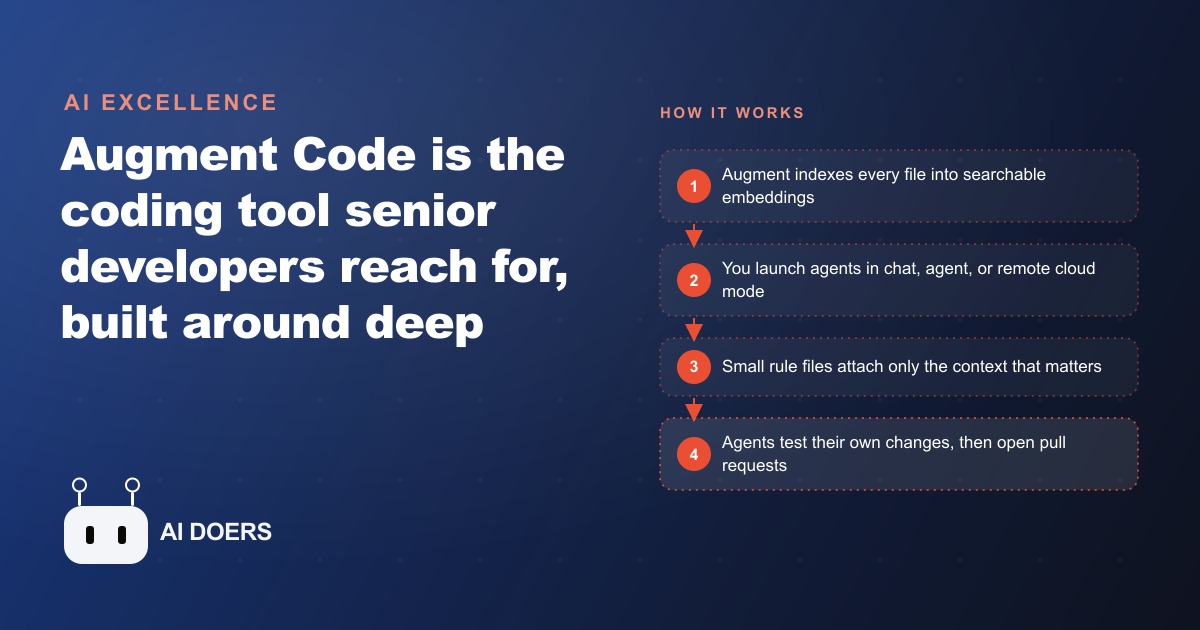
For years the practical limitation of AI coding tools was context. Show them a single file and they could produce useful suggestions. Point them at a real production codebase with thousands of files, accumulated conventions, and complex dependency relationships, and they lost the thread immediately. They gave suggestions that contradicted code two directories away. They missed patterns the team had established over years of work. They could not be trusted to make changes across multiple files without introducing inconsistencies that only showed up in integration testing, if they showed up at all.
That limitation shaped the entire category. Useful for greenfield projects and isolated functions. Unreliable for anything with real history.
Augment Code was built around a different premise, and the remote agent capability that moved into broader availability this week represents the most significant practical expansion of what AI can do for teams working on real codebases. Madhuranjan Kumar has spent time working through what this actually changes for teams with real software and real backlogs. The findings are worth understanding in detail, because the shift is not marginal.
Augment Indexed the Entire Codebase Before It Built Anything Else
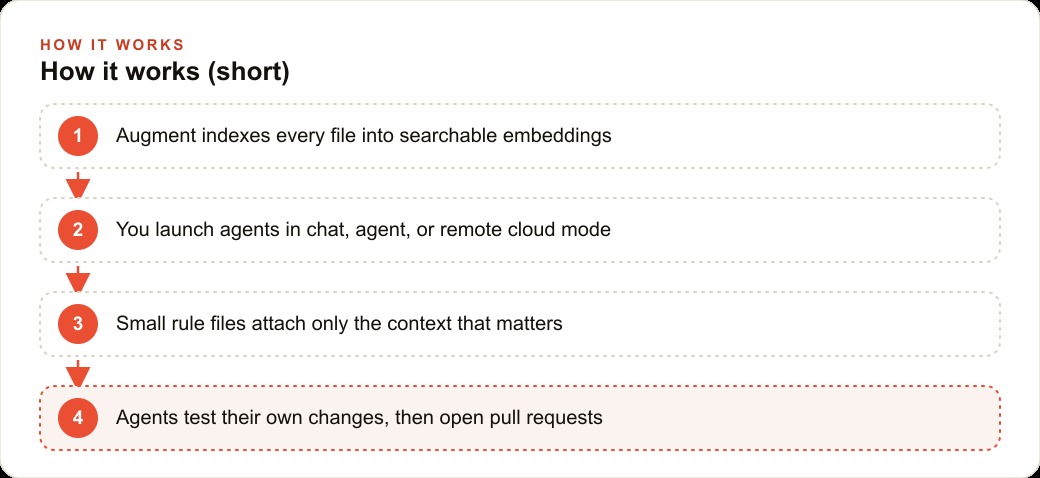
The feature that makes all the other capabilities work is the deep indexer. When you connect Augment to a repository, it reads every file and builds vector embeddings, a mathematical representation of meaning and relationships across the code. Not just function signatures and filenames. The actual semantic structure: how components relate to each other, what conventions the codebase follows, which files are central to the architecture and which are peripheral, where the patterns repeat and where they diverge.
When you or an agent describes a task, Augment uses those embeddings to identify which files are relevant and how the existing patterns should inform the implementation. It does not need to be told which files matter. It has already mapped the territory and can locate relevant code the way a senior engineer would, by understanding the structure rather than by searching for keywords.
Auto-indexing keeps this map current. When a new file is added or an existing one changes, the embeddings update in the background. You do not manage this process. You do not trigger a refresh or run a manual sync command. The index reflects the current state of the codebase continuously, which means an agent working on a task is always operating from accurate information about the project as it exists right now.
This foundation matters more than it might initially seem. A remote agent working for several hours with an outdated or incomplete index produces code that looks plausible and fails in integration. Function calls to methods that have been renamed. Imports from modules that have been reorganized. Logic that contradicts constraints established elsewhere in the codebase. Deep, continuously updated indexing is the prerequisite that makes autonomous agent work reliable rather than risky. Every other capability in Augment depends on this foundation being solid.
Remote Agents Deliver Pull Requests While the Team Works on Other Things
The remote agent capability changes how the work is divided. A remote agent receives a task description, spins up in a cloud container, and works on the task asynchronously. The developer who assigned the task is not supervising it in real time. They wrote the description, added it to the queue, and moved to other work. When the agent finishes, it delivers a pull request.
The agent is not limited to writing code. It can run the test suite, read the failure messages, adjust the implementation, and rerun. It can consult documentation for a library it needs to use, through an MCP connector that gives it access to current, accurate documentation rather than relying on training data that may be outdated. It can open a browser, navigate to the feature it just built, and verify the behavior visually before declaring the task complete. It commits frequently as it works, creating a readable trail of the decisions it made and why at each step.
The result is a pull request the developer reviews, not a half-finished suggestion the developer completes. This distinction is meaningful. Reviewing code is higher-leverage work than generating it. A developer who reviews and approves five well-written pull requests in a morning has accomplished more toward the team's goals than a developer who completes five AI-assisted code fragments in the same period. The cognitive work shifts from "what should this code do" to "does this code do what it should" and the second question is faster to answer than the first.
What a Lean Team With a Real Backlog Actually Gets From This
Consider a real estate brokerage with an internal platform for managing listings, client contacts, and appointment scheduling. The platform was built over two years and has grown with the business, accumulating the complexity that comes with real use. The development team is two people. The backlog has not materially shortened in six months. Features get added when there is time between maintenance work. The ratio of meaningful new capability to reactive firefighting is not where the team wants it.
A Monday morning with Augment in the workflow looks different. The two developers review the backlog together. They identify six tasks that are clearly bounded and well-defined: add a price range filter to the listing search results, fix a rendering error on the mobile client detail view, add a trigger that sends a confirmation email when an appointment is booked, update the data schema to include a new required field the business needs, refactor a component that has grown too complex to modify safely, and add a summary row to the monthly reporting export.
They write clear task descriptions for each, assign them to the remote agent queue, and return to a complex feature that requires genuine design judgment: a new client scoring system that needs them to understand how the business actually evaluates relationships, not just how to write the code.
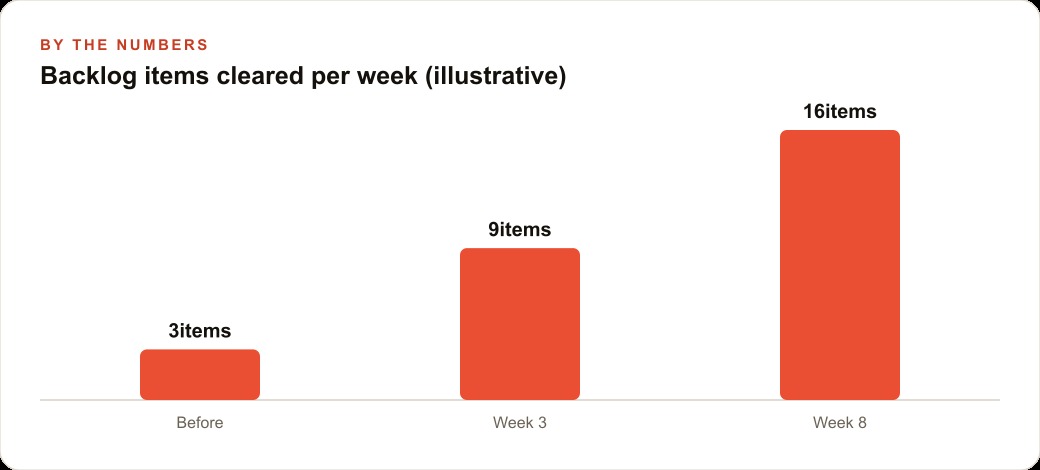
By Wednesday, five of the six tasks have pull requests ready for review. The refactoring task raised a clarifying question midway because the existing structure had an ambiguity about intended behavior that needed a human decision. The developers reviewed the pull requests on Thursday morning. Four were approved immediately. One had a small request for a change in the approach to error handling. All five were merged by Thursday afternoon.
In a typical week without this workflow, those same two developers would complete two to three of those six tasks, working around maintenance interruptions and context-switching costs. The same five-day period cleared five instead of two or three. No additional headcount. No overtime. The work that required judgment got undivided attention because the bounded work was handled asynchronously.
The Rule Files That Keep Agent Output Consistent With Team Standards
One of the features that makes remote agent output integrate cleanly with an existing codebase is the rule file system. Instead of embedding the team's conventions in every individual task description, you write them once in a small markdown file. The agent reads this file before starting any task.
The contents are the kinds of things a senior developer would cover with a new team member in the first week. Always add an error state to any component that fetches data from an API. Write a unit test alongside any new function you add. Follow the existing naming patterns in the components folder rather than introducing new conventions. Use the project's existing class system rather than inline styles. Commit in small, logical increments rather than in one large batch at the end.
These rules take less than an hour to write and they apply automatically to every subsequent agent task. The difference in output quality between an agent working with a clear rule file and one working without it is significant in practice. Without the rules, the agent solves the problem but does so in whatever style seems natural to it, which may differ from the conventions the rest of the codebase follows. With the rules, the output fits. Code reviewers spend less time on style corrections and more time evaluating whether the implementation is actually correct.
MCP Connectors Extend What the Agent Can Verify
MCP connectors add external capabilities to the agent's working toolkit. A connector to the documentation for a third-party API the platform uses means the agent has current, accurate information about that API when it writes code that calls it, rather than relying on training data that may reflect an older version of the API. A browser connector means the agent can open the feature it just built in a real browser, click through the flow, and confirm the behavior before writing the pull request.
These connectors are not complex to configure and they meaningfully expand what the agent can verify independently. The browser testing capability in particular catches a class of errors that code review and unit tests miss: subtle rendering differences on specific screen sizes, form submission flows that break in the browser even though the logic looks correct in the code, loading states that were implemented correctly but show at the wrong moment in the actual user experience.
An agent that can verify its own work visually before declaring a task complete submits pull requests that require less human review time. The reviewers can focus on the design decisions and business logic rather than catching presentational errors that the agent could have caught itself.
The Frequent Commit Pattern as a Review Tool
Augment is designed to commit frequently as it works, and this is intentional rather than incidental. A pull request with twenty small, coherent commits gives the reviewing developer a readable sequence of decisions. They can see what the agent tried first, what changed and why, and what the final state represents. This makes review significantly faster and more accurate than reviewing a single large commit that represents hours of work compressed into one change.
The commit granularity also enables a different kind of agent task scope. Because the work is broken into committed increments, a developer can leave a review comment on an early commit and the agent reads it, adjusts, and continues from there rather than having to redo work it has already done. This interaction model makes it practical to assign larger tasks to the agent because the human can intervene at any point without losing the work that came before.
The Practical Starting Point for Teams New to This Workflow
The starting point Madhuranjan Kumar consistently recommends for teams approaching Augment for the first time is: connect one real codebase, let the index build fully, queue three to five clearly defined backlog tasks with well-written descriptions, and review the resulting pull requests with the same rigor you would apply to any code review.
The first round is calibration, not throughput. The goal is to learn what task descriptions produce reliable results, where the agent needs more specific guidance, and what categories of task are good fits for autonomous completion versus what categories need more human involvement at the design stage.
Most teams find that the first round of tasks teaches them how to write better task descriptions, which makes the next round faster and more reliable. The investment in description quality pays back across every subsequent task the agent handles. A task description that takes ten extra minutes to write well might save two hours of revision work on the resulting pull request.
For any team carrying a backlog that consistently outpaces its development capacity, this represents a practical path to meaningful throughput improvement without the risk and cost of hiring before the business can support additional headcount. The deep indexing is the technical foundation. The remote agent capability is the practical output. The rule files, MCP connectors, and frequent commit pattern are the quality layer. Together they make autonomous coding work on real projects, not just on demonstrations designed to look impressive.
The shift from completing AI suggestions to reviewing AI pull requests is a genuine change in how development work is organized and where skilled engineering time gets applied. Understanding what enabled that shift, and specifically that it rests on a deep, continuously updated index of the actual codebase, is what separates teams that use this kind of tool effectively from teams that add it as another suggestion engine and wonder why the results are uneven.
That is exactly what we do at AI DOERS. Book a private 30-minute call with Madhuranjan Kumar and we will map the fastest path to it for your specific business.
Book your call →
Madhuranjan Kumar
Madhuranjan Kumar brings 20 years of performance-marketing experience and has managed over $200 million in Facebook ad spend for brands across the United States and beyond. His expertise spans the full modern marketing stack: Meta, Google Ads, TikTok, email automation, CRM, and the websites that hold it together. At AI DOERS he turns that track record into lead-generation systems for businesses across every industry.