
Build an Army of Kimi K2 Agents: Cheap, Open, and Great at Tool Calling
Kimi K2 is a low cost open source model that is unusually good at using tools, which makes it an ideal brain for a fleet of agents. Here is how the agents work and how I would put them to work for a real business.

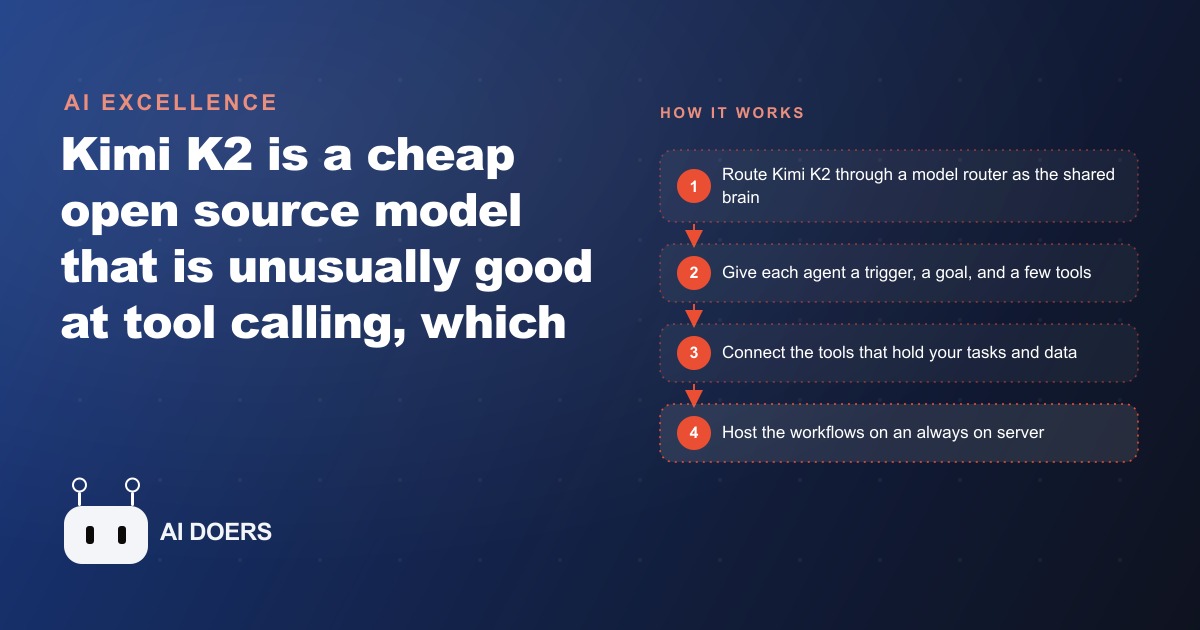
Most conversations about AI agents focus on the model: which one is smartest, which one costs less, which one passed the latest benchmark. I am Madhuranjan Kumar, and I want to make the case for a different frame. The variable that actually determines whether an agent completes a task or merely starts one is not the model's general intelligence. It is whether the model was trained to call tools correctly. Tool calling is not a feature sitting on top of what makes an agent work. It is the definition of what makes an agent work. A model that reasons well but calls tools poorly produces an agent that plans beautifully and accomplishes nothing. That gap is where most cheap model deployments fail, and it is the specific gap that Kimi K2 was built to close.
Kimi K2 is an open-source model from Moonshot AI. It costs a fraction of the premium closed models while matching or beating them on several coding and agent benchmarks. It has a large context window and uses an efficient architecture that activates only a portion of the model per token. But the characteristic that makes it genuinely interesting for building agent fleets is not the cost or the context window. It is that the model was trained specifically for tool calling in the way that matters: it picks the right tool from a set, sequences several tool calls in the correct order without losing the thread, and uses the same tool repeatedly when the task requires it. Those three behaviors are precisely where other cheap models break down, and they are the behaviors an agent depends on to move from planning to execution.
Tool calling separates agents that complete tasks from agents that only start them
When an agent receives a task, it needs to act on the world, not just describe what it would do. Acting on the world means using tools: reading from a calendar, writing to a CRM, sending a message, querying a database, fetching a web page, creating a file. The agent calls a tool, receives the result, decides what to do next based on that result, and calls the next tool. This loop is how an agent moves from receiving a goal to actually completing it.
A model that cannot call tools correctly breaks this loop. The breakdown takes a few common forms. The model picks the wrong tool from the available set. It calls tools in the wrong order, so later steps fail because an earlier step's output is not available. It calls a tool once when the task requires it to call the same tool ten times in a row, stopping short before the work is done. Or it loses track of what it was doing after three or four tool calls and reverts to a generic summary of what it attempted rather than completing the actual task.
These failures are invisible in most model benchmarks, which test language quality, reasoning, and factual recall rather than multi-step tool execution. A model that scores well on standard benchmarks and scores poorly on real agentic tasks is a mismatch that wastes infrastructure spending and operator time. The businesses that discover this usually discover it when an agent that ran well in testing breaks on real work with real tools and real data, because the testing environment did not exercise the specific failure modes that appear when tool chains get longer than three steps. Every business deploying agents should treat tool-calling reliability as the primary selection criterion for the underlying model, not an afterthought.
Why most low-cost models break on multi-step tool chains
The failure pattern is consistent enough to describe precisely. A low-cost model given a task that requires five sequential tool calls will often complete the first two or three correctly. At step three or four, it begins to lose the thread. It either calls the wrong tool, calls the right tool with incorrect parameters derived from misreading an earlier result, or interprets the task as complete when it has only done part of it.
The root cause is training data and training objectives. Most base models are trained on text prediction. Tool calling requires a different kind of behavior: reading a tool result, integrating it into a running state of the task, deciding which action to take next based on that state, and maintaining consistency across many such cycles. Models that were not trained specifically for this behavior handle it inconsistently. They can follow the first few steps because those are predictable from the instruction. The later steps require genuine conditional reasoning based on what the earlier steps returned, and that is where models trained only on text prediction break down.
The practical cost is not just failed tasks. It is false confidence. An agent running a low-cost model will often produce output that looks complete. The task summary says it finished. The last message reads as a conclusion. But the actual work, the CRM record that was supposed to be updated, the calendar slot that was supposed to be booked, the file that was supposed to be saved, is missing or wrong. Catching this requires checking each step of the output against the actual state of the connected systems, which defeats the purpose of having an agent.
Kimi K2 was trained to handle the failure modes that break other cheap models
Kimi K2 was trained with tool calling as a first-class objective, not a downstream capability added after general language training. The model picks the right tool from the available set consistently. It sequences multi-step tool chains without losing the thread between calls. It uses the same tool repeatedly when the task demands it, whether that means creating one calendar event per task across a list of twelve tasks or calling a search tool for each item in a batch. These are the specific behaviors that make a cheap model usable as an agent brain rather than merely capable as a text generator.
The open-source aspect adds an important dimension. Because Kimi K2 is open, it can be hosted on infrastructure you control rather than sent to a closed API. For businesses where data privacy matters or where the volume of agent calls would make a premium API cost prohibitive, that control is practically significant. The cost per call at self-hosted open-source pricing is a fraction of what premium closed models charge, which means you can run agent fleets that execute many times per day without the bill becoming a consideration. An agent that checks a sales pipeline every morning, monitors a competitor page three times a day, and compiles a daily status summary can run thousands of cycles per month for a few dollars at open-source inference pricing. At premium closed-model pricing, the same usage volume costs significantly more.
The model router turns a single reliable brain into a maintainable operational backbone
Building agent fleets with one model per agent is the approach most people start with and most people regret. Each agent has its own model configuration. Each has its own API key. Each has its own update process. When a better model ships, you update each agent individually. When a billing issue occurs, you trace it across multiple configurations. The operational overhead of a fleet built this way grows with the number of agents.
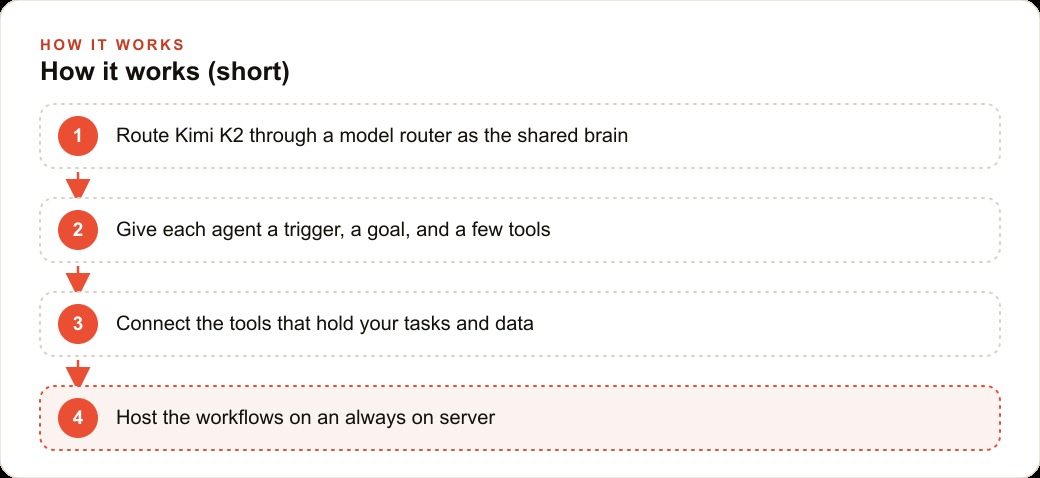
The model router solves this cleanly. You configure Kimi K2 once behind a router and point all agents at the router rather than directly at the model. The router handles the connection to the model. Every agent shares one configuration, one API key, one billing account, and one update point. When a better version of Kimi K2 ships, you update the router and all agents immediately use the improved model without any per-agent changes. When you want to test a different model for a specific task, you configure one agent to route to a different endpoint and compare performance without disrupting the rest of the fleet.
For a CRM and website stack where agents are reading customer records, updating pipeline stages, tagging contacts, and flagging overdue follow-ups, the router architecture means the owner maintains one operational system rather than a collection of individually configured automations. Adding a new agent to the fleet is a matter of defining its trigger, its tools, and its goal, then routing it through the same brain as every other agent. The consistency of behavior across the fleet improves because all agents share the same underlying model and the same tool-calling training, rather than each agent being a product of a different configuration decision made on a different day.
The same architecture benefits Facebook and Instagram ad campaigns when agents are responsible for pulling performance data, flagging campaigns that have drifted outside target parameters, and drafting adjustment recommendations. A router-backed fleet of three or four agents handling different parts of the ad operations workflow maintains consistent behavior and a single update path, compared to three or four independently configured automations that drift apart over time.
The think step and always-on hosting are the prerequisites most builders skip
Two design decisions are standard in every productive agent fleet and skipped in most first attempts. The first is the think step. The think step is a tool given to the agent that prompts it to write out its plan before taking any action. The model produces a brief internal plan: what the goal is, what tools are available, what sequence of steps would complete the task, and what to watch for. The agent then executes against that plan rather than improvising each step from the raw instruction.
The improvement in output consistency from adding a think step is measurable and immediate. The model that plans before acting is less likely to call the wrong tool first, less likely to stop short of completion, and less likely to produce a summary that sounds done while leaving the actual work incomplete. The think step costs almost nothing in additional tokens and adds no noticeable latency. It is the single cheapest improvement available for a model that needs to maintain consistent behavior across multi-step tasks, and it is the step most builders skip because it feels like unnecessary overhead until they see a deployment break without it.
The second is hosting. An agent that only runs when someone manually triggers it is not automation. It is a more complicated manual task. An agent fleet that runs on an always-on server, firing each agent on its configured schedule without anyone needing to start it, is the only configuration that delivers the compounding value of automation. If the agents live on a local laptop, they stop when the lid closes. If they require a manual trigger to run, the consistency that makes automation valuable disappears. Getting the fleet onto an always-on server, whether a cloud instance or a VPS, is not a stretch goal to complete after the agents are proven. It is the last prerequisite before the fleet is actually operational.
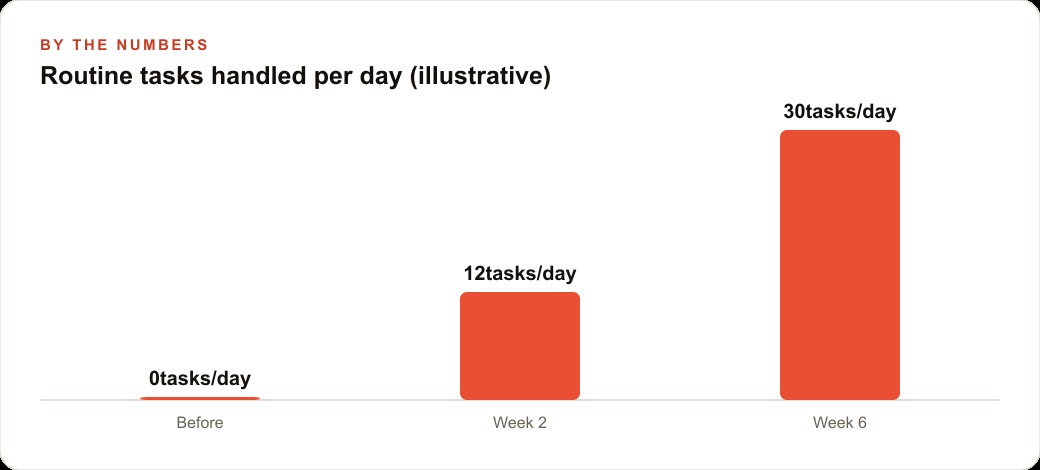
A fleet of four or five agents built on Kimi K2 through a model router, each with a think step and a clear trigger, hosted on a server that fires them on schedule, handles a meaningful volume of routine business work without human intervention. The tasks it handles are the ones that previously filled the edges of the owner's day: the morning status check, the daily report compilation, the follow-up reminders for overdue items, the data pulls that someone has to do before the team meeting. Those are not glamorous tasks, but they are the tasks that determine whether a business runs smoothly or sloppily. An agent fleet that handles them reliably at low cost is the operational infrastructure that lets the owner spend their attention on work that actually requires them. The cost of running such a fleet is low enough that it does not need to appear on a budget line for most small businesses. The value it produces in recovered time and reduced execution errors is the kind of change that shows up in how the owner spends their day within the first month.
That is exactly what we do at AI DOERS. Book a private 30-minute call with Madhuranjan Kumar and we will map the fastest path to it for your specific business.
Book your call →
Madhuranjan Kumar
Madhuranjan Kumar brings 20 years of performance-marketing experience and has managed over $200 million in Facebook ad spend for brands across the United States and beyond. His expertise spans the full modern marketing stack: Meta, Google Ads, TikTok, email automation, CRM, and the websites that hold it together. At AI DOERS he turns that track record into lead-generation systems for businesses across every industry.