
How to Build an AI Voice Agent That Books Appointments 24/7
A voice AI agent answers calls in a natural human voice, checks your calendar for open slots, and books the appointment, all without you on the phone. Here is how the pieces fit together and how I would set one up for a real business.

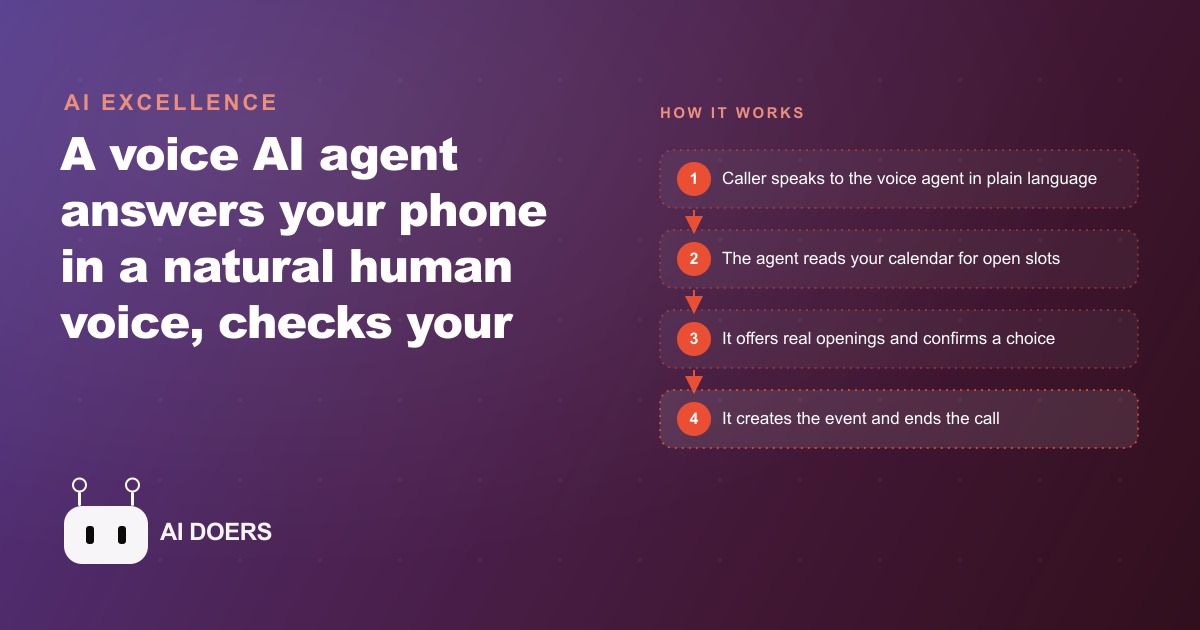
A missed call at a local business is usually a missed job, and most owners lose several of them every single week without ever knowing the number. I am Madhuranjan Kumar, and the fix that surprises people is a voice AI agent that answers the phone in a natural human voice, checks your calendar, and books the appointment, around the clock, with nobody on the line. Here are the eight things that actually make one of these work, each one a specific decision you can get right or wrong.
1. Voice is the modality that finally fits how people call
Start with why voice, not chat. Talking is roughly three times faster than typing for most people, and the latest voice models are realistic enough that the large majority of callers cannot tell they are not speaking to a person. That combination is what makes a voice agent worth building where a chat widget was not. Nobody wants to type their scheduling request into a box on your website at nine at night, but they will happily call and speak. Meeting customers in the channel they already reach for, the phone, is the whole reason this works, and it is why a voice agent feels valuable in a way an ignored chat icon never did.
2. Always on is the entire point, not a nice extra
An agent is only useful if it answers every time, day or night. This is the difference between a gadget and a business tool. The whole value proposition is catching the calls that currently go to voicemail, and voicemail is exactly what happens at seven in the morning, at nine at night, and during the hours the owner is busy with a customer. So the agent has to run on a cheap always-on server that keeps it awake continuously. If it only answers during office hours, it solves nothing, because those are the calls you were already catching. Design for the after-hours call from the start, because that is where the recovered revenue lives.
3. Two pieces, joined by a webhook
The architecture is simpler than people expect, and understanding it removes the fear. There are only two pieces. A workflow tool holds the logic and the calendar, and a voice tool handles the speech. A single webhook link joins them in a few clicks. That is the entire mental model. The workflow is the brain that decides what to do and talks to your calendar, and the voice layer is the mouth and ears that carry the conversation. Once you see it as two connected boxes rather than one intimidating system, the build stops feeling like software engineering and starts feeling like wiring two tools together, which is exactly what it is.
The reason this two-box design matters is that it keeps each piece replaceable. If a better voice model comes out next month, you swap the voice layer and leave the logic untouched. If your booking rules change, you edit the workflow and the voice layer never knows the difference. Systems that fuse everything into one monolith are the ones that become impossible to change later, and impossible-to-change is how good automations quietly rot. By keeping the brain and the voice separate and joined only by a webhook, you build something you can actually maintain and improve over time, which for a small business is the difference between a tool that lasts and one you abandon after the novelty wears off.
4. Read the calendar first, then book into it
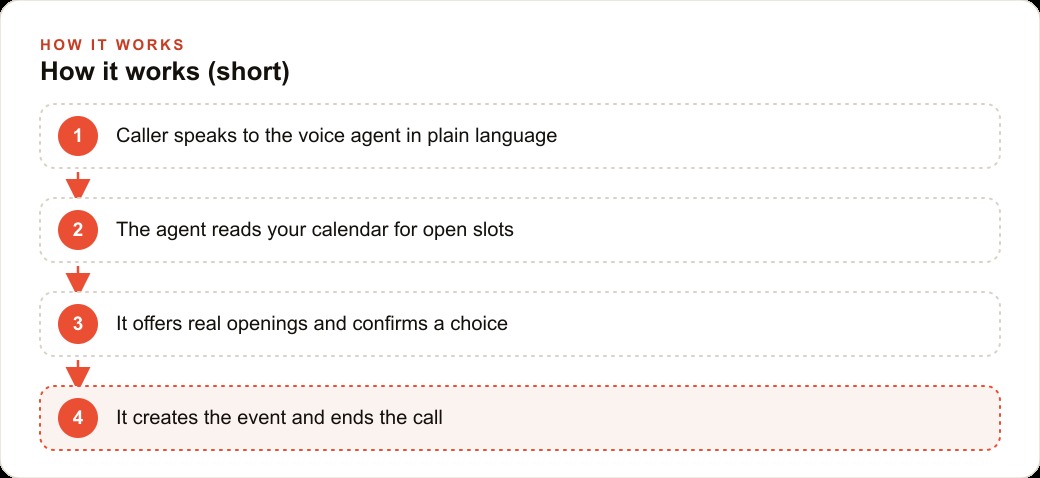
The core booking behavior is a two-step move, and getting the order right is what prevents the most embarrassing failure. Inside the workflow you set up two calendar tools. The first reads your schedule to find genuinely open slots. The second creates the event once a time is chosen. The sequence matters: the agent reads before it writes, so it offers real openings and never double-books a slot that is already taken. An agent that books blindly without checking availability first will eventually schedule two customers into the same hour, and one bad experience like that undoes all the goodwill. Read, then book, every time.
5. Let the model fill the details instead of hardcoding them
Here is a design choice that keeps the whole build clean and flexible. For most of the meeting fields, you let the AI agent decide the details rather than hardcoding them. You do not script every possible field and value in advance. You give the agent a model as its brain and a short system prompt describing how to behave, and you let it fill in the specifics of each booking from the actual conversation. This keeps the build simple and lets it flex across different requests without you rewriting logic for every scenario. Hardcoding feels safer but produces a rigid agent that breaks the moment a caller says something you did not anticipate. Trusting the model with the details is what makes it feel human.
6. Tune the voice settings until it sounds real
Realism is not automatic. It comes from a handful of small settings that most people skip, and they raise the perceived quality a great deal. Add ambient background noise so there is a subtle sense of a real environment. Keep the voice calm. Set the speaking speed slightly slower than default so it is easy to follow. Turn on the setting that makes the agent speak first instead of waiting silently for the caller. None of these are big engineering tasks, but together they are the difference between a caller relaxing into the conversation and a caller immediately sensing a robot. The tuning is where a functional agent becomes a convincing one, so do not treat it as optional polish.
The psychology behind these settings is worth understanding, because it tells you what to prioritize when you tune. A caller decides whether they are talking to a machine in the first two or three seconds, mostly on subconscious cues: dead silence, an unnaturally fast or flat delivery, or a voice that starts talking over them. Every setting on this list is aimed at those first seconds. Speaking first prevents the awkward silence that screams automation. A slightly slower pace reads as calm and human rather than rushed and robotic. A hint of ambient noise fills the unnatural vacuum that pure digital silence creates. Get those first seconds right and the caller settles in, which means they actually complete the booking instead of hanging up to try a competitor. That is why I treat voice tuning as core functionality, not decoration.
7. Handle time zones explicitly when your callers are spread out
This is the small detail that saves you from a very specific and very annoying class of mistake. If your callers come from different areas, tell the agent to ask which time zone they are in before it confirms a time. Left unspoken, a booking made at what the caller thinks is two in the afternoon can land in your calendar at an entirely wrong hour, and now both sides show up at different times. It is a one-line instruction in the prompt, and it eliminates a category of failure that would otherwise erode trust in the whole system. Whenever geography is in play, make the time zone an explicit question, not an assumption.
8. Specialize in one niche if you plan to sell this
The last point is for anyone who wants to offer this as a service rather than just run it for themselves. Build a near-finished agent for a single industry, then customize only the last part for each client. One niche sharpens both your offer and your speed, because the calendar logic, the voice tuning, and the prompt structure are largely the same across every business in that vertical. You are not rebuilding from scratch each time. You are swapping the specifics. Trying to serve every industry at once means you rebuild constantly and get fast at nothing. Picking one lets you become genuinely excellent and quick, which is what actually closes clients.
There is a sales advantage hidden in the niche choice too. When you can walk into a dental office and say you build booking agents specifically for dental practices, and you already understand their scheduling quirks, their common questions, and their busy hours, you are a specialist rather than a generalist with a demo. Specialists command trust and better rates. The agent you hand over also gets better with every client, because each build teaches you the edge cases of that one industry, and those lessons fold back into your near-finished template. Breadth makes you forgettable. Depth in one vertical is what turns a one-off project into a repeatable, referable business.
A worked example: an auto detailing shop
Let me put all eight together on one business. Picture an auto detailing shop where the owner misses booking calls constantly because both hands are on a car. A customer calls to book a full detail for Saturday. The agent answers in a natural voice, asks whether they want to book, reschedule, or ask a question, then reads the shop's calendar for open slots. Saturday at two is taken, so it offers the next real openings and confirms whichever the customer picks, then creates the event automatically. I would write the system prompt around the shop's actual services, a basic wash, an interior detail, and a full package, so the agent quotes the right time block for each, and I would have it confirm the time zone when a caller is out of area.
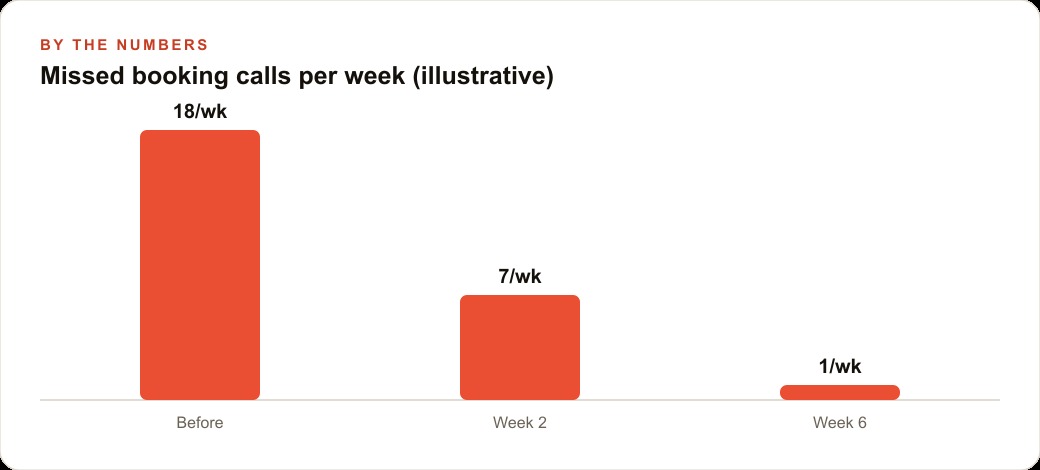
Now some illustrative numbers to show the shape of the payoff. Say the shop was missing around eighteen booking calls a week before the agent, mostly early morning and evening. Within two weeks of the agent going live on a cheap always-on server, that might drop to seven, and by week six to close to one, as the agent catches nearly everything voicemail used to swallow. If even half of the recovered calls turn into booked details, that is real money the shop was simply losing before. None of this replaces the detailer or the front desk. It catches the calls that were quietly turning into lost jobs. Those bookings also become data: the leads and appointments can flow into the CRM and website stack where follow-up and reminders live, and a business confident that no inbound call is wasted can spend more aggressively on Facebook and Instagram ad campaigns and Google Ads, because every call those ads generate now gets answered instead of dropped.
How to build your first one this week
Take it one flow at a time. Map the single flow you want, booking, and build only that. In the workflow tool, set up the webhook, the AI agent, a model, and the two calendar tools, one to read open slots and one to create the event, and let the model fill the details so you are not hardcoding fields. Write a short, plain system prompt for how the agent should behave, and save often. Then build the voice layer: choose a natural voice, write a brief greeting prompt, set it to speak first, add background ambience, and slow the speed slightly. Connect the two with the webhook URL, run a test call, and listen for anything that sounds off. Tune the prompt and the voice settings until it feels real, then put it on an always-on server so it never sleeps.
A focused owner can stand up a first working version in an afternoon. The harder part is writing the prompt so the agent books exactly the way your shop runs and handling the edge cases gracefully. You can take this do-it-yourself path, or bring in someone who has already built these many times and have it set up, tuned, and handed over working. Either way, the eight decisions above are what separate an agent people trust with their bookings from one they hang up on.
That is exactly what we do at AI DOERS. Book a private 30-minute call with Madhuranjan Kumar and we will map the fastest path to it for your specific business.
Book your call →
Madhuranjan Kumar
Madhuranjan Kumar brings 20 years of performance-marketing experience and has managed over $200 million in Facebook ad spend for brands across the United States and beyond. His expertise spans the full modern marketing stack: Meta, Google Ads, TikTok, email automation, CRM, and the websites that hold it together. At AI DOERS he turns that track record into lead-generation systems for businesses across every industry.