
How To Build an AI Knowledge Base and Actually Learn Anything Fast
Bookmarks and bottomless chat threads are not a learning system. Here is how I centralize videos, articles, and podcasts into one AI knowledge base that summarizes, links, and quizzes, and how a law firm can use the same setup.

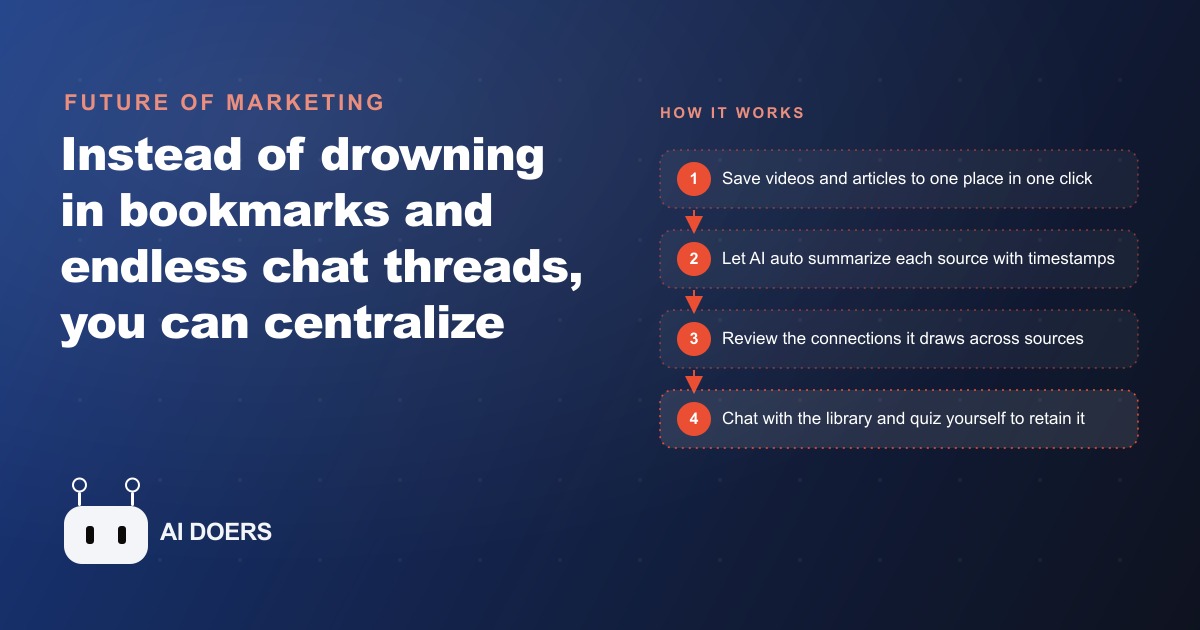
The retention problem almost every professional I talk to has is not a shortage of good sources. It is the inability to find what they already consumed when it actually matters. I am Madhuranjan Kumar, and the pattern I see again and again is this: someone spends two hours watching expert interviews, saves a browser tab, closes the laptop, and six weeks later cannot reconstruct what they learned. The information existed. It was good information. The system failed to hold it. Building an AI knowledge base is not about collecting more things. It is about changing the architecture of how knowledge gets stored, retrieved, and connected so that the time you spend learning actually compounds.
Why scattered sources compound into a retention debt that only gets worse over time
The word clutter understates the problem. Scattered learning is not just messy, it is actively expensive. When knowledge lives across YouTube playlists, bookmark folders, podcast apps, and chat history, every future use of that knowledge requires rediscovery rather than retrieval. Rediscovery is not free. It costs the same attention units you already spent the first time you found the source. You pay twice: once to learn it and once to find it again. And the second time you often do not remember enough to know exactly what you are searching for.
The deeper issue is that scattered sources cannot generate connections on their own. A research paper you read three months ago and a podcast episode you saved last week might reference the same framework or contradict each other in a meaningful way. If they live in different apps with no bridge between them, that connection never surfaces. Your brain is supposed to make those connections, but the brain is not reliable at cross-referencing content encountered months apart. The connection either happens spontaneously or it does not happen at all. A knowledge base changes that from a random event into a systematic one.
There is also a compounding effect that works in the wrong direction when you leave sources scattered. The more you save without organizing, the harder it becomes to use what you have. A bookmark folder with 200 items is less useful than one with 20 items, not because the extra 180 are worthless, but because adding them increased the noise relative to the signal. A knowledge base inverts this. Every additional source increases the value of the library because the system finds connections the new source creates with everything already stored. That property, that more content means more useful rather than more confusing, is the fundamental difference between a knowledge base and any form of simple storage.
The architectural difference between saving a link and indexing what it contains
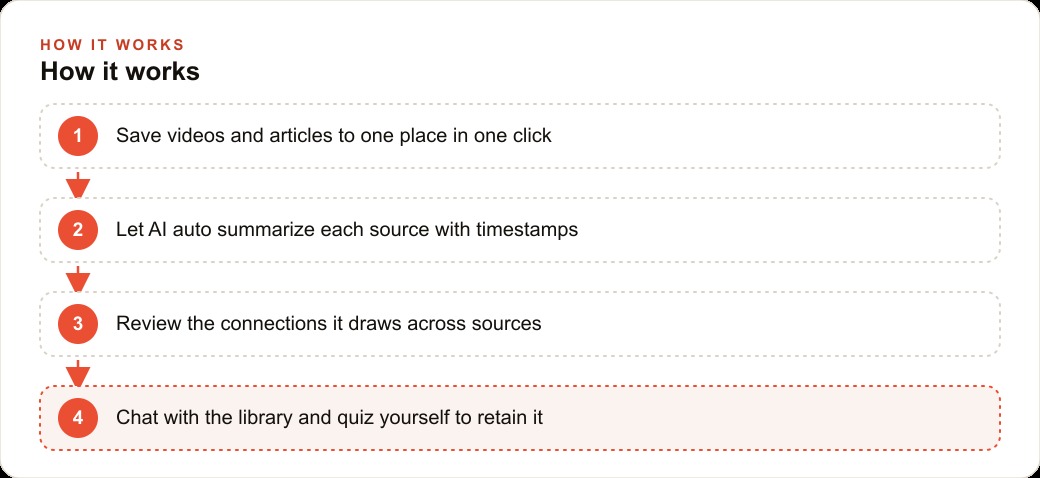
The core concept sounds simple: pull everything worth keeping into one place, assign it to topics the system identifies automatically, and let AI generate structure from the raw material. The result is not a better bookmark folder. It is a different category of tool because the retrieval behavior is fundamentally different.
When you retrieve from a bookmark folder, you search for a label you assigned. When you retrieve from an AI knowledge base, you ask a plain question. "What are the three most common mistakes businesses make when setting pricing for this kind of service?" returns an answer that pulls from six saved sources you forgot you had, with timestamps pointing to exact moments in video content where the answer appears. The retrieval unit shifts from "find the document" to "answer the question from everything I know."
There is also a difference in what gets indexed. A bookmark folder indexes the URL and whatever title the page happened to have. An AI knowledge base indexes the content itself. A two-hour podcast episode becomes fully searchable by topic, speaker quote, and concept. You can ask which part of this recording covers pricing strategy and get a timestamp rather than scrubbing through the full audio. For a small team of three consultants saving ten hours of video per week, the time recovered on research extraction over a quarter is significant. If each re-access previously took twenty-five minutes of active watching and that drops to five minutes with timestamped summaries, the team recovers roughly five hours per month per person. Over twelve months across three people, that is close to 180 person-hours of recovered research capacity, which compounds into faster decisions and deeper client work.
Why chat tools fail as a long-term knowledge store
The instinct to use a chat tool as a knowledge base is understandable. You paste a transcript, ask for a summary, and get an answer in thirty seconds. That works well exactly once. The problem emerges when you do it fifty times. A chat history with fifty summarized transcripts is not searchable in any meaningful way. You can scroll through it, but you cannot ask it a cross-source question. You cannot ask it to find everything across these fifty sources that mentions pricing and get a structured answer.
Chat threads are also ephemeral by design. The memory window is finite. An article you pasted into a conversation eight months ago is effectively gone. The model either has no memory of it or requires you to paste it again. The interaction model optimizes for a single conversational session, not for accumulation over time. That design choice makes chat tools excellent at generating new ideas and poor at storing and retrieving existing ones.
The failure mode becomes visible when you try to build on previous work. You remember learning something important about a topic, you know it was in a chat thread somewhere, and you spend fifteen minutes scrolling before giving up and re-reading the original source. The time you spent generating that insight the first time is lost. A knowledge base does not have this failure mode because its architecture is designed for retrieval at arbitrary future times, not just for the session where you saved the material. Every tool has a job it is good at. Chat tools are good at generation within a session. A knowledge base is good at accumulation and retrieval across sessions. Treating a chat tool as a substitute for the second category produces the frustration people report when their AI-assisted learning does not compound.
The save-first workflow and why decoupling capture from consumption changes the behavior
Most learning systems fail at the point of capture. The ideal system makes saving a source as fast as the thought "I want to come back to this," and until that speed exists, people skip saving and lose the material. The save-first workflow addresses this by separating capture from consumption. You save the source in one click with a browser extension, move on, and return to the library later when you have the mental bandwidth to engage with the material deeply.
This decoupling is more important than it sounds. The moment you encounter an interesting source is often not the moment you have time to engage with it carefully. If saving requires watching or reading first, you will save almost nothing. If saving requires one click, you will build a library you can actually mine.
The psychological shift is significant. Instead of every interesting source feeling like an immediate obligation, it becomes an asset you can draw on later. The library grows during low-attention moments, and the actual analysis happens during high-attention sessions when you search the library rather than the open internet. Those are completely different cognitive modes, and keeping them separate produces better output from both. Save-first changes the relationship with incoming information from "I need to deal with this now or lose it" to "I captured this and will engage with it when I can get the most from it." That reframing also reduces the mental backlog that accumulates when you encounter more useful content than you can immediately consume, which for most knowledge workers in a fast-moving field is a constant condition.
How timestamped auto-summaries change the value of a two-hour source
The auto-summary feature sounds like a convenience. It is actually a different research paradigm. Without it, you have to engage with the full source to know whether it has what you need. With it, you read a three-paragraph summary and decide in sixty seconds whether to go deeper. That decision point, which used to require significant time investment, becomes nearly free.
Timestamped sections compound this. A two-hour panel discussion that covers eight topics now has chapters. You want the part about a specific pricing mechanism. You jump to the timestamp, listen for four minutes, and move on. The source is queryable at the section level, not just the document level. The length of the source no longer determines how long retrieval takes.
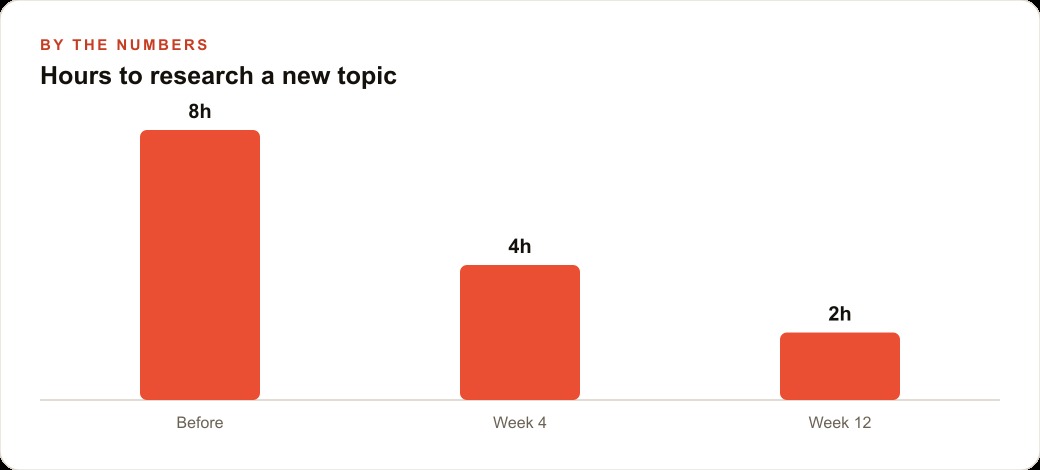
Here is where numbers make this concrete. Imagine a team of three consultants saving ten hours of video content per week across competitor moves, industry trends, and technical developments. Before a knowledge base, extracting one insight from a source took twenty to forty minutes of active watching. Ten sources meant three to seven hours of extraction time per week just to surface the relevant ideas. With auto-summaries and timestamped sections, the same extraction takes ten to twenty minutes total because the navigation is instant. Over twelve weeks, the difference in research time for a three-person team is measurable in days of recovered working time. That recovered time goes back into analysis and client work rather than into scrubbing through audio looking for the part you half-remember.
Connection mapping across sources: how the library reveals which ideas are worth studying first
This is the feature that separates a knowledge base from a better search engine. As the library grows, the tool maps the people, companies, and concepts that appear across multiple saved sources. When the same framework appears in a case study you saved, an expert interview from two months ago, and a research paper you added last week, that convergence surfaces automatically without you having to query for it.
The value is that convergence across independent sources is one of the strongest signals that an idea deserves your attention. A single author saying something is true is weak signal. Three unrelated experts, writing or speaking in different contexts, all pointing to the same mechanism: that is strong signal. You do not have to read everything to find it. The connection map shows where the intersections are, and you go there first. That changes the order in which you engage with what you have saved, steering you toward the high-confidence material early rather than discovering it by chance deep into a research session.
The map also diagnoses gaps. If a topic you care about appears in many sources but always in passing and never as a main subject, you know you need a primary source on it. That diagnosis used to require remembering what you had saved and cross-referencing it mentally. The connection view makes it a visual inspection that takes seconds rather than a memory exercise that might or might not surface the right gap. Both the convergence signal and the gap signal deliver value passively as the library grows, which is the compounding property that makes the tool more useful the longer you use it.
Active recall through built-in quizzing: the retention mechanism passive saving skips entirely
Saving and summarizing improve access. They do not guarantee retention. The built-in quiz mechanism addresses this directly by testing whether you can answer questions from material you saved at intervals after saving it. This is active recall, and the difference it makes to long-term retention compared to passive re-reading is consistent: testing yourself on material produces significantly stronger retention than reading the same material again.
The practical upside is that you do not need to re-watch a two-hour podcast to refresh a specific point before a meeting. If you quizzed yourself on it two weeks ago, you likely still have it. If you did not, the quiz surfaces it in under five minutes. Either way, the time cost of refreshing knowledge drops significantly compared to a system that relies on passive re-consumption.
For a team of five people saving ten to fifteen items per week, the difference between a quizzed library and an unquizzed one is visible within a quarter. The quizzed team can answer questions from material they saved three months ago. The unquizzed team is starting research from scratch on questions they already answered. That difference compounds over time and translates directly into the quality and speed of decisions the team makes. A consulting team that can pull a well-sourced answer in four minutes instead of rebuilding research from scratch bills those recovered hours to other work or uses them to go deeper on the analysis that actually differentiates their recommendation. The quiz is the mechanism that closes the loop between saving information and actually having it available when it counts.
Building a knowledge base as a practice rather than a one-time installation
The most important thing about an AI knowledge base is not what it does in the first week. It is what the library looks like after twelve months of consistent saving and querying. At that point, the collection reflects exactly the landscape of sources your team has engaged with, cross-referenced, and tested through recall. No search engine can replicate it because no search engine knows your specific combination of saved sources and the connections between them. The library is unique to your team's work and perspective.
The compounding shows up in research tasks first. A topic you need to brief a client on in January takes two hours of fresh research because the library is new. The same topic in December, after a year of saving, surfaces twelve connected sources with auto-summaries, a connection map showing which three are most frequently cited by the others, and quiz history showing which team members are already up to speed. The research task has a completely different starting point.
It also shows up in onboarding. A new team member who joins after twelve months of library-building inherits the curated reading list of everyone who came before them, searchable and quizzable. The traditional alternative is months of asking the person who knows this, followed by incomplete informal briefings. The knowledge base compresses the time to base competency significantly, which is one of the most expensive bottlenecks for growing teams.
The starting step is not complicated: create one collection around one topic the team researches regularly, save five sources in the first ten minutes without reading them, ask the library a plain question, and run the quiz on the material it surfaces. That full sequence takes about fifteen minutes and shows you more about how the tool works than reading any documentation does. The advantage from there is not immediate, but it is durable, and durable advantages are the only kind worth building.
That is exactly what we do at AI DOERS. Book a private 30-minute call with Madhuranjan Kumar and we will map the fastest path to it for your specific business.
Book your call →
Madhuranjan Kumar
Madhuranjan Kumar brings 20 years of performance-marketing experience and has managed over $200 million in Facebook ad spend for brands across the United States and beyond. His expertise spans the full modern marketing stack: Meta, Google Ads, TikTok, email automation, CRM, and the websites that hold it together. At AI DOERS he turns that track record into lead-generation systems for businesses across every industry.