
Build AI Apps 10x Faster With LangFlow and Flowise
Drag-and-drop tools let you assemble a working AI knowledge assistant from simple blocks. Here is how they work and how a flooring company could answer routine questions automatically.

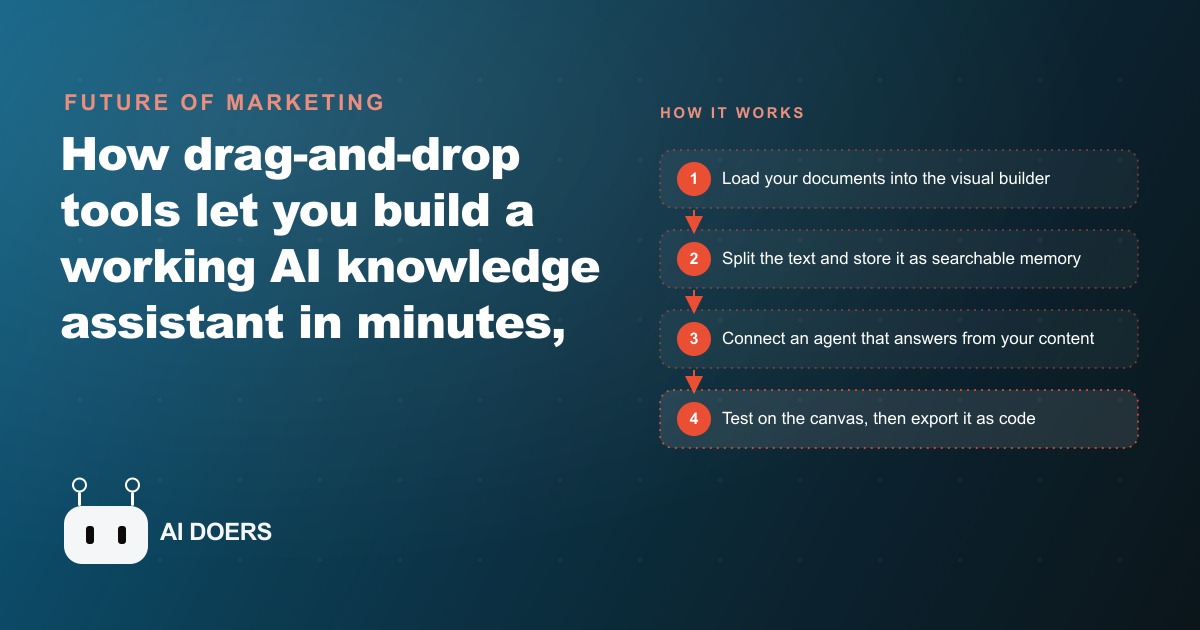
A flooring company owner sat down with Madhuranjan Kumar a while back and described the problem in a single sentence: every week, his phones ring with the same questions. What material works in a bathroom? Can you give me an estimate for 800 square feet of hardwood? How do I clean engineered oak? His team answered those questions patiently, hundreds of times a year, and did not see that the answers already existed in the documents on his desktop. Spec sheets, care guides, warranty terms, installation guides. The knowledge was there. The only missing piece was a way to make it answer automatically at any hour. That piece now costs an afternoon to build.
The answers your customers need are already written down somewhere in your business
Most small businesses have more documented knowledge than they realize. Decades of operating experience crystallizes into files: the pricing sheet that took a year to get right, the materials guide that explains every product in plain language, the FAQ document that the most patient team member wrote so others could look up answers instead of calling her. The care guide for each product line. The warranty terms. The onboarding checklist. All of it is written, specific, and accurate. It just sits in folders on a desktop, invisible to every customer who calls the main line after hours or visits the website on a Sunday evening.
The friction that kept this knowledge locked away was entirely technical. To turn your documents into a 24-hour answering system, you used to need a developer who understood language model frameworks, vector databases, embedding pipelines, and deployment infrastructure. You needed someone to write the code, test it, debug it, and maintain it over time. For a flooring company, a dental practice, or a neighborhood accounting firm, that combination of skills and budget was unrealistic. So the phones kept ringing with the same questions, the staff gave the same answers for the thousandth time, and the stack of spec sheets stayed in the folder.
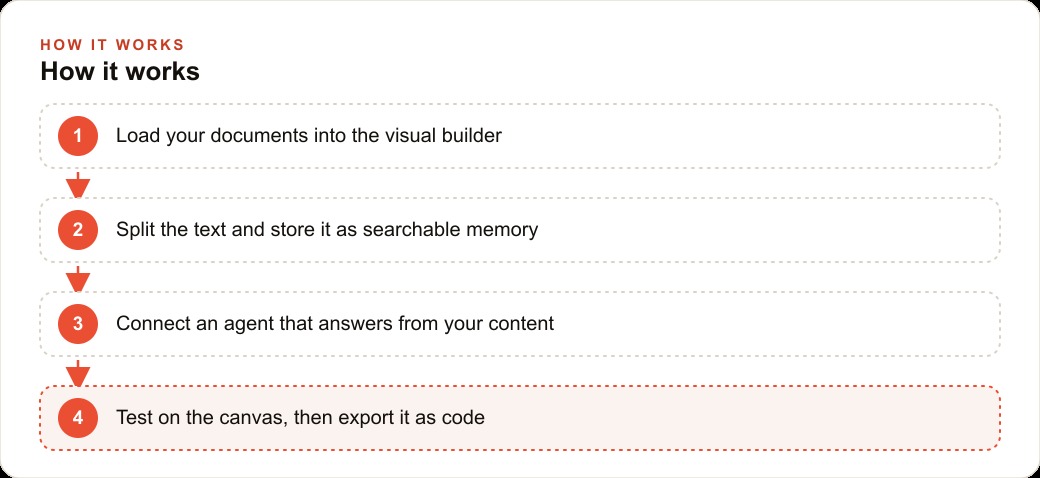
LangFlow and Flowise are open source visual builders that remove every piece of that technical barrier. You do not write code. You drag and drop blocks onto a canvas, connect them with lines, and press run. The blocks handle the hard parts: loading your documents, splitting them into chunks the model can process, converting those chunks into a searchable memory, and connecting an AI agent that reads from that memory before answering any question. When every block turns green the assistant is ready, and you can chat with it right there to test it. The only thing it needs from you is the documents you already have.
Visual builders removed the last technical barrier between your documents and a 24-hour assistant
The architecture of a working knowledge assistant built in LangFlow or Flowise follows a small chain of blocks, each doing one job. A loader block pulls in your content: a PDF, a text file, a web page. A text splitter breaks that content into smaller pieces the model can work with reliably. Those pieces flow into a vector store, which is a searchable memory where text is indexed by meaning rather than by keywords alone. An embedding model converts each chunk into a mathematical representation that captures what the chunk is about, not just what words appear in it. An agent block ties everything together: when someone asks a question, the agent searches the vector store for the chunks most relevant to that question and answers from that specific content instead of guessing.
The vector store is the part worth understanding clearly because it is what makes the assistant accurate rather than confusing. A keyword search would only find text that contained the exact words used in the question. A vector store finds text that means the same thing as the question, regardless of which specific words appear. A customer asking how do I protect my new floors from furniture scratches gets pulled from a care guide section titled furniture damage prevention, even though none of those words appeared in the question. That semantic precision is why the assistant can answer from dense technical documents rather than breaking down at the first question that does not use textbook phrasing.
When you have several types of documents covering different subjects, you add a router block. The router reads the question, decides which store is most relevant, and directs the search there. Warranty questions go to the warranty store. Care questions go to the care guide store. Material and specification questions go to the spec sheet store. The answer comes back with the precision of someone who read the right document rather than the vagueness of someone trying to remember everything at once.
When the canvas is working and the assistant answers accurately in testing, a single button exports the entire flow as code you can wire into your own website. That export step is what makes this a real business tool rather than a demo. You build and test visually, then deploy a working feature that your customers interact with, not a prototype you show at a meeting.
The two builders differ in small practical ways. LangFlow tends to make deployment to an external web server more straightforward. Flowise has a smoother search-and-drag interface that some builders find faster during the initial construction. Both produce the same kind of result and both are completely free to run on your own hardware. The right choice is whichever one you spend ten minutes with and find more intuitive. The underlying architecture is identical.
The businesses that build in the next 90 days set the pace for their category
The timing argument for building a knowledge assistant right now is not about chasing a trend. It is about a structural gap that exists today and is actively closing. Most small businesses have not yet built this kind of tool. The ones that do in the next 90 days are not adopting an established practice. They are building a meaningful operational advantage before their competitors notice the option exists.
The gap closes unevenly by category. Businesses in fields with strong technical early adopters, like software agencies and digital marketing consultancies, will have assistants running within months. Businesses in categories where the average owner is focused entirely on the trade itself, like flooring, plumbing, landscaping, and property management, will take longer. For businesses in those categories, building now is not catching up to anyone. It is setting the pace before anyone else in the category moves.
The compounding effect is worth thinking through carefully. An assistant deployed this month generates knowledge every week it runs, not because the model updates automatically but because the questions it receives reveal exactly which topics your documents answer well and which ones they leave gaps around. Every gap you close by updating a document or adding a new section makes the assistant sharper. A business that starts this process now has six months of refinement and data by the time a competitor launches their first version. That lead does not disappear quickly, and it compounds because the assistant improves continuously while the competitor is still figuring out where to start.
There is a conversion argument too. A prospect researching flooring options at ten in the evening, who gets a clear, accurate answer about whether engineered hardwood holds up in a bathroom with moderate humidity, is more likely to remember that business and call in the morning than one who searched a static FAQ page, found nothing helpful, and moved on. The assistant does not close the sale. It keeps the prospect engaged long enough for a human to close it. That is the practical value of 24-hour availability, and it is much easier to measure than most owners expect once the question logs start arriving.
The flooring company that stopped losing prospects to the voicemail
For the flooring company owner who described the phones ringing with the same questions, the build looked like this. The team gathered their product spec sheets, care and maintenance guides, warranty documents, and a written version of the most frequently asked questions that their most knowledgeable team member had been answering from memory for years. Those documents went into the visual builder through separate loader blocks: one set for spec sheets, one for care guides, one for warranty terms, one for the FAQ content.
A text splitter broke each document into sections small enough for the model to process without losing context. Each category of sections went into its own vector store. A router agent sat above those stores and decided which one to search based on the nature of each incoming question. Everything connected to a language model that read from the selected store before composing any response.
Testing on the canvas exposed three specific gaps. The spec sheet for one product line was missing moisture resistance ratings entirely, which meant the assistant could not answer a very common question about bathroom installations for that product. The care guide used trade abbreviations the model could not confidently expand without guessing. Two warranty-related questions fell in a boundary area between categories in a way the router had not anticipated, resulting in vague answers that pulled from the wrong store. All three gaps were fixed by updating the source documents and reloading them. No changes to the builder configuration were needed. The assistant answered all three questions correctly in the next round of testing.
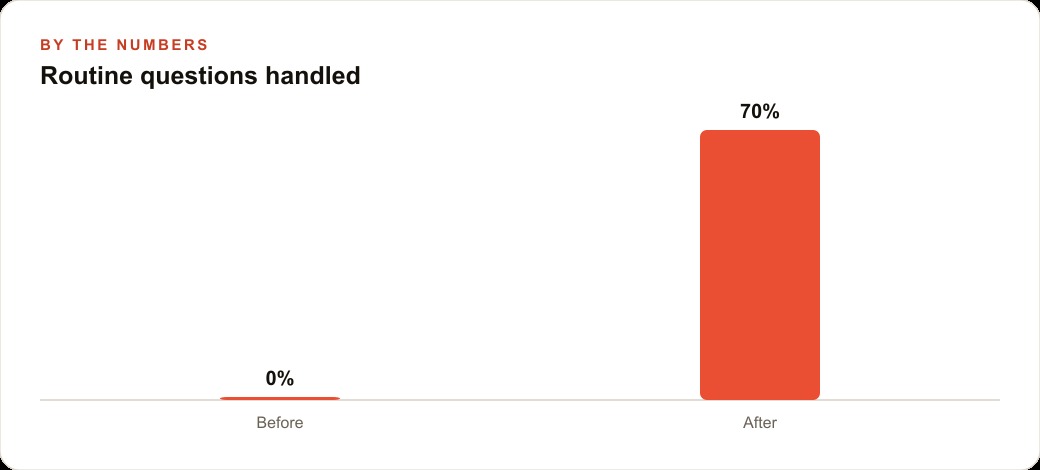
The finished assistant went onto the company website as a chat widget. Within the first month it was handling a consistent share of the routine questions that had previously reached the phones. The number that mattered most to the owner was not the percentage of questions answered automatically. It was the number of times his staff ended the workday without feeling worn down by repetitive calls. Those recovered conversations became follow-up calls to warm prospects, revisits to quotes that had gone quiet, and small process improvements the owner had wanted to make for two years but could never find the time to address. For any business also running Facebook and Instagram ad campaigns or investing in SEO and organic content, the assistant has a parallel function as a conversion tool: a visitor who arrives from an ad or an organic search result and immediately gets an accurate answer to a specific question is warmer when they speak to a salesperson than one who bounced off a static page with unanswered questions. The assistant bridges the gap between discovery and conversation. For businesses that have also invested in a CRM and website stack, connecting the chat logs to the CRM creates a clear record of what prospects asked before they converted, which sharpens every part of the sales and content operation over time.
The barrier to building a 24-hour knowledge assistant for your business is no longer technical expertise or developer budget. It is an afternoon and a folder of documents you already have. The businesses that act in the next 90 days will spend years ahead of the ones who wait for the practice to become standard.
Starting with the visual builder is the right move even if the first version is rough. A rough but deployed assistant that handles fifty questions a month teaches you more in thirty days than a perfectly specified plan that never gets built. The questions it receives, the gaps it exposes, and the phrasing real customers use when they need help are all information you cannot get any other way. Build the first version this week with the documents you have, deploy it, and let real use shape every improvement that follows. The technology is ready. The documents are already written. The only remaining step is the afternoon you spend connecting them. The visual builders, LangFlow and Flowise, are both free, both open source, and both deployable on hardware you own. The barrier is lower than it has ever been, and the window of competitive advantage for the businesses that move first is narrower than it will be in twelve months.
That is exactly what we do at AI DOERS. Book a private 30-minute call with Madhuranjan Kumar and we will map the fastest path to it for your specific business.
Book your call →
Madhuranjan Kumar
Madhuranjan Kumar brings 20 years of performance-marketing experience and has managed over $200 million in Facebook ad spend for brands across the United States and beyond. His expertise spans the full modern marketing stack: Meta, Google Ads, TikTok, email automation, CRM, and the websites that hold it together. At AI DOERS he turns that track record into lead-generation systems for businesses across every industry.