
The Big Lie About Smarter AI Models, and What Actually Matters for Your Business
For most real-world tasks, today's AI is already smart enough, and the value now comes from speed, integrations, and knowing what to automate, not from chasing the next benchmark, which is good news for any business waiting on the sidelines.

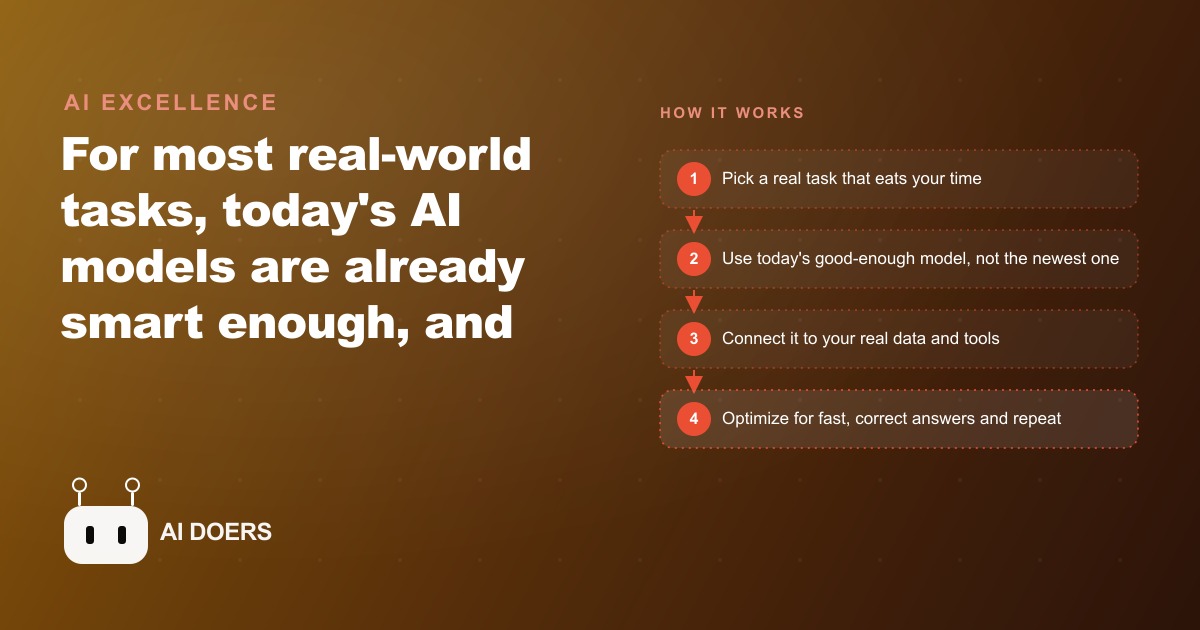
Every few weeks a new model tops a leaderboard, the internet gasps, and a business owner somewhere decides to keep waiting before they try AI for real. I am Madhuranjan Kumar, and I want to make an argument that runs directly against that instinct: the waiting is the mistake. The models are already smart enough for almost everything you actually need, and the value you are missing has nothing to do with the next release.
The lie is that the next model is the unlock
Here is the belief I want to take apart. It says that AI cannot really help your business yet, that it will help once it gets a bit smarter, and that the responsible move is to wait for that smarter version before committing. This belief feels careful. It is actually expensive, because it postpones value that is already sitting on the table, month after month, while you watch launch videos.
The people deepest in this field keep repeating the same uncomfortable truth: for the vast majority of real tasks, the models are already good enough. The headline benchmarks keep climbing, science scores, math scores, reasoning tests, but those gains barely register for normal work. If you already carry PhD-level intelligence in your pocket everywhere you go, the difference between the very best model and one that is slightly less capable rarely matters for the work you actually need done. Even the heaviest users admit they seldom reach for the deepest, slowest reasoning mode. For most tasks they want the best answer as fast as possible, and that preference holds even when writing code, where quick iteration through ideas beats squeezing out a marginally better output.
So the unlock is not the next release. The unlock is using what already exists. That single reframe, if you accept it, changes where you spend your attention for the next year, and it moves you from spectator to operator.
If intelligence froze today, there would still be years of value left
Try a thought experiment. Suppose model intelligence stopped improving right now, this second. No smarter version ever ships. How much value would be left to capture? The honest answer is: an enormous amount, probably more than most businesses will manage to use for years.
That is because the models are already ahead of how we use them. The bottleneck is not the intelligence. It is the scaffolding around the intelligence, the deployment, the integration, the unglamorous work of getting these tools into the flow of daily work. A more intelligent model does not help you if you never wired the current one into your business in the first place. An empty box with a genius inside it does nothing, and most businesses are staring at exactly that box, waiting for a smarter genius instead of opening the lid.
A few principles fall out of this once you sit with it. Speed usually beats raw power, because a fast correct answer is worth more than a slightly better slow one. Integration and data access matter more than deeper thinking, because a model needs the right context to be useful at all. The hard part is identifying which tasks can be automated well, not running the model itself. And a surprising amount of the ceiling people hit is just education, meaning they do not yet know the full range of what the tools already do.
The practical version of all this is that value comes from connection, not cleverness. A model that can see your calendar, read the right document, and act inside the tools you already use is worth more than a smarter model sitting isolated. Distribution and integration are the real moat, which is exactly why the companies with the most everyday touchpoints hold such strong positions. It is not that they have a secret smarter model. It is that theirs is wired into everything you already do, and that wiring, not the raw intelligence, is what makes it feel indispensable.
The bottleneck is human, and that is good news
If the models are ready and the value is real, why is so little of it captured? Because the two remaining bottlenecks are human, not technical, and that is genuinely good news, because human bottlenecks are the kind you can actually clear this month without waiting on anybody's release schedule.
The first bottleneck is knowing which tasks are good candidates for automation. This is harder than it sounds, and even experienced users find it genuinely difficult. It takes an honest look at where your team's hours actually go, and a feel for which of those hours are repetitive and rule-bound enough to hand off cleanly. The second bottleneck is doing the unglamorous integration work, connecting the model to your real data and tools so it has the context to be useful. Neither of these requires a smarter model. Both require clear thinking and a bit of patience, and both are entirely within your control.
This is why chasing the newest release is a treadmill that never pays off for everyday work. Every new model resets the same false hope, and while you are refreshing the leaderboard, the actual work, mapping your repetitive tasks and wiring a good-enough model into them, goes undone. That work is a one-time investment that compounds. The leaderboard is a distraction that repeats, and it is a comfortable one, because reading about a smarter model feels like progress while requiring none of the effort that real progress takes.
The businesses winning with AI right now are not the ones with access to some secret smarter model. They are the ones who figured out exactly which parts of their operation to hand off, and connected the tools properly. That is a strategy and integration problem, not an intelligence problem, and it is solvable today with tools that already exist.
What good enough actually looks like in practice
It helps to be concrete about what good enough means, because the phrase can sound like settling for less. It does not mean second-rate. It means a model that answers a customer question correctly and instantly, drafts an email that needs only a light edit, pulls the right figure from a document, and does it reliably enough that you stop double-checking every output. A model that clears that bar is already sitting in your pocket, and it has been for a while. The marginal intelligence added by each new release mostly shows up on exotic tasks, graduate-level reasoning, competition math, the kinds of problems that make headlines precisely because they are far from what a normal business does all day. Your invoicing questions, your scheduling logic, your customer replies, your content drafts, none of them live anywhere near the frontier of difficulty. They were solved model generations ago. So when you hear that a new model is smarter, ask the only question that matters for you: smarter at what, and does that what have anything to do with the work in front of you? Almost always the honest answer is no, and that answer is your permission to stop waiting and start building.
A neighborhood bakery proves the whole point
Let me make this concrete with a business that could not care less about graduate physics: a neighborhood bakery. A bakery does not need a model that can win a math olympiad. It needs fast, reliable help with the same handful of tasks every single day, and those tasks are sitting there waiting to be handed off.
Think about the repetitive load. The counter staff answers the same questions about custom cake orders, allergens, and pickup times dozens of times a week. Someone drafts the daily social post about what came out of the oven that morning. The owner guesses how much to bake and either runs out by noon or throws away trays at close. None of that requires the smartest possible model. It requires a quick, dependable one connected to the bakery's real information: its menu, its order calendar, its past sales. The intelligence to handle every one of those tasks has existed for a while. What has been missing is someone choosing the tasks and doing the wiring.
Here is how I would approach it, and notice that not one step depends on a smarter model arriving. I would start by listing the questions the counter staff answers a hundred times a week and setting up an assistant that handles them instantly, tuned for speed, because a customer waiting on a custom-cake quote will not sit through a slow, over-thought reply. Then I would connect a tool to the bakery's sales history so it can suggest production quantities, turning yesterday's numbers into tomorrow's baking list and cutting waste. The daily social post gets drafted automatically in the bakery's voice, so the owner reviews and posts in a minute instead of staring at a blank caption box.
And because a bakery still has to fill the shop, I would wire that same good-enough model into the marketing rather than treating it as a separate project. The captions it drafts double as the creative feeding Facebook and Instagram ad campaigns that fill slow weekday mornings. The menu and answer content it produces quietly supports SEO and organic search so the bakery shows up when someone nearby searches for a birthday cake. And every order inquiry lands in the CRM and website stack where a simple follow-up turns a one-time custom order into a repeat customer. What turns all of this into real value is not a leaderboard win. It is choosing the right tasks and giving the model access to the right data, and a bakery that does that beats one waiting for a smarter model every single time.
The comfortable trap of always waiting
There is a psychological reason the waiting feels responsible, and naming it helps you break it. Waiting for the next model lets you feel involved with AI without ever risking a real attempt. You read the announcements, you form opinions about which lab is ahead, you feel current, and none of it requires you to look honestly at your own operation or to sit through the awkward first weeks of wiring a tool into a messy real workflow. That awkwardness is exactly where the value lives, and it is exactly what the waiting lets you avoid. Every business that has actually captured value from these tools went through a stretch where the first automation was clumsy, the first integration half worked, and the results only showed up after some patient tuning. The businesses still waiting skipped that discomfort and, with it, the payoff. The uncomfortable truth is that the gap between the companies pulling ahead with AI and the ones standing still is not a gap in access to models. Everyone has access to models that are more than good enough. The gap is in who was willing to do the unglamorous work now instead of promising themselves they would start once the tools got a little better.
Stop waiting and start mapping
The honest takeaway is that the models are ready, and the thing standing between you and results is not a release date. It is the clear thinking about which tasks to automate and the patient work of connecting everything to your real data.
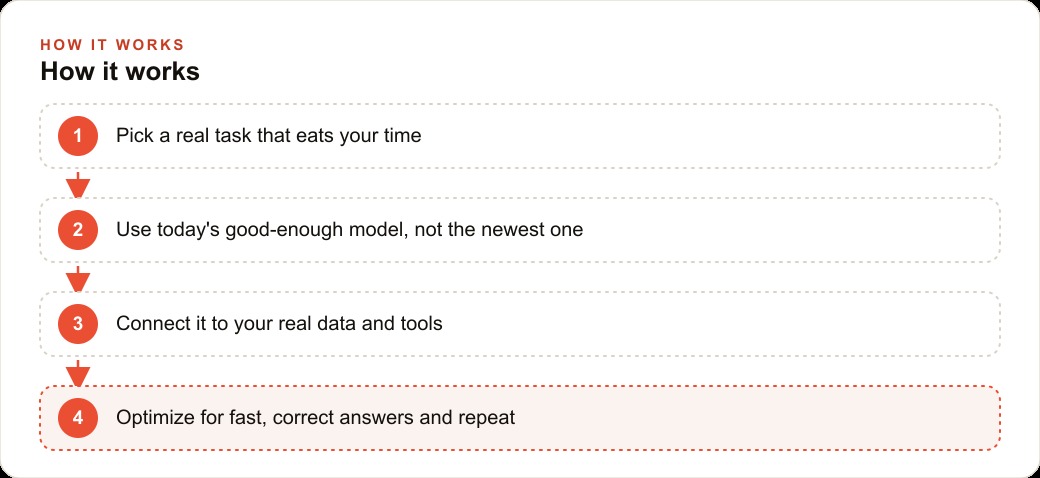
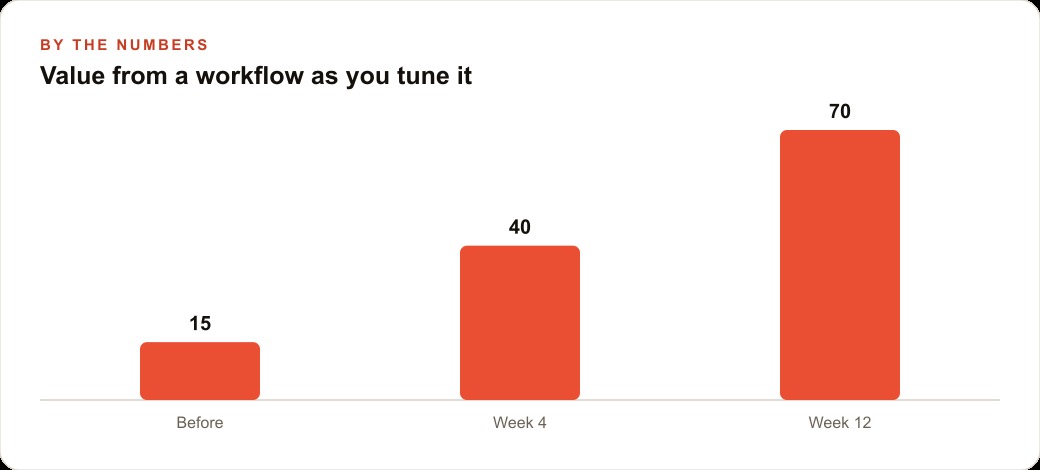
So here is where to start, and it does not begin with picking a model. It begins with a pen. Write down the tasks that repeat constantly in your business, because identifying good automation candidates is the real skill and the real bottleneck. Resist the pull toward the newest, smartest model and instead use one that is already good enough, optimizing for fast, correct answers over marginally better slow ones. Then spend your real effort on integration, connecting the model to the data and tools it needs, your calendar, your records, your menu, whatever context makes its answers actually useful. Treat each automated task as a small project you tune over a few weeks, not a one-click fix, because most of the early limits are simply learning what the tool can already do.
You can absolutely begin yourself by listing your repetitive tasks and wiring up the first one, and I would push you to do exactly that this week rather than after the next launch. If you would rather have the right tasks identified, the integrations built, and a fast, practical system set up around the tools that already exist, that is the kind of work you can hand to an expert and start seeing value sooner. Either way, stop waiting for a smarter model. The one you already have is smarter than the way you are using it, and closing that gap is worth more than any benchmark you will read about this year.
That is exactly what we do at AI DOERS. Book a private 30-minute call with Madhuranjan Kumar and we will map the fastest path to it for your specific business.
Book your call →
Madhuranjan Kumar
Madhuranjan Kumar brings 20 years of performance-marketing experience and has managed over $200 million in Facebook ad spend for brands across the United States and beyond. His expertise spans the full modern marketing stack: Meta, Google Ads, TikTok, email automation, CRM, and the websites that hold it together. At AI DOERS he turns that track record into lead-generation systems for businesses across every industry.