
Building on Open Tools Is Smart, but Hiding the Source Costs You Trust
A coding company added real value on top of an open model yet got burned for not crediting it, and the same transparency and summarization lessons apply directly to running a service business.

A company built something impressive on top of an open-source foundation, shipped it, and nearly watched the reputation they had earned evaporate because they did not say what they built on. That is the headline, but the actual lesson is more useful than the drama, and there are two of them buried in this story that any business owner can take directly to work.
I am Madhuranjan Kumar. What happened was this: a fast-growing coding company released a model that people loved, frontier-level quality at a much lower cost, and presented it largely as their own work. Someone then noticed the new model still referred to an open-source base under the hood, and the company had not clearly said so. The backlash came fast. The interesting part is that the company had not stolen anything. They built on an open-source model released specifically for this kind of use, and they added an enormous amount of real work on top. The mistake was not using the foundation. The mistake was not crediting it clearly. One is legitimate. The other was a reputational own-goal.
Map what you are building on before you say anything publicly
Before you describe your product, your service, or your process to anyone, know what it is built on. This is not about legal exposure in most cases. It is about the slow-burning trust problem that emerges when the truth surfaces later and you are the one who did not mention it first.
Building on an open-source foundation is how the ecosystem is supposed to work. Someone releases a strong model, a framework, a component, or a platform openly, and others build real value on top of it. That value is genuine. The resulting product can be dramatically better than what the original foundation alone would produce. The credit question is separate from the value question, and mixing them up is where businesses get into trouble.
The company in this story did genuine work. A large share of the total effort went into training and tuning on top of the base, not into the base itself. That contribution was real and the resulting product was impressive. The only thing missing was a sentence at the start that said what the foundation was. The reason they hesitated had more to do with optics than with dishonesty in the technology, and that hesitation cost more than the disclosure ever would have.
Map your dependencies first. What software, platform, model, or framework is your work built on? Write it down. Then write what you added on top. The second list is your actual contribution. Lead with it when you describe the work, and mention the first list somewhere visible. That practice protects you from the kind of surprise that turned a genuine technical achievement into a trust crisis.
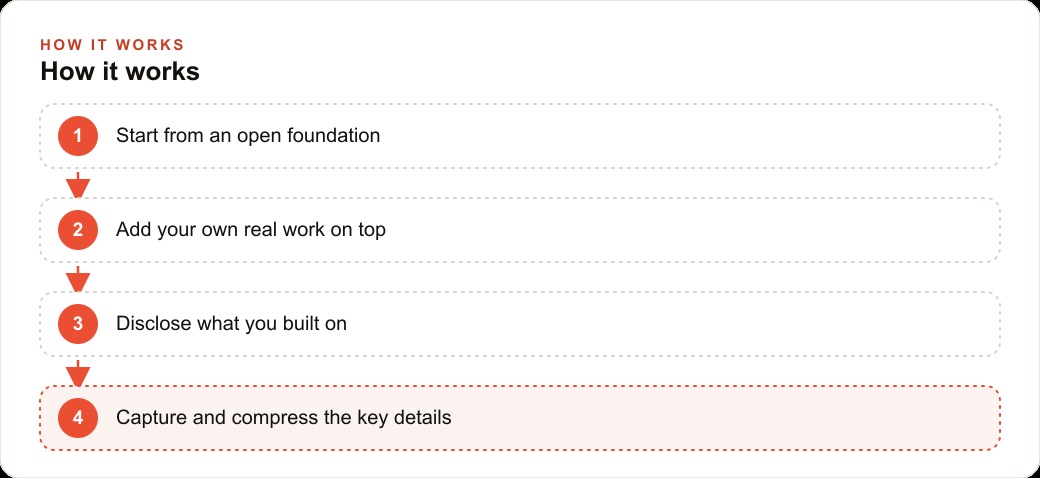
Add your real work on top and document what it actually is
The second step in building on an open foundation is doing real work on top of it and being able to articulate exactly what that work is. This matters both for credibility and for your own clarity about where the value in your product actually lives.
For the coding company, most of the real effort went into the training and tuning layer above the base model. That is where the performance improvements came from, and that is what made the product worth using. The base gave them a starting point. Their work gave it the quality that users valued. Being able to explain that clearly is the difference between a story about building on a foundation and a story about passing off someone else's work as your own.
For a service business, the equivalent question is: what do you add on top of the tools, platforms, and processes you borrowed? If you use a scheduling platform, what is your booking experience on top of it? If you use a standard materials package from a supplier, what is your installation quality and your warranty? The tools are the foundation. Your judgment, your training, your standards, and your relationship with the customer are what you built on top. Document those clearly and lead with them.
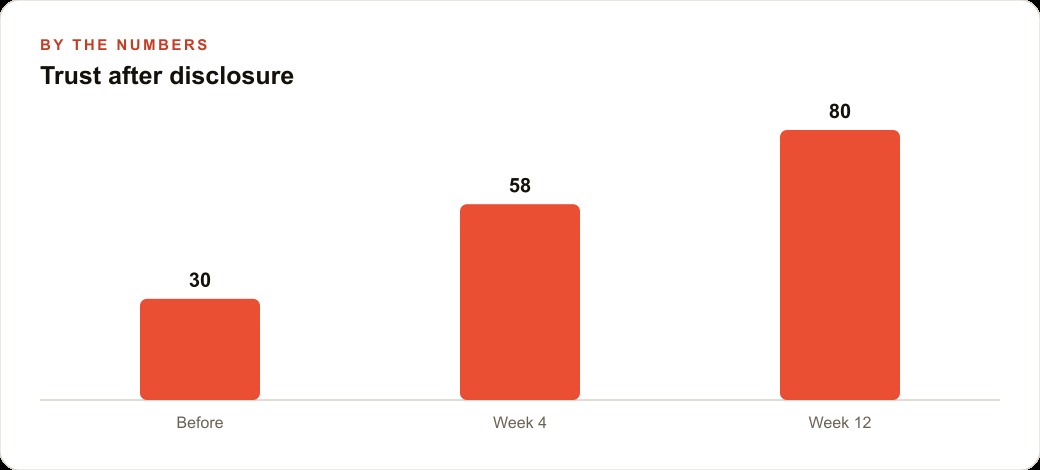
Credit the foundation clearly and early
The timing and placement of attribution matter as much as the attribution itself. A footnote at the bottom of a technical document that mentions the base model after seven paragraphs of capability claims is not the same as a clear sentence near the top that says the product is built on a specific open-source foundation with significant additional training.
For a business that uses third-party software, platforms, or tools as part of its service, the equivalent is being upfront with clients about what is proprietary and what is industry-standard. A client who later discovers that the reporting dashboard they assumed was custom-built is actually a standard platform tool they could have accessed themselves may not care about the dashboard. They will care that you let them assume something false. That is the trust erosion the company triggered, and it is avoidable.
The marketing value of transparency is underrated. Saying we built on this foundation because it gave us the best starting point, and then we added our specific expertise on top is a credible story. It signals confidence in your actual work and honesty about your methods. That combination builds trust faster than a claim of originality that does not hold up to scrutiny.
Use self-summarization to stay accurate through long jobs
The second lesson from this story is a technical technique that solves a problem every long, multi-step job runs into, whether the job is being done by a person or an AI system.
Self-summarization works like this: when a job gets large enough that there is more information than can fit in active attention at once, you pause at a set point, compress everything you know into a short structured note, and then continue using that compressed summary instead of trying to carry the full history. The insight that makes this more than just note-taking is that good summaries get reinforced. A summary that keeps the critical details leads to better outcomes on the continued task. A summary that drops important context leads to worse outcomes. Over time, the summaries that work best are the ones that persist, and the practice converges toward compression that is tight without losing what matters.
For the AI system in this story, the technique let it run hundreds of steps on a complex task without losing its place. It periodically compressed what it had learned into a short, structured note and used that to continue. The same principle applies to any job with many handoffs or a long timeline.
Keep handoffs short and structured so nothing important gets lost
For a roofing company, a property manager, a construction firm, or any business where a job passes through many hands, the self-summarization lesson is about handoff quality. Most service businesses lose money not on the work itself but on the transitions, where details drop between the sales call, the project manager, the crew, and the office.
A roofing job is a good concrete example. The inspection finds three soft spots, the customer wants a specific shingle color, the crew needs to know about the skylight on the back slope, and the office needs the final measurements for the invoice. Carrying all of that forward informally through phone calls and memory is how critical details get lost. The fix is a structured handoff note at each stage, short enough that everyone reads it and complete enough that nothing important is missing.
The estimate summary feeds the crew. The crew's end-of-day note feeds the office. Each handoff compresses the full history into the facts that actually matter for the next stage, exactly like the model that compressed a long task into a short note and kept going without losing context. Fewer dropped details means fewer callbacks, fewer disputes, and cleaner invoices.
The businesses that implement this well start with one job type, prove it reduces callbacks, measure the reduction, and then expand the habit to every job type. The tracking does not need to be sophisticated. A structured note with five fields, customer name, key requirements, materials confirmed, work done, and outstanding items, is enough to prevent most of the expensive mistakes that come from informal handoffs.
For any business that also runs paid ads to generate leads, the same discipline applies to the lead-to-sale handoff. A lead that comes in through Facebook and Instagram ad campaigns or through Google Ads has a context attached to it: which ad they responded to, which offer they clicked, what they said they needed. Compressing that context into a short handoff note for whoever handles the follow-up call is the same habit applied to a different stage. Leads that come with good context convert at higher rates because the follow-up is relevant instead of generic. And the CRM and website stack that holds those leads is only as useful as the quality of the information that enters it.
Adapt and ship quickly, and be transparent about how you do it
The bigger lesson from the whole episode is about the competitive advantage that now belongs to whoever can adapt and ship fastest while staying transparent, rather than to whoever pretends to have built everything alone.
The speed of building on an existing foundation is a legitimate advantage. Starting from a strong open base and adding real work on top is faster than starting from nothing, and the result can be dramatically better than either the base or the new work alone would produce. The businesses that understand this and build their culture around it, crediting foundations clearly while being confident about their own contributions, are the ones that can iterate fastest and maintain trust longest.
The alternative, claiming more originality than exists, creates a growing gap between what the business says and what it does, and that gap tends to close at the worst possible moment. The coding company learned this expensively. The lesson is available for free.
That is exactly what we do at AI DOERS. Book a private 30-minute call with Madhuranjan Kumar and we will map the fastest path to it for your specific business.
Book your call →
Madhuranjan Kumar
Madhuranjan Kumar brings 20 years of performance-marketing experience and has managed over $200 million in Facebook ad spend for brands across the United States and beyond. His expertise spans the full modern marketing stack: Meta, Google Ads, TikTok, email automation, CRM, and the websites that hold it together. At AI DOERS he turns that track record into lead-generation systems for businesses across every industry.