
Are We in an AI Bubble? What the Numbers Actually Mean for Your Business
A legendary short-seller is betting against AI while demand climbs and the build-out hits record size. Here is how I read the debate and what a small business should actually do about it.

The week the bubble talk reached a small shop
The owner of a small retail boutique read the same headline everyone else did. A famous investor, the one who called the 2008 housing crash, had placed a large bet against the AI industry. The word bubble was suddenly everywhere. And in a back office between customers, that owner did what a lot of sensible people did. They froze. If the smart money is betting against AI, they thought, maybe I should wait before I put any of this into my business.
I want to walk through that owner's journey over the following months, because it is a clean case study in how to separate a macro investment argument from a practical operating decision. The two questions feel like the same question. They are not. Whether AI stocks are overpriced and whether AI can save a boutique three hours a week are completely different problems with completely different answers. This is the story of an owner learning to tell them apart.
Chapter one: the fear, and the number that caused it
The anxiety was reasonable. A bubble is a real thing. It is when the price of an asset rises far above its sustainable value because of speculation, and history is full of them. The owner had lived through a couple. So the starting position was caution, and the number driving it was abstract but scary: forecasts putting global data center investment in the hundreds of billions of dollars a year now, and trending toward trillions by the end of the decade. That is the largest build-out in modern history, and when a number is that big, it is easy to assume it must be a bubble by definition.
The mistake buried in that assumption is treating all bubbles as the same. They are not, and the distinction is the hinge this whole story turns on.
Chapter two: learning that there are two kinds of bubbles
The owner did some reading and found the idea that reframed everything. There are two types of bubble. One pops and leaves lasting damage because nothing real was built underneath it, just credit and speculation stacked on more speculation. The other type involves real infrastructure with the wrong timing. When companies laid enormous amounts of fiber optic cable in the ground before the internet truly took off, most of it sat dark and unused for years. The timing was early. The build-out itself was sound, and that fiber became the backbone of the modern internet.
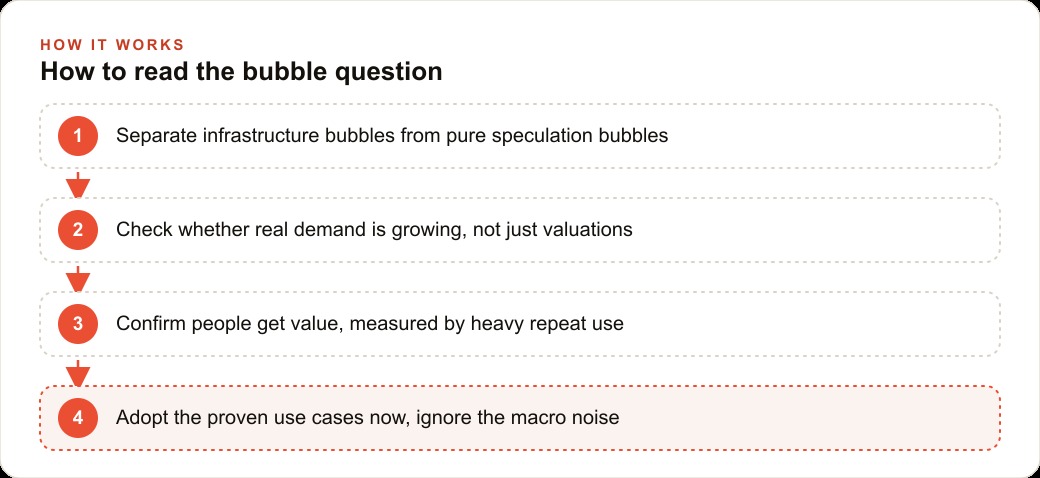
So the question for AI was never simply is this a bubble. The useful question was which kind. Is the spending backed by something real that will get used, even if the timing of the returns is early. To answer that, the owner stopped looking at stock prices and started looking at demand, which is the one signal an operator can actually reason about.
Chapter three: the demand numbers that changed the decision
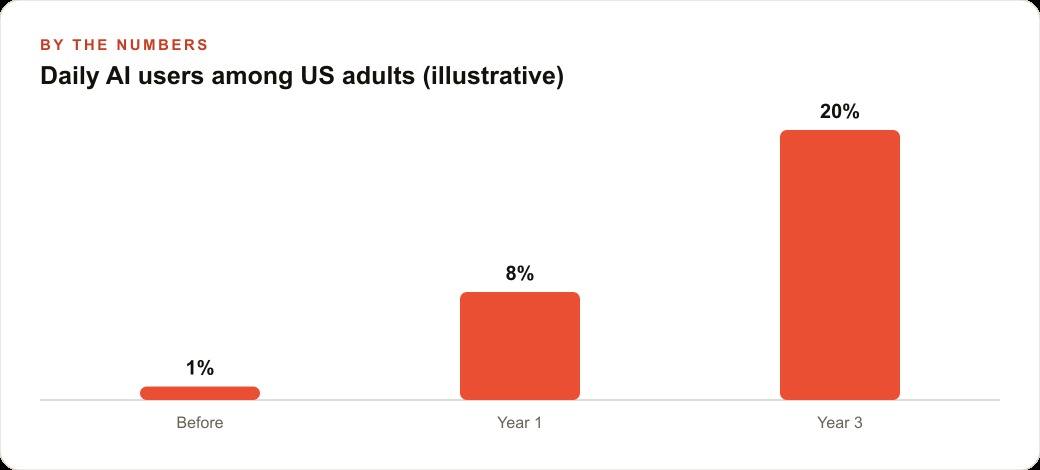
Demand has two layers, and only one of them mattered to a boutique. The first layer is the AI labs themselves buying up compute. That is an investor's concern. The second layer is whether real people and real businesses actually use the output, and here the signal was hard to argue with. The leading chatbot went from about a million weekly users to nearly 800 million in roughly three years. Around one in five US adults now reports using AI every single day.
That last figure is the one that moved the owner, and there is a principle behind why. How much people use a tool is a proxy for how much value they get from it. Nobody returns to a product every day out of hype. They return because it does something for them. Heavy, repeated, daily use is the tell that the value is genuine. A speculative bubble with no underlying value does not produce 800 million weekly users who keep coming back. The build-out might be early. The usefulness was clearly already here.
There was a second detail that reassured the owner as a small operator. Consumer adoption was running far ahead of enterprise adoption. Most large companies were still piloting AI rather than scaling it across the business, because a big, secure, careful rollout takes time and committees. That gap was not a warning sign. It was an opening. A small, nimble shop could adopt the proven use cases now and bank the savings while larger competitors were still writing policy documents.
Chapter four: the first workflow, and the first real number
Convinced that the operating decision was safe regardless of the macro debate, the owner picked one workflow and ran it for a week before touching anything else. The choice was the inbox, which was the most obvious pain. The boutique fielded a steady stream of product questions, sizing inquiries, and order updates, and answering them ate into every day.
The owner set up an AI assistant to draft replies in the shop's voice, so the work became approving rather than writing from scratch. In week one the results were rough and needed heavy editing. By the end of the second week the drafts were landing close enough that the owner was mostly tapping approve. The measured result was real and modest: roughly five to six hours a week returned to the business. Not a revolution. A genuine, countable saving, from a tool the owner was renting for a small monthly fee rather than building.
Chapter five: expanding to copy and spreadsheets
With one win proven, the owner extended the same discipline to two more chores. First, product copy. Feeding in the basic details of a new arrival produced a first draft of the website description, the email blurb, and three social captions, all ready to edit. For a shop launching several new items a month, that reclaimed another chunk of hours that a small team never really had to spare, and it fed the storefront and the SEO and organic search content at the same time without extra effort.
Second, the spreadsheet work. The AI summarized which items sold, flagged what was running low, and turned a messy sales export into a clean weekly snapshot the owner could read in two minutes instead of thirty. Add it all up and the boutique was saving somewhere in the range of ten hours a week across messages, copy, and reporting, on a stack that cost less than a single afternoon of a part-time employee's wages. None of it required a position on whether AI stocks were overpriced. The savings came from the cheap, reliable layer that already worked.
Chapter six: the number that keeps getting friendlier
There was one more figure that settled the owner's mind for good. The cost of using these models keeps falling. The boutique was not buying chips or building a data center. It was renting a thin sliver of value from infrastructure that someone else had paid hundreds of billions of dollars to build. If the timing of that build-out turned out to be early, that was the investors' problem, not the shop's. And because the price per use kept dropping, the math on the owner's side only improved over time. That is close to the ideal position in any market. You capture the value of an expensive asset while someone else carries the cost and the timing risk.
The same logic extended naturally to the parts of the business the owner had once assumed were too advanced. The cheaper and more reliable the models got, the more it made sense to let them draft the copy behind Facebook and Instagram ad campaigns and organize the leads that came in, because the marginal cost of trying was almost nothing.
Chapter seven: the competitor who waited
Around the same time, the owner watched a comparable shop two towns over take the opposite path. That competitor read the same bubble headlines, decided the whole thing was overhyped, and chose to wait until the dust settled before touching any of it. On the surface that looked like the prudent, sober choice. In practice it meant the competitor kept paying full staff hours for the same inbox, copy, and reporting chores that the boutique had quietly handed to a cheap tool. Month after month, the boutique reinvested its reclaimed ten hours a week into the parts of the business only a human can do, styling the storefront, talking to customers, sourcing new stock, while the competitor stayed exactly as busy as before.
This is the part of the story I want to sit on, because it exposes the real cost of freezing. The bubble debate framed waiting as the safe option, but waiting is never free. Every week the competitor delayed, they paid a tax in hours they did not have to spend, and they fell a little further behind on the boring operational efficiency that quietly decides which small business has room to grow. The owner did not out-think the market or make a bold bet. They simply refused to let an investment argument they could not resolve stop them from an operational decision that was never in doubt. The competitor let the headline make the decision for them, and the headline was answering a different question entirely.
What the boutique's journey teaches
Step back from the shop and the lesson generalizes to almost any small business. You do not need to resolve the bubble debate to capture AI value today. The investment question, is the market overheated, is genuinely hard and genuinely uncertain. The operating question, can this save me time on a real task this week, is easy and already answered. Conflating the two is what keeps good owners frozen while the practical wins sit right in front of them.
The honest picture underneath the case is worth restating. The spending is historic and real. Demand is strong and growing, measured by heavy daily use that only happens when a tool delivers value. Enterprise adoption lagging behind consumer adoption is an advantage for the small and fast. And the cost of using the tools keeps dropping. Every one of those facts points the same way for an operator. Adopt the proven, boring use cases now, and let the investors argue about the timing of the build-out.
The one place the boutique nearly slipped
The owner did hit a stumble worth naming, because it is where most people stall. The value of every workflow depended on the output sounding like the boutique and not like generic AI filler, the bland text people can now spot instantly. The first drafts of the product copy were technically fine and completely lifeless, and had they gone out that way they would have cheapened the brand rather than helped it. The fix was spending real time teaching the assistant the shop's voice with examples, feeding it past replies and product descriptions the owner was proud of, until the drafts came back sounding like the owner rather than like everyone else. It took a few evenings of tuning, but once the voice was dialed in, every workflow downstream inherited it, and the drafts stopped needing heavy edits. Choosing the right task and setting it up so the output has a genuine voice is the judgment work, and it is exactly the part that a first demo makes look easier than it is.
You can absolutely walk this path yourself, and I would encourage any owner to start the way this one did, by naming the single chore that eats the most time and proving one workflow for a week before adding anything. If you would rather have the high-value workflows chosen, built, and handed over already tuned to your business so the output sounds like you from day one, that is the kind of setup I do for clients. You can take the do it yourself route, or bring in someone who has already wired this up many times and skip the trial and error entirely.
That is exactly what we do at AI DOERS. Book a private 30-minute call with Madhuranjan Kumar and we will map the fastest path to it for your specific business.
Book your call →
Madhuranjan Kumar
Madhuranjan Kumar brings 20 years of performance-marketing experience and has managed over $200 million in Facebook ad spend for brands across the United States and beyond. His expertise spans the full modern marketing stack: Meta, Google Ads, TikTok, email automation, CRM, and the websites that hold it together. At AI DOERS he turns that track record into lead-generation systems for businesses across every industry.