
Anthropic Passed OpenAI, And The Price War Tells You Who The Customer Really Is
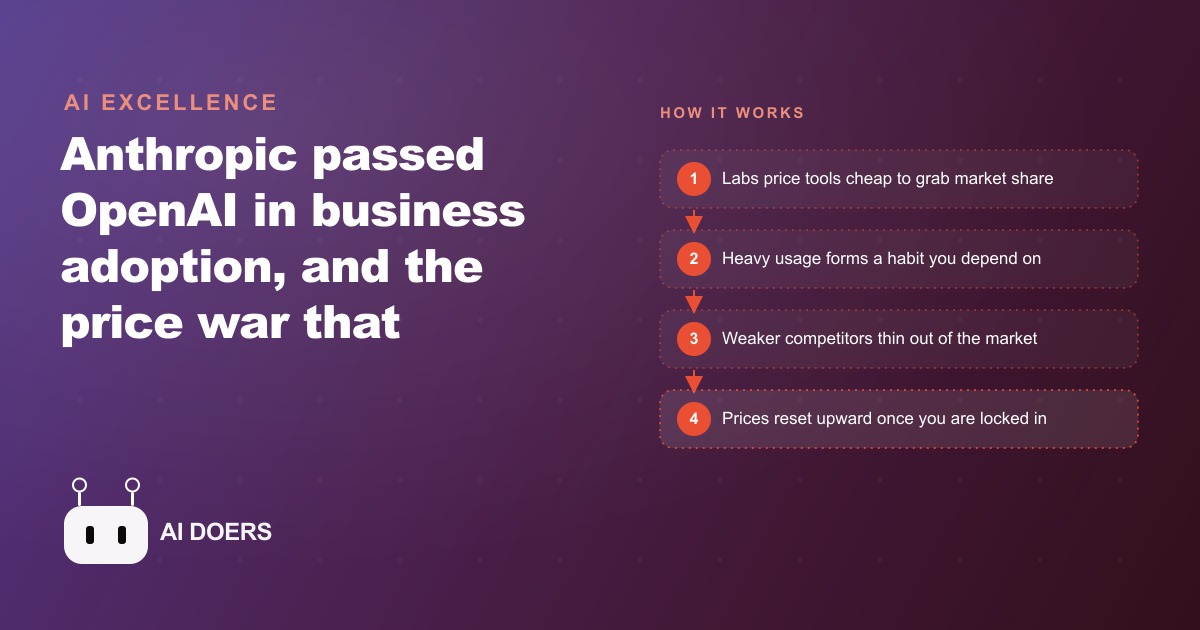
Anthropic overtook OpenAI in business adoption, and the rapid-fire offers that followed reveal a free sample phase where the labs want your adoption and usage data more than your subscription fee. Here is how a business should play it.

The labs responded to each other within 45 minutes and that is the detail worth sitting with
I am Madhuranjan Kumar, and I want to talk about what the Anthropic-OpenAI leapfrog sequence actually signals, because most of the coverage focuses on the wrong thing. The coverage focuses on benchmarks, capability comparisons, which model is best for which task. These are interesting questions for practitioners. They are not the interesting question for anyone trying to understand where this is going and what it means for the business decisions you make in the next 12 months.
The interesting detail is the 45 minutes. When one lab released a significant capability update, the competing lab responded with its own announcement within 45 minutes. Not within a week, not within a quarter. Forty-five minutes. That is not a coincidence of timing. That is a signal about the organizational state of these companies, what they are monitoring in real time, and what they are prepared to launch on short notice.
The contrarian read is this: the speed of the leapfrog cycle is accelerating faster than any business can track it by following model release announcements. The strategy of waiting to see which model wins before building on one is a strategy that will leave you permanently behind the release cadence, because there will not be a winner. There will only be the current leader, holding the position until the next 45-minute response.
What training on your data actually means and why it is not the surveillance claim it sounds like
One of the things discussed in the context of these model releases is the training data question: where the capability improvements come from, and whether the output of interactions with these models feeds back into future training. This question produces a particular kind of anxiety that tends to distort the business decision about which tools to use and how.
The useful reframe is direct: if you are using a language model to write output that goes into the world, whether emails, social posts, documentation, or analysis, that output was shaped by the collective writing of everyone who came before you. The training data is human expression at scale. The fact that your interactions may contribute to future training is not a surveillance relationship. It is a continuation of the cumulative knowledge relationship that has defined every library, every textbook, every search index.
The practical implication is different depending on whether you are processing proprietary business data through a model versus using a model to help you think and write. Processing proprietary data through a commercial API without a data processing agreement is a compliance question worth asking. Using a model to help you draft a client proposal is no more a surveillance risk than using Google to research the client.
The claim worth examining is the stronger one: that your specific patterns of reasoning, your particular ways of framing problems, are being extracted and used against you. This claim requires the model to be identifying you as an individual across sessions and specifically learning your patterns. The architecture does not support this claim for standard API users. The training process aggregates across millions of interactions; it does not extract and apply individual user patterns in the way the anxiety suggests.
Why passing OpenAI in one benchmark at one moment is not the story
The benchmark comparison between Anthropic and OpenAI at any given moment is a snapshot of a race that will look different within weeks. Reporting it as a definitive capability ranking is like ranking marathon runners by their position at mile seven. The current position is real data, but it is not the predictive variable the coverage implies it is.
The benchmark design problem compounds this. Different benchmarks measure different things, and the organizations running the benchmarks have different incentives. A benchmark designed to highlight reasoning capability will rank models differently than a benchmark designed to highlight instruction following or code generation. Each lab tends to perform better on the benchmarks that align with their architectural choices and training emphasis.
The business decision most affected by the false certainty of benchmark comparisons is platform choice for long-term projects. Developers and businesses that commit deeply to one model provider's API, building prompt architectures, tooling, and workflows specifically around that provider's quirks and capabilities, are not making a decision that can be easily reversed. When the benchmark rankings change in three months, as they will, the switching cost is significant.
The alternative is to abstract the model dependency at the architecture level. Build your AI-powered workflows so that the model provider is a configuration setting, not a hard dependency. This costs more time up front and requires more disciplined engineering. It is worth the cost because it means benchmark shifts and price changes are handled by updating a configuration, not by rebuilding the system.
The window for early-mover advantage is closing faster than most people realize
There is a compression happening in the adoption curve for AI tools in business that is worth being direct about. The businesses that were using AI tools two years ago were genuinely early. The learning curve they went through, the experimentation, the failed deployments, the successful ones, produced real institutional knowledge that their competitors did not have.
The businesses that are starting to explore AI tools now are not early anymore in most industries, but they are not too late either. The specific window that is closing is not the adoption window. It is the window where the early institutional knowledge can be built before competitors who start later can access AI-generated shortcuts to skip the learning curve.
Practically this means: the businesses that start now have 12 to 18 months before AI-assisted onboarding tools and pre-built playbooks make the institutional knowledge advantage of the early adopters replicable on a compressed timeline. The advantage of having run 200 AI experiments is that you know which 180 failed and why. Within two years, there will be tools that encode those learnings and give latecomers access to them without the experimentation cost.
This is not an argument to panic. It is an argument to treat the next 12 months as the highest-leverage period for building AI competency in your business or practice. The experiments you run now, even the ones that fail, produce institutional knowledge that will be harder to generate once the market matures and the learning playbooks are commoditized.
The small business that documents what it learns becomes the consultancy
Here is the specific opportunity the Anthropic-OpenAI race creates for an individual practitioner or small business: the pace of change is so fast that the organizations with the resources to hire dedicated AI research staff are the only ones who can keep up with all of it. Every other organization, including most mid-sized businesses, will rely on external expertise to make sense of what is happening.
A one-person consulting practice or a small agency that systematically documents its AI experiments, publishes what it learns, and builds a track record of implementations has something that the large labs and the large consultancies do not have: specificity about a particular type of business problem. The large labs know everything about what models can do. They do not know anything specific about the operational context of a three-location dental group or a regional freight broker. That contextual specificity is where the practitioner advantage lives.
The documentation discipline is the mechanism that converts experimentation into a defensible practice. A practitioner who runs 20 AI implementations and keeps no records has 20 data points that exist only in their memory. A practitioner who runs 20 implementations and documents each one in the same structured format has a database that can be searched, analyzed, and used to generate insight about which interventions work in which contexts.
The race between labs does one thing for this practitioner: it keeps the tooling improving and the cost declining. Every capability improvement that releases from either Anthropic or OpenAI improves the quality of the implementations you can offer. Every price reduction makes the implementations more accessible to clients who could not justify the cost six months ago. The leapfrog race is working in your favor as a practitioner, not against you.
What a 75-minute response gap would have meant three years ago
Three years ago, if a major AI lab released a significant update to its model, competitors would have had weeks or months to respond with their own comparable capability. The response cycle was measured in research timelines. A team would identify the capability the competitor had released, evaluate whether their own research was close to producing something comparable, and either accelerate an existing research direction or initiate a new one. The elapsed time between a competitor's release and a meaningful response was at minimum several months.
The compression from months to 45 minutes is not explained by incremental process improvement. It represents a structural change in how these organizations maintain competitive readiness: not by responding to competitor releases but by maintaining a continuous inventory of capabilities that are ready to release at short notice, calibrated to the competitive landscape they monitor in real time.
This structural change has a specific implication for the practitioners and businesses that build on top of these models: the competitive landscape at the model layer is changing faster than any integration built on top of it can track. The integrations that will remain stable are the ones that treat the model as a replaceable component rather than a fixed feature of the system.
The practical architecture that survives a 45-minute competitive cycle
The 45-minute response cycle is an argument for a specific software architecture. Any system that hardcodes model-specific behavior, whether a specific model's response format, a particular model's function calling convention, or a capability that is exclusive to one provider's current release, is a system that will require engineering work every time the competitive leapfrog cycle produces a significant change.
The abstraction layer is the solution and it is not complex to implement. A configuration that specifies which model the system uses, what format the system expects from that model, and how the system handles cases where the model's response does not match the expected format, converts a hardcoded dependency into a configurable one. When the competitive landscape shifts and a different model becomes the better choice for your application, the migration is a configuration change and possibly a prompt tuning exercise, not a system rewrite.
For practitioners building AI-powered products for clients, this architecture principle is a commercial argument as well as a technical one. A client whose AI system requires an expensive rebuild every time the model landscape changes is a client with a growing total cost of ownership. A client whose system treats the model as a configurable component will find that competitive improvements in the model layer translate directly into improvements in their system without additional investment. That difference in total cost of ownership is a real differentiator in a sales conversation with a client who has been burned by a previous AI integration.
The 45-minute cycle as a forcing function for practitioner positioning
The pace of the leapfrog cycle between Anthropic and OpenAI is useful to a practitioner in one specific way: it makes the argument for vertical specialization over general AI expertise impossible to refute. The practitioner who positions as an AI expert competes with the labs themselves for the audience that wants to understand the technology. That is a competition no individual can win when the labs are releasing updates on 45-minute timescales. The practitioner who positions as a dental practice AI implementation specialist, or a real estate agency AI workflow consultant, competes in a domain where contextual expertise is the primary differentiator and the model release cadence is irrelevant. The labs make the tools. The vertical specialist makes the tools work in a specific context. These are different businesses and only one of them becomes more defensible as the technology improves.
That is exactly what we do at AI DOERS. Book a private 30-minute call with Madhuranjan Kumar and we will map the fastest path to it for your specific business.
Book your call →
Madhuranjan Kumar
Madhuranjan Kumar brings 20 years of performance-marketing experience and has managed over $200 million in Facebook ad spend for brands across the United States and beyond. His expertise spans the full modern marketing stack: Meta, Google Ads, TikTok, email automation, CRM, and the websites that hold it together. At AI DOERS he turns that track record into lead-generation systems for businesses across every industry.