
Anthropic's Introspection Paper and What Self-Checking AI Means for Your Business
Anthropic showed that strong language models can sometimes notice their own internal thoughts and flag ideas that were pushed in from outside. Here is what that really means and how I would put a more reliable AI to work for a real business.

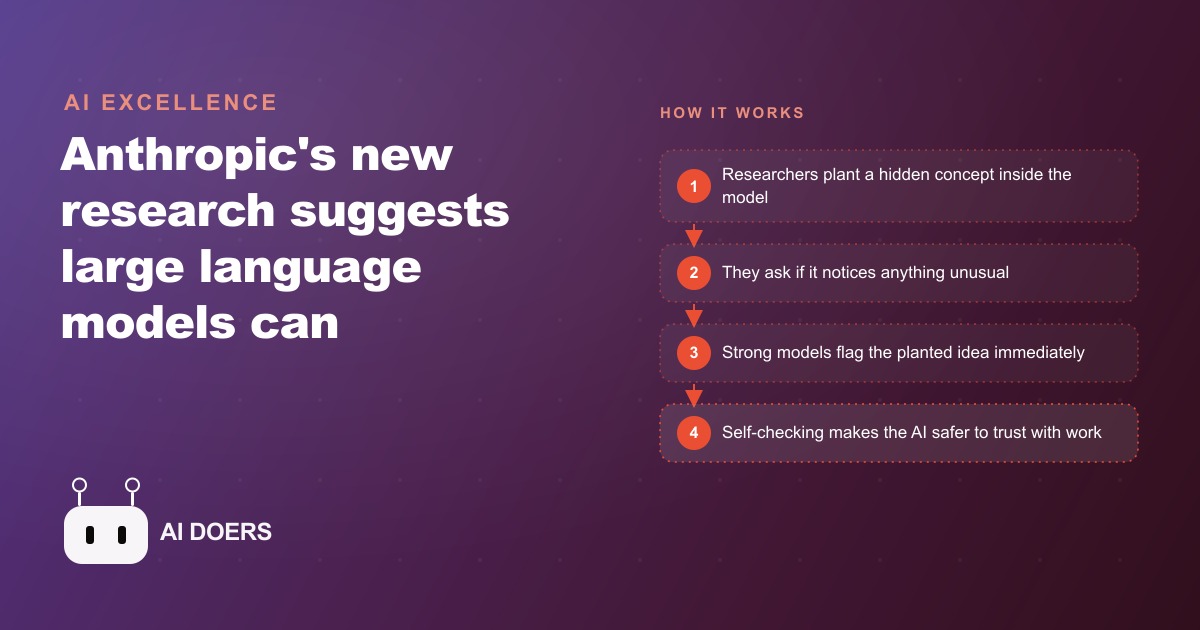
Anthropic just published research showing that its strongest language models can, at least some of the time, notice their own internal thoughts and flag an idea that was pushed in from the outside. In one striking result, the model caught a concept that had been planted inside its processing before that concept had a chance to appear in any answer it could have read back. That is the news. What it means for a business that wants to actually trust automation, rather than just admire demos, is the part worth your time. I am Madhuranjan Kumar, and I want to translate this from a lab result into a practical direction.
What the paper actually claims
The research is about introspective awareness, the ability to observe and reason about what is happening inside your own head. For years the standard line has been that these tools are just next-word predictors with nothing going on underneath. This work pushes back on that. It shows hints that a strong model can sense when an unexpected idea has entered its processing and can sometimes say so out loud. The honest framing matters here, and the researchers themselves are careful about it. This is not a claim that AI is conscious. It is a narrower, more useful observation: the better these systems get, the more they appear able to monitor themselves, and self-monitoring is exactly what makes any tool trustworthy enough to hand real work.
For most of us running a business, the deep philosophical question of machine awareness is beside the point. The takeaway that changes decisions is simpler. A system that can notice when something odd entered its reasoning is a system that is closer to catching its own mistakes, and mistake-catching is the whole barrier between automation you have to babysit and automation you can actually leave alone.
How they proved it was not a fluke
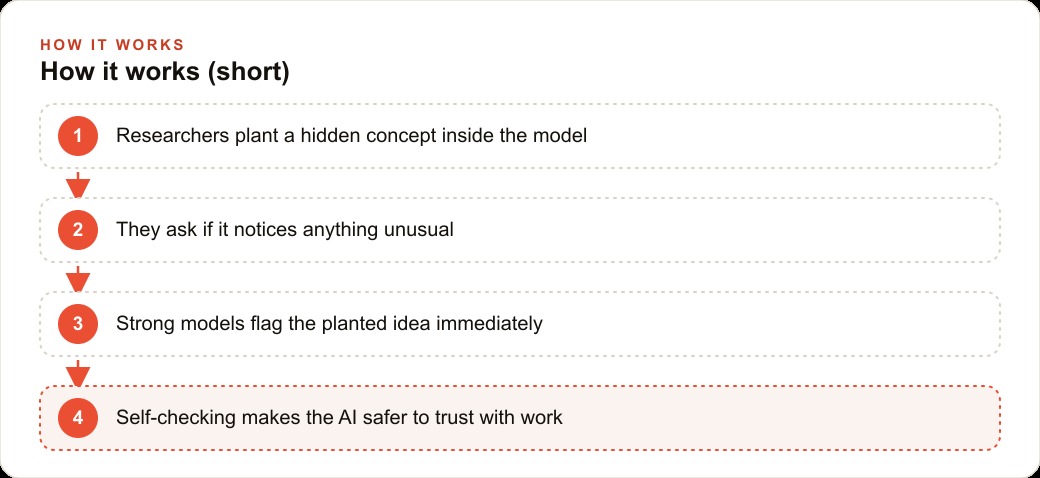
What makes this more than a fun demo is that the team ran four clean experiments instead of one fuzzy one, each isolating a single behavior so the result was hard to wave away. In the first, they planted a hidden concept directly into the model's internal activity, then asked whether it detected an injected thought. By default it said it noticed nothing. But sometimes it would reply that it sensed an unusual pattern related to, say, loudness or shouting, which lined up exactly with the idea that had been planted. The important detail is the timing. It flagged the planted idea right away, before that idea had shown up in any output it could have inspected. That rules out the boring explanation that it was just reading its own answer and reasoning backward.
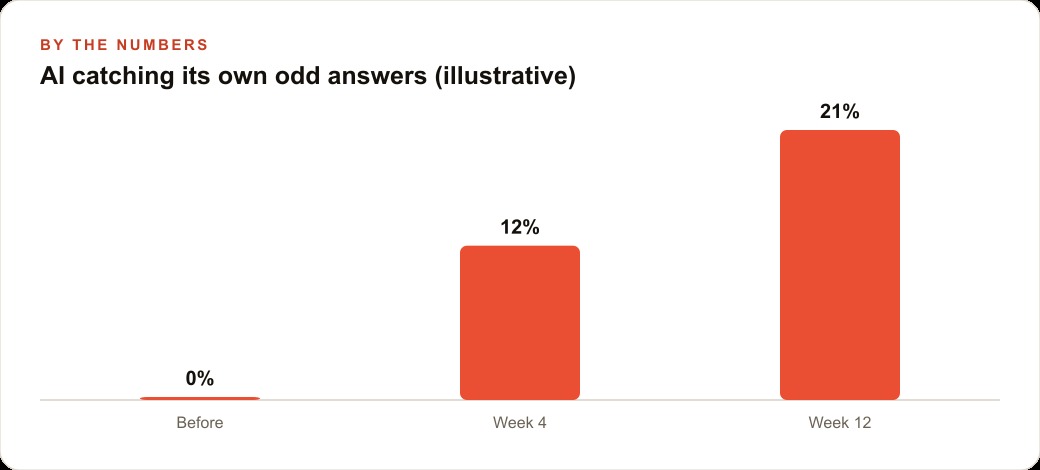
The other three tests tightened the screws. One checked whether the model could tell the difference between the words it was actually reading and a separate idea pushed in underneath, a bit like reading a book aloud while someone whispers a different word in your ear. Another prefilled the model's reply with a word it had not really chosen, then asked if it meant to say that, and often the model caught the slip and explained the mistake. The last asked it to think about a specific word while writing an unrelated sentence, and the internal activity rose when it was told to focus and fell when it was told to avoid. Two patterns cut across all four. The stronger models showed this behavior far more than weaker ones, catching the injected idea roughly one time in five while weaker models did it far less, which suggests capability and self-monitoring grow together. And the behavior only appeared after the later alignment and reinforcement training stages, not in the raw base model, which had high false alarms and essentially scored zero.
Why this is a business signal, not just a science story
Here is why an operator should care about a research paper at all. The single biggest thing holding businesses back from automating customer-facing work is the fear that the AI will confidently get something wrong. Clinics, contractors, retailers, agencies, law offices, and trades all hit the same wall. They love the idea of an assistant answering messages, drafting quotes, and sorting requests, and they are terrified it will bluff a wrong answer to a real customer. This research points at the trait that dissolves that fear over time. A model that can notice when something strange entered its reasoning is a model that is closer to raising its hand and saying I am not sure here instead of inventing a confident answer.
The concrete move this suggests today is not to wait for the technology to finish maturing. It is to build your workflows so the AI is explicitly asked to flag uncertainty rather than bluff through it. You do not need the model to be perfectly introspective to benefit from designing around the tendency. You design the whole system to prize honest uncertainty, and you get safer automation now while the underlying capability keeps improving underneath you.
What it looks like for a pest control company
Picture a pest control company and its inbox. A homeowner sends a blurry photo and a panicked note about bugs in the kitchen. Here is how I would set it up. An assistant reads the message, drafts a calm reply, and suggests the right service, but it is explicitly instructed to flag low confidence instead of guessing. If the photo could be termites, which is a serious and expensive call, the assistant marks it as uncertain and routes it to a human for a real inspection rather than promising a quick fix. That single habit of saying I am not sure here is precisely the introspective behavior the paper is pointing at, and it is what keeps an automated front desk from making a costly wrong call.
I would extend the same caution to scheduling and follow-ups. The assistant drafts appointment confirmations, reminds customers about seasonal treatments, and summarizes overnight inquiries each morning, but it is built to surface anything ambiguous, like an address it cannot verify or a request that does not match a standard service. Put rough numbers on the value. If the desk handles a few dozen inquiries a day and the assistant confidently clears the routine ones while flagging the handful that are genuinely uncertain, you remove the bulk of the triage and typing while keeping a human exactly where judgment matters. None of this replaces the technician who actually treats the home. It removes the desk work and keeps a person in the loop at the high-stakes edges. A system that knows the edges of what it knows is far safer to put in front of your customers than one that answers everything with false confidence.
Where a more trustworthy assistant pays off across the business
The moment an assistant can be trusted to handle the front door without bluffing, its value spreads past the inbox. A booking flow that reliably captures and qualifies leads means the traffic you buy through Facebook and Instagram ad campaigns stops leaking, because every inquiry gets an instant, sensible first response instead of sitting until someone is free. That same reliable intake, wired into the CRM and website stack, lets follow-up sequences run on their own with a human review step only where the assistant raised a flag. And an assistant that can consistently answer the common questions accurately is quietly producing the clear, honest content that supports SEO and organic search, because the same well-written answers that reassure a nervous homeowner also rank for the questions people are typing into search. Self-checking behavior is what makes it safe to connect these systems together instead of keeping them all behind a manual gate.
The direction matters more than any single result
It is easy to over-read a single research paper, and the honest read here is not that AI has suddenly become reliably self-aware. The rates are modest, the behavior is inconsistent, and the researchers themselves flag that they may be wrong about parts of it. What matters for a business is not the exact number but the direction. As these models get stronger, the capacity to monitor their own reasoning appears to grow alongside, and every step in that direction chips away at the single biggest reason owners hesitate to automate: the fear of confident, unnoticed error. You are not betting on today's result. You are noticing a trend line and positioning for where it is heading.
That is why the practical move is to build the habit now rather than wait for the technology to be finished. Design your workflows today so the assistant is asked to flag uncertainty, escalate the ambiguous cases, and keep a human at the high-stakes edges. When the underlying self-checking gets better, and the trend says it will, your systems are already shaped to take advantage of it. The owners who set up around honest uncertainty early will absorb each improvement automatically, while the ones waiting for a guarantee will still be building from scratch when it arrives.
It also helps to be transparent with your own customers about where a human stays in the loop. Far from being a weakness, telling people that a real person reviews anything the system is unsure about is a genuine reassurance in a moment when many customers are wary of talking to a machine. The self-checking behavior this research points at is what makes that promise honest rather than marketing, because the assistant really can surface the cases that need a human instead of quietly guessing. A business that pairs capable automation with a visible human backstop earns more trust than one that hides the automation or one that removes the human entirely, and that trust is itself worth more than the hours the automation saves.
Trust is built one narrow task at a time
If there is a single principle to carry out of all this, it is that trust in automation is not granted, it is accumulated, and it accumulates fastest when you start narrow. Do not hand the assistant your whole inbox on day one. Give it one task where a wrong answer is cheap, watch how it handles the ambiguous cases, and widen its scope only as it earns it. A self-checking model makes this easier because it can tell you when it is unsure, which gives you a natural signal for where the boundary of its competence sits. You expand the boundary as the flags get rarer and the judgment gets sharper.
That incremental approach is also what keeps you safe while the technology is still early. Each narrow task you automate well is a small, contained bet, and a string of small contained bets is how you build a genuinely reliable system without ever exposing the business to a single catastrophic mistake. The clinics and contractors and trades that win with this will not be the ones who flipped everything to automatic overnight. They will be the ones who handed over one careful task at a time, kept a human where it mattered, and let the assistant prove itself into more responsibility. Self-checking behavior is what makes that gradual handover trustworthy, and gradual is exactly how durable automation gets built.
The move to make now
Start by writing down the few tasks where a confident wrong answer would actually hurt you, then build the assistant to flag those instead of bluffing. Give it clear rules on when to escalate to a human, feed it your real price list and service descriptions so it has solid context, and test it on a week of real messages before trusting it live. Keep the high-stakes calls, a possible termite job or a contract question, behind a human review step from day one. The technology in this paper is early, and the researchers are honest that they may be wrong, so treat self-checking as a helpful tendency to design around, not a guarantee to lean on.
Honestly, a focused owner can stand up that first cautious inbox assistant in an afternoon. The harder part is deciding where the AI must stop and a human must step in, and writing the rules so it behaves the way your business actually does. That judgment work is where most people stall after the demo. You can take the do-it-yourself path above, or bring in someone who has wired up these guardrails many times and hand it over already working, so the automation you deploy is the kind you can trust rather than the kind you have to watch.
That is exactly what we do at AI DOERS. Book a private 30-minute call with Madhuranjan Kumar and we will map the fastest path to it for your specific business.
Book your call →
Madhuranjan Kumar
Madhuranjan Kumar brings 20 years of performance-marketing experience and has managed over $200 million in Facebook ad spend for brands across the United States and beyond. His expertise spans the full modern marketing stack: Meta, Google Ads, TikTok, email automation, CRM, and the websites that hold it together. At AI DOERS he turns that track record into lead-generation systems for businesses across every industry.