
Why Anthropic's Quiet Focus Is Winning, and What It Teaches Your Business
Anthropic is climbing by going deep on enterprise coding while rivals spread thin across consumer apps and devices. The focus lesson behind that strategy is exactly how a small business should choose its tools.

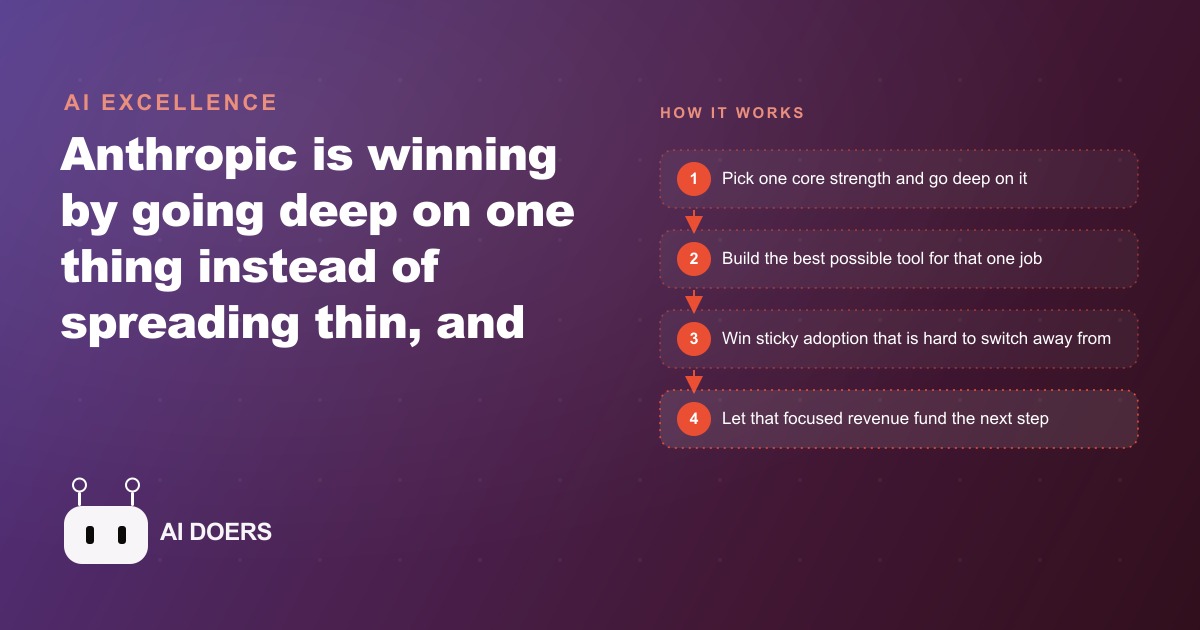
Here is a position most small business owners will resist: the reason your marketing feels mediocre is not that you lack tools, it is that you have too many. The prevailing advice is to add. Add another app, another channel, another AI platform that does everything. I think that advice is backwards, and the clearest proof is sitting in the AI industry itself, where the company winning right now is the one that refused to spread out. I am Madhuranjan Kumar, and I want to argue that focus, not breadth, is the strategy, using Anthropic's quiet rise as the evidence and your own business as the place to apply it.
A few months ago plenty of people doubted Anthropic could compete with the biggest labs. Today its coding assistant, Claude Code, is everywhere, and the phrase getting Claude pilled has spread from engineers to broader knowledge workers, with even non technical users blown away by it. That did not happen because Anthropic did more than its rivals. It happened because it did dramatically less, and went deeper on the one thing it chose. That is the whole argument, and everything below is why it should change how you run your business.
The case against doing everything
Look at what the biggest labs are chasing. Consumer apps. Devices. Image generation. Video generation. A sprawling surface of products, each competing for a slice of finite engineering attention and finite capital. Now look at Anthropic. It has long been known for the best coding models, and instead of chasing every shiny use case, it doubled down on that single strength. The result is not a company that is pretty good at ten things. It is a company that is the best in the world at one, and that distinction is doing enormous commercial work.
The contrarian point is that spreading finite resources across many priorities does not make you versatile, it makes you mediocre everywhere. Resources spread thin never beat resources concentrated on one strength. This is not a slogan, it is arithmetic. If you have a fixed amount of attention and you divide it ten ways, each priority gets a tenth of your best effort. The competitor who puts all of it into the one thing that matters most will beat you on that thing every time, and that thing is usually the one that actually drives revenue. Anthropic understood that. Most of its rivals, and most small businesses, do not.
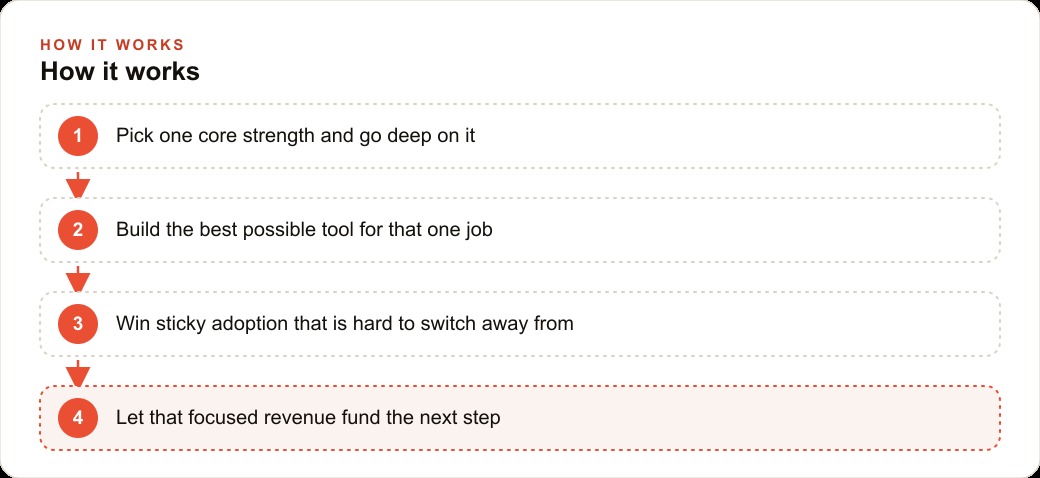
Focus is what makes a tool expand, not scatter
Here is the part of the argument people get wrong. They hear focus and think small, limited, unambitious. The opposite is true. Because Anthropic made Claude Code genuinely excellent at its core job, it grew on its own. Claude Code started as a command line tool that takes a prompt and manages the agents, the context, and the memory in the background. Developers found it noticeably better than the alternatives. Then something telling happened. People began using it for far more than code, building presentations, writing, handling desktop tasks. The team realized that anything you can do on a computer can be done in code, so they wrapped it in a friendlier interface called Claude Co-work for non technical users, and that interface was itself built in about ten days with every line written by Claude Code.
That sequence is the entire lesson. Expansion earned by excelling at a core is durable. Expansion attempted by launching in ten directions at once is fragile. The focused tool that nails one job grows outward from a position of strength. The scattered platform that does everything adequately has no strength to grow from. When you choose tools for your own business, this is the test. Does this tool do the one thing I most need better than anything else, or is it a wide menu of features I will mostly ignore?
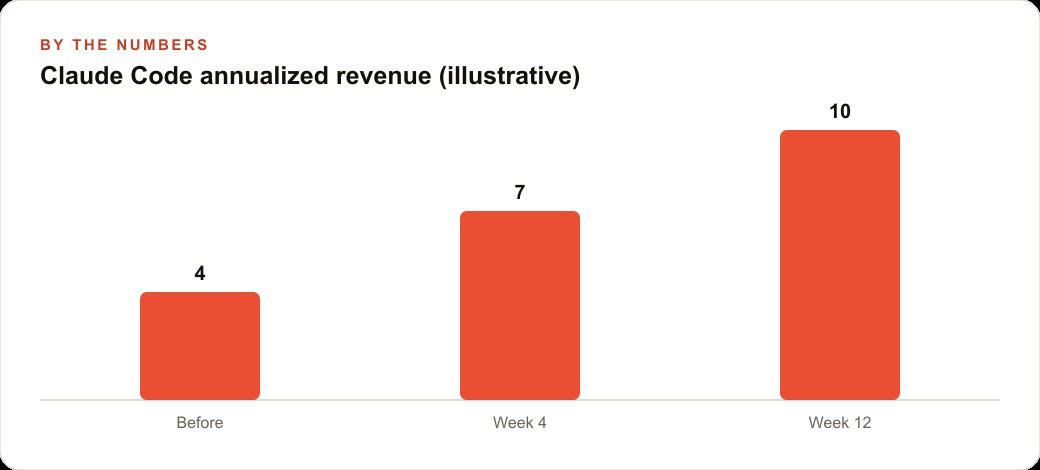
The stickiness that focus creates is a moat, not a trap
The strongest evidence for the focus argument is financial and it is sticky. Most of Anthropic's revenue comes from selling tokens through its API to enterprises, largely for coding, and Claude Code alone is close to a billion dollars in annualized revenue, up from roughly 400 million a few months earlier. That is the kind of growth that comes from doing one thing extremely well. And critically, it does not churn. Once a company wires Claude into its workflow, it does not casually switch a month later, because rebuilding those workflows somewhere else is exactly the kind of change management that makes adoption so hard to displace.
Some people hear sticky and think trap. I think that is the wrong read. Stickiness is a feature, not a trap, as long as you chose well. The whole point of picking one focused tool and going deep is to build habits and workflows around it that competitors cannot easily copy and that you have no reason to abandon. The momentum shows in who is praising it, with Nvidia's leadership going from publicly disagreeing with Anthropic to calling Claude incredible and using it across the company. That is what winning by focus looks like from the outside. It looks like the whole industry quietly conceding that the deep, narrow bet beat the wide, shallow one.
The proof is in who stopped arguing
The most persuasive evidence for a focus strategy is not a revenue chart, it is a change of mind at the top of the industry. Nvidia's leadership went from publicly disagreeing with Anthropic to calling Claude incredible and adopting it across the company. When a competitor's leadership reverses course and starts using your product internally, that is not marketing. That is the market conceding the point. It happened because Anthropic built something so good at its one job that even skeptics could not ignore it, and that only becomes possible when you concentrate your effort instead of scattering it.
Contrast that with what breadth buys you. A company spread across consumer apps, devices, image, and video generates a lot of announcements and a lot of activity, but activity is not the same as being undeniably best at anything. Nobody reverses a public position and adopts your tool because you have the widest product line. They do it because you are clearly the best at the specific thing they needed. That is the reputational payoff of focus, and it compounds, because being known as the best at one job pulls in the customers, the talent, and the momentum that fund the next step. A scattered reputation, good at many things, best at none, pulls in nobody with conviction. This is the part of the argument that is easy to underrate. Focus does not just make your product better. It makes your reputation legible, and a legible reputation is what turns skeptics into customers.
Applying the argument: a real estate team that stops scattering
Let me make the position concrete, because a contrarian claim is worth nothing if you cannot act on it. Consider a real estate team, using illustrative numbers. A typical team runs ten half used apps, one for listings, one for social, one for email, one for scheduling, and so on, and dabbles in all of them. The result is a team that is slow everywhere and great at nothing, and where every agent uses a different system so nobody's process matches.
Applying the focus argument, I would first name the single job that drives revenue, which for most teams is speed and quality of follow up with new leads. Then I would pick one focused tool to own that job and commit to it, rather than the ten app scatter. I would wire that tool to handle lead intake, draft personalized follow ups, and keep notes on every conversation, the way Claude Code quietly manages context in the background, and I would connect it to the CRM and website stack so no lead ever slips. Only after that follow up workflow was rock solid would I let it expand into a second use case like listing descriptions, exactly the way Anthropic let Claude Code grow only after it dominated its core. The payoff is the same sticky advantage. Once agents trust one system to never drop a lead and to write follow ups that sound like them, they stop bouncing between tools and their close rate climbs. Say a team converting a modest share of leads improves that follow up speed and consistency; even a few points of close rate on the same lead flow is real money, and it compounds because the habit is hard for competitors to copy.
Notice what I did not do. I did not tell the team to launch on five new marketing channels at once. The focus argument applies to acquisition too. A team is better off going deep on one strong channel, whether that is Facebook and Instagram ad campaigns or the long game of SEO and organic search, and mastering it before adding a second, than spreading a thin budget across every channel and being invisible on all of them.
The counterargument, and why it fails
The fair objection to everything I have argued is this: does not focus make you fragile? If you go deep on one thing and the world shifts, are you not stranded, while the diversified competitor adapts? It is a reasonable worry, and it is worth answering directly, because it is the reason many owners talk themselves out of focus.
The answer is that the objection confuses focus with rigidity, and they are not the same. Anthropic did not bet on a single frozen product. It bet on a single core strength, the best coding models, and then let that strength expand naturally into presentations, writing, and desktop work as the demand revealed itself. That is focus with adaptability, deep roots and flexible branches. The fragile company is not the focused one. It is the one spread so thin that it has no deep strength anywhere, so when the ground shifts it has nothing solid to pivot from. Depth in one area gives you a base to extend from. Breadth with no depth gives you nothing to stand on. Notice too that AI is writing the software now, and the company that went deep on coding is precisely the one positioned for that shift, not in spite of its focus but because of it. Focus did not make Anthropic fragile to the biggest change in the industry. It made the company the natural beneficiary of it.
For your business, the practical translation is that focus does not mean never adapting. It means building one thing so well that you have earned the right to extend, and extending from strength rather than flailing across ten weak bets. The diversified competitor is not more resilient. They are just more evenly mediocre, which feels safer and performs worse.
The uncomfortable part of the argument
I will be honest about why most people will not do this even after agreeing with it. Focus is emotionally hard. It means saying no to shiny new features, ignoring the constant industry noise, and resisting the pull to chase every new tool that trends this week. There is a culture lesson buried in Anthropic's run that makes this concrete. Part of why the company keeps shipping is that its team is steady and pointed in one direction, heads down while rivals churn through drama and scattered bets. A business works the same way. A group that agrees on one core priority and one set of tools moves faster than one where everybody runs a different system.
That discipline is the actual cost of the strategy, and it is why the strategy works, because most competitors cannot pay it. Software ate the world, and now AI is writing the software, and the company that focused on coding is well positioned precisely because it did not get distracted while everyone else did. The same is available to you, and it is free to adopt. Name the single job that makes you the most money, choose one tool that does that job better than any other, commit long enough to build real workflows around it, and measure whether it moves your core number rather than whether it has the most features. Only after that core is solid should you let it expand.
You can absolutely apply this yourself by picking your one priority and building around it, and I would encourage you to start this week by writing down that single revenue driving job. If you would rather have someone map your workflows, choose the right focused stack, and wire it to your core revenue job, that is the kind of setup you can hand to an expert and skip the trial and error.
That is exactly what we do at AI DOERS. Book a private 30-minute call with Madhuranjan Kumar and we will map the fastest path to it for your specific business.
Book your call →
Madhuranjan Kumar
Madhuranjan Kumar brings 20 years of performance-marketing experience and has managed over $200 million in Facebook ad spend for brands across the United States and beyond. His expertise spans the full modern marketing stack: Meta, Google Ads, TikTok, email automation, CRM, and the websites that hold it together. At AI DOERS he turns that track record into lead-generation systems for businesses across every industry.