
Anthropic's Deskilling Report and What It Means for Your Small Business
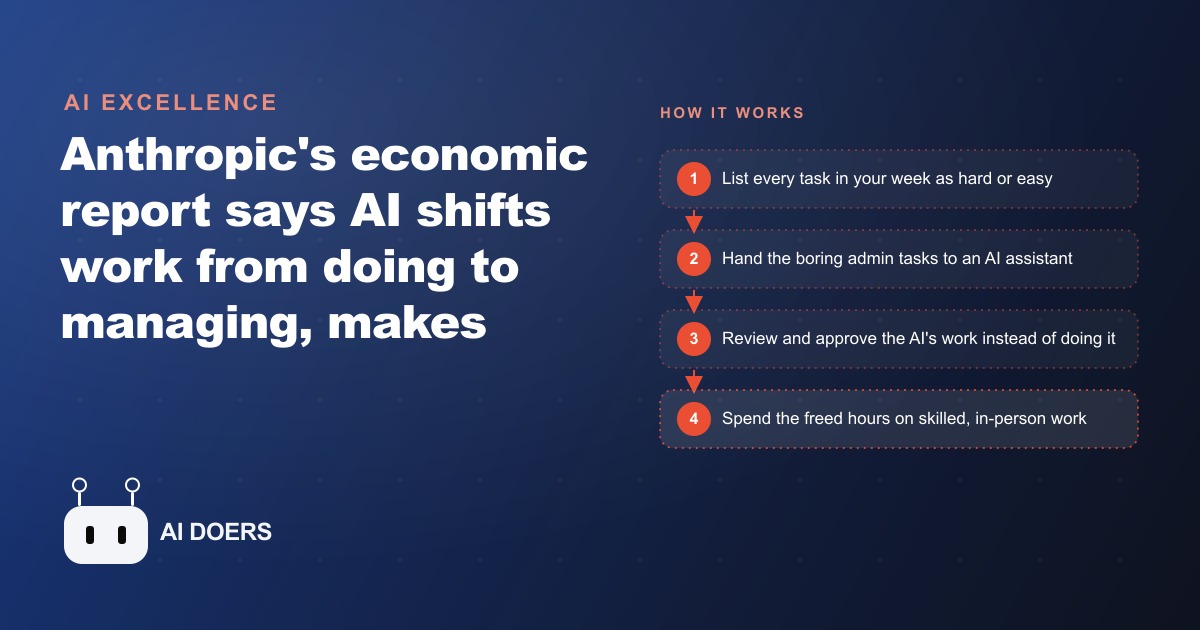
Anthropic's economic report says AI is not replacing whole jobs as fast as people feared. Instead it shifts work from doing to managing, and it makes hands-on trades more valuable, not less.

Anthropic published an economic report this month that contains the most useful and the most misread finding about AI and work that any lab has produced. I am Madhuranjan Kumar, and what follows is my reading of the five findings that matter most for a small business, in plain terms, with the practical implication attached to each one.
1. Deskilling and upskilling are opposite outcomes from the same tool, and you choose which one you get
The report introduces a distinction that most AI coverage misses. Deskilling happens when AI takes the high-skill parts of a role and leaves the person with only the routine tasks, effectively hollowing out the value of their expertise. Upskilling happens when AI takes the routine tasks and leaves the person with more time for the high-value work that requires genuine judgment and expertise. The tool does not determine which outcome you get. How you point the tool determines it.
A property manager who uses AI to research market comps, run financial models, and evaluate lease options is on the deskilling path. The AI is doing the intellectual work while the manager approves outputs. Over time, the manager's ability to do that work independently atrophies. A property manager who uses AI to handle rent collection notices, maintenance request routing, and lease renewal scheduling, while spending their own time on negotiation, tenant relationships, and portfolio strategy, is on the upskilling path.
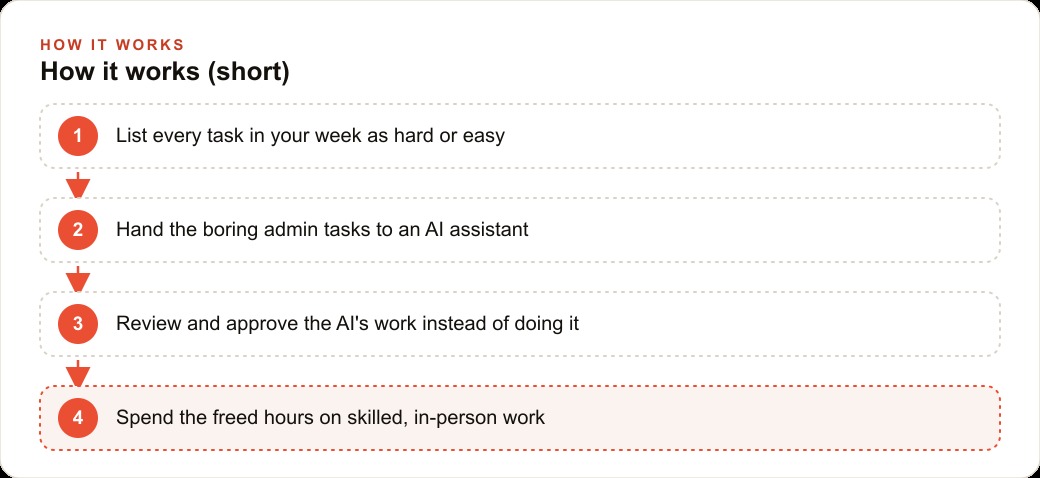
The practical implication is to identify which tasks in your role require genuine judgment and protect those from automation. Then identify which tasks are standardized and time-consuming and automate those aggressively. This is not a vague principle. It requires sitting down with a list of your weekly tasks and explicitly categorizing each one.
2. AI reliability drops sharply on long tasks without a human in the loop
The report's most cited finding is about productivity, but the more important finding for practical implementation is about reliability. On long, multi-step tasks run without human supervision, AI success rates drop below 50 percent after a few hours of autonomous operation. The same tasks with a human checking and correcting along the way stay reliable much longer.
This finding is the reason the report halves its own productivity estimate from roughly 1.8 to about 1 percentage point of annual economic gains. The gap between what AI could theoretically do and what it reliably delivers in practice is almost entirely explained by the reliability drop on unsupervised long tasks.
For a small business, the practical implication is straightforward: the human review step is not a concession to AI's limitations. It is the mechanism that keeps the workflow reliable. A cleaning service that lets AI draft booking confirmations without any human review will eventually send a confirmation with the wrong date, address, or service type. The review step that catches those errors costs thirty seconds per message. Removing it to save thirty seconds will eventually cost an hour of customer service recovery and potentially a lost client.
3. The productivity gains go to the people using AI as a tool, not the people being replaced by it
The report makes this point with more nuance than the headline version, but the core message is consistent: the AI tools generating real economic value for small businesses are the ones where a person uses AI to work faster, not the ones where AI operates without a person involved. The role that changes is the person's relationship to their work: from doing every task to reviewing the AI's work on the tasks that can be automated.
Managing AI output well is a skill in itself, and it is a learnable one. The business owner who has spent three months reviewing AI-generated quotes, emails, and reports has developed a specific set of pattern-recognition abilities around what the AI does well and what it consistently gets wrong on their type of tasks. That skill compound over time in a way that pure task execution does not.
The implication for hiring and training is that employees who learn to review and direct AI output are more productive than employees who either ignore AI entirely or use it without reviewing its output. Building AI review into job descriptions and training processes is the structural change that captures this finding in a real business context.
4. Hands-on, in-person work becomes more valuable as digital tasks automate faster
The bottleneck economy observation is the finding that most directly benefits trade businesses, service businesses, and any operation that requires physical presence to deliver. As digital and knowledge-based tasks automate and speed up, the tasks that require a person to be physically present become relatively more scarce and therefore more valuable. The report describes this as a bottleneck economy: the automated tasks clear faster and the in-person tasks become the constraint.
A plumbing company whose office work, quoting, scheduling, follow-up, and review management all run on AI automation can route more physical jobs through the same administrative infrastructure. The plumber's time in the field is the scarce resource. The office work that previously competed with field time for the owner's attention has been removed from the competition. This is the upskilling path applied to a trade business: AI handles the office, the tradesperson focuses on the field.
The same dynamic applies to any business where the primary value delivery requires human presence: physical therapy, personal training, veterinary care, legal consultation, financial planning, medical appointments. The administrative layer around those services is mostly automatable. The service itself is not. That asymmetry is good news for the person delivering the service and neutral news for the administrative work around it.
5. Prompt quality determines output quality more than model tier
The report finds that the AI responds at the level you write at. A vague prompt produces a vague output. A specific, expert-level prompt that asks for the answer broken into plain, actionable steps produces output that is both high-quality and readable by the intended audience. This finding has direct operational implications for how a small business should invest its AI adoption time.
The highest-leverage investment in AI for most small businesses is not choosing the best model or the most feature-rich platform. It is writing better prompts for the specific tasks the business runs on. A cleaning service with a precisely written prompt for booking confirmation emails that covers tone, required information, fallback language for edge cases, and format will produce better output from a twenty-dollar-per-month model than the same service with a vague prompt running on the most expensive model available.
Building a prompt library is the practical implication. For each standard output type the business produces, write a description of what perfect output looks like, what information it includes, what tone it uses, and what the reader needs to be able to do after receiving it. Test that description on ten real examples. Adjust until the output is consistently good enough that the review step takes under two minutes per item. Save the prompt. That library is one of the most valuable assets a small business can build around AI adoption.
The plumbing company example that ties all five findings together
I want to make these findings concrete with a single business example. A plumbing company with one owner-operator and an office manager running scheduling and communications has a clear separation between the work only the plumber can do and the work an AI tool can handle.
The plumber's work: diagnostics, physical repairs, customer trust on site. These stay entirely human. The report's finding about the bottleneck economy suggests the plumber's hourly value goes up, not down, as AI automates the office work that was competing for time.
The office manager's work with AI assistance: turning rough job notes into structured quotes, drafting appointment confirmation texts, writing review request messages, preparing the weekly service summary for the owner's review. Each of these is a standard output with a predictable structure. Each is automatable with a well-written prompt. Each is reviewed before it leaves the office.
The deskilling risk for the office manager is in tasks like researching permit requirements, handling complex billing disputes, or negotiating with suppliers. Those require judgment that should stay with the person. The upskilling opportunity is in everything else.
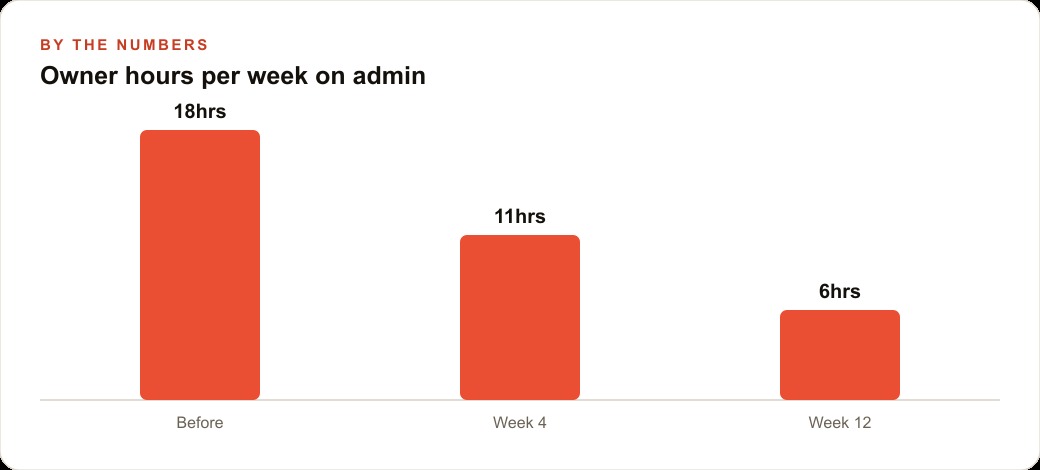
The reliability finding means the office manager reviews every AI-generated quote before it sends, every confirmation text before it goes out, and every invoice before it reaches the client. The review takes under two minutes per item once the prompts are tuned correctly. The total daily review time is roughly twenty minutes. The total time previously spent on the same tasks without AI assistance was closer to three hours. That two-and-a-half-hour daily recapture is what the report is measuring when it describes productivity gains from AI in successful implementations.
The prompt quality finding means the office manager's most productive investment is the first week: writing and testing the prompts for each output type until the output is consistently good enough that the review step is validation rather than correction. After that week, the system runs with light ongoing maintenance.
The result is a plumbing company that handles more service calls per week with the same administrative overhead, because the administrative overhead is not growing with the volume. The owner spends more time doing the work only the owner can do. The office manager spends more time on the judgment-requiring tasks and less on the standardized-output tasks. The business captures more of the available market for the same labor cost. That is what the Anthropic report describes as the upskilling path, and it is available to any small business that takes the time to point the tools correctly.
That is exactly what we do at AI DOERS. Book a private 30-minute call with Madhuranjan Kumar and we will map the fastest path to it for your specific business.
Book your call →
Madhuranjan Kumar
Madhuranjan Kumar brings 20 years of performance-marketing experience and has managed over $200 million in Facebook ad spend for brands across the United States and beyond. His expertise spans the full modern marketing stack: Meta, Google Ads, TikTok, email automation, CRM, and the websites that hold it together. At AI DOERS he turns that track record into lead-generation systems for businesses across every industry.