
An Insane Week in AI: Fable 5, Apple's New Siri, and Google's Live Translate
In one week Anthropic shipped Claude Fable 5, Apple rebuilt Siri with personal context and a Gemini partnership, and Google launched real-time live translate. The through line is more capability, more on-device processing, and what each of these actually changes for a business.

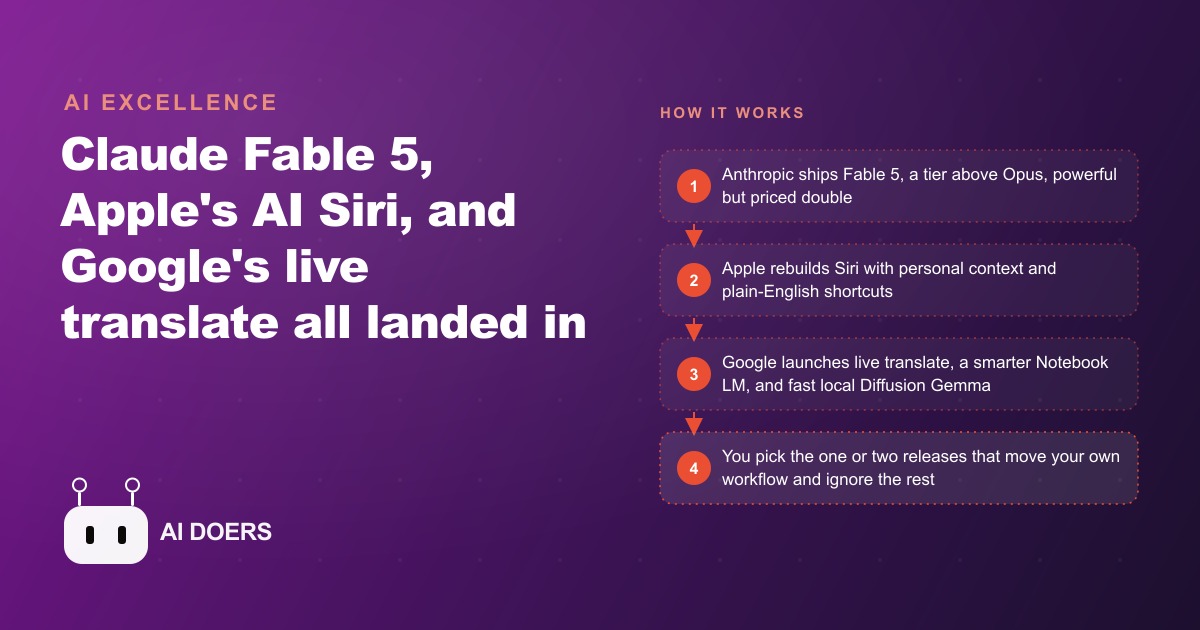
In a single week, three of the biggest labs in AI all raised the bar at once. Anthropic shipped Claude Fable 5, a model in a new tier above Opus. Apple rebuilt Siri from the ground up with personal context and a Google partnership. And Google launched real-time live translate along with a much smarter Notebook LM. I am Madhuranjan Kumar, and I watch weeks like this so business owners do not have to drink from the firehose. The honest headline is not that you have more to keep up with. It is that a flood of announcements almost always narrows down to one or two releases that touch your actual workflow, and the skill is picking those and letting the rest pass.
Anthropic shipped a model above Opus, and it is powerful but pricey
The frontier news is Claude Fable 5, described as a Mythos-class model sitting in a new tier above Opus and aimed at the biggest, most logic-intense work you can throw at it. The demos were genuinely striking. It one-shotted a playable 3D game complete with generated music, and a working YouTube-style clone with a live recommendation feed, both from single prompts, with a few follow-ups adding sprinting and terrain. That is the kind of thing that used to take a small team weeks, produced from a sentence.
The catch is cost and access, and this is where an owner should pay attention rather than get swept up. Fable runs at ten dollars per million input tokens and fifty dollars per million output, roughly double Opus 4.8, and on paid plans it was only available for a limited window before needing extra credits. It also launched with heavy safeguards that refuse some medical and security prompts and quietly downgrade certain requests, which drew real backlash, including from the CEO of Hugging Face, on concerns about concentration of power. Within about two hours Anthropic reversed some of its most conservative limits, and now it tells you when it is blocking something rather than silently downgrading. The practical read: this is a specialist tool for the occasional hard job, not something you run all day, and its price is the reason why.
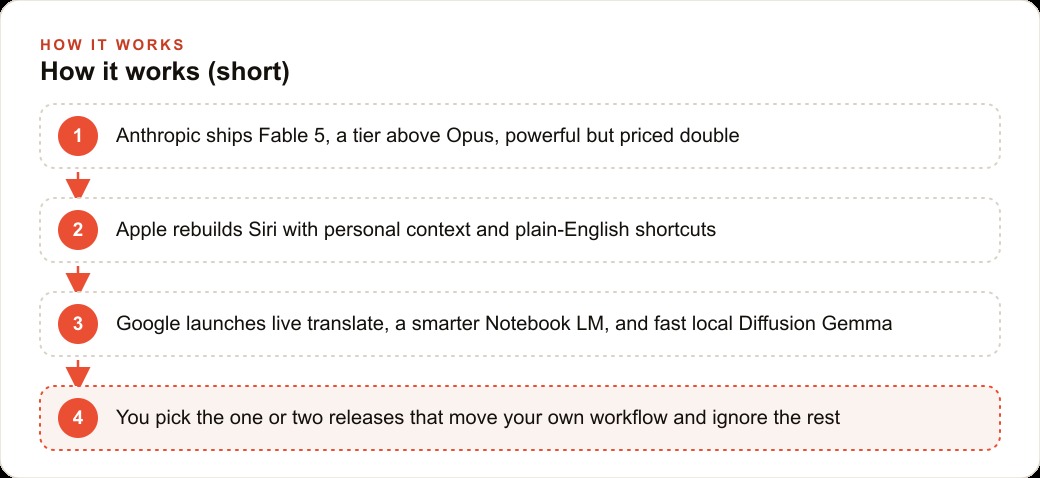
Apple rebuilt Siri, and the useful part is plain-English automation
The second big release is Apple's overhaul of Siri, and it changes what an assistant on a phone can actually do. The new Siri gained personal context across your photos, calendar, and messages, a dedicated app, and visual intelligence that understands what the camera sees, and it can act on your behalf rather than just answer. Notably, Apple built these foundation models in partnership with Google's Gemini, running on device or in a private cloud where Google sees none of your data, though the features will not ship in the EU at launch because of AI regulation.
For most people and most businesses, the single most useful piece is not the flashy visual intelligence, it is the ability to describe a shortcut in plain English. You write what you want in ordinary words, something like message a client my ETA when I leave the office, and Apple wires up the automation for you. That quietly removes the biggest barrier to phone automation, which was never capability but the intimidating editor most people never opened. When the setup becomes a sentence, the automations people always wanted but never built suddenly get built.
Google launched live translate and a Notebook LM that can actually work
The third bucket is Google's, and it is about communication and research. Gemini 3.5 live translate converts speech in near real time and is rolling into Google Meet, the Translate app, and AI Studio. This is the release with the most obvious, immediate payoff for a business, because it can erase a language barrier on a live call, which is a concrete problem many companies face every week rather than an abstract capability.
Alongside it, Notebook LM now runs on Gemini 3.5 with a secure cloud computer, over a hundred skills, and new export formats, and it can write and run code for deeper research and charts, which turns it from a note summarizer into something closer to a research desk. Google also shipped Diffusion Gemma, a model that drafts a whole 256-token block at once instead of word by word, using your local GPU far more fully and trading a little intelligence for a big jump in speed. That last one matters less day to day, but it signals where local, fast, cheap models are heading.
The through line: more capability, more on-device, and a discipline problem
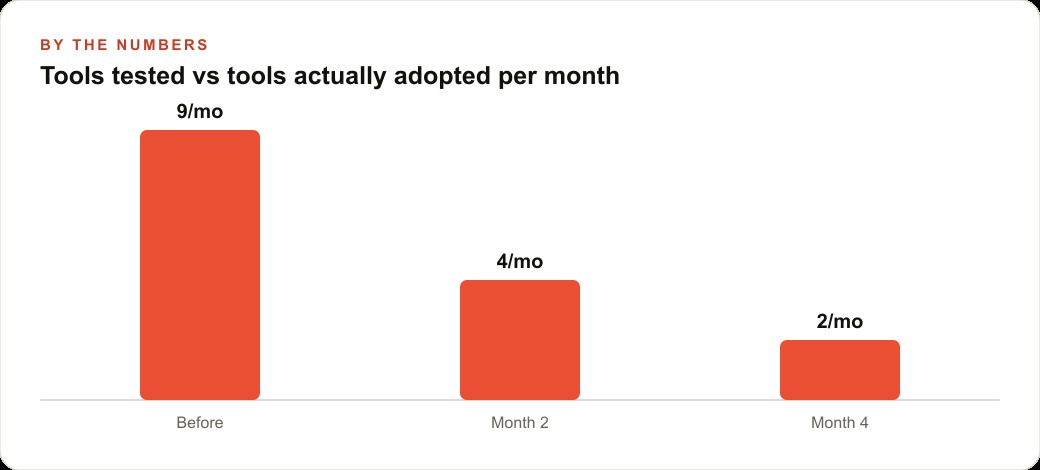
Step back from the individual releases and the pattern is clear. Every lab pushed capability up, more of the processing moved on-device or into private clouds, and the sheer volume of it created the real risk, which is not falling behind on features but exhausting yourself trying to adopt all of them. The genuine skill this week rewards is not technical. It is the discipline to ignore nine of every ten announcements and go deep on the one that removes a friction you already feel. More news does not mean more for you to do. It means one clearer choice to make.
What one real business should actually do with this week
Let me turn it into a concrete plan with a worked example and illustrative numbers, because a reading list is not a strategy. Take a real estate team, since real estate touches every one of this week's releases in a natural way.
Start with live translate, because real estate is full of buyers and sellers who are more comfortable in another language, and a misunderstanding on a six-figure deal is expensive. On a video call with an out-of-area buyer, live translate lets the agent and client speak naturally while the system converts in near real time, removing the awkward back-and-forth. If that helps close even one additional deal a quarter that would otherwise have stalled on communication, the payoff dwarfs anything the tool costs, and it is free to try. Next, Apple's describe-a-shortcut feature handles the small automations that eat an agent's day. Saying message my buyer the showing address when I leave the office wires up an automation in a sentence, and if it saves each agent fifteen minutes a day, that is over an hour a week per agent recovered from fiddling.
Then Fable for exactly one bigger project, used carefully because of the price. I would never run daily work on a model that costs double Opus. Instead I would use it once to one-shot a prototype, say a simple internal page that turns a property's details into a polished listing description and a set of social captions, then run the day-to-day generation on a cheaper model afterward. Notebook LM rounds it out as the team's research desk, pulling neighborhood data, comparable sales, and inspection notes into one place an agent can question before a listing appointment. Those figures are illustrative, but the shape is the point: adopt two or three releases that fit, ignore the rest.
The releases also compound with the systems a team already runs. The polished listing copy Fable prototypes becomes creative for Facebook and Instagram ad campaigns. The research Notebook LM organizes strengthens the content behind SEO and organic search. And the plain-English shortcuts that automate client messaging feed naturally into the follow-up living in the CRM and website stack. A week of announcements turns into a handful of quiet upgrades to how the team already works, rather than a pile of tools nobody has time to learn.
The team still sells houses the same way. The difference is that language barriers, busywork, and listing prep quietly shrink, because they adopted the two or three releases that actually fit and let the firehose pass.
The skill this week actually tests is filtering, not adopting
The instinct a week like this triggers in most owners is guilt. Three major releases landed, everyone online is talking about them, and the feeling is that you are already behind and need to catch up on all of it. That instinct is the trap, and learning to override it is worth more than any single one of these tools. The releases are not a to-do list. They are a menu, and the entire skill is ordering two things off it and ignoring the rest without guilt.
Consider what actually happens to the owner who tries to adopt everything. They sign up for Fable and burn through expensive credits experimenting on work that never needed a frontier model. They toggle on every new Siri feature and half-configure a handful of shortcuts they abandon. They open Notebook LM, poke at it once, and never return. At the end of the week they have spent real time and money, adopted nothing durably, and feel more behind than when they started, because there is always another release next week. This is the exact treadmill that produces the mental fog heavy AI users describe, and it produces zero business value while doing it.
Now consider the owner who filters. They read the same week of news in fifteen minutes, ask one question of each release, does this remove a friction I actually feel, and conclude that live translate solves a real communication problem they hit weekly while the rest does not apply right now. They spend their time deeply adopting that one thing, wiring it into how their team actually works, and they close the week with a concrete capability their business did not have on Monday. Same news, opposite outcome, and the only difference was the discipline to filter instead of chase.
This filtering skill matters more every month, not less, because the pace is not slowing down. If a single week can produce three frontier-level releases, the volume over a year is genuinely impossible to fully absorb, and any strategy that depends on keeping up with all of it is guaranteed to fail. The only durable posture is to get very good at deciding what to ignore. That sounds passive, but it is the opposite. It takes real conviction to watch an impressive release land, recognize it does not serve your business right now, and consciously let it pass so your attention stays on the one thing that does.
The framing I give owners is to treat AI announcements the way a good investor treats hot stock tips. You will hear about a hundred opportunities. Acting on all of them guarantees you spread yourself so thin that none of them pay off, and the transaction costs alone sink you. The winning move is to have a clear sense of what you actually need, evaluate each new thing against that, and say no to the overwhelming majority so you can go deep on the rare few that fit. The person who says no to ninety-nine tips and yes to the right one beats the person who chases all hundred, every time.
There is a compounding benefit to building this filter, too. Each week you practice it, the faster you get at spotting the release that matters, and the less the noise affects you. The releases that do fit your business start to stand out clearly against the ones that do not, because you have a stable sense of what you are looking for. Owners who never build the filter experience every big week as a fresh wave of anxiety. Owners who build it experience the same week as a quick scan and a simple decision, which is exactly the calm, clear-headed state that lets you keep making good calls while everyone around you is frazzled by the pace.
You can absolutely do this yourself by starting with one release this week. If you would rather have someone look at your specific business, pick the right one or two tools, and wire them into how your team actually works so they pay off immediately, that is the kind of setup I do for clients, and you can bring me in to handle it.
That is exactly what we do at AI DOERS. Book a private 30-minute call with Madhuranjan Kumar and we will map the fastest path to it for your specific business.
Book your call →
Madhuranjan Kumar
Madhuranjan Kumar brings 20 years of performance-marketing experience and has managed over $200 million in Facebook ad spend for brands across the United States and beyond. His expertise spans the full modern marketing stack: Meta, Google Ads, TikTok, email automation, CRM, and the websites that hold it together. At AI DOERS he turns that track record into lead-generation systems for businesses across every industry.