
The Always-On AI Assistant: A 24/7 Digital Employee You Text
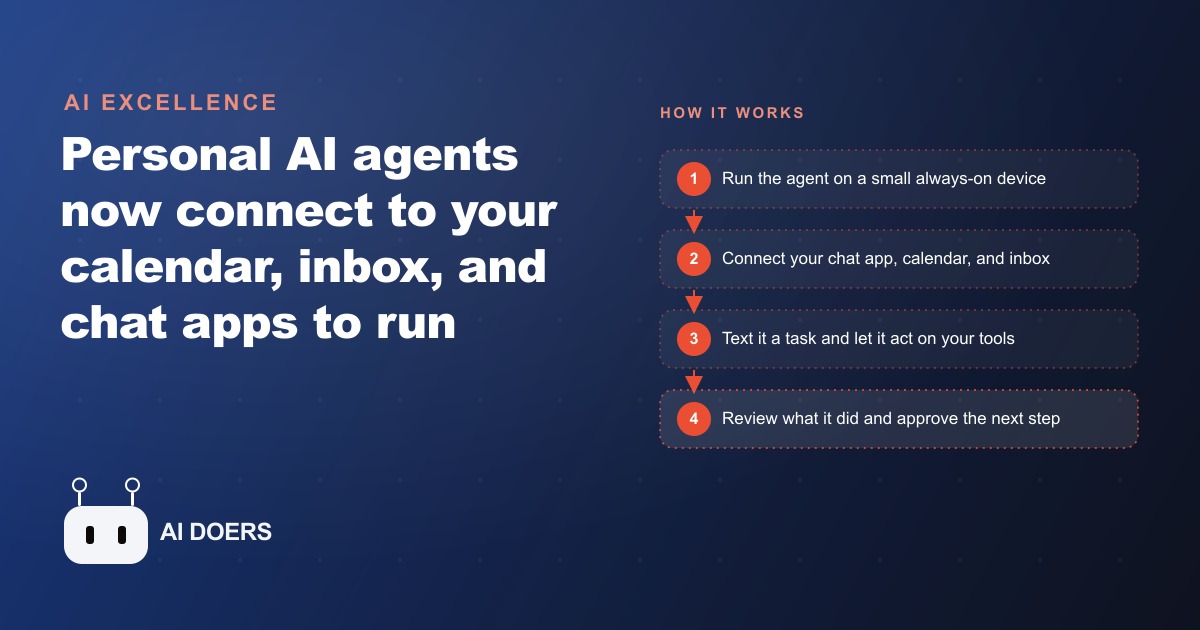
A new wave of personal AI agents connects to your calendar, inbox, and chat apps and runs tasks around the clock. Here is how a small business can put one to work safely.

At 11:07 pm on a Sunday, a potential patient sends a message asking whether there are any openings this week for a new-patient consultation. She found the practice through a friend's recommendation, checked the website, saw that online booking was closed for the weekend, and sent the message anyway on the chance that someone was still paying attention.
Without an always-on agent, the message sits until Monday morning. Someone checks the inbox at 8:45 am, types a reply between two other tasks, and sends it at 9:12 am. By then the potential patient has already booked with another practice, one that replied at 7:30 am because it had the infrastructure to respond overnight. The first practice never knew it was competing for that patient. The lost booking does not appear anywhere in the monthly review; it simply never happened.
With an always-on agent, the reply goes out at 11:10 pm. It names two available slots, provides a booking link, and addresses the insurance question embedded in the original message. The patient books the Tuesday slot before midnight. The next morning she receives the intake form automatically, because the agent sent it as soon as the booking was confirmed. The practice gained a patient while the owner was asleep.
That single Sunday evening captures the difference between AI used as a convenience and AI used as infrastructure. The convenience version helps when you open it. The infrastructure version works when you cannot.
The Distinction That Actually Matters: A Clever Talker Versus a Doer
Every AI assistant in use today is a clever talker. The useful question is whether it is also a doer, and the answer comes down to three capabilities: calendar access so the agent can read availability and write to it, inbox access so it can read incoming messages and compose replies without a human copying content between tools, and the ability to take action through other channels, such as a voice service that places real calls or a messaging app that sends reminders on its own schedule.
A chatbot is a transaction. You open it, type a question, receive an answer, and close it. Nothing happened in the world outside the conversation window. The information might be useful, but the work of acting on that information remains entirely yours. The chatbot has no idea whether you ever followed through on what it told you, and it cannot act without you initiating every step.
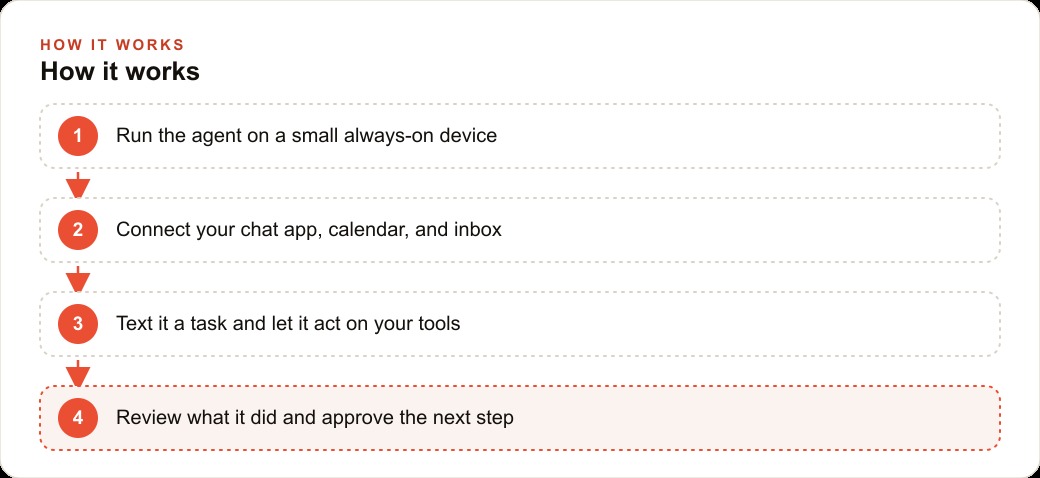
An always-on agent is a process. It runs continuously on a device that never sleeps: a small Mac mini tucked behind a desk or a modest cloud instance running at roughly ten dollars a month. It is connected to the tools that matter: the booking calendar, the primary inbox, the messaging app patients or customers already use. When a message arrives, the agent reads it, identifies what kind of response is needed, checks whatever context is relevant, and either sends the reply directly or flags it for human review, depending on the permissions you configured. When a booking is confirmed, it triggers the follow-up sequence automatically. When an appointment is 48 hours out, it sends the reminder without being asked.
The phrase I use with clients is that a chatbot answers the question you ask it; an agent handles the situation you described when you set it up. The setup conversation happens once. The agent applies it indefinitely. That asymmetry, one setup conversation versus unlimited executions, is where the economic case lives.
I am Madhuranjan Kumar, and the argument I want to make plainly is this: most local businesses are not losing money because their offers are wrong or their ads are underperforming. They are losing money to the gap between when a customer reaches out and when a human is available to respond. That gap is not a staffing problem. It is an architecture problem, and always-on agents close it.
Why Always-On Is the Property That Changes the Economics
A human cannot be always-on. The constraint is biological, not budgetary. You can pay someone to work long hours, but you cannot sustain genuine responsiveness at 11 pm on Sunday and again at 7 am Monday without consequences for the quality of that person's judgment and their longevity in the role. Most small businesses accept this as a structural limitation: published hours of operation, after-hours voicemail, and the implicit understanding that messages sent outside business hours will receive a response the next business day.
The problem is that the customer's decision to try a competitor does not wait for business hours. The person who sends a Sunday evening inquiry is usually checking two or three options in the same sitting. The practice that replies at 11 pm gets the booking. The one that replies Monday morning gets a polite message saying the slot was already filled somewhere else. The business never learns what it competed against because the lost patient never appears in the data.
The cost of an always-on agent makes the comparison concrete. A Mac mini running continuously costs roughly ten to fifteen dollars per month in electricity. The AI inference cost for handling 50 messages per day runs approximately twenty to fifty dollars per month depending on message length and the model in use. Total ongoing cost: thirty to sixty-five dollars per month for after-hours coverage that responds within minutes, knows the schedule, and never has a distracted day.
The comparison is not agent versus no help. The comparison is agent versus the revenue being lost to slow responses right now. For a service business where a single new patient is worth $200 to $500 over their first year, recovering five after-hours leads per month covers the agent's cost in a few days of the first month and then compounds from there. Every subsequent month the agent runs, the math becomes more favorable because the infrastructure cost is flat while the captured revenue accumulates.
The economics also change the staffing conversation. When the agent handles the first layer of triage and response around the clock, the front desk arrives Monday morning to a cleared inbox rather than a backlog. The team spends its first hour on calls and tasks that genuinely need judgment rather than on typing replies to questions the agent could have answered 12 hours earlier. That recovered focus is an operational benefit that does not show up in the revenue calculation but is felt immediately by the people doing the work.
The Trust Gradient: One Safe Task Before the Next
No one should connect an agent to the entirety of their business on day one. The right approach is a trust gradient: prove it on one low-risk task, watch it run for two weeks, and expand access only when the behavior is clearly reliable.
The first task should be completely reversible. A good first task for a service practice is having the agent sort the inbox into categories without replying at all, simply organizing incoming messages so the team can triage more quickly. After a week the owner can see whether the sorting logic is sensible. If it is, the next stage is having the agent draft replies that a human approves before sending. If the drafts are consistently accurate and on-brand, the stage after that is auto-sending replies for a narrow, well-defined category of messages: perhaps appointment confirmation responses or standard insurance coverage questions where the correct answer is one of three options.
At each stage, the token the agent holds is scoped to exactly what the task requires. If the task is reading the inbox, the token sees only the inbox. When the task expands to include calendar booking, a separate token is created that sees the booking calendar and nothing outside it. The agent never holds a master key. It holds a set of purposeful, limited keys that together allow it to do the specific jobs it has been assigned.
This graduation is not caution for its own sake. It is the architecture that makes the setup trustworthy for the long run. A business that grants the agent full access on day one will eventually encounter an edge case the agent handles poorly, and at full access that edge case can cause real damage. A business that promotes the agent through increasing responsibility has already observed how it behaves at lower stakes before trusting it with higher ones. The trust is earned through evidence, and the evidence accumulates during the graduated stages. Each stage that runs cleanly is data that the next stage is safe to begin.
What Ninety Days With an Always-On Agent Looks Like for a Chiropractic Clinic
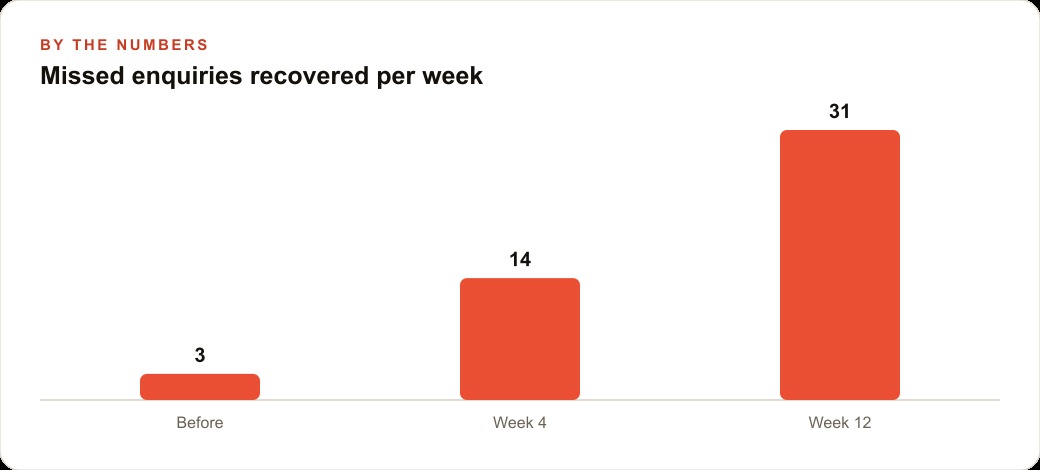
The first week the clinic connects the agent to its booking calendar and its primary patient inquiry inbox. The agent gets one task: respond to first-time patient inquiries arriving outside business hours with a message that names two available time slots and provides the direct booking link. Nothing else. The front desk arrives Monday morning to find four Sunday-evening inquiries already answered and two of them with confirmed bookings. Before the agent, those four messages would have waited until 8:45 am; two of the senders would have booked elsewhere by then.
At week three, the agent earns a second task: appointment reminders. It sends a reminder 48 hours before each appointment with the time, the address, and a low-friction reschedule link, and a second reminder on the morning of the appointment. Show rate over the following month climbs from 76 percent to 83 percent because the reminders are consistent in a way that manual sending never managed. No appointment slips through without a reminder because someone was too busy or forgot.
At week six, the clinic adds a post-appointment follow-up. After every completed visit, the agent sends a brief message asking how the patient is feeling and noting when a follow-up is typically recommended based on their visit type. This is work the clinic intended to do for years. It never happened consistently because it required manual effort at the end of a long day. The agent does it automatically, for every appointment, without exception.
At week ten, the clinic adds a review request to the post-appointment sequence, timed at 90 minutes after the visit while the experience is still vivid. Review volume over the following month triples compared to the prior quarter.
The numbers that matter: the clinic is booking approximately five additional first-contact patients per month who would previously have gone cold by Monday morning. At an average first-visit value of $180 for the initial consultation, that is $900 per month in recovered revenue. Against a total infrastructure cost of $55 per month for device compute and AI inference combined, the return in the first month is more than 16 to 1. By month three, the agent has handled more than 400 patient interactions, the scope has expanded through four verified stages, and the front desk spends its mornings on the work that actually requires a person rather than on inbox management that a process should own. The clinic did not hire anyone. It changed the architecture, and the architecture changed the economics.
What to Do With the Time You Get Back
The agent does not just save time. It changes the quality of what you can do with the hours that remain. When the routine layer of inbox management, appointment reminders, and post-visit follow-up is running automatically, the staff can direct their attention toward the work that actually requires them: the relationships that determine whether a patient returns, the judgment calls that no system can make on their behalf, the outreach that builds the practice's reputation in the surrounding community.
These are not tasks that were impossible before the agent. They were tasks that got crowded out by the administrative layer that the agent now owns. The shift is not from doing nothing to doing something. It is from doing administrative work to doing relationship work, and that shift compounds differently than recovered time measured in minutes. A practice where the staff has space to call patients who have not been in for three months, to follow up on the person who mentioned a concern at their last visit, and to build the kind of genuine familiarity that produces referrals is a different practice from one where every hour is consumed by inbox management and reminder scheduling.
The always-on agent does not replace the human at the center of a service business. It gives that human room to be the thing no process can replicate: the person who knows the patient's name, remembers what they talked about last time, and makes the kind of call that turns a one-time visit into a long-term relationship.
That is exactly what we do at AI DOERS. Book a private 30-minute call with Madhuranjan Kumar and we will map the fastest path to it for your specific business.
Book your call →
Madhuranjan Kumar
Madhuranjan Kumar brings 20 years of performance-marketing experience and has managed over $200 million in Facebook ad spend for brands across the United States and beyond. His expertise spans the full modern marketing stack: Meta, Google Ads, TikTok, email automation, CRM, and the websites that hold it together. At AI DOERS he turns that track record into lead-generation systems for businesses across every industry.