
AI Wearable Notetakers Compared: What Actually Works After Testing Five Devices at Four Conferences
Plaud Pin, Bee, Compass, Limitless Pendant, and the Otter app were tested over a week across four conferences. Here is what each device does well, where each one fails, and which professionals should use which option.

Divided attention is the hidden tax on every professional meeting. You cannot fully listen to a client and write down what they are saying at the same time, and the sentence you miss while typing the last one is often the one that mattered. I am Madhuranjan Kumar, and AI wearable notetakers exist to remove that tax. After five devices were tested over a week across four conferences, the real question is not which gadget is best. It is which failure mode you can live with, because every one of these tools trades something away.
The idea underneath the category
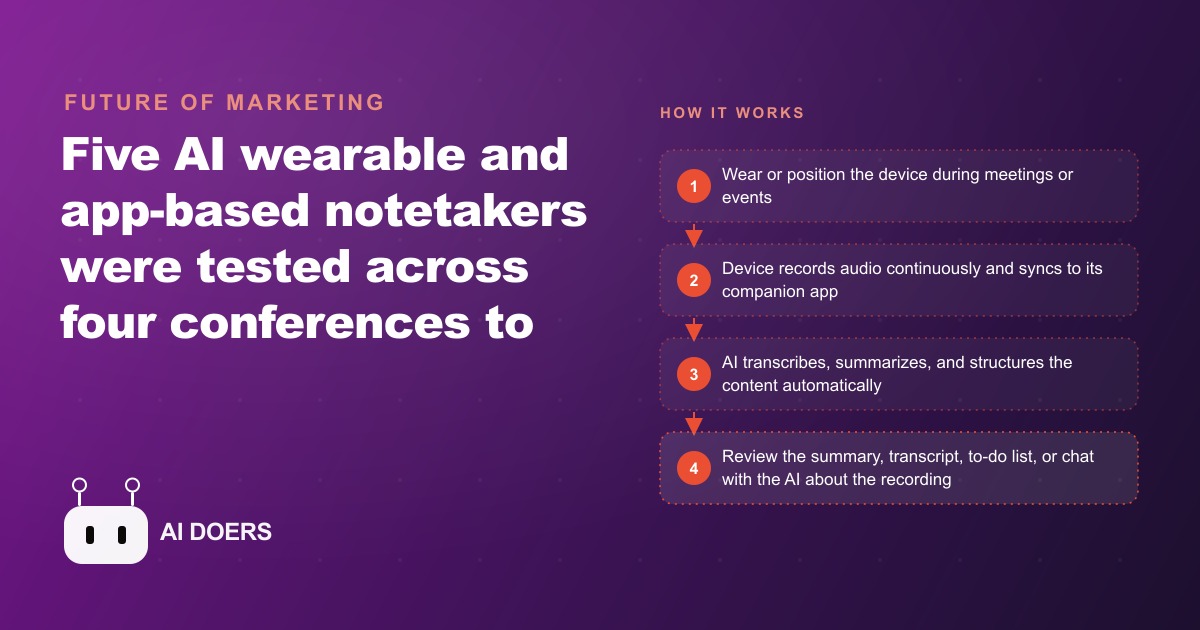
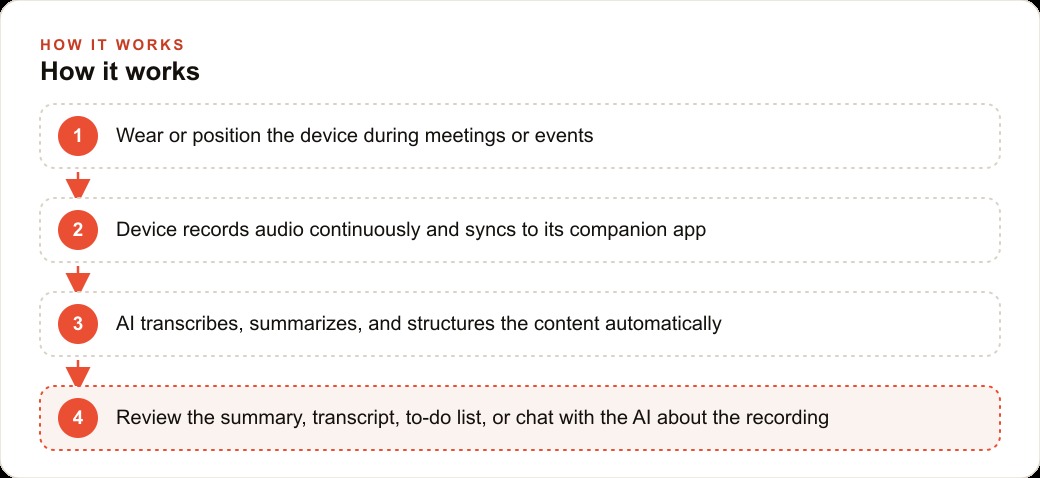
Strip away the marketing and a wearable notetaker is a simple stack of parts doing one job: a microphone, some local storage, a battery, and a wireless chip, worn or clipped to your clothing, recording audio continuously and syncing it to a companion app. In the app, an AI transcribes the audio, then layers more work on top, a structured summary, extracted action items, key entities mentioned, sometimes a mind map of the discussion. The promise is passive documentation. You attend the meeting, take no notes, and the device hands you a clean record.
The category splits along one line that decides most of the experience: dedicated hardware versus your phone. Dedicated wearables like the Plaud Pin, the Bee, the Limitless Pendant, and the Compass carry their own microphone and battery, so they record without draining your phone and leave your phone free to use during a meeting. App-only tools like Otter turn the phone itself into the recorder, which is cheaper but ties up the one device you most want available. That single architectural choice ripples through everything else, and it is the first facet worth understanding before you look at any spec.
Why the real testing ground is a noisy room, not a spec sheet
These five devices were used across four real conferences, GTC, GDC, a Convey event, and a Falls AI and Minx event, in genuine meeting conditions rather than a controlled lab. That distinction matters more than any datasheet, because the failures that make these devices unusable only show up in the field, and they are never the failures the marketing prepares you for.
Voice isolation is the clearest example. In a quiet one-on-one, almost any device transcribes well. In a conference hall with three conversations happening within earshot, the microphone array has to focus on the speaker and reject the rest, and that is where devices separate. The Plaud Pin was the strongest performer at isolating the speaker's voice from background conference noise, which matters enormously in an event environment. A device that produces a clean transcript at your desk and a garbled one at a trade show has not really solved your problem, it has solved the easy version of it.
Battery is the second field-only truth. A device that runs out of charge mid-afternoon at a conference is worse than no device, because you trusted it and it left a hole in your record. In testing, the Bee had dramatically better battery performance than the rest, recording continuously for two full days without the user realizing it was still on, and still holding charge. The Plaud Pin, by contrast, died once from accidental recording inside a bag. Specs will never tell you this. Only real use does, which is exactly why a week in the field is worth more than a page of numbers.
The five devices, and what each one actually trades away
Every device in this category is a set of trade-offs, and understanding each one is really understanding what it gives up to be good at its best thing.
The Plaud Pin is a magnetic, card-shaped device that can be worn as a pendant, clipped to a lapel, or worn on a bracelet, and it ships with the most complete accessory set of the group. Its app produces mind maps, meeting summaries, full transcripts, and an AI chat interface for questioning the recording. Its strength is voice isolation, the best of the group. What it trades away is battery reliability, as the accidental-drain failure showed, so it demands a little care about when it is actually recording.
The Bee is a small circular clip, described as a prototype, which tells you it is early. Its defining strength is battery life, the two-day run described above, and its app was assessed as the cleanest of the group, generating daily summaries titled by the day's activities, to-do lists pulled from conversations, and facts the AI learned about you. What it trades away is maturity, since it is still early production, and a monthly subscription of around twelve dollars is part of the deal. A newer version has since shipped with a form factor closer to the Plaud Pin.
The Limitless Pendant is a clip or string-necklace device at 199 dollars, with an unlimited bundle at 399. Its accessory set is the most limited, just a basic string necklace, and battery life lasted about a day. Its app is bare-bones, chunking conversations into segments and labeling speakers but lacking the richer output layers Plaud and Bee provide. It was not recommended as a first choice, and the trade it makes, a high price for a thin experience, is the hardest to justify of the group.
The Compass is the cautionary entry. It arrived in bare packaging with no instructions and no accessories, and after testing it could not be made to work at all. Whether that was a device fault or a setup error is unclear. At 14 to 19 dollars per month for unlimited recording, with a strong app store rating, it may deserve a second attempt, but in the test week it simply was not usable, which is its own kind of data point.
Otter is the app-only option, using your smartphone as the recorder. Its free tier gives 300 minutes per month with a 30-minute cap per session, and a paid plan around 8.33 dollars per month raises that to 20 hours. The app produces summaries, outlines, full transcripts, AI chat, and playback up to 3x. What it trades away is your phone. It must stay open and face-up for the whole recording, so you cannot use it for anything else and its battery drains at active-use rate. For small quiet meetings that is a fine trade. For a conference it is a real constraint.
The social friction nobody markets
There is one downside consistent across every wearable, and it is not technical. Each of these devices means wearing something visible and explaining it to the people in the room. That social friction is the single most consistent drawback across all of them, and it is the facet most buyers underestimate.
This is why disclosure is not just a legal box to tick but part of the product experience. A device discovered mid-meeting, unexplained, damages a relationship in a way no summary quality can repay. The professionals who get value from these tools are the ones who fold a short, honest disclosure into how they open a meeting, so the device stops being a secret and becomes a normal part of how they work. Handled that way, the friction fades within a minute. Handled badly, it can undo the trust that the meeting was meant to build.
Who actually benefits, and a law firm worked through
The clearest winners are businesses where documentation accuracy directly drives outcomes: law practices, financial advisory firms, consulting firms, accounting practices, medical and mental health practices, and real estate agencies. In each, a missed instruction or a mis-remembered figure carries real cost, sometimes liability. High-ticket sales professionals benefit too, because reviewing the exact wording of an objection changes follow-up quality, and better follow-up lifts close rates on the same number of meetings.
Let me work through a law firm, because it shows the value and the discipline together. Picture an attorney at a boutique practice handling client consultations, depositions, and partner meetings. I would use the Plaud Pin as the primary device for consultations, in the bracelet configuration for discretion. At the start of each consultation, the attorney discloses the recording as required by jurisdiction and firm policy. That step is mandatory and non-negotiable. After the meeting, syncing the device produces a full transcript, a structured summary, and a mind map that separates distinct threads, so a consultation covering an estate question, a business-ownership matter, and a tax concern comes back as three clean topics rather than one blur. The attorney reviews the summary for accuracy, adds context the audio missed, and the confirmed version becomes the official file note.
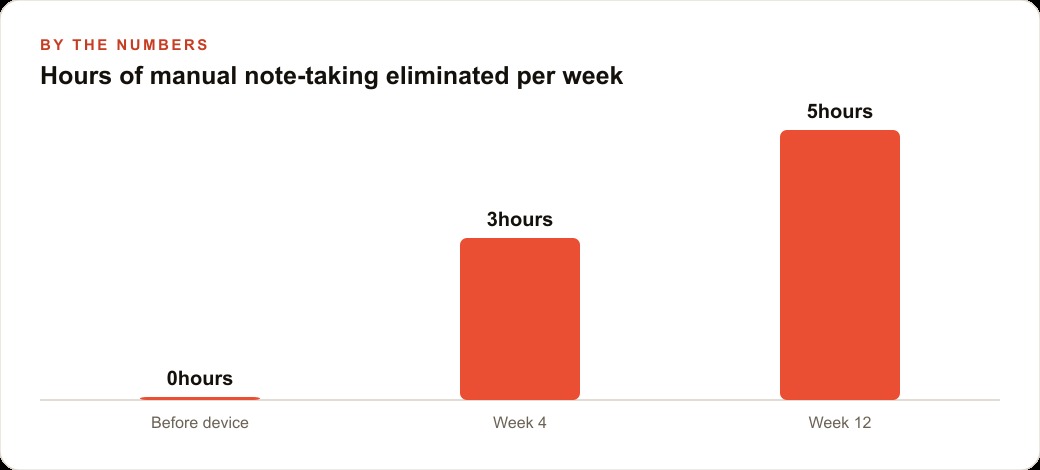
The numbers are where it becomes a business decision rather than a gadget. For an attorney with three consultations and two internal meetings a day, this workflow removes roughly 45 minutes to an hour of post-meeting documentation and recap daily. Over a 20-day month that is 15 to 20 hours reclaimed. Reclaiming even 10 of those hours for client work, at a 300 dollar billing rate, is 3,000 dollars a month in additional billable capacity, against a device under 200 dollars plus a modest subscription. That is illustrative, not a guarantee, but the shape is clear: the return on reclaimed billable time dwarfs the cost. There is also a free path worth respecting, a 30 dollar recorder plus free transcription through services like ElevenLabs, AssemblyAI, Descript, or OpenAI Whisper run locally, which delivers most of the transcription value at almost no ongoing cost for quiet one-on-one meetings.
The tools that surround the recording matter as much as the device. The clean transcripts and summaries a firm generates become searchable knowledge that supports SEO and organic search when repurposed into client education, the intake details captured in each consultation flow into the CRM and website stack so follow-up never depends on memory, and accurate records of what actually drives clients in make any Google Ads the firm runs measurable against real matters rather than guesses. A recording device, in other words, is not just a note-taker. It is the top of a documentation pipeline that, wired correctly, improves everything downstream of the meeting.
Choosing well means choosing your failure mode
The honest way to buy in this category is to stop looking for the best device and start deciding which trade-off fits your work. If voice isolation in noisy rooms is your constraint, the Plaud Pin leads. If all-day battery reliability is what you cannot compromise, the Bee is the standout. If you are not ready for a subscription at all, the recorder-plus-free-transcription path is genuinely viable. And whatever you choose, the mistakes to avoid are consistent: never record without proper consent disclosure, always review AI output before acting on a figure or a name, choose on real-world battery rather than the spec sheet, and take the free recorder alternative seriously before committing to a monthly plan.
Those four mistakes are worth dwelling on for a moment, because each one has bitten a real professional. Recording without disclosure turns a productivity tool into a liability. Acting on an unreviewed summary means trusting a machine with a client's name or a settlement figure it might have misheard. Buying on specs means discovering the battery dies at 2 p.m. on the day you most needed the record. And skipping the free path means paying a monthly subscription for value a thirty-dollar recorder could have delivered. None of these is exotic. All of them are avoidable with a little discipline, which is the theme of the whole category: the hardware is the easy part, and the habits around it are what actually determine whether you get value.
The device is only half of it. The other half is the standard operating procedure around it, a consent script for the start of client meetings, a file-naming convention for transcripts by matter and date, and a review checklist confirming any summary used in a file has been verified against the transcript. That procedure is what turns a useful gadget into a reliable workflow. You can absolutely build that yourself from the pieces above. If you want help designing the workflow for your specific practice so it produces consistent results instead of scattered recordings, that is the kind of system design I do.
That is exactly what we do at AI DOERS. Book a private 30-minute call with Madhuranjan Kumar and we will map the fastest path to it for your specific business.
Book your call →
Madhuranjan Kumar
Madhuranjan Kumar brings 20 years of performance-marketing experience and has managed over $200 million in Facebook ad spend for brands across the United States and beyond. His expertise spans the full modern marketing stack: Meta, Google Ads, TikTok, email automation, CRM, and the websites that hold it together. At AI DOERS he turns that track record into lead-generation systems for businesses across every industry.