
The Complete AI Video Tool Tier List: Which Model to Use and When
After testing every major AI video generator, here is a clear ranking organized by quality and specific use case, so you can pick the right tool without wasting time on the wrong one.

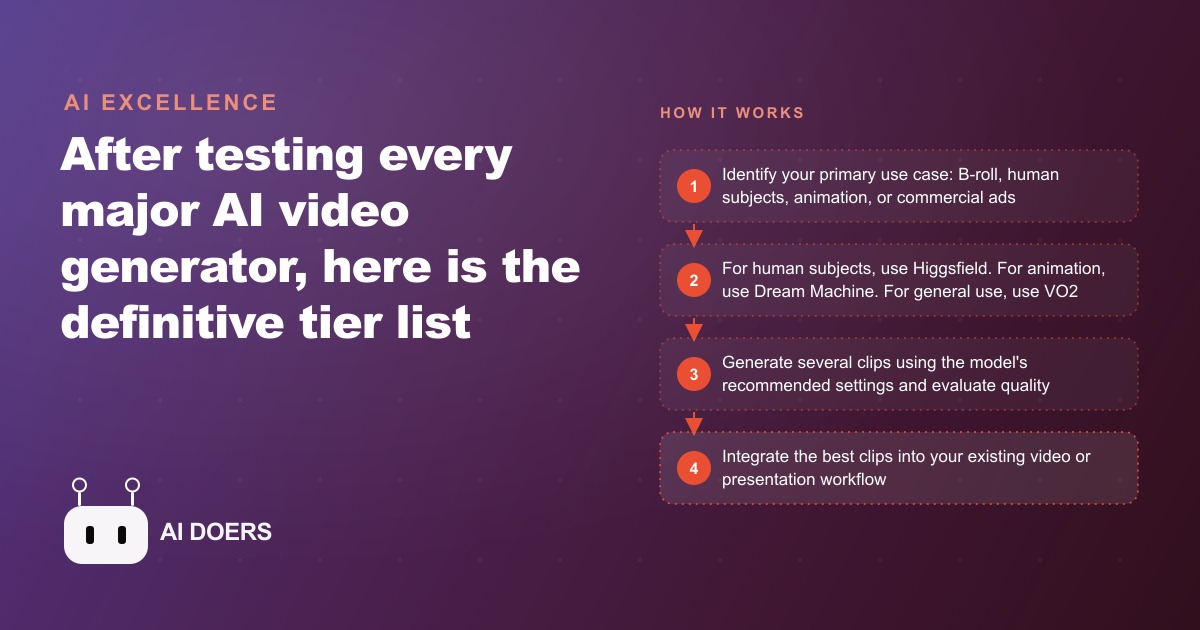
Most AI video rankings give one model the top score and leave the reader to guess whether that model is the right choice for their actual situation, which it often is not.
The AI video landscape in 2025 has a specific internal structure: different models are dominant in different production categories, and picking the wrong model for your use case costs real money in failed generations, wasted time, and visible quality gaps in the final output. After testing every major generator with consistent benchmark prompts across six categories, including logo animation, cinematic still, aerial photography, human in motion, portrait, and abstract animation, a clear tier structure emerges. The headline is not which model won overall. It is why different models win in different categories, and understanding that pattern is what makes the ranking actually useful for a business.
The anatomy problem in AI video and why Higgsfield is the only one that actually fixed it
Generating a video of a person doing something realistic has been one of the most persistent failures across the AI video category. The problem is not softness or artistic stylization. It is physics and consistency: limbs disappear at frame boundaries, bodies distort as they move, hands grow and shrink in the middle of a gesture, and the uncanny quality of the result is not subtle enough to survive the attention of a casual viewer watching a social media reel.
This failure mode has appeared in nearly every tool in the category at various points. Most of them have improved at the margins but have not treated it as a specific problem to solve at the architectural level. Higgsfield treated it exactly that way. The company identified realistic human motion as the core technical problem they were going to solve, and structured the model's training around solving it directly rather than treating human subjects as one test case among many.
The result is visible in the output. Walking, running, dancing, and physically interacting humans come out of Higgsfield with consistent anatomy across the full duration of the clip. Limbs stay proportional. Body mechanics follow physically plausible trajectories. Hands behave like hands. The improvement over other models on this specific category is not marginal. It is the difference between footage you would publish in a professional context and footage that signals AI generation immediately to any attentive viewer.
For a business, the implication is direct and practical: any content that features people belongs in Higgsfield for the generation step. Service highlight videos, social media content featuring employees or clients, testimonial-style visual content, and any promotional material involving human subjects should route through Higgsfield specifically, even if the business uses other models for every other use case. The model also has the most extensive camera control preset library in the category, covering dolly moves, orbital shots, focus pulls, and multiple tracking options, which gives a business meaningful creative control over how the human subjects are framed without requiring filmmaking expertise.
What makes this technically interesting is that fixing the anatomy problem required a fundamentally different training emphasis, not simply a larger dataset or more compute. The model was trained on human motion data at a specificity that general-purpose video models were not, because those models were optimizing across all categories simultaneously and no single category could receive the depth of training investment that Higgsfield gave to one. That specialization is what produces the visible quality gap on human subjects.
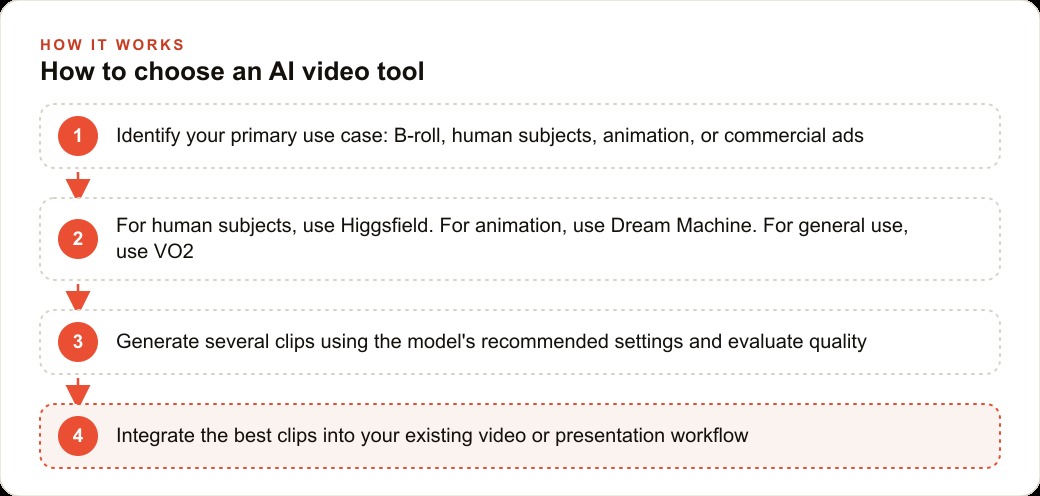
Prompt adherence and photorealism as separate skills in separate models
A common mistake in evaluating AI video tools is treating quality as a single dimension that can be captured by one score. It is not. There are at least two distinct capabilities a model can have, and they do not always appear together in the same place.
Prompt adherence is the model's ability to follow a detailed, specific instruction accurately across all specified dimensions. If you write a prompt that specifies a location, a lighting condition, a specific subject action, a camera angle, and a color palette, a high-adherence model delivers output that reflects all of those specifications. Cling 2.0 currently leads the category on this dimension. Give it a detailed creative brief and the output will reflect the brief more faithfully than any other S-tier model. For commercial work where a client or art director has approved a specific storyboard and the model needs to execute that brief precisely rather than interpret it freely, prompt adherence is the capability that matters most.
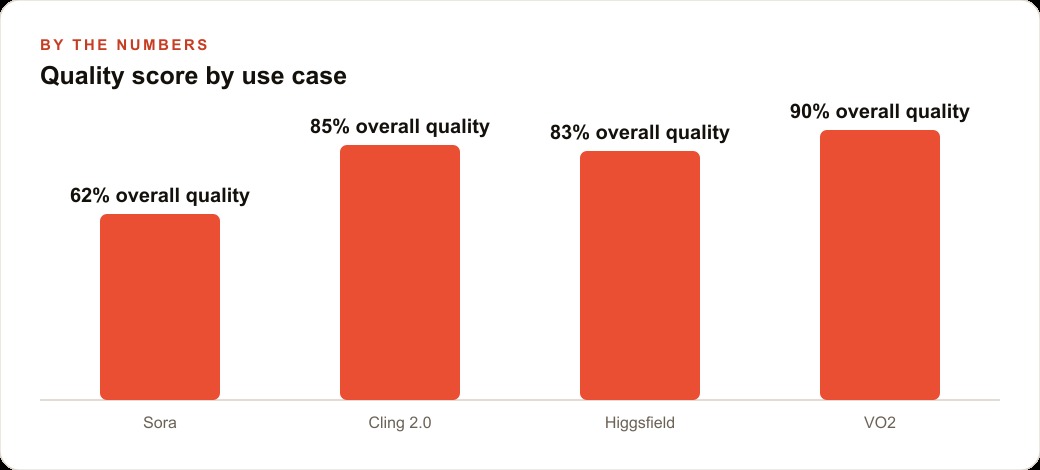
Photorealism is a separate skill. It is about how convincing the texture, lighting behavior, motion physics, and material rendering look to a viewer who did not read the prompt and has no preconceptions about what the output should contain. Google VO2 leads on photorealism at the current S tier. At the same level of prompt complexity, VO2 produces footage with more convincing motion physics, more accurate shadow behavior as light sources move relative to objects, and more natural color grading. But it is slightly less faithful to the specific details of a complex prompt than Cling 2.0.
Dream Machine from Luma occupies a third category: motion quality and aesthetic coherence in stylized or animated content rather than photorealism or strict prompt adherence. Logo animations, brand identity animations, title sequences, and motion graphics consistently outperform the photorealistic models when generated through Dream Machine's Ray 2 model, because it was not optimizing for realism. It was optimizing for aesthetic movement quality and smooth temporal consistency, and within that lane it produces results no other tool in the tier currently matches.
Understanding these as three separate capability axes rather than a single quality ranking changes which model you choose and why. The business that needs a cinematic product highlight with convincing physics and lighting chooses VO2. The business executing a precisely specified storyboard chooses Cling 2.0. The business producing brand animation for social media chooses Dream Machine. Each choice is right for its use case and wrong for the others.
API access as the barrier between a demo and a real workflow
A model can produce excellent video and still be unusable for any business that needs to integrate AI video generation into a repeatable production workflow at volume. The barrier is API access, and it separates models that are impressive in individual demos from models that can actually run reliably and programmatically in a real business context.
VO2 has full API access. This means a developer or no-code automation builder can trigger video generation programmatically, pass a prompt from another system, receive the output file, and route it to the next step in a content pipeline without manual intervention at the generation step. For a content team producing dozens of clips per week, or an agency automating client deliverable production, that capability is what makes the tool viable rather than a manual one-at-a-time utility.
Cling 2.0 does not have API access and does not offer an unlimited plan. Every generation is billed individually, and there is no programmatic interface for building automated workflows around it. That limitation does not eliminate Cling 2.0 as the right choice for high-precision manual work where prompt fidelity is the overriding concern. It does eliminate it from any use case where volume, automation, or integration into a larger system matters, which covers most serious ongoing business production contexts.
Runway has extensive API access and the most comprehensive platform feature set of any tool in the A tier: inpainting tools for editing specific regions of existing video, lip-sync capabilities for matching generated video to audio, video extension tools for lengthening clips, and a project management interface for handling multiple productions simultaneously. For a business that wants a comprehensive AI-powered video editing and generation platform that integrates into a production pipeline, Runway is the most complete available option even though the raw generation quality of the underlying model falls slightly below VO2 on the benchmark prompts.
When evaluating any AI video tool for a business application, API availability and pricing model should be evaluated before generation quality benchmarks. A model with slightly lower output quality that runs reliably through an API at a predictable per-unit cost produces more business value over time than a marginally higher quality model that requires a human to operate a web interface for each generation.
The offline and privacy dimension that most rankings ignore
Most AI video tier lists do not discuss privacy considerations because most individual users of AI video tools do not have data requirements that affect which tool they can use. For a meaningful category of business applications, the ability to generate video without transmitting data to an external server is not a preference but a hard requirement.
Alibaba's open-source video model addresses this directly. The model runs entirely locally on the user's own hardware. A business can generate video from its proprietary product footage, unreleased designs, client materials under NDA, or any other sensitive content without any of that data leaving its own network. The quality of this model is genuinely competitive with A-tier commercial options on the benchmark prompts, not a trade-off that requires accepting lower quality in exchange for privacy. It placed at the A level across several of the six test categories.
For a production company handling pre-release content, an advertising agency bound by client NDAs, a pharmaceutical company with regulatory constraints on where proprietary compound data can be transmitted, or any business in a regulated industry with data residency requirements, the offline capability changes the calculus from which model is best to which models are permissible. Ignoring this dimension in a tier list leaves out the information most relevant to the businesses for which it is the deciding factor.
The open-source model also eliminates per-generation billing entirely once the hardware is in place. For high-volume production use cases where the per-clip cost of commercial APIs accumulates into significant monthly spend, the compute cost of a self-hosted open model becomes a fixed infrastructure expense regardless of clip volume, which makes cost planning straightforward and removes the incentive to limit generation volume for cost reasons.
Where AI video is already good enough and where it still is not
AI video is already good enough for several specific business use cases that have real impact on marketing and content budgets. Understanding where the current quality ceiling is prevents both overpromising on what the tools can do and failing to invest in what they already do well.
It is already good enough for B-roll production. A business that licenses stock footage to fill gaps in real-camera content can replace a meaningful portion of that spend with AI-generated clips at lower cost and higher specificity. The advantage over stock is that you generate exactly the scene your content requires rather than finding the closest match in a library built for generic use. A roofing contractor can generate a clip showing their specific type of installation work in the right regional setting. A wellness studio can generate ambient footage that matches the actual aesthetic of their space without paying for a production day.
It is already good enough for brand animation and motion graphics. Dream Machine and VO2 both produce animation quality in the S tier that serves real brand identity needs: logo animations for social media and email, animated slide backgrounds for presentations and webinars, motion-graphic intros for video content. A business currently paying a motion designer several hundred dollars per animation can produce assets of comparable sophistication in minutes for a few dollars per generation.
It is not yet reliably good enough for hero campaign video where the brand is staking a major product launch or a significant media buy on the output quality. The artifact rate, where the motion or lighting behaves in a way that is subtly wrong in a way that is difficult to predict from the prompt, remains high enough that producing many clips to find the usable ones is not a viable production method for high-stakes applications. Those still benefit from human creative direction and professional camera production.
The practical worked example that illustrates where the balance sits: a hair salon producing ten short clips per month for Instagram Reels and service highlights. VO2 handles the service showcase clips, producing cinematic-quality footage of color transformations and styling results. Dream Machine handles the brand aesthetic animations used as looping backgrounds for promotional text posts and announcements. Total monthly cost in API credits across both tools: thirty to fifty dollars. The comparison against ten minutes of professionally edited freelance video at four hundred to eight hundred dollars per freelance session makes the adoption economics immediate and clear. The salon retains creative direction over what to produce. AI handles the production execution. The result is more content, higher visual quality, and a fraction of the prior cost.
That is exactly what we do at AI DOERS. Book a private 30-minute call with Madhuranjan Kumar and we will map the fastest path to it for your specific business.
Book your call →
Madhuranjan Kumar
Madhuranjan Kumar brings 20 years of performance-marketing experience and has managed over $200 million in Facebook ad spend for brands across the United States and beyond. His expertise spans the full modern marketing stack: Meta, Google Ads, TikTok, email automation, CRM, and the websites that hold it together. At AI DOERS he turns that track record into lead-generation systems for businesses across every industry.