
How AI Video Tools Are Transforming Gym and Fitness Studio Marketing
A wave of new AI video models arrived in a single week, including five products from one company in five days. Here is what fitness studios need to know about using them to attract members and reduce production costs.

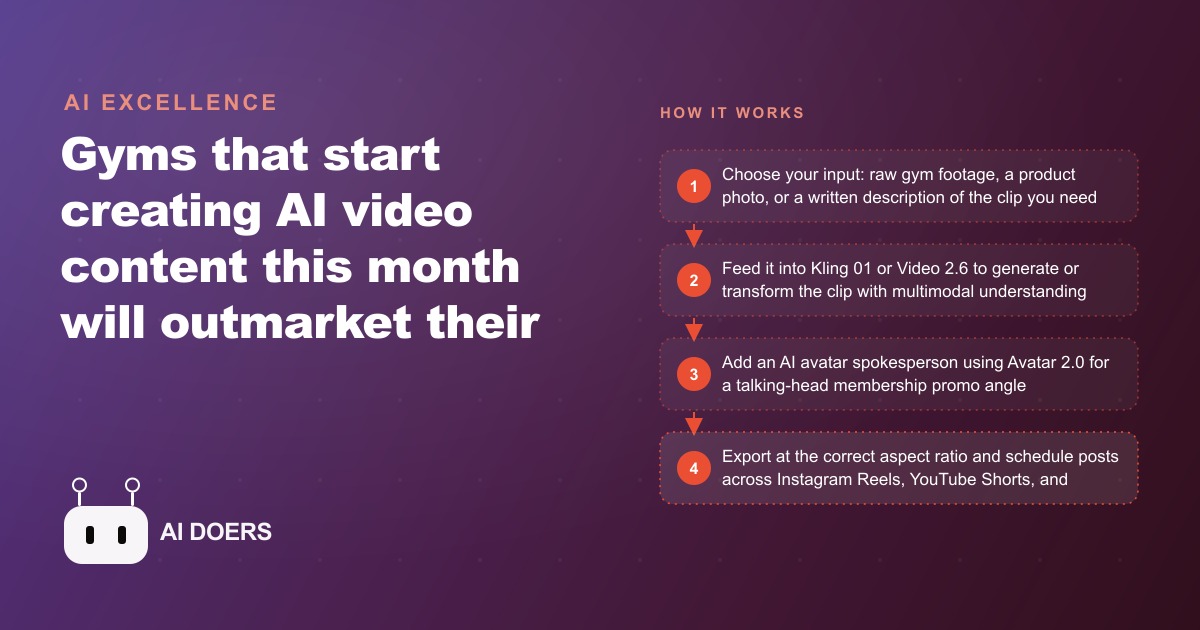
Five products from one AI video company in five consecutive days is not a product cadence. It is a signal. Kling AI's week of releases tells you something about where video production for marketing is going and how fast the gap between "what a gym can afford" and "what a gym's marketing looks like" is closing. I am Madhuranjan Kumar, and I want to take apart the specific mechanics of AI video creation for fitness marketing, because understanding how the tools actually work is what separates a gym that uses them effectively from one that generates content that looks obviously artificial.
The multimodal input breakthrough is the reason this week matters
Previous AI video generators worked from text prompts. You described a scene and the model generated it. The quality ceiling was limited by the gap between what you could describe accurately in text and what the model could interpret from that description. The scene you imagined and the scene the model generated were often related but not identical, and the iteration process to close that gap was slow and expensive in generation credits.
Kling 01's release changes this architecture. The model now accepts text descriptions, static images, and existing video clips in the same session. This is called multimodal input, and its practical effect for a fitness studio is significant: you no longer have to generate footage from scratch or describe it from imagination. You can upload a photo of your gym floor at peak hour, an existing clip of a trainer working with a client, and a text description of the energy and atmosphere you want, and the model synthesizes all three inputs into a generated clip.
The gap this closes is the gap between what the model can imagine and what your specific gym actually looks like. Your gym has a specific aesthetic: the color of the equipment, the natural light from the windows, the way the space feels during a busy class. A text prompt cannot capture that. Reference images and clips from your actual space can. Kling 01 treats those inputs as constraints rather than as suggestions, which means the generated output reflects your specific environment rather than a generic fitness context.
Native audio generation is what makes a clip feel like it came from a real location
The previous generation of AI video tools generated visuals and audio separately and then blended them in a post-processing step. The blending was detectable because the audio felt added rather than captured: the ambient sounds of the space did not quite align with the motion on screen, the music timing did not match the rhythm of the action, and the overall result had the quality of a video dubbed in a different language after the fact.
Kling Video 2.6 generates sound as part of the same creative pass as the visuals. When you prompt it for a clip of a group fitness class, the ambient noise of the space, the energy of the group, the music, and any movement sounds all generate simultaneously with the visual output. The synchronization is organic rather than blended because the two streams are produced from the same underlying generation process.
For a gym producing Instagram Reels, this matters for one specific reason: audio is often the element that breaks the illusion. A visually impressive clip with obviously artificial audio, or with a stock music track that clearly does not belong to the scene, signals to the viewer that the content was produced with shortcuts. Native audio generation reduces that signal significantly, which affects how long a viewer stays with the clip and whether they process it as representing a real experience they could have at your gym.
The production implication is that native audio generation removes two steps from the workflow that were previously required after AI video generation: finding and licensing appropriate music, and manually syncing that music to the visual output. A studio currently spending time and money on stock music subscriptions for their content can replace both the subscription cost and the editing time with the native audio output.
Avatar generation creates a presenter without scheduling a presenter
Kling Avatar 2.0 generates a realistic talking-head presenter from a script. The input is a written script and a visual style specification. The output is a realistic synthetic face delivering the script directly to camera, with natural speech patterns and appropriate facial movement throughout the delivery.
The fitness studio application is specifically for talking-head membership pitches, seasonal promotion announcements, and challenge program introductions. These are the content types that currently require scheduling a trainer, setting up a camera, doing multiple takes, and editing the result. Every one of those steps is a friction point that reduces how often the content gets made.
With Avatar 2.0, the production friction reduces to writing the script. The studio can update its membership pitch every two weeks with a new offer without scheduling the trainer who appears in the shot. It can produce location-specific versions of the same pitch for different membership tiers without organizing additional filming sessions. It can maintain a polished presenter presence in content even during the periods when no one in the studio is comfortable being on camera.
The appropriate use case requires being clear about what Avatar generation is and is not. It is appropriate for announcement content, promotional pitches, and informational videos where a presenter communicates structured information directly to camera. It is not appropriate for testimonial content, real client transformation stories, or any content where the authenticity of a real person's experience is the persuasive element. Audiences are increasingly accurate at detecting synthetic presenters, and using Avatar generation for content that depends on authenticity undermines the trust the content is trying to build.
Runway Gen 4.5 defines where the quality ceiling is going
Runway previewed Gen 4.5 this week, and early benchmark comparisons show it outperforming the current generation of AI video tools on realism and scene consistency. It is not publicly available in its final form yet, but understanding what it implies is useful for planning a content strategy that extends beyond this month.
The quality ceiling for AI video marketing content is still rising quickly. What looks impressive in AI-generated fitness content today will look ordinary within six months, because every studio that adopts these tools produces better content, which raises the ambient quality level the audience is calibrated to. The studios that adopt now build the creative workflows, the prompting patterns, the content calendar structures, and the selection sense that allow them to upgrade to each successive generation of tools from a position of experience rather than from scratch.
The studios that wait for Gen 4.5 or the generation after it before starting will spend their ramp-up time at the same moment their competitors are running efficiently on those tools. The learning curve does not get shorter because the tools get better. It gets compressed because the tools get easier to use, but it still exists, and the best time to climb it is before competitive pressure forces the pace.
The production workflow that produces a week of content from one Sunday session
I am Madhuranjan Kumar, and here is the concrete workflow for a 300-member fitness studio that wants to produce a full week of social content without a video production budget.
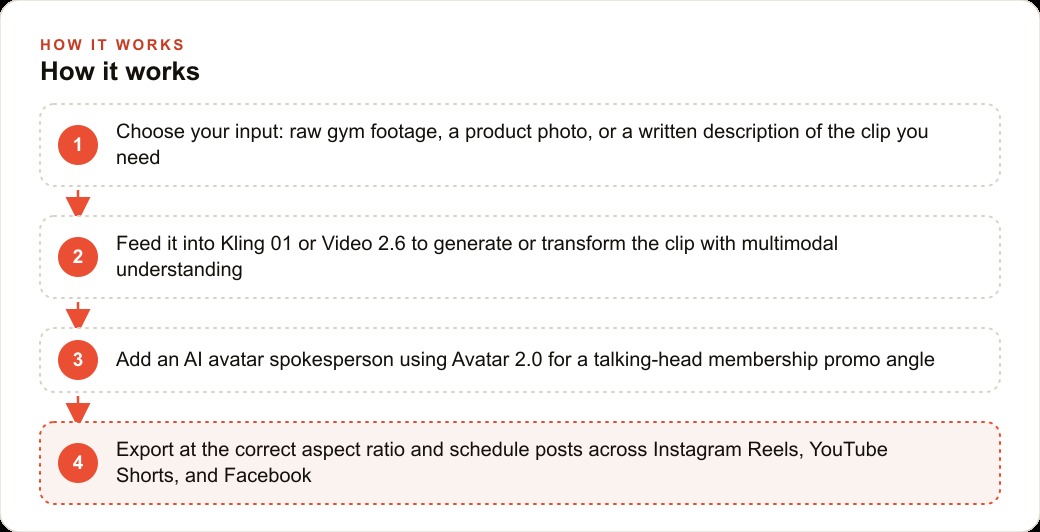
Sunday morning, 90 minutes of filming with no editing intention. The goal is raw reference material: four clips of trainers demonstrating exercises with correct form at 20 seconds each, four clips of the gym floor during a group class capturing energy and atmosphere, four clips of a trainer speaking to camera about specific membership benefits. Twelve raw clips total, none of them intended as finished content.
Sunday afternoon, one hour of generation using Kling 01. For each of the three most important product categories, upload the relevant raw clips as reference inputs alongside a text description of the energy and format: high-energy group class highlight, clean educational form demonstration, authentic member-benefit explanation. Generate three to four variations per input and select the strongest one. The result is three polished clips built around the studio's actual footage rather than generic AI scenes.
For the current seasonal membership offer, use Avatar 2.0 to generate a talking-head announcement from a 45-second script. This clip refreshes every two weeks with the current offer without additional filming.
Use Kling Video 2.6 to generate two to three ambient clips with native audio: the atmosphere of the studio during a busy morning class, the sounds and motion of the training floor. These serve as Instagram Story content and website background video throughout the week.
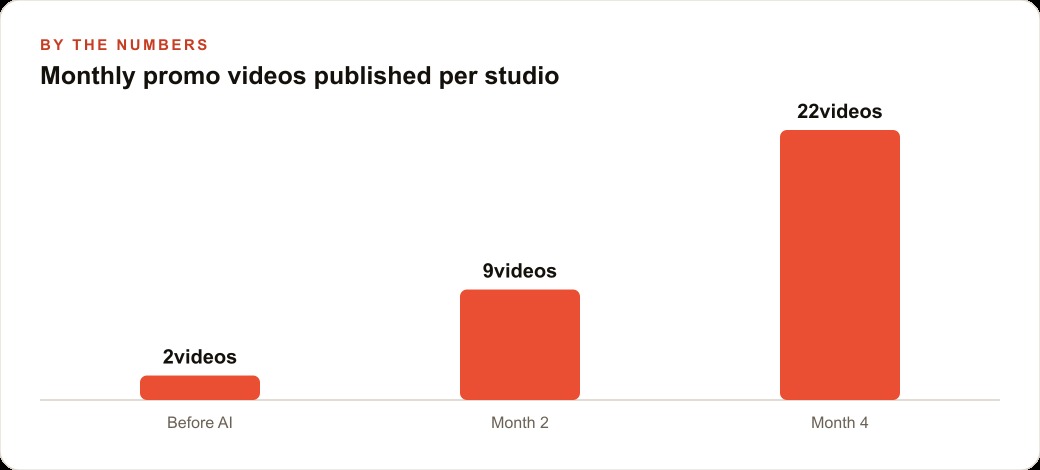
Total content produced from this session: three Reels, one talking-head announcement, three Stories, and two ambient clips for the website. Total filming time: 90 minutes. Total generation time: 60 minutes. Total content output: more than most studios produce in a month of manual video production. The quality differential between AI-assisted and traditionally produced content depends heavily on how the AI tools are directed, and the prompting skill builds quickly from the first Sunday session to the fourth.
For studios also running Facebook and Instagram ad campaigns, the same clips that drive organic engagement also serve as creative for paid distribution. A clip that performs well organically is a strong signal that it will perform as paid ad creative, and the incremental cost of using the same asset for paid amplification is zero. The content investment made on Sunday compounds across both organic and paid channels throughout the week.
The gym that starts this workflow this month and refines it across four Sunday sessions will have a significantly better content system by month two than the gym that evaluates the tools for another quarter before beginning. Start with one Sunday. Start with Kling 01 on one clip category. Run it, review the output, and decide from experience rather than from evaluation. That is the fastest path from the question to the answer.
That is exactly what we do at AI DOERS. Book a private 30-minute call with Madhuranjan Kumar and we will map the fastest path to it for your specific business.
Book your call →
Madhuranjan Kumar
Madhuranjan Kumar brings 20 years of performance-marketing experience and has managed over $200 million in Facebook ad spend for brands across the United States and beyond. His expertise spans the full modern marketing stack: Meta, Google Ads, TikTok, email automation, CRM, and the websites that hold it together. At AI DOERS he turns that track record into lead-generation systems for businesses across every industry.