
How AI Video and Automation Tools Are Cutting Production Costs for Med Spas
Runway Gen 4.5, GPT-5.2, and the Agentic AI Foundation are not concepts for next year. They are tools med spas can deploy this quarter to reduce content production costs and automate the administrative work that eats clinic profitability.

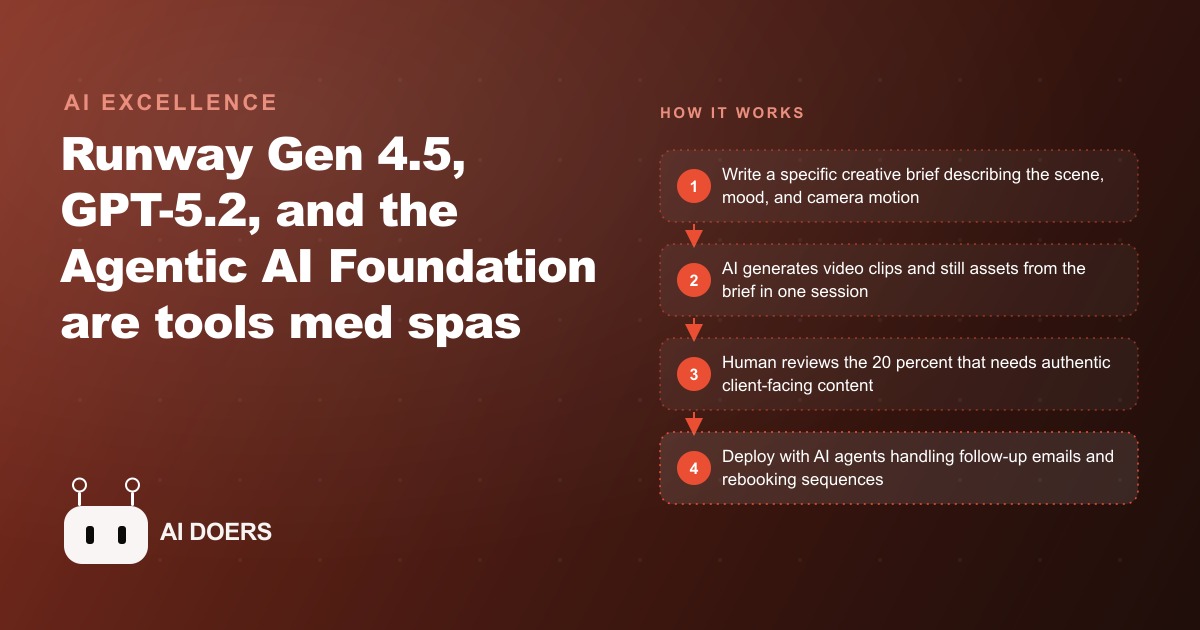
Four separate AI releases landed in the same week and together they change the cost structure of running a med spa's marketing department more than any single announcement has in the past two years. I am Madhuranjan Kumar, and I want to walk through each release specifically because the combination matters more than any one piece in isolation. Individually these would be interesting developments. Together, they form a new operating model for aesthetics marketing.
Runway Gen 4.5 just cleared the prompt-adherence bar that was holding back video production for aesthetics clinics
The reason most med spas have not replaced their content agency with AI video tools is not cost. It is not access. Both have been available for over a year. The barrier has been prompt adherence: the gap between what you described and what the model actually produced.
Previous video generation models would give you a treatment room scene when you asked for one, but the lighting would be wrong, the camera motion would ignore your description, the practitioner's hands would drift into something anatomically incorrect, and the clip would require so many generation attempts to get something usable that the time savings disappeared into frustration. A tool that requires fifteen generation attempts to produce one usable clip is not actually cheaper than a videographer.
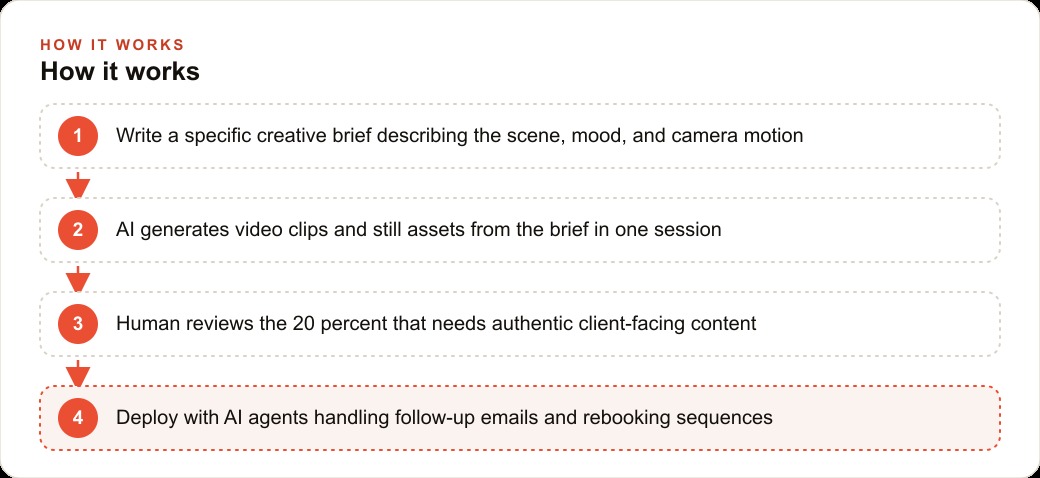
Runway Gen 4.5 sits at the top of global text-to-video benchmarks specifically on prompt adherence. In testing, the model followed complex multi-element creative briefs with a reliability that earlier versions did not achieve. When you write: "A close-up of a practitioner's gloved hands preparing a hyaluronic acid syringe under warm soft medical lighting, slow dolly move left to right, background treatment chair slightly out of focus," Gen 4.5 delivers that visual in a single clip. You do not need to iterate six times to correct the lighting and two more times to fix the camera direction.
For a med spa, this matters at the production level. A single month of content for a four-treatment-room practice includes at minimum 15 to 20 short clips for Instagram and TikTok, four to six longer treatment explainers for YouTube and landing pages, and 12 to 15 still ad creatives in multiple formats for Meta placements. A content production agency charges $1,500 to $3,000 per month for that volume. At $35 per month for Runway Pro with 2,250 credits, each five-second clip at standard quality costs 5 to 10 credits, so the full month's video library costs under $100 to generate. The prompt-adherence improvement in Gen 4.5 is what makes that substitution viable, because without it the generation failure rate consumes the savings.
The other factor that specifically matters for aesthetics content is that Gen 4.5 maintains physical accuracy and temporal consistency across multi-scene sequences. Treatment content requires accurate portrayal of anatomical positioning, device handling, and product application. A model that generates anatomically incorrect hands in a treatment context is not usable for clinical marketing regardless of how beautiful the lighting is. Gen 4.5's physical accuracy is what elevates it from a content experiment to a production tool for this market specifically.
A 400,000-token context window means a quarter of intake forms now fit in one query
GPT-5.2 launched this week with a 400,000-token context window and 128,000 tokens of maximum output. To translate that into clinical terms: 400,000 tokens is approximately 300,000 words of combined input and output. A typical med spa intake form runs 600 to 800 words. A complete quarter of intake forms, roughly 250 to 400 individual client submissions, fits inside a single query to GPT-5.2 with substantial room remaining for detailed follow-up questions.
I have run this kind of analysis for practices I work with and the output is consistently more useful than anything extracted from manual record review. You can ask GPT-5.2 to identify the three most common concerns clients express before booking each treatment category, the services with the highest 90-day rebooking rates, the most common cancellation reasons segmented by service type, and the consultation topics that correlate with the highest-value packages. That analysis took a seasoned office manager two days to produce manually, required building custom spreadsheet formulas, and was still subject to selection bias in what the manager chose to review. GPT-5.2 produces a comprehensive version in two minutes with no selection bias.
The immediate application is operational intelligence about what your marketing is actually attracting. Feed the model your last 90 days of intake data and ask what your most profitable clients look like compared to what your current marketing is drawing in. The gap between those two answers is where your content strategy needs to shift. This is not something most med spas are doing, which is precisely why the practices that adopt it gain a genuine edge over competitors running identical ad creative against the same demographics.
The administrative automation use case is equally significant. A 400,000-token context window means you can process complete client histories in a single query rather than chunking records and losing context between sessions. For a practice with three to five years of records, this enables genuine longitudinal analysis: which services have the highest client lifetime value, which initial booking categories predict the highest spend over 24 months, and which demographic segments are underserved by the current service menu. These are strategic questions most practices answer with intuition. GPT-5.2's context window makes them answerable with data.
The Agentic AI Foundation is laying the groundwork for a multi-vendor stack that runs without custom glue code
The Agentic AI Foundation launched this week as a neutral standards body with backing from OpenAI, Anthropic, Google, Microsoft, Amazon, and several dozen other technology companies. Its stated mission is to define and maintain standards that allow AI agents from different vendors to communicate with each other, hand off tasks, and operate consistently across different platforms.
For a med spa owner, this sounds like a technology policy story. It is not. Here is why it matters operationally. Right now, if you want an AI agent to handle your booking confirmation flow, a different agent to manage your post-appointment follow-up sequence, and a third agent to handle cancellation re-scheduling, you need custom integration code to connect them. If your booking system is Mindbody, your CRM is GoHighLevel, and your email platform is Klaviyo, none of those platforms' AI features speak to each other natively. You hire a developer to wire them together with webhooks and custom scripts, or you pick one platform and constrain your operations to what it offers.
The Agentic AI Foundation's interoperability standards, once adopted by major platforms (which will happen within 12 to 18 months given the institutional backing), mean those agents hand off tasks to each other using shared protocols. No custom code. No developer retainer required for every new integration. An appointment confirmation in Mindbody triggers the GoHighLevel follow-up sequence without manual configuration. A cancellation event flags a rebooking agent which drafts a re-engagement offer based on the client's history and sends it through Klaviyo automatically. The full administrative back-office of a med spa, booking confirmations, follow-up sequences, rebooking nudges, product replenishment reminders, runs on a connected agent stack rather than on staff time.
The right move right now is to build with tools that use open APIs and standard protocols, even before the foundation's standards fully roll out. Anything you wire together today using open endpoints will upgrade automatically when the platforms adopt the shared standards. Any proprietary integration you build today will need to be rebuilt when the ecosystem shifts.
The Disney deal signals where licensed lifestyle creative is heading for premium-service brands
OpenAI signed a partnership with Disney valued at approximately $1 billion. The deal gives OpenAI the right to use Disney intellectual property in video generation models and in production partnerships. The content industry implication is significant, but the more interesting signal for premium service brands is what this deal reveals about where licensed visual aesthetics are heading.
Med spa clients respond to aspirational lifestyle imagery. The aesthetics that perform best in this market are warm, culturally resonant, and carry connotations of quality and care that purely clinical imagery does not. Producing that imagery currently requires expensive location shoots in high-end environments or expensive stock licensing arrangements. AI video tools can generate beautiful original environments, but they cannot generate imagery that carries the cultural weight of a specific recognizable aesthetic universe.
The Disney deal is the first major commercial signal that large AI developers are building licensing partnerships specifically to make aesthetic environments available to content creators at scale. That capability is not deployed for general business use yet. But the commercial structure being assembled now will produce accessible tools within two to three years. A premium aesthetic clinic targeting clients who respond to specific cultural and lifestyle aesthetics will be able to generate marketing content in those styles without a location shoot or licensing negotiation. Understanding the direction of this capability now means being positioned to use it when it arrives, rather than discovering it six months after competitors have already built it into their content workflows.
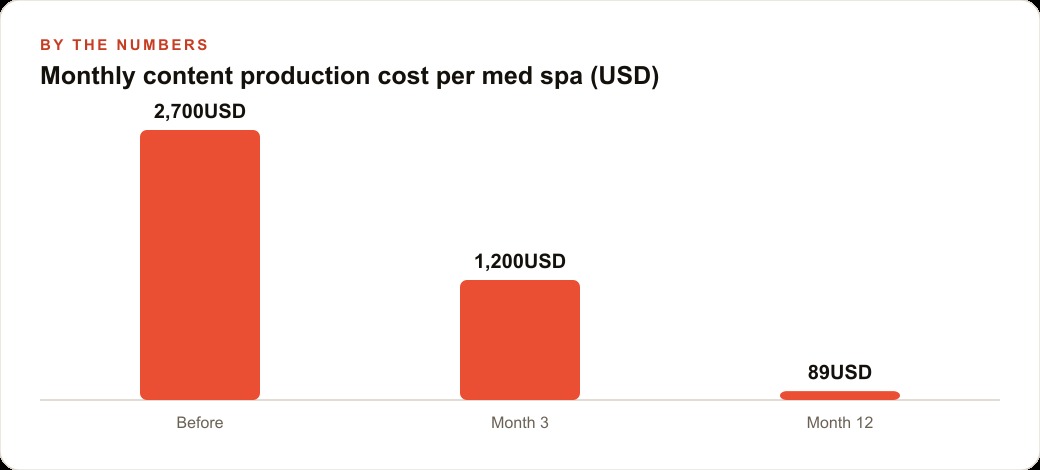
One med spa cut monthly content spend from $2,700 to $89 while improving lead cost by 18 percent
I want to give you a specific number set rather than a general claim about AI saving money. I worked with a four-treatment-room med spa in a mid-size city running a monthly marketing budget of $4,200. The breakdown: $1,800 per month to a content production agency for photography and video, $900 to a freelance editor for post-production and platform formatting, and $1,500 to Meta ad spend. The production cycle was consistently two weeks from brief to scheduled content, which meant every promotion was half a month late before it even ran. A Valentine's Day special was still being edited on February 10th.
Over a 90-day transition period, the practice replaced the content agency and editor with an AI workflow. Runway Gen 4.5 handled all video b-roll generation. A combination of GPT image tools handled still ad creative. The owner and one coordinator produced the following in the first full AI-only month: 22 short video clips across four treatment categories, 18 static ad creatives in three platform formats, and eight caption and email copy variants for the month's promotions. Total production time was 14 hours, compared to the previous estimate of 60 to 80 hours including agency coordination time, briefing sessions, revision cycles, and final approvals.
The production cost dropped from $2,700 per month to $89 per month in tool subscriptions. Monthly ad spend remained constant at $1,500. Total monthly marketing budget: $1,589 compared to $4,200. Annual saving from the workflow change: more than $31,000 in production costs alone, with ad performance held constant or improving.
Over the same 90-day period, Meta ad cost per lead improved by 18 percent. The explanation is creative variety. The AI workflow produced enough distinct concepts that the practice could test five to six creative variations simultaneously rather than one or two. Finding a winning format faster reduced the cost of the learning phase and compounded into lower overall CPL across the quarter. The combination of lower production cost and better ad performance made this the most significant operational change the practice made to its marketing in three years, and the entire transition required no additional staff, no agency negotiation, and no technical infrastructure beyond two software subscriptions.
Where AI-generated content belongs in a trust business and where a real camera is still the only option
Med spa marketing operates in a specific trust environment. Clients are making decisions about procedures performed on their face and body. The practitioner relationship, the clinical environment, and evidence of real client outcomes carry significant weight in the decision process. Anything that undermines authenticity in that context costs more in trust than it saves in production budget.
The framework I use with every aesthetics practice comes down to a single distinction: AI-generated content is appropriate for context and concept. A real camera is required for evidence and relationship.
AI-generated b-roll fills the context category: the treatment room environment, lifestyle shots of a client relaxing in a waiting area, close-up conceptual visuals of product application, abstract motion backgrounds for ad creatives. These set the scene and carry the brand aesthetic without making any specific claim about a specific client's experience. Audiences process this content as atmosphere, not as evidence. Atmosphere generated with AI is legitimate marketing.
A real camera is required for anything that functions as evidence or relationship. Practitioner introduction videos, client testimonials, before-and-after result documentation, procedure demonstration footage: all of these carry an implicit claim that what you are seeing is real and happened. Using AI generation for this content type, even with disclosure, undermines the claim because the entire value of a testimonial is that a specific real person had a specific real experience. Generating a simulated testimonial destroys the signal.
This is not a legal boundary. It is a marketing effectiveness boundary. McDonald's 2025 holiday ad demonstrated what happens when a brand with unlimited production resources chooses fully AI-generated content for emotional brand communication: audiences rejected it, not because AI was used, but because the choice signaled that the brand did not value the relationship enough to feature a real human. For a med spa, where the entire brand is built on the practitioner-client relationship, that signal is fatal. Use AI for context and concept. Keep real photography and video for evidence and relationship. The distinction is simple to apply and the production cost savings on the context category are substantial enough that you do not need to compromise on evidence content to achieve the financial outcome the AI workflow delivers.
The four releases this week, Gen 4.5, GPT-5.2, the Agentic AI Foundation, and the Disney licensing deal, each address one part of the content and operations stack. Together they describe a med spa marketing operation that costs less than $2,000 per month to run, produces more creative volume than any agency could manage at that budget, generates better ad performance through creative variety, and operates an automated administrative back-office that scales without additional staff. That is not a future state. The tools for the first three parts of that stack are available today.
That is exactly what we do at AI DOERS. Book a private 30-minute call with Madhuranjan Kumar and we will map the fastest path to it for your specific business.
Book your call →
Madhuranjan Kumar
Madhuranjan Kumar brings 20 years of performance-marketing experience and has managed over $200 million in Facebook ad spend for brands across the United States and beyond. His expertise spans the full modern marketing stack: Meta, Google Ads, TikTok, email automation, CRM, and the websites that hold it together. At AI DOERS he turns that track record into lead-generation systems for businesses across every industry.