
What an AI Vendor Getting Banned Overnight Teaches Small Businesses About Platform Risk
A leading AI provider went from woven into critical systems to officially cut off in a single afternoon. Whatever you think of the politics, the business lesson is sharp: never bet your whole operation on one tool you do not control. Here is how I would protect a small business.

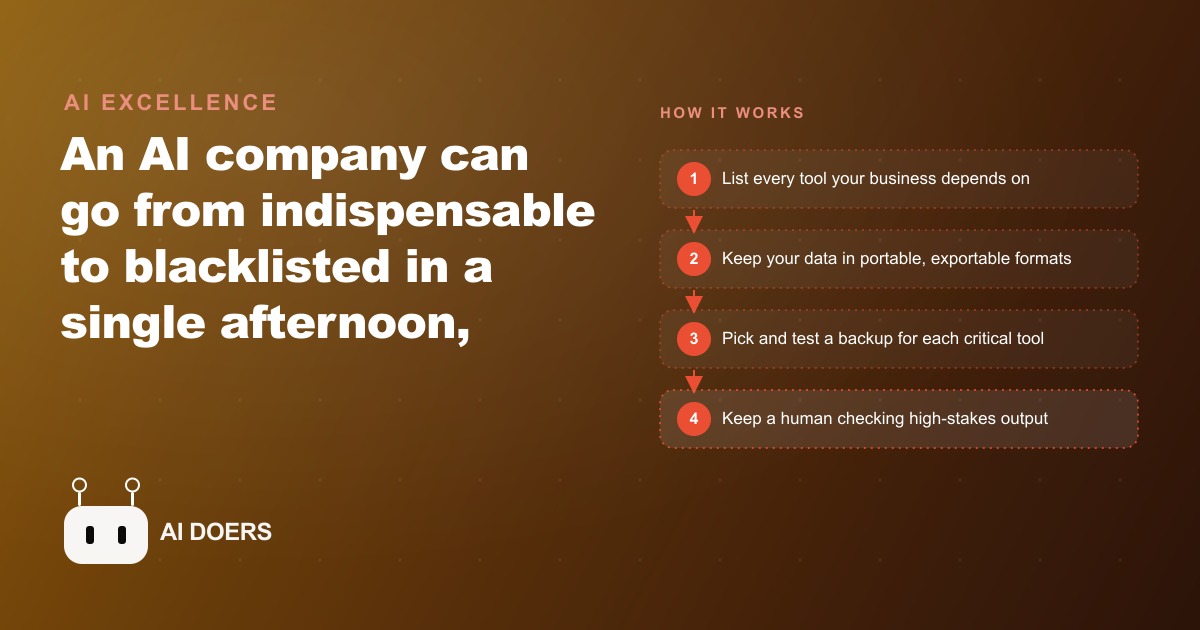
On a Tuesday morning in early 2025, a large organization discovered that the AI tool woven into nearly every workflow across its critical systems had been cut off. Not gradually phased out. Not warned about in advance with a transition plan. Cut off in under an hour by a single decision from above, before the organization had any realistic ability to remove it cleanly.
I am Madhuranjan Kumar, and I want to tell a version of that story at the scale of a small business, because the lesson is sharper at the small-business level, where there is no IT department to absorb the problem and no enterprise contract to demand a transition period. The lesson is this: when you build your operation on a tool you do not control, every decision that tool's provider makes becomes your problem to absorb.
The morning the main tool was gone
The coffee shop owner opened their laptop at 7:15 on a Thursday morning, before the first customer arrived. The dashboard that had run the morning routine for eight months, the one that confirmed overnight online orders, updated the loyalty point balances, and queued the promotional email for the day, returned a login error.
The tool was not down for maintenance. The account had been suspended. The provider had changed its terms of service for business accounts in a category update the owner had seen as a notification email three weeks earlier but never read. The new terms required re-verification of business credentials for certain account types, and accounts that had not completed verification were suspended automatically at the end of the grace period.
By 8:30 that morning, the owner had spent an hour on customer support chat, learned the verification process would take 24 to 72 hours, confirmed that no data export was available during a suspension, and realized that the phone numbers for the online orders that had come in overnight were inside the suspended account where they could not be retrieved until the account was restored.
It was not a catastrophe. It was a 48-hour disruption that cost the owner roughly 14 hours of manual recovery work, several missed order confirmations, and a handwritten apology note to three regular customers who did not receive their usual order-ready notifications. But it revealed something that had been true for eight months without the owner noticing: six distinct parts of the daily operation depended on one tool the owner did not control, and none of those dependencies had a backup.
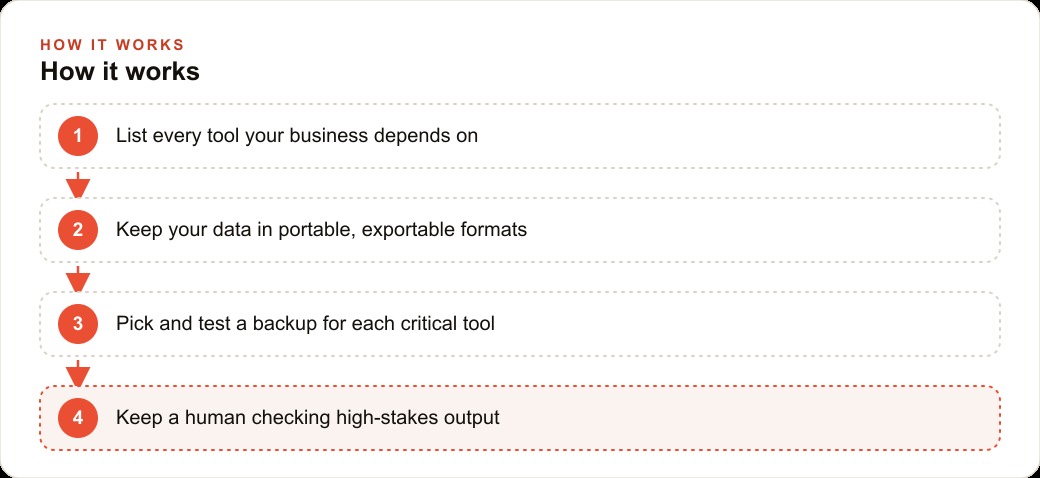
The audit that uncovered six places where the business had no escape route
Once the account was restored and the immediate crisis was resolved, the owner sat down to map every place the business depended on an external AI or software tool. The list was longer than expected.
The first dependency was the loyalty program. Customer points, tier status, and redemption history all lived inside a third-party platform. The data was accessible through the platform's admin panel but had never been exported. If the account closed permanently, the customer loyalty history would be gone.
The second dependency was the automated order confirmation messages. The system sent SMS and email confirmations through the tool's built-in messaging feature. The phone numbers and email addresses were stored in the tool's contact database, not in a separate system the owner controlled. There was no backup contact list.
The third dependency was the daily promotional email. The owner used an AI writing tool to draft the daily special announcement, which was then sent through a connected email platform. The AI tool's output was never saved independently. When the tool was suspended, drafts in progress were inaccessible.
The fourth dependency was the content calendar for social media. The owner had been using an AI assistant to plan and schedule two weeks of posts at a time. Those scheduled posts lived inside the tool's scheduler. During the suspension, three scheduled posts were missed because the owner did not have the copy saved anywhere else.
The fifth dependency was the pricing update workflow. Once a week, the owner used the AI tool to draft updated price cards for the chalkboard menu based on ingredient cost inputs. The format and voice of those cards had been refined over months but existed only inside the tool's chat history, not in a document the owner owned.
The sixth dependency was the customer feedback summary. The tool aggregated weekly Google review text and produced a plain-language summary of themes. The owner had relied on this summary for three months without saving any of the underlying review text or the summaries themselves in a separate file.
Six dependencies. Zero backup plans. None of them were the result of carelessness. Each one had developed naturally as the tool became useful and the owner integrated it more deeply into the routine. That is how platform dependency builds: gradually, through usefulness, until the embedded tool is load-bearing and removing it quickly is nearly impossible.
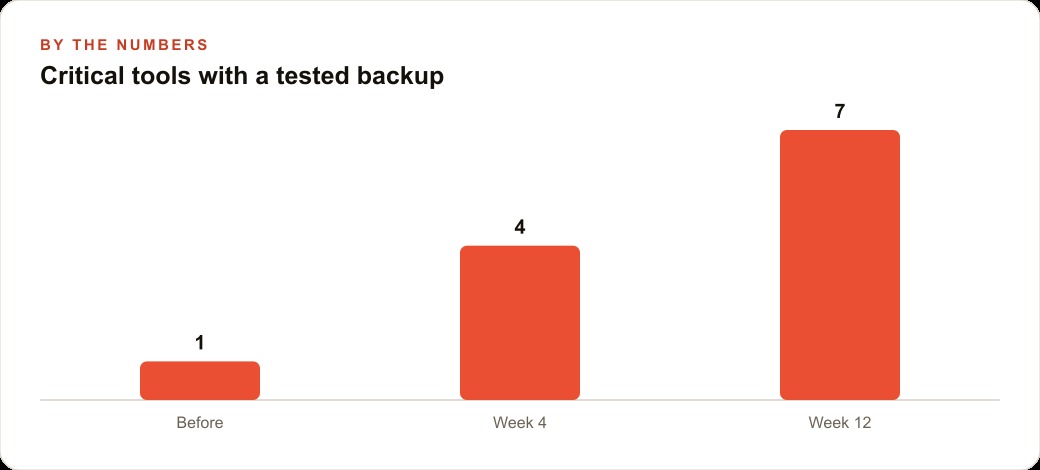
Three weeks to rebuild with portable data and tested fallbacks
The owner spent the next three weeks doing something that felt tedious in the moment but changed the resilience of the whole operation: auditing every dependency and building a version of each workflow that could continue if the primary tool disappeared.
For the loyalty program, the fix was a weekly export of the full customer and points database to a spreadsheet saved in the owner's own Google Drive. The export took five minutes every Sunday. If the platform ever suspended again, the data would be at most six days stale rather than permanently lost.
For the contact database, the fix was a parallel customer list maintained independently. Every new customer who signed up for the loyalty program was added to a simple spreadsheet with their name, phone number, and email, alongside their account in the platform. The redundancy felt like overhead until the owner imagined trying to reach 300 regular customers with the platform down.
For the AI writing tools, the fix was a simple folder in Google Drive with a document for each recurring content type: the daily special announcement format, the weekly promotional email template, and the voice guidelines for the pricing cards. The owner spent two hours transferring the best examples out of the tool's chat history and into documents the owner controlled. Those documents became the briefing material for whatever writing tool was available, rather than the only place the institutional knowledge lived.
For the content calendar, the fix was a Google Sheet with the next four weeks of posts planned in advance, with copy and image notes saved in the sheet regardless of which scheduling tool was currently in use. If the primary scheduler went down, the posts existed somewhere the owner could act on.
For the pricing workflow, the fix was a template document with the format, font choices, and voice guidelines written out explicitly, so the owner could produce the same output with any writing tool rather than relying on months of iterative refinement that existed only in one tool's context.
For the review summary, the fix was a habit: every Monday, before reading the AI summary, export the week's reviews to a text file and save it. The summaries were then also saved as documents rather than read and forgotten.
The total time investment across three weeks was approximately 11 hours. That number felt high to the owner when accounting for it. It felt very reasonable two months later, when a different tool in the stack had a billing error that suspended access for 36 hours. The second disruption cost the owner nothing, because every critical piece of data and every recurring content type had a parallel home.
What the stack looks like after the disruption
The rebuilt stack is not meaningfully different from the original one in terms of the tools used. The same platforms, the same AI writing assistants, the same scheduling tools. What changed is the architecture around them.
The owner now treats every external tool as a capability layer rather than a data home. Capabilities can be switched. Data that exists only inside a platform cannot be recovered if that platform makes a decision the owner does not control.
The practical rules that came out of the rebuild: all customer contact information lives in a system the owner directly controls, with a weekly export as backup. All recurring content formats exist as documents in Google Drive, not only in the tool's context history. Scheduled content is planned in a spreadsheet the owner owns before it is loaded into any scheduler. Any AI summary of business data is saved as a document at the time it is generated, not just read and closed.
The owner also instituted one behavioral change for anything customer-facing: a human review step before any AI-generated content goes live or is sent. This came from a different incident during the rebuild period, when a draft promotional email generated by the AI writing tool contained a price that was 40% lower than intended. The tool had extrapolated from a previous discount and applied similar math to a different promotion. The error would have been embarrassing and potentially costly if it had gone out without review. A 90-second read catches that kind of mistake. Automating the send step without a review step removes the catch.
The total illustrative cost of the disruption before the rebuild: 14 hours of recovery work, three missed order confirmations, and the reputational cost of three customer experiences that fell below the shop's usual standard. The cost of the rebuild: 11 hours. The cost of the second disruption two months later: zero, because the portability work was already done.
For any small business that runs overlapping digital marketing workflows, including Meta ads campaigns alongside organic content, Google Ads alongside email, and web and CRM tools for customer follow-up, the platform dependency question applies at every layer. The content strategy that lives only inside one platform's interface is one billing error away from being inaccessible when you most need it.
The behavioral change around review steps also revealed something the owner had not previously quantified: how often the AI writing tool produced output that was technically coherent but operationally wrong. Over the three weeks of the rebuild, the owner reviewed every AI-generated draft before sending and flagged the ones that would have caused a problem if they had gone out unchecked. The count across three weeks was seven. Three had incorrect pricing. Two used a promotional framing that the shop had moved away from six months earlier but that the AI had no way to know was outdated. One used a competitor's product name in a comparison that the owner did not want to make publicly. One was simply badly phrased in a way that the owner found embarrassing in retrospect.
Seven incorrect outputs in three weeks, on a workflow that had been running without review for eight months. That is not a criticism of the AI tools. It is a calibration of what human oversight is actually worth in a content production pipeline. The tool produces quickly and consistently. The operator understands context, brand sensitivity, and business decisions that the tool has no access to. Both things are true, and both are necessary.
This is also where the portability work pays an indirect dividend. When the weekly review produces a drafted promotional email that needs to be changed because the pricing is wrong, fixing it takes three minutes when the template and the customer contact list are in the owner's own documents. When the same problem occurs and the template only exists in a suspended account, fixing it is impossible until the account is restored. The portability is not just about disaster recovery. It is about the daily operational agility to make corrections without being blocked by platform access.
For any business owner thinking about where to start, the priority order from this story is: export your customer contacts and loyalty data first, because that is the dependency most likely to strand you if access is lost. Build a template document for your recurring content types second, because that is the most common form of institutional knowledge that gets lost when a tool changes. And establish the human review step for customer-facing output third, because that is the habit that catches the errors the tools produce reliably but inconsistently enough that they do not show up until something goes wrong.
The rule that comes out of this story is not "do not use external tools." Every business depends on external tools, and the productivity gains from AI tools in particular are real and significant. The rule is simpler: own your data, know your backup, and keep a human in the loop on anything customer-facing. Those three habits are what turn a platform disruption from a crisis into a boring afternoon.
That is exactly what we do at AI DOERS. Book a private 30-minute call with Madhuranjan Kumar and we will map the fastest path to it for your specific business.
Book your call →
Madhuranjan Kumar
Madhuranjan Kumar brings 20 years of performance-marketing experience and has managed over $200 million in Facebook ad spend for brands across the United States and beyond. His expertise spans the full modern marketing stack: Meta, Google Ads, TikTok, email automation, CRM, and the websites that hold it together. At AI DOERS he turns that track record into lead-generation systems for businesses across every industry.